
The way most clinicians handle inappropriate jokes is broken. Either everyone laughs uncomfortably and nothing changes, or someone blows up, feels isolated, and still nothing changes.
You need something better: calm, clear, repeatable ways to shut it down in the moment without torching working relationships—or your reputation.
This is a skills problem, not a personality problem. So we are going to treat it like skills training.
The Real Problem: You Are Walking a Tightrope
You are not just reacting to “a joke.” You are managing:
- Power dynamics (attending vs intern, nurse vs surgeon, staff vs chief)
- Your reputation (thin-skinned vs complicit)
- Patient safety (hostile cultures are unsafe cultures)
- Legal/HR landmines
- Your own emotional bandwidth at 3 a.m. on hour 26 of a shift
So no, “just speak up” is not a helpful strategy. You need a structured playbook.
Here is what you are actually up against:
- Serial offender: The colleague who always makes sexist/racist/disability jokes and hides behind “I am just old school.”
- Trying too hard: The fellow or resident using dark humor badly, punching down instead of up.
- Power mismatch: Attending, senior nurse, or administrator making jokes that land on students, residents, or new hires.
- Group laughter: You are the only one not laughing. Social pressure is loud.
- Patients or families nearby: Now it is not only inappropriate; it is dangerous and reputationally toxic.
You are going to handle each of these with a small toolkit of phrases and moves. You do not need 100 options. You need 6–8 reliable ones that you can execute even when you are tired and annoyed.
The Core Toolkit: Simple Phrases That Shut It Down
Think of these as “verbal procedures.” You do not improvise an intubation; you should not improvise this either. Memorize a few lines and then adapt.
Use three basic levels depending on context:
- Soft redirect – for clumsy, one-off comments where intent was not malicious.
- Clear boundary – for comments that cross the line or repeat behavior.
- Escalation – when boundaries are ignored or the power differential is huge.
1. Soft Redirect (Low Confrontation, High Usability)
Use when:
- The comment is borderline but not vicious.
- You want to give the person an easy out.
- You are early in the relationship.
Examples:
- “Let’s not go there.”
- “I know you are joking, but that one does not land well.”
- “Oof. I am going to pass on that one.”
- “Different audience, maybe. Not here.”
In medicine-specific contexts:
- “Let’s keep the humor away from patients, yeah?”
- “We probably do not want that kind of joke floating around the unit.”
- “Dark humor is one thing. That one is more about people than about the job.”
Key technique:
Say it flat, not emotional. You are not performing outrage; you are setting a norm.
2. Clear Boundary (When It Was Not OK, Period)
Use when:
- The joke is sexist, racist, homophobic, transphobic, ableist, or targets a vulnerable group.
- You have seen this person do it more than once.
- Someone else in the group looks uncomfortable.
Phrases that work in clinical spaces:
- “I am not OK with jokes about [group].”
- “That kind of comment makes the team feel less safe.”
- “We work with patients who live with this. Joking about it is not something I am going to join in on.”
- “I know some people find that funny. I do not. I am asking we leave that stuff out.”
If it targeted someone in the room:
- “That sounded personal. Can we not do that here?”
- “That is not fair to [name] or anyone else listening.”
- “We are at work. That crosses the line for a professional environment.”
Again: calm tone, steady eye contact or neutral gaze, no nervous laughter. You are modeling what “professional” actually looks like.
3. Escalation (When They Do Not Get It—or Do Not Care)
When the behavior:
- Repeats after you have addressed it
- Targets specific individuals
- Happens around trainees, students, or patients
- Violates institutional policies (and many of these do)
You move to two channels:
- In-the-moment hard stop
- Documentation and formal reporting
Sample hard-stop phrases:
- “We have talked about this before. This is not appropriate here.”
- “I am going to step away from this conversation.”
- “This needs to stop. We have institutional policies about this.”
- “If this keeps happening, I will have to bring it up with leadership.”
You are not threatening out of emotion; you are outlining process. Calmly.
Then you follow through (we will go into process later).
Reading the Room: Matching Your Response to the Situation
Not every bad joke needs a full HR incident. Some do. Discernment matters.
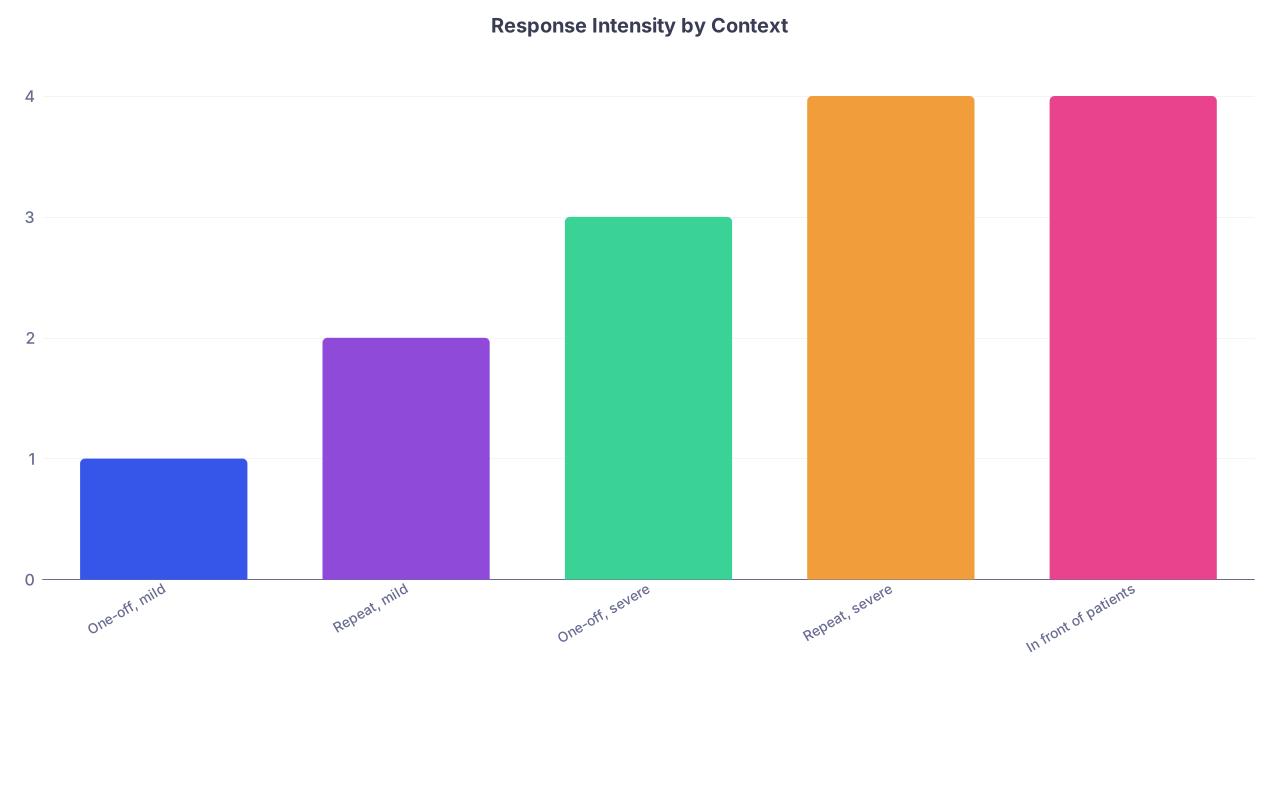
| Category | Value |
|---|---|
| One-off, mild | 1 |
| Repeat, mild | 2 |
| One-off, severe | 3 |
| Repeat, severe | 4 |
| In front of patients | 4 |
Legend:
1 = Soft redirect only
2 = Clear boundary, consider follow-up
3 = Immediate clear boundary, likely follow-up
4 = Boundary + documentation, consider formal report
Quick triage questions
Ask yourself, rapidly:
- Who is being targeted?
- Patients? Trainees? Minority group? → Higher response.
- Who is speaking?
- Peer vs attending vs chief? Adjust your tone, not your values.
- Is this a pattern?
- First time vs tenth time. Patterns need documentation.
- Who is watching?
- Students and junior staff are learning what is acceptable by watching you.
Scripts for Common Clinical Scenarios
You do not want to be inventing language at 4 a.m. Let’s build a small library.
Scenario 1: The “Old-School” Attending
You are a resident. Attending makes a sexist or racial joke during pre-round chatter.
Options:
Soft but clear (in front of group)
“I know you are messing around, but that kind of joke is rough for some of us.”Direct but respectful
“Dr. Smith, I am not comfortable with jokes like that about [group]. Can we skip those?”Private after rounds
“Dr. Smith, quick note. That joke earlier about [topic] landed pretty badly for me, and I suspect for others too. I would appreciate if we could avoid that type going forward.”
Pick based on:
- Your relationship
- How severe the comment was
- How safe the group feels
Scenario 2: Nurse’s Station Dark Humor Gone Sideways
You are at the nurses’ station. Someone jokes about a patient’s body, mental health, or socioeconomic status.
Fast in-room options:
- “Let’s keep our jokes away from patients’ bodies / conditions. It does not sit right.”
- “We are venting, sure, but making fun of patients is not where I want to go.”
- “We have probably all had similar struggles ourselves or in our families. That is too close to home for joking.”
If a student or new nurse looks particularly uncomfortable:
- “Hey, by the way, this is not how I expect us to talk about patients. If you heard that and felt off, you are not overreacting.”
You are both blocking the behavior and protecting the learner’s sense of reality.
Scenario 3: Group Laughs, You Are the Only One Not Smiling
Someone makes a homophobic joke. Others laugh. All eyes swing to you.
Options:
- “I am not laughing. That is not funny to me.”
- “I am going to be the wet blanket here. That joke is not OK.”
- “I am going to bow out of this one. That crosses my line.”
If you are in a minoritized group yourself (LGBTQ+, for example), you might choose more self-protective options. Which leads to an important point:
You are not obligated to be the spokesperson for every target group. Your safety comes first.
Scenario 4: In Front of a Patient or Family
Someone makes a flippant joke about a patient’s weight / adherence / “frequent flier” status—audible to the patient or family.
Immediate in-the-moment options:
- “Let us keep our comments respectful. The patient can hear us.”
- “Pause. This conversation is not appropriate with the patient in the room.”
- “We are drifting into unprofessional comments. Let us step out if we need to talk.”
Then, after leaving the room, you follow up more directly:
- “Comments like that, within earshot of patients, damage trust. That is not who we are as a team.”
If necessary, you apologize to the patient:
“Some of the comments you may have heard were not appropriate. I am sorry about that.”
Power, Hierarchy, and Self-Protection
Here is the uncomfortable truth: your ability to push back is constrained by hierarchy. That does not mean you stay silent. It means you are strategic.
When You Have Less Power
You are:
- Medical student
- Intern
- New nurse / allied health staff
- Junior consultant in a rigid specialty
Your priorities:
Protect yourself first.
You are not required to sacrifice your career to reform a terrible attending single-handedly.Use lighter language in public, stronger language in private.
Example progression with an attending:- In room, in the moment:
“Let us not go there, Dr. Smith.” - Later, one-on-one:
“I wanted to circle back. The joke earlier about [topic] felt off to me. I am hoping we can avoid that kind of thing when learners and staff are around.”
- In room, in the moment:
Document patterns quietly.
Date, time, who, what was said, witnesses. Short, factual. No drama. You might need it later.Use allies and structures.
- Program director
- Chief resident
- Nursing supervisor
- DEI office / ombudsperson
- Institutional anonymous reporting tools
You are not “snitching.” You are flagging unprofessional, potentially unsafe behavior.
When You Have More Power
You are:
- Senior resident
- Attending
- Charge nurse
- Faculty
- Administrator
Then you have responsibilities, not just options.
Expectations:
- You shut it down out loud, in real time. Silence from senior people is endorsement.
- You follow up with the offender, not just the target.
- You loop in leadership or HR if the behavior repeats or is severe.
Example as an attending:
“Team, quick pause. Jokes about [group] are not acceptable here. We are not doing that. If anyone has concerns about this kind of thing, my door is open.”
Then privately with the offender:
“I need you to understand this clearly. That joke was not professional and cannot happen again in front of staff or learners. If it continues, I will have to escalate it formally.”
This is part of your job as a leader, not an extra DEI hobby.
Practical Micro-Techniques: What to Do in the Exact Second After the Joke
People freeze because they do not know what to do with their body and voice. So here is the micro-level:
Pause.
Do not laugh. Do not fake smile. Two seconds of silence.Neutral face.
Not outrage. Just not amused.Short phrase.
One of your pre-planned lines:
“Not funny to me.”
“Let us not go there.”
“I am not OK with that one.”Then move forward.
Shift back to task or change subject:
“Anyway, about bed 12…”
“So for the next patient…”
This “interrupt + redirect” pattern works extremely well in clinical teams because it respects time pressure but still plants a clear flag.
How to Back Up a Colleague Who Spoke Up
You will see someone take a risk and shut a joke down. Do not leave them hanging.
Support looks like:
Immediately after they speak:
“Agreed.”
“Yeah, I am with [name] on that.”
“Good point.”Later, privately:
“Thanks for saying something earlier. That mattered.”
If someone gets mocked for “being sensitive,” you counter:
- “Expecting basic respect is not being sensitive.”
- “Professional standards are not optional.”
This is how cultures actually change. It is rarely the first person who speaks up; it is the second and third voices that turn it into a norm.
Formal Steps: When It Is Time to Document and Report
Not every inappropriate joke is a reportable incident. Some absolutely are. Especially when they involve:
- Harassment or targeting of protected classes (race, sex, gender identity, sexual orientation, religion, disability, age)
- Retaliation or threats
- Sexually explicit content at work
- Clear, repeated patterns despite feedback
Basic Documentation Protocol
Keep a simple, private log:
- Date and time
- Location (unit / clinic / OR)
- Who was present
- What was said or done (verbatim as much as possible)
- Your response (if any)
- Immediate impact (e.g., “med student left the room,” “patient appeared distressed”)
You do not editorialize. You record facts. This is gold if things escalate or if others report similar behavior.
Reporting Channels (Typical Hospital/Academic Setup)
| Option | Best For |
|---|---|
| Direct supervisor | Unit-level or team issues |
| Program director/chief | Resident/fellow behavior |
| HR / Employee Relations | Staff-wide or legal risk issues |
| DEI/Ombuds office | Bias, discrimination, patterns |
| Anonymous hotline | High-risk or retaliation concerns |
Choose based on:
- Who is involved
- Severity
- Your tolerance for being identified
You can also ask: “I want to discuss an unprofessional behavior issue hypothetically before I name names. Is that possible?” Many DEI/Ombuds offices will do this.
The Future: Humor That Heals Instead of Harms
Medical culture is not going to stop using humor. Nor should it. Gallows humor is a pressure valve, and it keeps people from emotionally shattering some nights.
The issue is direction:
- Healthy = Jokes about the system, the bureaucracy, the pager, the EMR, your own mistakes (appropriately anonymized), your own exhaustion.
- Unhealthy = Jokes about patients’ bodies, trauma, identities, or colleagues’ personal traits. Anything that punches down.
You can set this tone explicitly on teams you lead:
- “We joke a lot here to get through tough shifts. The line is: we do not joke at patients’ or each other’s expense.”
- “We can roast the EMR all day. We do not roast trainees or nurses.”
- “If a joke lands wrong, say so. I will back you up.”
This is not “future of medicine fluff.” It is practical. Units with psychologically safe cultures have better retention, fewer errors, and better patient satisfaction. Jokes that poison trust undermine all of that.
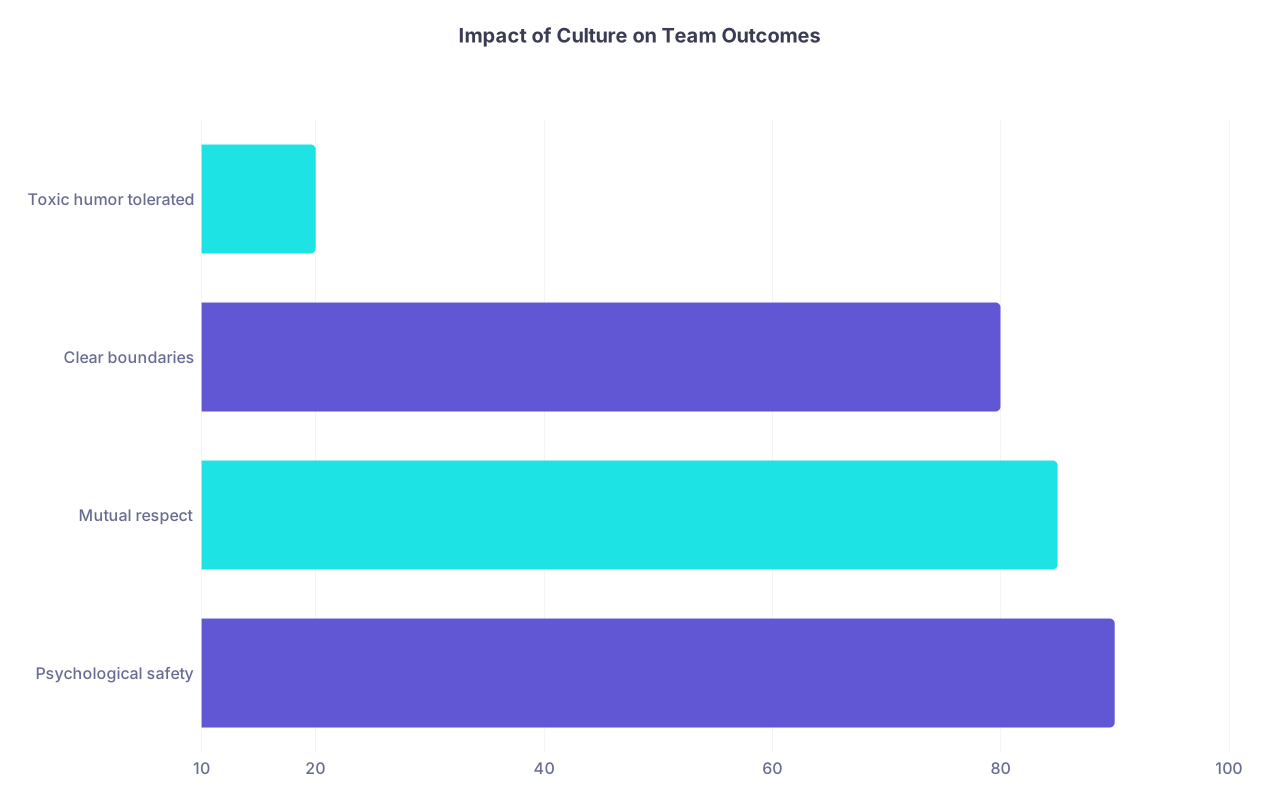
| Category | Value |
|---|---|
| Psychological safety | 90 |
| Mutual respect | 85 |
| Clear boundaries | 80 |
| Toxic humor tolerated | 20 |
(Values here are conceptual, not from a specific study—but the trend matches what every burnout and safety study keeps finding.)
Quick Reference: Go-To Lines You Can Memorize
Here is your minimal, high-yield kit. If you remember nothing else, remember these:
Soft stop:
“Let us not go there.”Clear boundary:
“I am not OK with that kind of joke.”Group reset:
“We are at work. That is over the line for a professional setting.”Patient protection:
“The patient can hear us. This is not appropriate.”Escalation warning:
“We have talked about this before. If it continues, I will need to take it further.”Support a colleague:
“I agree with [name]. That is not OK.”
Practice these out loud once or twice. They come out much smoother when your mouth has said them before.

| Step | Description |
|---|---|
| Step 1 | Hear joke |
| Step 2 | Ignore or lightly redirect |
| Step 3 | Soft or clear boundary in moment |
| Step 4 | Soft boundary now, document, seek ally |
| Step 5 | Clear boundary now, consider report |
| Step 6 | Monitor |
| Step 7 | Document and report via proper channel |
| Step 8 | Offensive or harmful? |
| Step 9 | Power balance? |
| Step 10 | Pattern? |