
You are halfway through morning rounds. You are tired. The attending is tired. The patient in room 14 just said something unintentionally hilarious, and you feel a perfect one-liner forming. You want to be human, not a robot. You also very much want to match, not get reported to professionalism committee.
Here is the tension: you know humor builds rapport and keeps you sane. You also know one badly timed joke can follow you for years. I have seen both happen.
Let us fix this systematically.
1. What Humor Is For On Rounds (And What It Is Not)
Before you even think about “how,” you need to be clear on “why.”
Humor on rounds has exactly three legitimate jobs:
- Reduce anxiety and tension.
- Strengthen relationships (with patients and team).
- Sustain attention and morale over long, punishing days.
Anything outside that—mocking, venting, scoring social points, showing you are clever—is where people get burned.
Think of humor as a clinical tool, not a personality trait. Used correctly, it:
- Humanizes you in front of patients and nurses.
- Makes you more memorable to attendings (in a good way).
- Keeps your team awake at 11:30 a.m. when the 25th SOAP note is blurring into the 24th.
Used poorly, it:
- Undermines trust.
- Makes you look immature or unprofessional.
- Gets quoted in complaint emails you never see until the chief calls you in.
The rule: If it does not help the patient or the team function better, skip it.
2. The Core Rules: A Simple “Humor Safety Checklist”
You need something you can run in your head in two seconds, in real time, on rounds.
Here is the checklist I teach residents and students.
| Rule # | Question To Ask Yourself | If Answer Is No |
|---|---|---|
| 1 | Is the patient’s dignity fully protected? | Do not say it |
| 2 | Would I say this if my program director was standing here? | Do not say it |
| 3 | Could this be misheard as mocking or dismissive? | Do not say it |
| 4 | Does it reduce, not increase, tension? | Do not say it |
| 5 | Would I be fine seeing this written in the chart? | Do not say it |
Run through that mentally. You will notice how many “funny” comments die instantly. That is you doing professionalism correctly.
The non-negotiables
There are categories you simply do not joke about on rounds. Not ever. Not “in a friendly way.” Not “because we know the nurse.”
- Race, ethnicity, or culture
- Gender, sexual orientation, gender identity
- Religion
- Weight, physical appearance, disability
- Mental illness, substance use, suicide
- Socioeconomic status, housing, immigration
- Code status, prognosis, “at least they will not feel it” type comments
You are not the edgy comedian in a club. You are the person who is supposed to be safe. Removing these topics from your humor palette is how you keep your license and your reputation.
3. Types of Humor That Work Well on Rounds
You do not need to be “funny” to use humor well. You need safe templates.
3.1 Self-deprecating (about yourself, not your competence)
This is the safest and most effective.
Good:
- “I definitely had more coffee than sense when I wrote that note last night.”
- “My handwriting is doing its best impression of hieroglyphics. I promise I can read it.”
Avoid self-deprecation about your competence in front of patients:
Bad in front of patients:
- “I have no idea what I am doing.”
- “You probably should not let me near that order set.”
It feels funny. It makes attendings nervous and may worry patients. Use competence jokes only in closed team spaces where people know you are actually capable.
3.2 Situational / observational
You comment lightly on what everyone sees.
- At 6:59 a.m. when everyone is clustered by the workroom:
“We appear to have formed a coffee-dependent organism.” - Waiting 20 seconds for Epic to respond:
“Perfect, time for a brief meditation while the wheel spins.”
This reads as human, not flippant.
3.3 Shared struggle / gallows-lite (with extreme control)
There is a line between healthy dark humor and “I am calling the wellness office.”
Healthy, mild versions:
- “Nothing bonds a team like all being paged at 3 a.m. by the same number.”
- “Medicine: where the printer is somehow the sickest patient on the floor.”
Unhealthy / unsafe (do not use):
- “Honestly I would rather be intubated than do another admission tonight.”
- “If this admission list gets longer, just DNR me.”
If your “joke” is essentially a cry for help, drop the humor and just get help.
3.4 Patient-directed rapport humor (gentle, never at their expense)
This can be powerful if you read the room correctly.
Example:
Patient (smiling): “Doc, you keep bringing more students. Is there a discount for bulk?”
You: “We are building you your own fan club. Rounds membership only.”
Or with a child:
“You know, you are braver than about half the residents on this floor when it comes to needles.”
Key: laugh with the patient, not at them. If you are not sure they will find it funny, do not test it.
4. Situations Where Humor Will Backfire (Even If It Seems Tame)
You can say something entirely “clean” and still get into trouble if timing or context is wrong.
4.1 In high-acuity or actively emotional moments
Examples:
- Right after someone has coded or died.
- Immediately after a difficult family meeting.
- During breaking bad news.
- When a patient is sobbing, angry, or clearly distressed.
In those contexts, zero humor. Even if your line would be harmless elsewhere, here it reads as you not caring.
If you feel tension and want to lighten it for yourself, use grounding techniques instead of jokes:
- Take a slow breath before speaking.
- Answer clinically, simply, plainly.
- Delay humor until you are back at the workstation or workroom and the moment has passed.
4.2 When hierarchy is very steep
New attending. Chair on rounds. Visiting “big name” from another institution.
This is not your open mic.
You are being evaluated for:
- Clinical thinking
- Communication skills
- Situational awareness
Drop your humor frequency by 80% in these settings. When in doubt, match the attending’s level. If they never joke, you stay neutral. If they use gentle, appropriate humor, you can mirror a bit, slowly.
4.3 When the team is stressed, behind, or in conflict
You might be trying to “lighten the mood.” The attending may interpret it as “this person is not taking things seriously.”
Clues it is not humor time:
- Attending walking fast, clipped speech
- Senior resident giving one-word replies
- The list is long and no one has eaten
In those scenarios, humor that acknowledges the load can work:
- “We will have our team debrief-slash-snack break after this one. I am scheduling it in my soul.”
But random jokes that do not move things forward will irritate people. Save them.
5. How To Actually Practice Safe Humor (Yes, Practice)
You will not “figure it out” on the fly. You build the skill.
5.1 Start with written humor first
Begin in the lowest-risk space: group chats and texts with people at your level who know you.
- Draft a joke.
- Read it once imagining it being screenshotted and forwarded.
- If it would embarrass you in front of your PD or the patient, delete it.
Once you learn what is safe in writing, you gain some instinct for what is safe out loud.
5.2 Use a “2-beat delay” on rounds
Before you speak, mentally pause for two beats:
- “Who is in earshot?”
- “Does this help or just entertain me?”
If there is a patient, family member, or nurse nearby, assume they are listening. Even if they appear occupied. Your reputation is often built on what people hear when you forget they are there.
5.3 Watch and copy the safest person
Every service has:
- The attending who thinks they are a stand-up comedian (half the team winces).
- The senior who says 1–2 lines per day and every single one lands perfectly.
Study the second person. Things to note:
- Tone (softer, not loud, never cutting).
- Topics they stick to (usually themselves, schedules, harmless situations).
- Timing (often after a stressful moment, but never during).
Imitate that template while you build your own style.
6. Humor With Patients: A Clear Protocol
You want to use humor with patients without being “the clown.” Here is a safe, stepwise approach.
Step 1: Read the baseline
Look for:
- Facial expression: guarded vs open
- Speech: clipped vs conversational
- Body language: tense vs relaxed
If a patient looks guarded, scared, or annoyed: no humor in the first 2–3 minutes. Earn trust first with clear, calm communication.
Step 2: Offer a very small, low-risk line
Make it trivial and about yourself or the situation, not about them.
Examples:
While struggling with the computer:
“The computer and I are having a small disagreement. I am optimistic I will win.”When introducing a big team:
“We brought a whole committee today. The upside is more smart brains. The downside is we might block your TV for 2 minutes.”
Then shut up and read their reaction.
Step 3: Respect their response
If they:
- Smile, chuckle, or add a small joke back → you can use light humor periodically.
- Give a faint smile but quickly look away → dial way down.
- Stay flat or serious → stop. Go 100% professional, no jokes.
You are customizing your amount of humor like you titrate a drip. Based on response, not desire.
Step 4: Never use humor to dodge real emotions
If the patient shares something heavy:
- “I am scared this will not get better.”
- “I feel like a burden to my family.”
That is not the place for “Well at least…” or “On the bright side…”. That is where you say:
- “Thank you for telling me that.”
- “That sounds really hard.”
- “Let me talk through what we can do.”
You can use humor after validating, if and only if the patient leads or appears ready.
7. Humor With the Team: Staying Off the “Unprofessional” List
People rarely get in trouble just for a joke to a patient. They get in trouble for what they say in front of staff, nurses, or other trainees who then (reasonably) question their judgment.
7.1 The “walls have ears” rule
Assume at all times:
- A family member is just around the corner.
- A nurse is charting at the desk.
- Someone is listening who respects this patient deeply.
So:
- No joking about a patient’s personality, life choices, “noncompliance,” etc.
- No re-enacting patient quotes in mocking voices, even behind curtains.
- No debriefing using sarcasm as your main coping style.
You can vent frustration, but keep it:
- Focused on systems, not individuals.
- Calm, not performative.
- Away from patient care areas if possible.
7.2 Horizontal vs vertical humor
Upward (toward attendings, chiefs):
- Keep it lighter, less frequent.
- Make sure it never sounds like you are minimizing clinical issues.
Sideways (co-residents, co-students):
- More room, but same rules: no cruelty, no punching down.
Downward (toward students, interns if you are senior):
- Be extremely careful.
- Humor can feel like bullying if power is unequal.
Example of bad “joking” downward:
- “Wow, this note is almost as disorganized as you are. Kidding.” (You are not kidding. They feel it.)
Better:
- “This is a solid start. Let us clean up the assessment so the attending sees your thinking right away.”
If you want to joke with juniors, keep it about shared difficulty, not their deficits.
8. Guardrails for Dark Humor (Because You Will Encounter It)
You are going to hear real dark humor. From attendings. From ICU nurses. From people you respect.
It exists because:
- Exposure to trauma is constant.
- People are trying to numb themselves so they can keep working.
Here is the blunt truth: you are allowed to outgrow that culture even if you are surrounded by it.
Use these guardrails:
- Never introduce dark humor yourself.
- If someone else does it, do not amplify it. A half-smile and silence is enough.
- If something feels off, you can redirect:
“This case is hitting everyone. Want to grab 2 minutes after rounds to debrief?”
If a senior says something that truly crosses a line in front of a patient or family, your priority is the patient. You can:
- Quickly re-center: “We are taking your concerns seriously.”
- Follow up later with the senior or attending privately, or with a trusted mentor.
You do not have to become the professionalism police. But you also do not have to pretend you enjoy corrosive humor to belong.
9. Fixing It When a Joke Lands Badly
You will misread a room at some point. The difference between “problematic” and “professional” is how you recover.
Step 1: Notice the cues
Signs you misfired:
- Awkward silence.
- Patient’s expression changes abruptly.
- Attending goes stone-faced.
- Nurse looks away, stiff.
Do not double down. Do not “explain the joke.”
Step 2: Own it quickly and simply
Out loud, in the moment if possible:
- “Sorry, that did not come out how I meant it.”
- “I apologize, this is a serious topic. Let us focus on your care.”
- To the team: “That was not the right time for a joke. My mistake.”
Short. Direct. No self-flagellation.
Step 3: Debrief later with someone you trust
After rounds, talk to:
- A peer you respect.
- A chief resident.
- A faculty mentor.
Ask explicitly: “I made this comment today and realized it was off. How would you have handled it, and how do I repair any damage if needed?”
If the misfire was in front of a patient and you sense hurt:
- Go back later alone if appropriate.
- “I wanted to apologize for my comment earlier. I was trying to be light, but I realize it may have felt minimizing. Your concerns are important to me.”
You will gain respect for this, not lose it.
10. A Simple Decision Flow You Can Memorize
Here is the mental workflow you can run on every potential joke.

| Step | Description |
|---|---|
| Step 1 | Funny thought |
| Step 2 | Do not joke |
| Step 3 | Use brief gentle humor |
| Step 4 | High acuity or strong emotions? |
| Step 5 | Patient or family in earshot? |
| Step 6 | Does it protect dignity and reduce tension? |
| Step 7 | Team stressed or behind? |
| Step 8 | Does it move team forward or acknowledge load? |
| Step 9 | Would I say this in front of PD? |
Run this silently in under three seconds. You will cut 70% of risky comments without feeling muted.
11. Building a “Safe Humor Library” For Yourself
If you want to use humor consistently without reinventing the wheel each time, build a mental library of 10–15 pre-vetted lines that you know are safe.
Categories you want covered:
- Introductions with patients
- Waiting for the computer / imaging / labs
- Acknowledging a long day with the team
- Minor personal self-deprecation (coffee, handwriting, pager anxiety)
- Transitioning from heavy topic back to plan without sounding cold
Example stock lines:
- “If this computer goes any slower, it will need its own consult.”
- “That is my pager. It has strong opinions about my schedule.”
- “We are going to talk through a lot of details. Please stop me anywhere—this is your body and your time.”
You are not trying to become a scripted robot. You simply want safe defaults so you do not have to improvise at your worst (tired, hungry, post-call).
12. Where Humor and Professionalism Actually Align
There is a myth that being “professional” means being humorless. That is wrong. The clinicians who age well in this career almost always have a healthy, kind humor style.
Humor supports professionalism when:
- It preserves empathy by giving you a pressure valve.
- It makes patients feel you see them as people, not tasks.
- It lowers the fear level for students and interns, so they actually ask for help.
- It signals confidence without arrogance.
Your goal is not “be funny.” Your goal is:
Be the person everyone is relieved to see on rounds. Competent, calm, and human.
Humor, used correctly, is part of that.
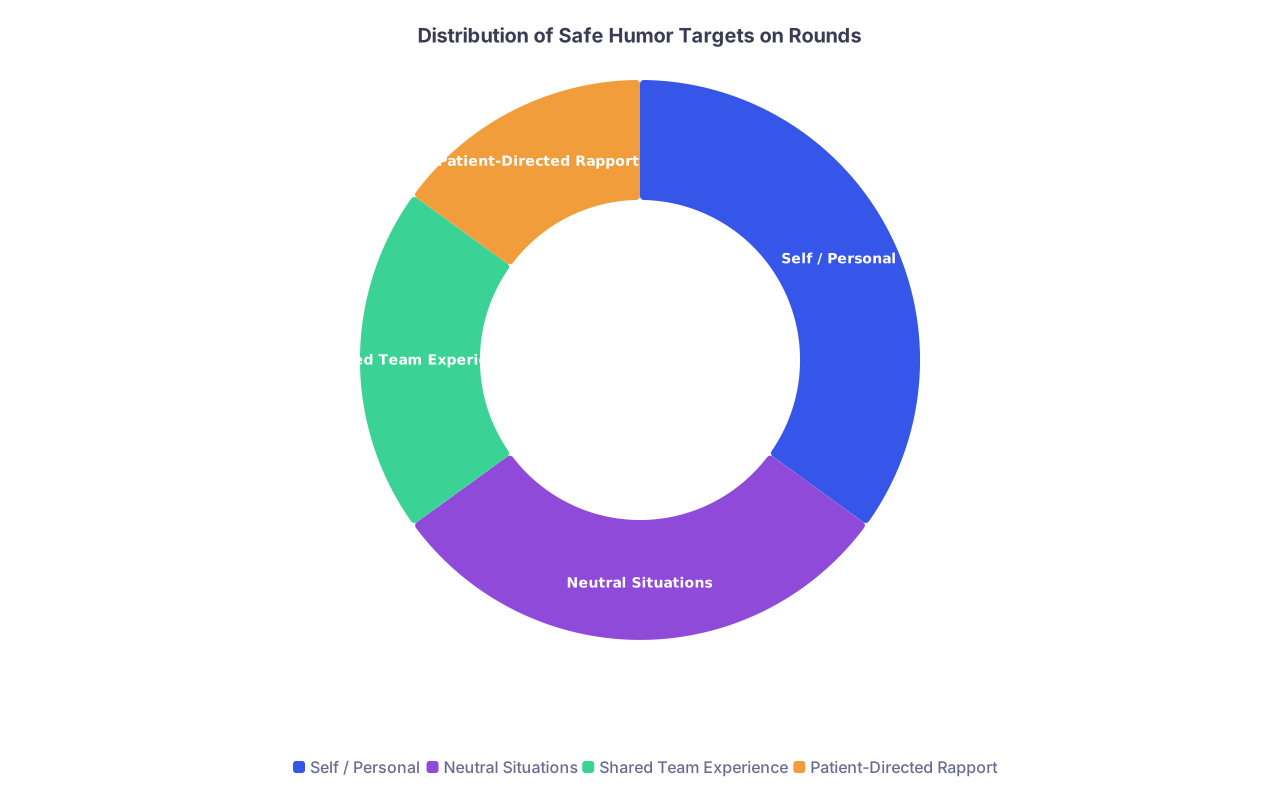
| Category | Value |
|---|---|
| Self / Personal | 35 |
| Neutral Situations | 30 |
| Shared Team Experience | 20 |
| Patient-Directed Rapport | 15 |
13. Quick Reference: Do / Do Not Summary
| Do | Do Not |
|---|---|
| Use gentle, brief humor | Make yourself the star of a comedy show |
| Aim jokes at yourself or neutral situations | Aim jokes at patients, nurses, or other staff |
| Read the room before and after you speak | Assume everyone shares your sense of humor |
| Apologize quickly if something lands wrong | Argue or over-explain a failed joke |
| Match the attending’s level and style | Try to “loosen up” a clearly serious attending |
| Keep dark humor to private, trusted spaces (or skip it) | Introduce dark humor on rounds or at the nurses’ station |

FAQs
1. What if my attending uses humor that feels inappropriate—does that give me permission to do the same?
No. You are not evaluated the same way as a senior attending. They have years of built reputation and context (and sometimes bad habits) that you do not. If an attending makes a questionable comment, you stay anchored to your own standard. You can respond neutrally or redirect the conversation without joining in. If it crosses a serious line, talk to a trusted chief or mentor about how to handle it; you do not have to confront them alone or in the moment.
2. I am naturally sarcastic. Do I have to change my whole personality to be professional?
You have to translate your sarcasm into something safer in clinical spaces. Sarcasm is high-risk because it can sound hostile, especially in text or when people do not know you well. You do not need to erase your sense of humor, but you do need to change the delivery: more warmth, less edge, and no sarcastic comments about patients or colleagues. Save sharper humor for trusted friends, off the unit, off the chart, and never in front of learners who may copy you.
3. How can I tell if I am actually funny or just making people uncomfortable?
Watch behavior, not just laughter. If people consistently avoid making eye contact after your jokes, quickly change the subject, or you notice attendings going serious immediately afterward, that is feedback. You can also ask directly in a low-key way: “Sometimes I try to lighten things with humor—if I ever overdo it, will you tell me?” Ask a co-resident or senior you trust. If two different people suggest you pull back, treat that like a lab value you would not ignore.
Your Next Step Today
Pull up a blank note on your phone and write down five safe, stock lines you can use on rounds—one for introducing yourself, one for computer delays, one for long days with the team, one self-deprecating but not about competence, and one to acknowledge patient concerns without minimizing them. Tomorrow, use exactly one of them once, then pay close attention to how it lands. Adjust from there.