
You are here
You are pre-rounding at 5:45 a.m.
Someone drops a meme in the group chat: a tired resident photoshopped onto a fossil with the caption “PGY-7 on a 3‑year program.” Everyone reacts with cry-laughing emojis.
Then one of the interns DM’s you:
“Hey… is this making fun of [Name]? I know they went part-time for health stuff. Kinda feels off.”
Now you are stuck.
You like having a fun, sarcastic team culture. The memes absolutely make brutal days survivable. But you also know how fast “just jokes” can turn into HR meetings, burned trust, and that one co-resident who suddenly goes silent in the chat and never really comes back.
Here is the problem:
You want a meme culture that is:
- Actually funny
- Actually safe
- And does not torpedo someone’s career or mental health because “we were just being dark”
This is fixable. You do not need a committee. You need a simple, resident-level system for building a meme culture that vents pressure without blowing up the team.
Let us build that.
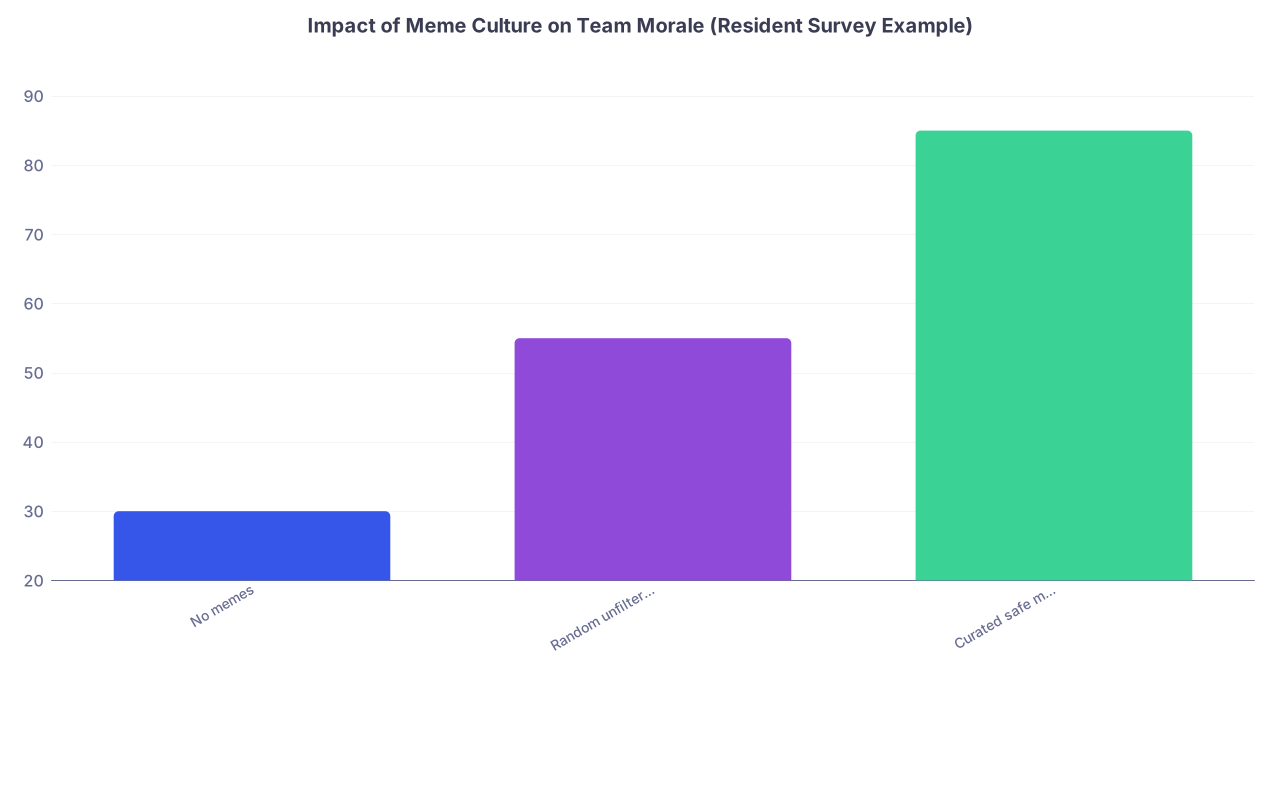
| Category | Value |
|---|---|
| No memes | 30 |
| Random unfiltered memes | 55 |
| Curated safe meme culture | 85 |
1. What “Safe Meme Culture” Actually Means
Start with a clear definition. Most meme disasters come from people playing different games with no shared rules.
A “safe” meme culture on a medical team has three non-negotiables:
Punches up, not down
You are allowed to roast:- Systems
- EMR
- Insurance
- 3 a.m. consults for chronic toenail fungus
You do not roast: - Patients
- Specific coworkers
- Identities (race, gender, disability, religion, etc.)
- Someone’s real, current vulnerability (illness, pregnancy, remediation, leave of absence)
Opt-in, not trapped
People can:- Mute the chat without being punished socially
- Step out of a joke thread
- Say “hey, that one did not land for me” without getting labeled as “sensitive”
Never career-limiting
Nothing you send in a resident chat should:- Be screenshot-able and used against you in a professionalism complaint
- Look indefensible if the PD, CMO, or your patient’s family saw it
- Require a paragraph of context to explain “why it is not that bad”
Test:
If a screenshot of the meme on a projector in GME Grand Rounds would make the room go dead silent → it fails.
You want memes that would make most of the room laugh, not make them start quietly updating their CVs.

2. Set Simple Ground Rules Without Killing the Vibe
You do not need a policy document. You need a 60‑second “this is how we do memes on this team” speech and a few pinned norms.
Script you can actually use
On day 1 of a rotation, as senior, you say something like:
“We have a group chat. Memes welcome. But a few hard rules so no one ends up in an HR meeting:
– No screenshots of patients, no identifiers, ever.
– We make fun of systems and ourselves, not each other’s identities or patients.
– If someone says ‘not cool’ or leaves the convo, we stop. No debate, no dogpiling.
That way we can keep it fun without getting any of us nuked.”
That is it. Short, specific, and it tells everyone:
- Memes are allowed
- There are boundaries
- Consent matters
Pin this in the group chat description or as a pinned message.
The “red lines” list
You can even drop a short list in the chat day one:
- No patient faces, names, room numbers, unique conditions
- No mocking psych, obesity, substance use, homelessness
- No targeting a specific coworker or attending
- No identity-based “jokes” (race, gender, disability, etc.)
- No posting during active codes/rapid responses (yes, I have seen this happen)
If someone pushes back with “we are adults, we can handle jokes,” answer calmly:
“Cool. I like dark humor too. I just like having a medical license more. These lines are non-negotiable on this team.”
You do not need them to love the rule. You just need them to respect it.

| Step | Description |
|---|---|
| Step 1 | Think of meme |
| Step 2 | Do not send |
| Step 3 | Save for later |
| Step 4 | Send |
| Step 5 | Involves patient or PHI |
| Step 6 | Targets identity or vulnerable person |
| Step 7 | Would I defend this in front of PD |
| Step 8 | Is team actively drowning right now |
3. Content Rules: Exactly What Is Safe vs Risky
Here is where people usually mess up. They think “no PHI” is enough. It is not. That is the legal floor, not the cultural standard.
Safe targets (green light)
These almost never cause trouble if done without cruelty:
Systems
- Prior auth memes
- “Please fax the fax to confirm we faxed your fax”
- “EMR downtime during peak admits” jokes
Schedule and fatigue (as a shared experience)
- “Post call brain loading…”
- Memes about Q4 call feeling like Q2
Universal med training experiences
- Drawing 10 tubes of blood and realizing you forgot the lactate
- The PGY‑1 “nodding like I understand the plan” face
Self-roast, not other-roast
- “My face when I order a test I know will not change management” joking about yourself
- Laughing at your own pre-round note from intern year
Yellow light (requires judgment and context)
You can do these, but only if:
- The team is close
- You know no one in the group is sensitive to that topic
- You are clearly not targeting a specific real person
Examples:
- Specialty stereotypes (e.g., surgery vs medicine)
- Light teasing of each other’s coffee dependency, note length, etc.
- Dark humor about death and codes (in very limited, private resident-only spaces, never tied to a specific patient)
Rule of thumb:
If you do not know everyone in the room or chat well → do not touch yellow-light material yet.
Red light (skip entirely)
These are never worth the “laugh”:
Anything that makes fun of:
- Patient death or suffering in a specific case
- Suicidality, self-harm, or mental illness as a character flaw
- Substance use as moral failure
- Obesity, disability, or chronic illness
- Pregnancy or fertility struggles
- Remediation, probation, or someone failing an exam
Anything that:
- Could be reasonably interpreted as racist, sexist, homophobic, transphobic, ableist
- References a real colleague by name, nickname, or obvious description
- Shows any piece of PHI (yes, even if you crop the name but leave a unique condition)
Test yourself:
If the person with that diagnosis, identity, or struggle were in the room, would they feel like the joke made them smaller? If yes, do not send it.
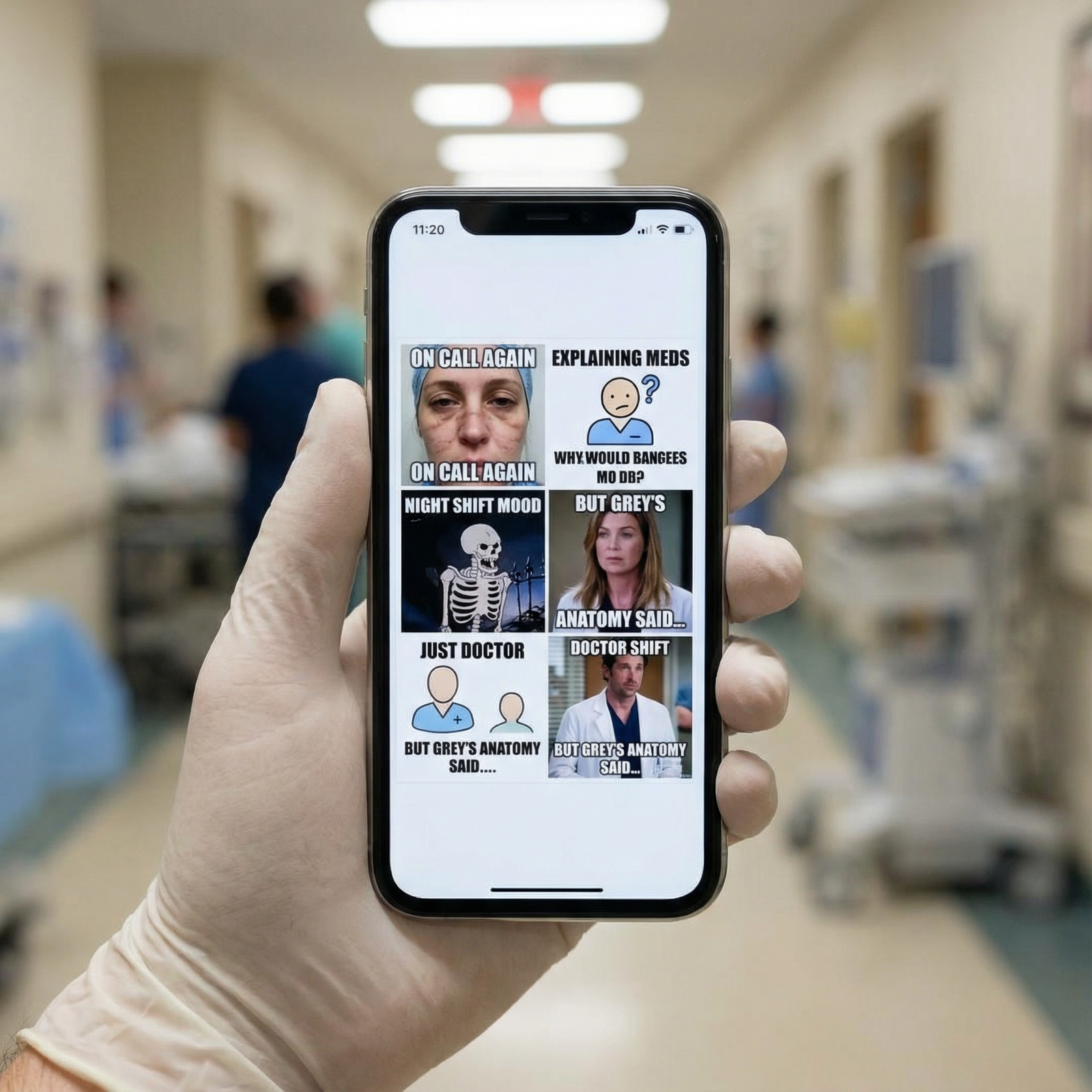
4. The “Before You Hit Send” Personal Checklist
You do not have time for a moral treatise at 2:30 a.m. So you need a fast internal filter.
Use this quick 5-question check. It takes five seconds once you are used to it.
Replace “group chat” with “PD email list.” Still comfortable?
If no, do not send.Could this be screenshotted out of context and still look okay?
If your defense starts with “well, you have to understand the backstory…” → that is a bad sign.Is anyone here currently vulnerable to this topic?
For example:- Joking about failing Step 2 when someone just barely passed on second attempt
- Joking about “lazy residents” when someone is on light duty for health reasons
Will this joke still feel okay after you sleep?
Sleep is the enemy of bad judgment. If this will make you cringe tomorrow, do not do it now.Are we coping or deflecting?
Dark humor that lets everyone exhale is coping. Dark humor that shuts someone down when they are trying to be serious is deflecting.
If you are already wondering “is this over the line?” you probably already know the answer.
| Scenario | Safer Meme Version | Risky Meme Version |
|---|---|---|
| Overnight admits | SpongeBob tired meme about sign-outs | Screenshot of actual patient list |
| Difficult attending | Generic “when attending says ‘one more thing’” | Meme using their real catchphrase or name |
| Fatigue | “PGY brain loading” meme | “Only weak interns ask for help” |
| Code blue | Generic “everyone running to the code” gif | Joke about specific patient or outcome |
| Documentation burden | “Note bloat boss level” meme | Screenshot of actual chart or note |
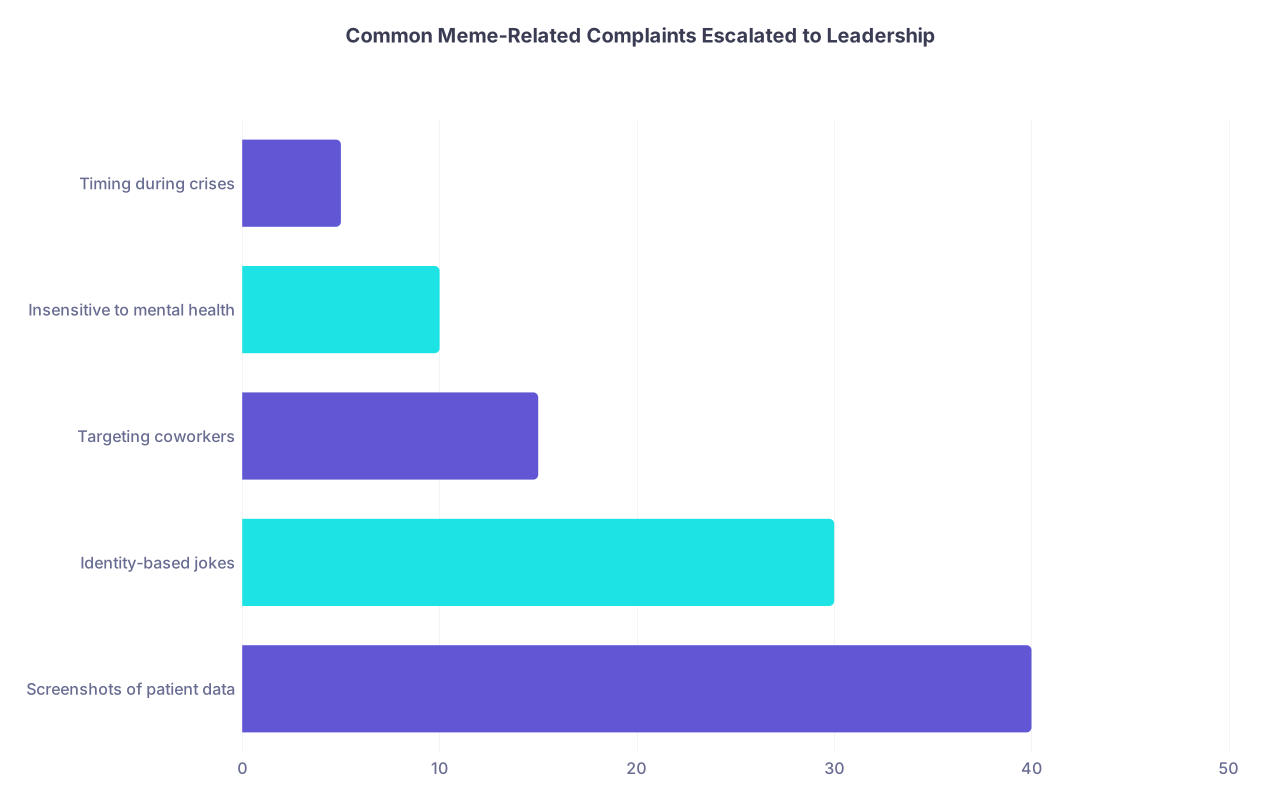
| Category | Value |
|---|---|
| Screenshots of patient data | 40 |
| Identity-based jokes | 30 |
| Targeting coworkers | 15 |
| Insensitive to mental health | 10 |
| Timing during crises | 5 |
5. Handling It When a Meme Goes Wrong (Because It Will)
Eventually someone will send something that lands badly. Could be you. Could be a co-resident. What you do in the next five minutes decides whether it becomes a scar or just a small bruise.
If you posted it
Do this quickly and cleanly:
Own it immediately
In the same chat:“That meme was a miss. I did not realize how it could hit. My bad; I will not send that kind again.”
No “if anyone was offended” nonsense. That phrase is poison.
Delete if possible
If the platform allows deletion, remove it.
Yes, screenshots might already exist. That is not your call. You still do the right thing.If it clearly hurt a specific person → direct message
“Hey, that meme I sent earlier – I realized it was close to something you are dealing with. I am really sorry. No pressure to respond; just wanted to own that.”
Keep it short. Do not demand forgiveness.
Change behavior
Next few weeks: you lead by example and keep your memes obviously safe. People notice.
If someone else posted it and you are senior
Your job is not to debate humor. Your job is to protect the team.
-
In the chat:
“Gonna call timeout on that one – it is a little too close to real people / real situations. Let us steer memes more toward systems and ourselves.”
Do not dogpile the sender
You are correcting behavior, not labeling a villain.
If others start piling on, steer it back:“We all misjudge sometimes. We have the rule, we adjust, we move on.”
If it is truly serious (PHI, overt discrimination)
- Screenshot for documentation
- Talk to chief or PD privately, quickly
- Do not try to “handle it quietly” if it is past a certain threshold. That is how you end up complicit.
If you are the one hurt by it
You have a few options, depending on your energy and safety level.
Low-energy version (if you do not want a big deal):
React with a neutral emoji or nothing. Later, DM the sender:
“Hey, that meme earlier hit close for me. Could you keep jokes away from [topic] in this chat?”Direct but measured in-group message:
“Hey, can we keep jokes away from [topic] here? That one did not land for me.”
If pattern persists or it is way over the line
Loop in a chief or trusted faculty. You are not being “dramatic.” You are protecting yourself and probably other quieter people.

| Step | Description |
|---|---|
| Step 1 | Problematic meme appears |
| Step 2 | Apologize in chat |
| Step 3 | Delete if possible |
| Step 4 | Adjust future behavior |
| Step 5 | Call timeout in chat |
| Step 6 | Redirect norms |
| Step 7 | DM sender |
| Step 8 | Contact chief or PD |
| Step 9 | You posted it |
| Step 10 | You are senior |
| Step 11 | You are hurt by it |
6. Build a Shared Meme Language That Actually Helps the Team
If you want a strong, safe meme culture, do not just ban stuff. Create positive patterns.
Here is how to intentionally build the good side.
1. Create “team memes” that everyone owns
Example:
- Every time someone forgets to pend their orders, you share the same harmless meme (like a cartoon brain falling asleep).
- When a night float signs out a ridiculous number of admissions, you use a specific GIF everyone expects.
This does a few things:
- Normalizes imperfection
- Builds in-jokes that are not at anyone’s expense
- Makes corrections feel lighter without shaming
2. Use memes to model vulnerability from above
As a senior or chief, drop the occasional self-deprecating meme about:
- You forgetting to follow up a lab earlier in your training
- You writing literal novels as PGY‑1 progress notes
- You misunderstanding an attending’s plan
This signals:
- It is safe to admit mistakes
- You do not equate worth with perfection
- The meme culture is about shared struggle, not ranking people
3. Meme as a pressure-release valve with intention
There are specific zones where meme use is high-yield:
-
- After the work is done, share a meme that captures the collective exhaustion.
- This lets everyone exhale without needing a 45-minute therapy session they do not have time for.
Pre-board season stress
- Share light memes about Anki, UWorld, and knowledge attrition.
- Reinforces that everyone is anxious, no one is alone.
Service from hell weeks
- Use memes to track “Boss Level: Floor 6 admits this week” kind of stuff.
What you avoid:
Sending memes instead of answering pages, writing notes, or addressing real conflict. If the nursing staff thinks “they are glued to their phones laughing while we drown,” you have failed.
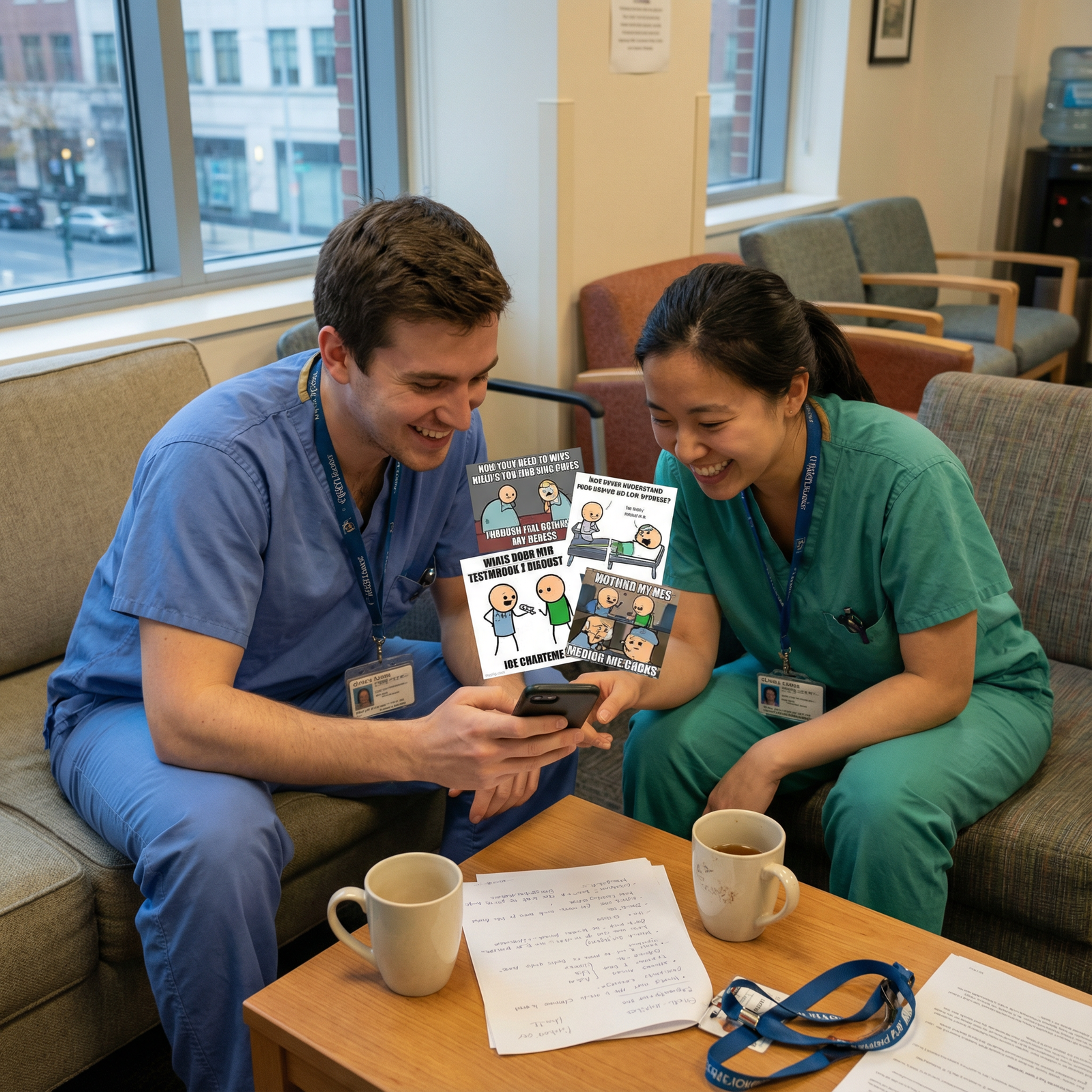
7. Platform, Privacy, and the Boring (But Real) Risk Management Part
No one wants to talk about this. You should anyway.
Choose your platform like a grown adult
Use personal devices, not hospital-owned
Anything on a hospital device is effectively the hospital’s property.Prefer end-to-end encrypted apps (Signal, WhatsApp)
Not because you are planning crimes, but because you are minimizing exposure.Avoid mixing teams
Different chats for:- Your specific service team
- Entire residency class
- Cross-hospital or social-only groups
The more mixed the group, the safer and more generic the memes should be.
Assume screenshots exist
Always behave like:
Someone could forward this to:
- Your PD
- Credentialing committee
- A malpractice attorney’s discovery request
Context will not be charitable
So:
- Do not vent about specific attendings by name
- Do not discuss clinical decisions in meme form
- Do not send “jokes” you would not want dissected in a deposition
And yes, I have seen memes show up in professionalism investigations years later. People think chats disappear. They rarely do.
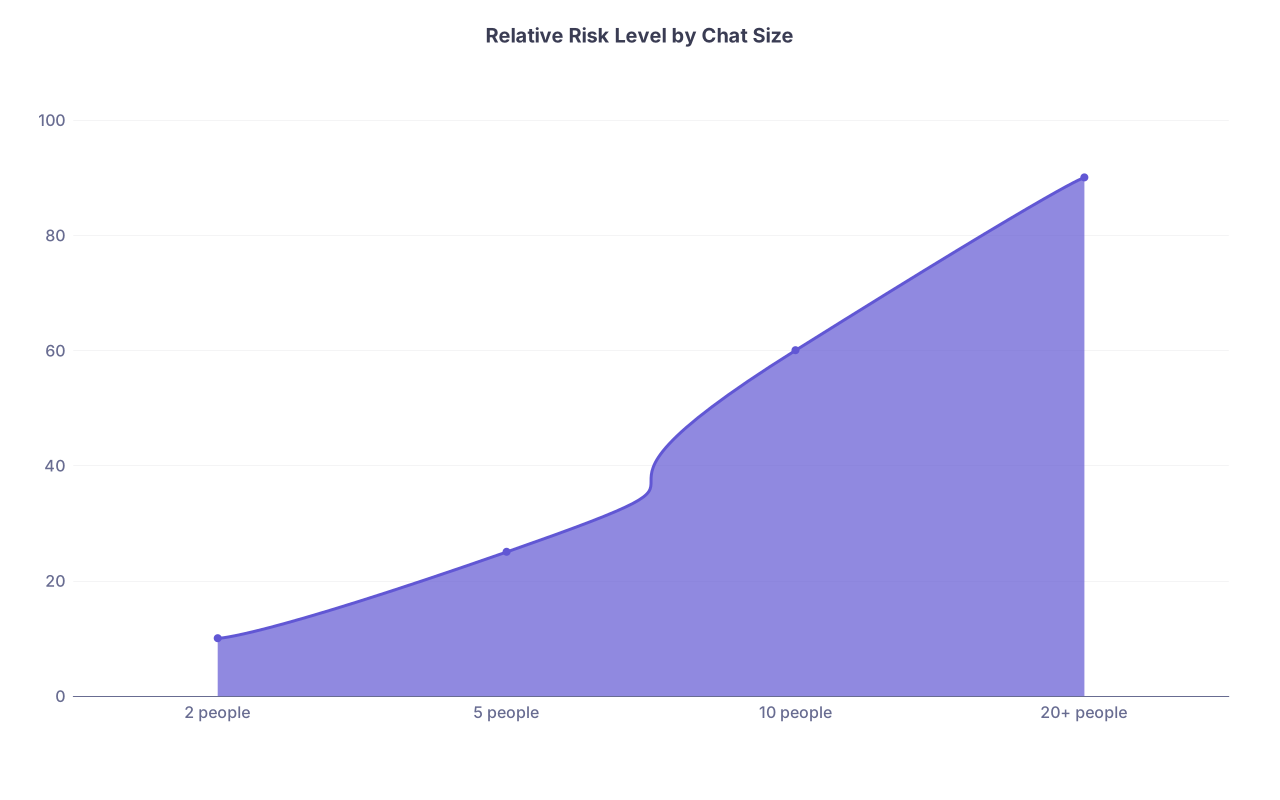
| Category | Value |
|---|---|
| 2 people | 10 |
| 5 people | 25 |
| 10 people | 60 |
| 20+ people | 90 |
8. Training Interns (And Yourself) into a Healthier Humor Culture
You are shaping the next generation’s default. Might as well do it on purpose.
Explicitly normalize “I am not up for jokes today”
Tell your team:
“If you ever are not in the mood for memes, mute the chat or say ‘I am tapping out of jokes today.’ That is always fine. No one will give you grief.”
Then, when someone actually says it:
- Respect it instantly
- Do not pry
- Maybe DM later: “Got you. Here if you need anything, no need to respond.”
That is how you build psychological safety without a workshop.
Model how to course-correct
When a meme flops, do not just go silent. Show interns how to recover:
“Oof, that one did not land. I am retiring that genre.”
You are teaching that:
- Being wrong is allowed
- Repair is expected
- Denial and defensiveness are optional
Use memes to reinforce good behavior
Not just to mock bad ones.
- When an intern escalates a concern early → send a heroic meme about “Early pages save lives”
- When someone double-checks an order and catches an error → celebratory meme
You are wiring their brain to associate good clinical habits with positive social feedback.
Key Takeaways
- Safe meme culture = punch up, opt-in, never career-limiting. If you would not defend it in front of your PD, do not send it.
- Set clear, simple rules and enforce them calmly. Short script, pinned norms, and quick course-correction prevent most disasters.
- Use memes as a tool, not a reflex. Aim them at systems, shared struggle, and your own past mistakes. Protect patients, colleagues, and anyone currently vulnerable.
Build the culture you wish you had as an intern. The jokes will be better. The team will be stronger. And you will sleep easier knowing nothing in your group chat is waiting to explode.