
It’s 2:17 a.m. You’re in the resident workroom, post-call brain mush, someone just made a dark joke about consults coming in waves, and everyone laughed. You gave a small, delayed chuckle… then instantly panicked.
“Wait, was that okay?
If someone recorded that, would I get written up?
Am I supposed to laugh? Not laugh? Report it?
What if I say the wrong thing next and ruin my career?”
Welcome to modern medicine, where you’re supposed to be human, relatable, and “a good culture fit” — but also perfectly professional, unproblematic, and always aware that literally anything can blow up on social media or in an evaluation.
You’re not crazy for worrying. The baseline anxiety here is rational. The tricky part is figuring out what’s actually risky, what’s just normal human banter, and how safe (or unsafe) “workroom humor” really is.
Let’s walk through this like we’re both sitting in that same workroom, scrolling through emails and pretending our cortisol isn’t through the ceiling.
The Reality: Workroom Humor Is Both Completely Normal… and Potentially Dangerous
Here’s the uncomfortable truth: almost every team has some flavor of workroom humor. Attendings, residents, nurses, RTs, everyone. Jokes about:
- Overnight pages
- The EMR crashing
- Consults at 6:59 p.m.
- “Frequent flyer” patients
- Absurd documentation requirements
And then there’s the darker stuff. Gallows humor about death, bad outcomes, brutal call nights. People use humor to survive this job. If no one joked about anything, the burnout rate would somehow be even worse.
But at the same time, this is your professional workspace, and you really can get in trouble for crossing lines — sometimes even when you didn’t mean to. The “I thought it was just a joke” defense doesn’t carry much weight when someone’s offended or a complaint is filed.
So where’s the line?
I think about it like this:
- Humor about the system, the job, yourself → generally safer
- Humor about vulnerable people or protected groups → landmine
- Humor that would be fine if said privately, but not on a microphone or in an email → medium risk / be careful
And here’s where your worst-case-scenario brain is not totally off: the more exhausted everyone is, the more likely people are to say something borderline. And the more borderline the environment, the easier it is to get pulled into something you don’t actually agree with.
The Big Red Lines: What Is Basically Never “Safe”
Let me just be blunt. There are some categories where I don’t care how “chill” your team is — you will regret joking about these at some point.

Anything that targets patients or colleagues based on:
- Race or ethnicity
- Gender or gender identity
- Sexual orientation
- Religion
- Disability
- Age
- Immigration status
- Body size/appearance (yes, this is getting more attention too)
This includes “jokes,” mocking impressions, stereotypes, fake accents, or “I’m just kidding” comments about “those” patients.
This is not me being hypersensitive. This is how institutional policies, HR, and professionalism committees think. If they get involved, they don’t really care that you were tired, or that “everyone laughed,” or that you didn’t mean it that way.
If you remember nothing else, remember this:
If a reasonable person could interpret it as discriminatory, degrading, or mocking a vulnerable person or group, it’s radioactive. Just don’t.
Same goes for:
- Making fun of a specific patient by name or a clearly identifiable scenario
- Posting ANYTHING remotely mocking about patients or coworkers online, even “anonymized” (people are shockingly good at de-identifying “anonymous” posts)
- Sexual jokes in mixed company, especially about coworkers
- “Roasting” a junior, nurse, or student who doesn’t know you well
I’ve seen careers get seriously dinged not by some huge scandal, but by “a couple of comments” that someone reported because they felt uncomfortable.
The “Gray Zone” Humor That Freaks You Out the Most
Here’s where most anxious, conscientious people like you get stuck. The jokes that are… not horrible, but not clearly harmless.
Stuff like:
- “He’s back again, third visit this week”
- “Gen surg is gonna love this at 6:55 p.m.”
- “Of course the EKG machine dies now”
- “I swear the ED waits for us to sign out to page”
Or mild gallows humor:
- “If we get another STEMI in the next hour, I’m just going to live here”
- “ICU census is 30, but my soul count is zero”
Are you a monster if you laugh? No. Are you unprofessional if you ever vent about patients or services? No. I don’t know a single honest resident who hasn’t done some version of this.
The real questions are:
- Where are you saying it?
- Who’s in earshot?
- What’s your pattern over time?
If you occasionally mutter, “Wow, they really love the ED” about a repeat patient, that’s human. If you’re known as “the person who always trashes frequent flyers,” that’s a professionalism narrative.
That narrative is what bites you on evaluations.
So no, you don’t need to be a robot. But your anxious brain is onto something when it says:
“If this got quoted in my dean’s letter, would I be proud of it?”
That’s actually not a bad internal filter.
Who’s Actually Listening? (More People Than You Think)
Here’s what makes workroom humor risky: you never really know who’s mentally taking notes.
There are at least four “audiences” you can’t fully see:
The person in the corner who’s quiet but uncomfortable.
They might never say anything to you. They might just think, “Huh. So that’s what they really think about patients like mine / people like me.”
Then you get a vague “professionalism concern” comment on an eval.The person who laughs on the outside, angry on the inside.
They might go to the chief, clerkship director, PD, or HR. Especially if there’s a pattern.The random nurse, tech, or consultant walking past the door.
Workrooms are not soundproof. Paper-thin doors. Hallway traffic. You know this.Future-you, months later, when someone paraphrases what you said — badly.
“Remember when you joked that that obese patient couldn’t help being noncompliant?”
You didn’t say it like that. But that’s how it’s remembered.
You don’t have to obsess about this every second, but you’re not wrong to factor it in. Overthinking is the tax you pay for trying not to hurt people or screw up your career. Annoying, but real.
How Safe Is It to Just… Not Joke?
There’s another anxiety I see all the time:
“If I never joke, people will think I’m weird / not a team player / no personality.”
Short answer: you can be polite and warm without being comedic.
You don’t need to be the funny one. You don’t need to match the tone of the loudest person in the room. Most attendings and chiefs care more that you:
- Don’t make the room worse
- Don’t offend people
- Don’t create work for them by being a professionalism problem
If your “brand” is: kind, reliable, slightly quiet, chuckles politely but doesn’t do edgy humor — that’s not hurting you. If anything, people often feel safer around that person.
You can always lean on these “safe” behaviors:
- Smile. People massively over-interpret facial expression. A half smile + “yeah, this night is wild” goes far.
- Laugh lightly at clearly harmless stuff (weather, food, pagers, residency life).
- Make tiny self-deprecating jokes that don’t undermine your competence:
“My brain is running on 2% battery, please double-check my orders.” - Shift focus: “Okay, jokes aside, we still have like 5 notes to finish.”
No one is writing, “Did not aggressively participate in dark humor, concerning” on your evals.
A Simple Mental Framework: “Punch Up, Not Down”
This is a useful shortcut when your head is spinning.
Humor that “punches down” = dangerous.
Humor that “punches up” or sideways = usually safer.
Punching down means making jokes at the expense of:
- Patients (especially vulnerable ones)
- Students, juniors, support staff
- Marginalized groups (race, gender, etc.)
Punching up or sideways looks like:
- Making fun of the EMR, administration, bureaucracy
- Lightly roasting yourself
- Shared suffering “us vs the system” jokes:
“Med school debt bingo: who’s over 300k?”
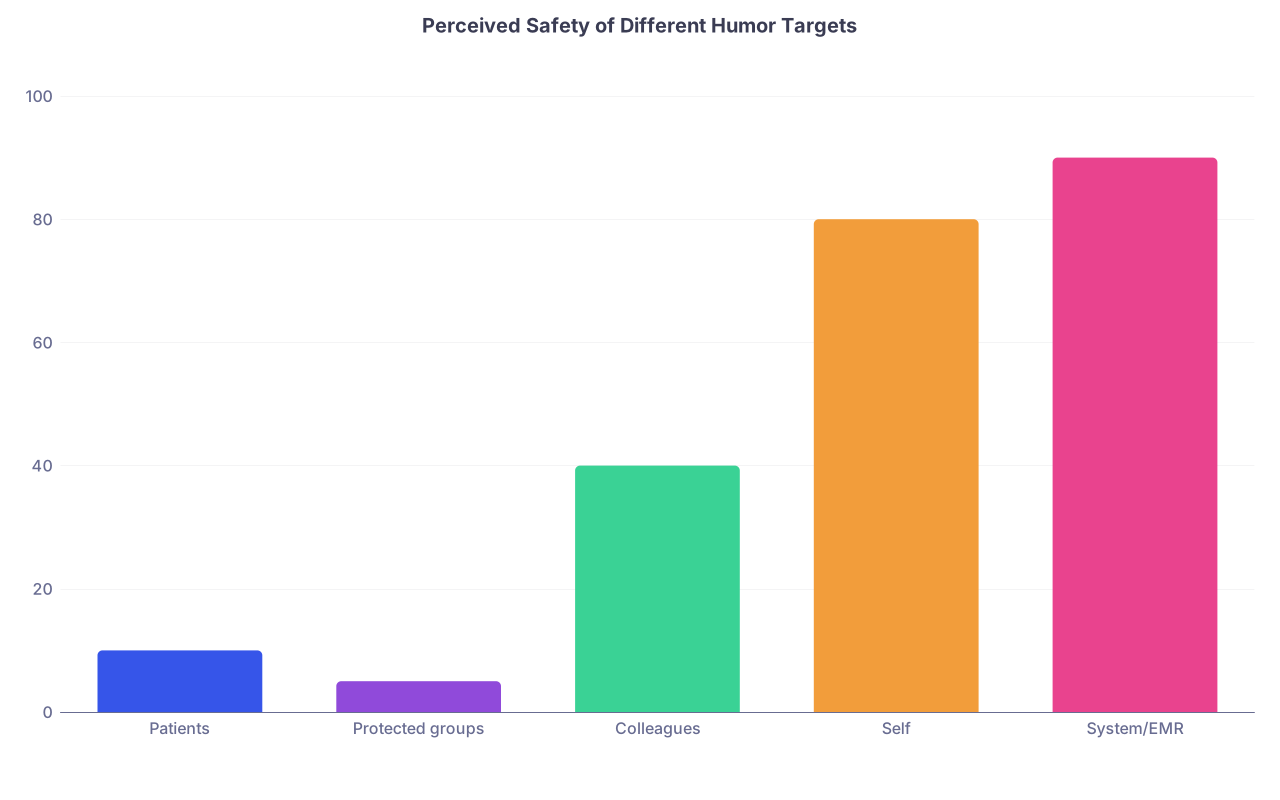
| Category | Value |
|---|---|
| Patients | 10 |
| Protected groups | 5 |
| Colleagues | 40 |
| Self | 80 |
| System/EMR | 90 |
No, this chart isn’t from a peer-reviewed paper. But it’s a pretty fair representation of how professionalism committees function. System jokes and self-jokes are 80–90% safe. Patient and protected-group jokes are how things blow up.
What If You Accidentally Cross the Line?
This is the nightmare scenario, right?
You’re tired, you try to be funny, it lands badly. Someone goes quiet. Someone says, “Uh, that was kind of harsh.” Your stomach drops into your shoes instantly.
Here’s roughly the best-case way to handle it:
- Stop talking. Don’t dig deeper. Don’t justify. Just pause.
- Own it quickly.
“You’re right, that wasn’t cool. I’m sorry.” - Aim it at them and the group, not your ego.
“I don’t want to make people uncomfortable here. Thanks for calling that out.” - Change your behavior going forward.
This matters more than the perfect apology script.
What not to do:
- “Relax, it was just a joke.”
- “You’re being too sensitive.”
- “Everyone else thought it was funny.”
- Sulk about “cancel culture” for the rest of the shift
I’ve seen people recover from one dumb comment by being straightforward and humble. I’ve also seen people turn a small issue into a big professionalism problem by doubling down.
Your anxious brain will replay it 400 times anyway. But if you respond like a decent person and don’t repeat it, most teams move on.
How to Survive When the Room’s Humor Makes You Uncomfortable
Another fun scenario: you’re not the one making jokes. You’re the one sitting there, heart rate 120, thinking, “Is this… allowed? Do I laugh? Do I report this? Will they hate me if I say something?”
This is tricky, and there’s no perfect universal answer. But here are some options that don’t require you to become the culture police, yet still protect you:
- Neutral reaction. Small, noncommittal smile, then go back to your work. People usually get the hint over time.
- Subject change. “Anyway, did you guys see the new policy about…”
- One-on-one later, if you feel safe.
“Hey, sometimes the jokes about [X] land weird for me. Just wanted to mention it.” - Escalate if it’s repeated or egregious.
You’re allowed to talk to a chief, advisor, or PD if you’re repeatedly hearing racist, sexist, or cruel stuff.
No, you’re not overreacting if a pattern of comments about a certain group is making you sick to your stomach. That’s exactly how formal complaints start in real life.
The Future of Medicine: Humor Isn’t Dying, But the Old “Anything Goes” Culture Is
We’re in a weird transition era.
Older physicians sometimes nostalgically talk about “how we used to joke in the call room.” Translation: a lot of stuff that would get you in serious trouble right now.
The culture is shifting, slowly but definitely:
- Patients are more engaged and empowered
- Institutions are terrified of PR disasters
- Trainees are more willing to report discrimination
- Everything can be recorded, screenshotted, quoted
But humans are still humans. Residents will always joke about pages at 3 a.m., the EMR eating notes, and that one impossible policy nobody follows. That’s not going away.
What is fading (thankfully, honestly) is the idea that being funny means being cutting, cruel, or punching down at the most vulnerable people in the building.
If your goal is: “I want to be someone people feel safe around,” you’re very much aligned with where medicine is headed.
Quick Mental Checklist Before You Say the Thing
Because your brain is going to spin anyway, give it something structured:
- Would I be okay if this were quoted in a 360 eval?
- Would I be okay if the patient’s family was standing in the doorway?
- Is this punching up (system, self) or down (patients, juniors, marginalized groups)?
- Am I saying this because I’m exhausted and bitter?
- Is there a version of this that vents without dehumanizing anyone?
If a joke fails those questions, let it die in your head. You don’t get extra residency points for being edgy.
| Situation | Safer Comment | Risky Comment |
|---|---|---|
| 3 a.m. admission | "ICU never sleeps, I guess none of us do." | "These people always come in at 3 a.m." |
| Difficult consultant | "Cards is really protecting their service today." | "Cards is useless, as usual." |
| Frequent flyer patient | "We see them a lot, must be rough for them too." | "Our favorite bed blocker is back again." |
| Heavy census | "We’re at max capacity, brain and census both." | "Great, more admits to dump on the interns." |
| Bad outcome | "That was really hard, I need a second." | "Well, one less note, I guess." |
FAQ: Workroom Humor and Not Ruining Your Life
1. What if I grew up with super dark humor and that’s just how I cope?
You don’t have to abandon humor completely, but you do have to adapt it to where you are. Save the truly dark stuff for people you know very well, in private, off-hospital grounds, and never in writing or online. At work, lean more on “punching up” and self-deprecation. If your coping mechanism regularly makes others tense, it’s not coping — it’s creating problems.
2. Can I get in real disciplinary trouble for just laughing at someone else’s bad joke?
Honestly, it’s unlikely you’ll be formally punished for an awkward laugh once or twice. But if you repeatedly join in or are seen as “part of that group,” it can absolutely color how people see you. You’re not obligated to perform amusement. A half smile and silence is enough. Distancing yourself a little is protective.
3. What if my attending makes inappropriate jokes — am I supposed to report them?
You’re not responsible for fixing the entire culture, but you are allowed to protect yourself. If it feels hostile, targeted, or discriminatory, you can talk confidentially with a chief, clerkship director, or GME/Title IX office. If it’s more “cringey” than dangerous, quietly minimizing your participation and seeking kinder mentors is reasonable. You don’t have to laugh just because they’re senior.
4. Is gallows humor about death always wrong?
Not always. Clinicians have used gallows humor forever to cope with grief and horror. The line is whether it dehumanizes the patient or feels cruel. “That was brutal, my soul is leaving my body” is about you. “Well, they won’t miss their meds anymore” is about them — and that’s where people start to flinch. If you’re not sure, keep grief and seriousness in the room and save any joking for much later, in safer company.
5. I already said something I regret. Is my career over?
Almost certainly not, unless it was egregious and repeated. Most people have at least one comment they cringe about years later. What matters is: did you notice, did you adjust, and do people generally experience you as respectful and safe? If you’re really worried, talk to a trusted mentor or chief, own what happened, and ask for feedback. A one-off mistake, followed by growth, usually becomes a footnote — not a headline.
Bottom line:
- Humor isn’t forbidden in medicine, but “anything goes” absolutely is.
- Punch up or sideways, not down. System, self, shared suffering = safer. Patients and vulnerable groups = no.
- You don’t need to be hilarious. Being kind, a little cautious, and someone people feel safe around will carry you much further than any joke ever will.