
What If My PD Thinks I’m Not Serious Because I Joke Too Much?
What if that one sarcastic comment on rounds is the thing your program director remembers at ranking time?
That’s the loop my brain runs, over and over: I try to keep things light, everyone laughs, and then I go home and convince myself I’ve just branded myself as “the clown who doesn’t take medicine seriously.”
If you’re here, I’m guessing you do the same thing: crack a joke to diffuse the tension, then spend the next 48 hours replaying it in 4K, slow motion, with director’s commentary.
Let’s talk about it. The humor, the “am I unprofessional?” panic, and the very real power dynamics with attendings and PDs.
The Core Fear: “They Think I Don’t Care About Patients”
This is the nightmare scenario in my head:
You’re on a brutal call night. It’s 3 a.m., everyone’s dead on their feet. Someone groans, “We have four new admits?” You mutter, “Good, I was worried I might get sleep tonight,” and the intern laughs. So does the senior.
And then, suddenly, you notice the PD is at the desk. You didn’t know they were there. They don’t laugh. They just glance up, then go back to their computer.
The story your anxiety writes from there:
- “Now they think I hate patients.”
- “I’m going to be labeled unprofessional.”
- “That’s going in my evaluation.”
- “This will follow me forever—in letters, in fellowship apps, in every whisper behind closed doors.”
Here’s the uncomfortable truth: people do get labeled. “Too laid back.” “Doesn’t seem serious enough.” I’ve heard those exact phrases in feedback and eval meetings.
But here’s the other truth: humor itself is not the problem. Mis-timed, misdirected, or misused humor is.
And you can fix that. Even if you’re already spiraling that you’ve messed it up.
What PDs Actually Care About (Underneath All This)
Let me be blunt: PDs don’t care if you’re funny.
They care if:
- You’re reliable
- You’re safe
- You’re teachable
- You don’t make them regret fighting for you when something goes wrong
Humor becomes a problem for them when it creates doubt about any of those.
I’ve heard variations of these lines from faculty and PDs:
- “I like them, but I’m not sure they understand the gravity sometimes.”
- “Great personality, but occasionally jokes at the wrong moment.”
- “Fun to work with, just need more maturity under stress.”
Those are not career-death comments. They’re “redirect” comments. But they sound like a death sentence when you’re a resident or student who overthinks everything.
The line most PDs care about is this:
Does your humor ever make patients, families, nurses, or colleagues feel disrespected, unsafe, dismissed, or like you’re not taking the situation seriously?
If yes—problem.
If no—and you’re otherwise solid—they’re usually fine with you being the “lighten the room” person.
How Humor Gets You In Trouble (And How It Doesn’t)
Here’s where the worst-case scenarios actually start to become real.
Situations Where Joking Is Risky
These are the ones where I’ve seen people legitimately get dinged:
At the bedside during serious news
- Patient crying. You’re trying to comfort with humor. It lands as dismissive.
- Family perceives it as “they don’t care.” Complaints follow.
Sarcasm that sounds like contempt
- “Great, another noncompliant diabetic” in front of nurses.
- Or: “We love when consults give us zero information.”
That stuff spreads fast. And not in a fun way.
-
- About psych patients, houseless patients, substance use, BMI, etc.
Someone always hears it who’s had that experience personally. They don’t forget.
- About psych patients, houseless patients, substance use, BMI, etc.
Joking in front of the wrong attending/PD
- Some attendings have zero tolerance for humor when they’re “on.”
- They’re not monsters. They just grew up in a different culture of medicine. And they’re the ones writing your evaluation.
Now, on the flip side, here’s where humor almost never hurts you:
- In the work room with peers, away from patients, when you’re clearly working hard
- Self-deprecating humor about your own learning curve (“I wrote that note 3 times before I stopped sounding insane”)
- Brief, humane jokes that acknowledge shared pain (“If I open one more EMR message, I’m just going to dissolve into pixels”)
The core difference:
Does the joke punch up or sideways, and show you’re still engaged?
Or does it punch down or look like you’re checked out?
Are You Actually in Trouble, Or Just Spiraling?
Your brain says: “They hate me now.”
Reality usually says: “They probably forgot your comment within 10 minutes.”
Your anxiety can’t tell the difference between “mildly not ideal” and “absolute catastrophe.” So here’s a very imperfect but helpful gut-check:
| Scenario Type | Likely Impact |
|---|---|
| Joked once on rounds, everyone moved on | Probably fine |
| Attending looked annoyed but never mentioned it again | Mild risk, but likely forgotten |
| You were directly told your tone was inappropriate | Real feedback—take seriously |
| You joked in front of a crying patient/family | Higher risk—may need explicit repair |
| You heard your name + “unprofessional” in feedback | Time to actively course-correct |
If you’re in the “probably fine” zones, you don’t need to completely change your personality. You just need tighter filters.
If you’re in the “higher risk” zones, yes—PDs will notice patterns. But patterns can be changed before they solidify into your “reputation.”
How to Dial Back Without Becoming a Robot
The fear is: if I stop joking, I’ll be awkward, stiff, and miserable. Patients will notice. Staff will think I’m cold. I’ll burn out faster.
I don’t think the solution is “stop being funny.” I think it’s “be strategically funny.”
A Simple Mental Rule: Filter Before You Fire
Before you let the joke out, run it through three filters:
Audience filter
- Is this patient-facing? Family-facing? New attending? PD?
- If yes, humor needs to be 10x cleaner and gentler than what you’d use in the work room.
-
- Is the room emotionally hot? (Bad news, code, serious dispo issue)
- If yes, default to quiet, present, and earnest. Jokes are rarely worth the risk in those moments.
Direction filter
- Who is the butt of the joke?
- If it’s the patient, the family, a marginalized group, or a specific colleague: skip it.
- If it’s you, the EMR, “the system,” or the shared exhaustion—it’s usually safer.
That sounds tedious, but after a while you do it automatically. Like checking allergies before ordering a med.
Explicitly Signaling That You Are Serious
If you’re worried your PD or attendings only see the joking side, you can actively counterbalance it.
Some ideas:
- On rounds: “I know I joke a lot, but I do want feedback on where I can improve my efficiency with notes.”
- After a serious case: “That one stuck with me. I reviewed the literature on X last night—can I run a question by you?”
- In an email: “Thank you for the opportunity to work with your team. I really appreciated seeing how you handled [serious scenario]. It gave me a lot to think about.”
You’re not groveling. You’re just giving them more data to overwrite the simplistic “funny resident” label.
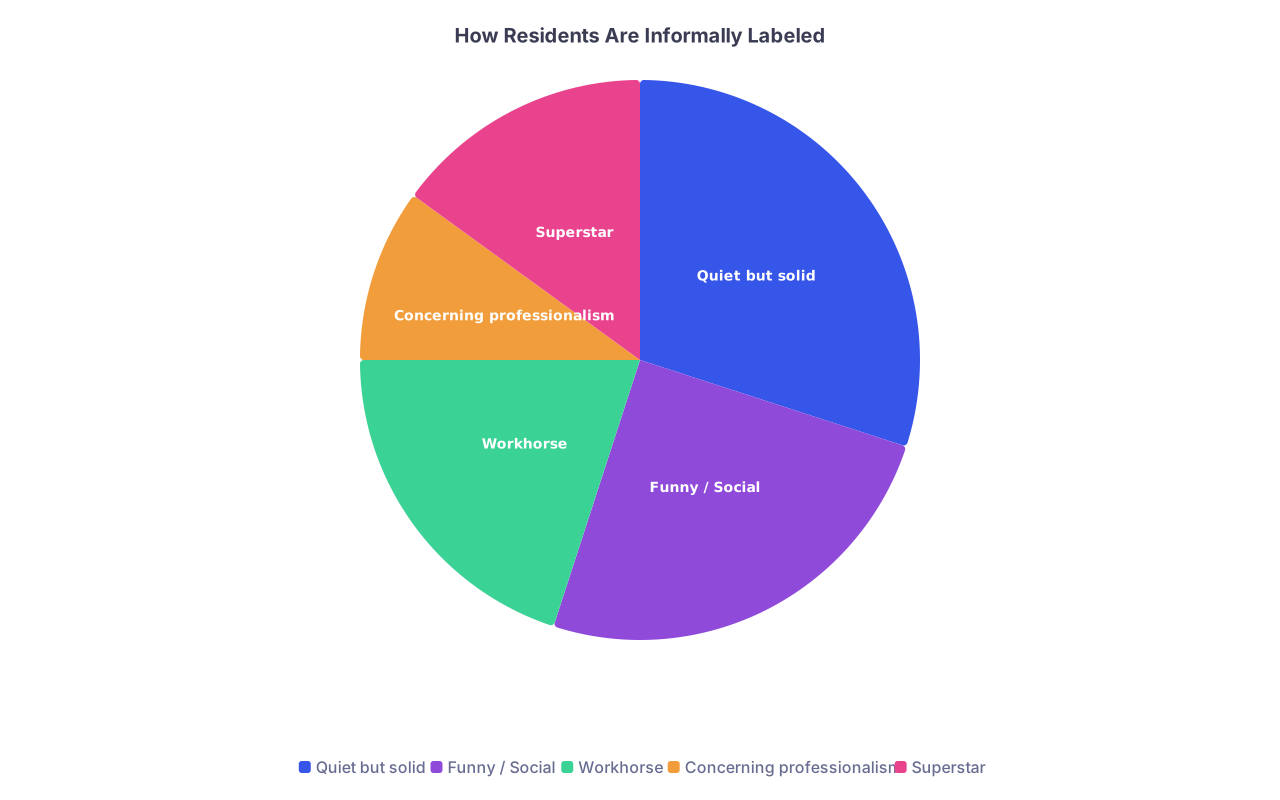
| Category | Value |
|---|---|
| Quiet but solid | 30 |
| Funny / Social | 25 |
| Workhorse | 20 |
| Concerning professionalism | 10 |
| Superstar | 15 |
Notice the “concerning professionalism” group is small in reality. But in our heads, we’re convinced we’re in that slice every time we make one awkward joke.
What If Damage Is Already Done?
This is the horror story running in the background: “What if my PD already thinks I’m not serious and it’s too late?”
Okay. Worst-case mode. Here’s what “too late” would theoretically look like:
- You’ve had multiple comments in formal feedback about professionalism / tone
- You were directly counseled about humor or boundaries
- Nurses or staff have complained about you more than once
- Your PD has said words like “pattern,” “perception,” or “concern” to your face
If you’re not there? You’re probably not in the “too late” category. You might just be in “yeah, I could clean this up” territory.
But say you are there. Then what?
You don’t fix it by becoming humorless overnight. You fix it by being painfully, boringly consistent for a while:
- Show up early
- Double-check orders
- Be the one who volunteers for the unsexy tasks
- Ask for feedback mid-rotation: “I know we’ve talked before about my tone. Am I on a better track now?”
I’ve seen people absolutely flip their narrative in 3–6 months. But it wasn’t with one grand gesture. It was dozens of tiny, boring, adult choices stacked together.
Humor, Burnout, and Why You Probably Joke So Much Anyway
Let’s be honest: a lot of us leaned into humor because it’s either that or cry in the medication room.
Medicine is ridiculous.
The pager that goes off the second you sit.
The 12-click order set for one Tylenol.
The “Please call lab” message with zero info.
If you don’t laugh at least some of this, you will break.
And truthfully? Most PDs know that. Many of them used to be the sarcastic resident on nights. They just live in a different role now. They’re held responsible for “culture,” so they see your humor through a different lens: “How will this look on paper if someone complains?”

The future of medicine is supposedly more human, more open about mental health, more honest. But we’re still stuck in this weird half-world where you’re allowed to be a human as long as you don’t make anyone uncomfortable.
So yeah, it’s confusing. Be relatable. But not too much. Be funny. But not like that. Be resilient. But don’t use the coping strategies that make some people nervous.
You’re not crazy for feeling like you’re threading an impossible needle.
A Few Practical Scripts (For When You’re Panicking)
If you’re still replaying a specific moment, here’s how I’d handle it in real life.
1. You Made a Questionable Joke in Front of Your PD
Later that day or the next:
“Hey Dr. X, I realized that comment I made earlier might’ve come off as flippant. That wasn’t my intent—I take this work seriously. I use humor when I’m tired, but I’m working on being more thoughtful about timing.”
Short. Owning it. Not melodramatic.
2. You Got Feedback About “Tone” or “Professionalism”
“Thank you for being direct about that. I don’t want my attempts to keep the mood light to ever read as disrespectful. If you notice specific situations where it crosses a line, I’d appreciate you pointing them out so I can course-correct in real time.”
That turns you from “problem” to “coachable.” PDs love “coachable.”
3. You Just Want to Quietly Reset
For the next few weeks:
- First, prove you’re reliable and prepared
- Then, use smaller, safer humor: self-deprecating, observational, never at patients’ expense
- Let your work speak loudly, and your jokes more softly
It feels overcorrected at first. But giving people a few solid weeks of “this person is on top of it” does more for your reputation than any single awkward comment hurts it.
The Anxiety You Won’t Say Out Loud
The part that really eats at me is this:
What if my actual personality just isn’t what medicine wants? What if the “serious, stoic, stone-faced” vibe is the only safe option, and everything else is just tolerated until it’s not?
I don’t buy that.
Yes, there are rigid people who think everyone should be joyless. But there are also:
- Attendings who say “I loved working with you because you kept the team sane.”
- Nurses who specifically ask to work with the funny resident on nights.
- Patients who say, “Thank you for making me laugh today. I needed that.”
We’re not the problem. Unfiltered, misplaced humor is. That can be shaped.
You don’t have to turn yourself into a blank slate to survive this field. You just have to prove, consistently, that when it matters, you can shut up, focus, and be fully present.
And you probably already do that more than your anxiety will ever give you credit for.
FAQ (Exactly 5 Questions)
1. Should I apologize to my PD for every dumb joke I’ve ever made?
No. That would look more unsteady than professional. Apologize or clarify only if there was a clear misstep: wrong timing (serious situation), wrong audience (patient/family), or someone visibly uncomfortable. Otherwise, just tighten your filter going forward.
2. What if my evaluations mention that I’m “too relaxed” or “too casual”?
That’s a signal to adjust, not a death sentence. Pair warmth with visible preparation: know your patients cold, finish notes on time, anticipate plans. When attendings see “relaxed but very on top of things,” the narrative flips from “not serious” to “confident and comfortable.”
3. Is it safer to just stop joking completely during training?
It’s “safer” in the most miserable way possible. You’ll feel fake, and patients notice inauthenticity. Aim instead for clean humor: no sarcasm toward patients, no bedside jokes during intense moments, and minimal joking around people who clearly don’t like it (you know who they are).
4. Can one bad joke actually tank my chances for fellowship or a job?
One bad joke? Almost never. A pattern of boundary-crossing humor, documented complaints, or professionalism flags? That can absolutely make people hesitate. Focus less on the one-off cringe moment and more on building a long, boring track record of reliability that outweighs it.
5. How do I know if my PD really sees me as unprofessional or if I’m just catastrophizing?
Look for data, not vibes. Have you had documented feedback? Direct conversations? Formal warnings? If not, it’s probably more in your head than in your PD’s file. If you’re still unsure, you can ask a trusted attending or chief: “I’m trying to be mindful of tone—do I ever come across as not taking things seriously?” Their answer will tell you far more than your anxiety will.
Key points to walk away with:
- Humor isn’t the problem; timing, audience, and direction are.
- One awkward joke rarely defines you—patterns and documented concerns do.
- You can keep your personality and still reassure your PD you’re deadly serious about the work when it counts.