It’s 2:17 p.m. You’ve just finished a soul‑draining noon conference, you’re drowning in notes, and you walk past the attendings’ workroom. The door is half‑open. Inside, three attendings are laughing at something on someone’s phone. Hard. The kind of laugh you’ve never seen from them on rounds.
You keep walking. Because you’re a student. Or an intern. And there is an invisible line at that doorway.
Let me tell you what’s actually happening in that room. What they really find funny. What they roll their eyes about. And, just as important, what they don’t joke about when the door closes.
You will not hear this on a podcast. You hear it at 1 a.m. on call, when someone finally forgets to be professional for ten minutes.
First: The Line They Don’t Cross
Before we get into the good stuff, you need to understand where the real attendings—the ones you’d actually want to become—draw the line.
No, they aren’t back there laughing about dead patients or racist jokes or making fun of someone’s accent. That crap is how you spot a malignant culture, not normal workroom banter.
The default, healthy state of an attending workroom:
Patients are off‑limits for cruelty. Tragedy is off‑limits. Actual suffering is handled with gallows humor maybe, but not mockery. And never with outsiders.
What is on the table?
You.
And them.
And the system.
Not in that order.
The Favorite Category: The System Is Absurd
If you think residents complain about the system, wait until you hear attendings when the door closes. This is the unifying comedy genre across specialties: the absolute absurdity of modern medicine.
I’m talking about stuff like:
- The 14 clicks required to order Tylenol.
- The prior authorization response faxed to a machine nobody has checked since 2019.
- The Joint Commission email about “safety culture” sent directly after administration cut staffing.
The jokes usually sound like this:
“Remember when I could admit chest pain in two orders? Now it’s a 27‑item order set and I still forget something and get a ‘friendly reminder’ email from pharmacy.”
Or:
“We got cited for not having enough signage… so now there are six signs on the code cart and still no one changed the defib pads.”
They’ll pull up screenshots of hilariously contradictory EHR alerts. I’ve seen a room lose it over an allergy banner that said:
“ALLERGY: WATER – reaction: UNKNOWN.”
That will live in that workroom for weeks. Printed. Taped up. Annotated.
The EHR Comedy Hour
Every workroom has an attending who is the unofficial curator of “EPIC horrors of the week.” They collect:
- Bizarre copy‑pasted notes (“Neurologic exam: CN II–XII intact” in a guy with a right above‑knee amputation and no neuro complaint).
- Epic-long med lists where “home meds” include things like “epidural bupivacaine” because someone clicked the wrong carry-forward.
- Meaningless “SmartPhrases” used in the worst possible way.
One ICU attending showed us a note that literally said:
“Patient appears comfortable, no acute distress”
…on the death note.
That became a running line for months. A patient’s crashing? “Looks comfortable, no acute distress.” Pager exploding? “No acute distress.” Attending gets three ‘see me’ emails from the department chair? “Appears comfortable.”
They’re not doing this to be cruel. They’re laughing at how detached EMR text is from reality. You can’t survive as an attending if you don’t occasionally laugh at the documentation circus.
Residents and Students: What They Actually Joke About
Let’s be blunt: yes, your name gets mentioned. Yes, your mistakes get replayed. But not in the way your anxiety thinks.
The number one thing attendings laugh about with trainees is intensity mismatch. When you bring neurosurgery-level intensity to a non-problem. Or the opposite.
The Anxious Overkill
Example from a medicine workroom:
“I got five pages from the intern about the potassium being 3.4 on a stable floor patient. Meanwhile the guy in 12B has a lactate of 7 and nobody’s called me yet.”
Followed by:
“Honestly though, I’d still rather they overcall. At least they care.”
That last part’s the key. Most attendings would much rather have the neurotic intern who triple‑checks everything than the checked‑out one. The jokes sting less when you realize they respect the energy… they just need to blow off steam.
Common overkill scenarios that get retold:
- The student who presents a 12‑minute HPI for a dressing change.
- The intern who writes a step‑by‑step novel of the last 6 years of a chronic condition… in the ED note.
- The resident who places 11 consults for one vaguely abnormal lab.
The Comical Under‑Reaction
On the flip side, there’s dark humor around the “I didn’t think it was that bad” moments:
“Resident called it a ‘soft belly.’ CT read: ‘Perforated viscus, large pneumoperitoneum.’”
You’ll hear:
“Remember when he tried to sign out the GI bleed at 4:55 as ‘clinically stable’? While they were actively being transfused?”
They’re not laughing because it’s harmless. They’re laughing because every one of them has been that person once, and it’s either laugh or spiral into existential dread about all the close calls.
The “Med Student is Too Prepared” Genre
This one is common and genuinely fond.
They laugh about:
- The student who prints color‑coded, tabbed folders for each patient.
- The M3 who has an Anki deck for ward attendings’ favorite pimp questions.
- The student who shows up on a sub‑I with a laminated “common orders” card… and it’s actually better than the resident’s list.
The line you’ll hear:
“She’s way more organized than I will ever be. It’s terrifying.”
You’re not being mocked there. You’re a mirror reminding them how far they’ve drifted from that phase of life where they thought they could control chaos with binders.
The Pimping Debrief: What They Say After You Leave
Every time you walk out after getting grilled on rounds, there is a debrief. I’ve heard it hundreds of times, in multiple specialties.
It usually goes one of three ways.
1. The “We Pushed Too Hard” Realization
As soon as the door closes:
“Did I go too hard on him about the acid–base?”
“Yeah, he looked like he might cry.”
“Dammit. I was actually trying to teach. I’ll grab him later.”
And then later, if they’re a decent attending, they try to soften it with “Hey, you did fine today. I know I pressed you—if you want to go over that, come find me.”
That conversation is often the direct result of the workroom reality check.
2. The “Why Don’t They Know This?” Rant
This one sounds harsher, but it’s more about med school training gaps than about you personally.
“How are they on sub‑I and they’ve never seen a CHADS‑VASc score?”
“Do they not teach acid–base anymore?”
It’s usually followed by a mini‑curriculum-building session.
“Okay, tomorrow I’ll have them all present an ECG. They clearly haven’t had reps.”
You think they’re just out to humiliate you. In reality they’re trying to reverse‑engineer what your education skipped.
3. The “That Kid is Scary Good” Whisper
They do not say this in front of you. But they definitely say it.
In a surgery workroom:
“That M4 knew the steps of the Whipple better than my PGY‑2 did at that stage.”
“Rank list material. I’d hire them.”
Or on medicine:
“She connected the rash and the eosinophilia faster than the senior.”
“She’s dangerous. In a good way.”
You’ll never hear that directly. But when you’re wondering if you tanked the rotation, remember: the most important conversations about you happen after the door closes.
The Specialty Tropes They Laugh At (Including Their Own)
Attendings absolutely joke about specialty stereotypes. Constantly. The key difference from residents is they usually include self‑deprecation.
Surgery vs Medicine vs Everyone Else
You’ll see this dynamic:
Surgery attending: “Medicine’s solution to everything is ‘optimize and observe.’ The patient’s appendix could be in a different ZIP code and they’d say, ‘trend the WBC.’”
Medicine attending: “Meanwhile surgery’s solution to anemia is ‘we’ll fix it in the OR’ even when they don’t know what they’re going to do in there.”
Anesthesiology gets tagged as:
“Paid naps.”
“Goes to the OR to hide from the hospitalist pages.”
But in the same breath:
“Honestly, I sleep better knowing this anesthesiologist is in the room.”
Emergency medicine?
“They think everything is sepsis or ACS… until it’s not. Then it’s ‘needs rapid outpatient follow‑up’ which means I get a 2 a.m. admit for a week‑long vague story.”
These jokes are tribal. They reinforce identity. And yes, you will absorb the humor style of your chosen tribe almost by osmosis.
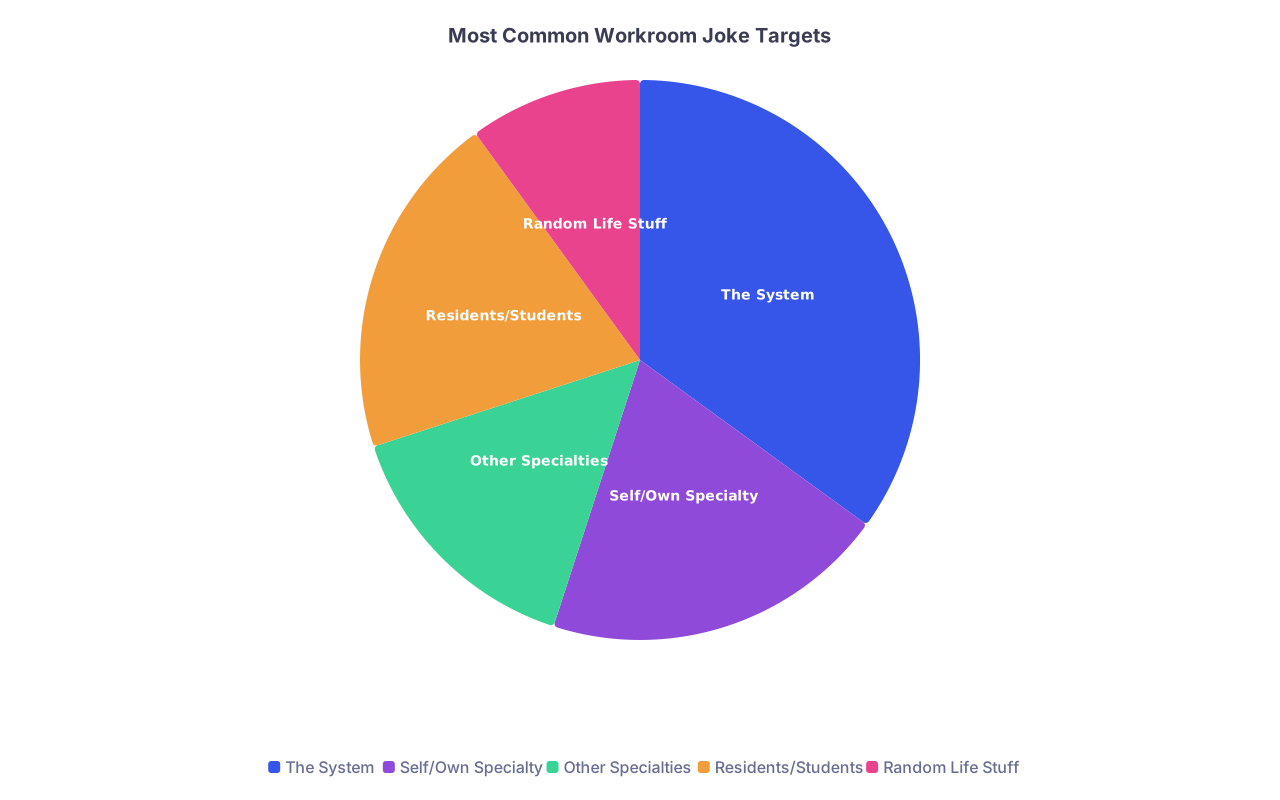
| Category | Value |
|---|---|
| The System | 35 |
| Self/Own Specialty | 20 |
| Other Specialties | 15 |
| Residents/Students | 20 |
| Random Life Stuff | 10 |
The “We’re All Aging Out” Humor
This one blindsides you the first time you hear it as a trainee.
Attending pulls out reading glasses:
“I used to be able to see the EKG without zooming it to 300%.”
Another attending: “I need the resident to read the screen to me like a court stenographer.”
They joke about:
- Not understanding the new slang residents use.
- Being scared to open TikTok.
- Their first moment of “Wait, I’m the oldest person in this room.”
In OB/GYN workrooms, I’ve heard:
“I’m delivering babies of people I delivered. That’s the sign I should retire.”
In the ED:
“I saw a chart that said ‘elderly male, 42.’ I was 42 that year. I have never recovered.”
Why does it matter that they laugh about this?
Because it’s where they admit vulnerability without having to say, “I’m scared I’m getting older.” Humor is the safest way for them to acknowledge that medicine is a young person’s sport… and they are no longer the young people.
The New Toy Jokes: Tech, AI, and “The Future”
Since you mentioned the “future of medicine” angle—yes, they joke about that too.
Right now, the workroom AI humor usually sounds like this:
“So the note writer AI thinks the patient ‘is a pleasant 87‑year‑old male in NAD’ while they’re on vasopressors and a ventilator.”
“Great, now the computer hallucinates just like the interns.”
Or:
“I love that the AI suggests ‘reassurance and outpatient follow‑up’ for everyone, including the guy with ST elevation.”
They’re half‑joking, half‑uneasy. They’ll say:
“In 10 years, the AI will round and I’ll just be here to click ‘attest.’”
“Good, maybe it can answer my 40 inbasket messages too.”
Younger attendings tend to be more amused and curious. Older ones lean more toward bitter sarcasm. But everyone recognizes the same thing: the tech is coming, and nobody has any idea how to integrate it without making everything slower and dumber first.

| Step | Description |
|---|---|
| Step 1 | New Tech Announced |
| Step 2 | Mock mercilessly |
| Step 3 | Try it on 1 patient |
| Step 4 | Complain to admin |
| Step 5 | Realize it adds 10 clicks |
| Step 6 | Age over 50 |
Dark Humor: Where the Line Actually Sits
Let’s not sugarcoat it. There is dark humor in that room. If you never develop any sort of gallows humor, you will not survive the second half of your career.
But there are rules. The good attendings enforce them.
They may joke about:
- The absurdity of three consultants arguing about who owns a problem while the patient waits.
- The 19th “code sepsis” alert on a clearly not‑septic patient.
- The hospital’s idea of “resilience training” being a mindfulness video emailed at 11 p.m.
They do not joke about:
- Actual suffering for kicks.
- Patients’ bodies or identities in demeaning ways.
- Specific tragedies in a way that identifies the patient.
Do some people cross that line? Yes. And other attendings notice. Those are the ones quietly labeled as “avoid working with if you can.” People remember who laughed when they shouldn’t have.
Gallows humor, done right, isn’t about the patient. It’s about the absurdity of the situation they’re both trapped in—doctor and patient—because of a dysfunctional system.
What They Laugh About Themselves For
Maybe the most honest laughter in that room is at their own expense. And it’s more common than you think.
Stories that get told and retold:
- The time they confidently declared “this is not appendicitis” and then scrubbed in for an appendectomy 6 hours later.
- The time they mixed up two room numbers and gave a profound, heartfelt family meeting… to the wrong family.
- The time they called a consultant at 3 a.m. for something that absolutely could’ve waited.
They’re not invincible. They remember their stupid intern moves too. Often with more detail than you remember yours.
I sat in a cardiology workroom once where an old‑guard attending admitted:
“I once gave a whole talk about distinguishing pericarditis from STEMI and then missed a pericarditis on my own service the next day. Residents never let me live it down.”
Everyone laughed. Not to mock him. To exhale. Because if he can screw up and keep going, maybe they can too.
| Category | Typical Story Trigger |
|---|---|
| Missed Diagnosis | Called “viral” → turned out bacterial |
| Wrong Room / Patient | Family meeting, wrong family |
| Overconfidence | “Definitely not X” → obviously X |
| Tech Fail | Dictation fiasco, wrong chart note |
| Early Career Panic | First solo night on call anecdotes |
What This Means For You (As a Trainee)
You’re not getting into that inner circle tomorrow. And you shouldn’t. There needs to be a boundary.
But here’s what you can take from knowing what they really laugh about:
They’re not superhuman.
They’re older, more tired versions of you with slightly better pattern recognition and a slightly larger portfolio of mistakes.They remember what it was like.
The most brutal jokes in that room are about how they were ridiculous once too.If they’re laughing about something you did, it’s usually out of relief, not contempt.
“Thank God this was a learning mistake, not a catastrophic one.”The system absurdities that make you want to quit?
They see them too. Nobody is blind to it at the attending level. The laughter is just the coping mechanism for having much less flexibility than you think to fix it.
And one more thing: the closer you get to them in training, the more you’ll start getting invited into that room. First for chart review. Then for a coffee. Then one day you realize the door closed and someone just made a joke they wouldn’t have made on rounds… and nobody looked at you like you didn’t belong.
That’s the moment you crossed from “student” to “one of us.”