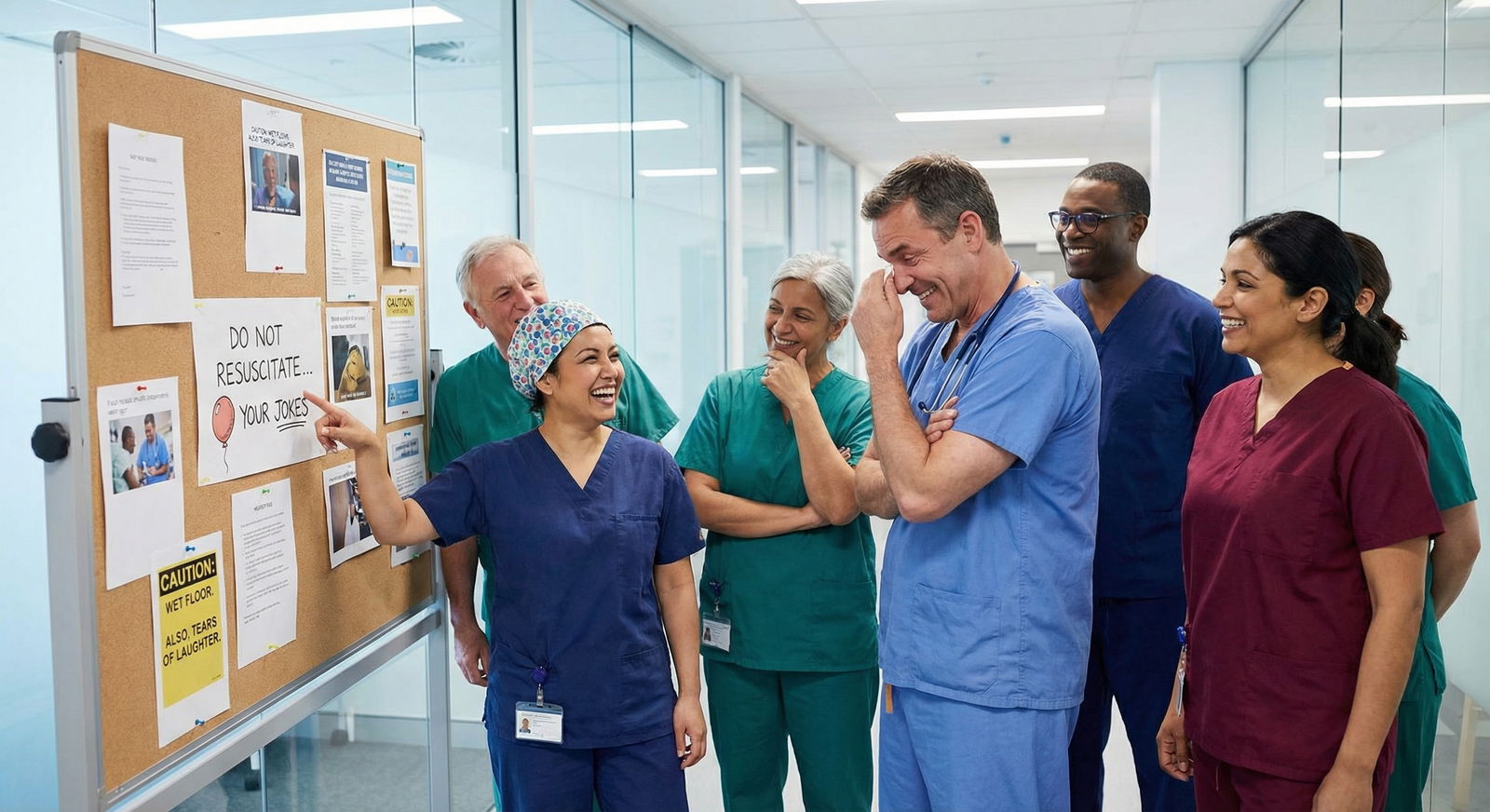
The funniest jokes in medicine are written in plain English in the progress notes—and most med students never realize they’re jokes.
Let me ruin that innocence for you.
What you think are “polite clinical phrases” are often just code. Attendings see it instantly. Seniors learn to spot it by winter of intern year. You, as a student or early intern, are still taking “patient tolerated the procedure well” at face value.
Let me show you what that really meant.
The Hidden Lexicon: What That Note Really Said
Attendings don’t need emojis to know when a resident is screaming internally. The comedy is baked into the phrasing. You can almost hear the writer’s emotional state through the “objective” language.
Here’s the translation layer nobody explains to you during orientation.
| Chart Phrase | What Attendings Read |
|---|---|
| NAD | I did not really look carefully |
| Patient tolerated procedure well | Chaos, but no one died |
| Will continue to monitor | I have no idea what else to do |
| No acute distress | Alive and not actively coding |
| Appears comfortable | I asked while walking out the door |
Let’s walk through some of the greatest hits.
“No acute distress” (NAD)
What you wrote: “Elderly male, lying in bed, NAD.”
What your attending reads: “I saw him from the doorway and he wasn’t blue or screaming.”
Every attending knows how this line is abused. When it shows up in every single note from every single service, it becomes background noise. But when it appears next to “10/10 pain,” that’s when we smirk.
We’ve all seen it: resident documenting “NAD” on a patient who is:
- Tachy to 130
- Sweating
- Actively negotiating with God
Comedy code unlocked.
“The patient tolerated the procedure well”
This is the national anthem of medical euphemism. Attendings know this phrase is purchased with blood, sweat, and missed pages.
Translation options:
- Real meaning #1: “BP dropped to 70/40, we bolused, someone fainted, RT yelled, but we finished.”
- Real meaning #2: “Nothing technically terrible happened, but I never want to do that again.”
- Real meaning #3: “They survived.”
When we see “tolerated well,” we instinctively scan for anesthesia notes, extra fluids, “brief hypotension,” or “transient desaturation.” Those are the footnotes to your lie.
“Will continue to monitor”
This is resident code for: “I’ve reached the boundary of my current knowledge and emotional bandwidth.”
Attendings know this line lives in notes written at 2:47 a.m. under fluorescent lights by someone with a cold cup of coffee and 18 unchecked tasks.
We see it and think:
- Either you’re appropriately cautious and waiting on data
- Or you’re completely stuck and trying not to write, “¯\_(ツ)_/¯” in the chart
The comedy is we all remember when we first discovered this phrase. It feels grown-up. Mature. Conservative. The written equivalent of nodding wisely.
We knew, when we wrote it, that it meant, “I do not know what to do.” So do your attendings.
“Appears comfortable”
Attendings read this one with a very specific side-eye.
The fun translation:
- “I asked, ‘You doing okay?’ while backing out of the room.”
- “They said, ‘I’ve had worse’ and I believed them because I wanted to.”
If the same patient has:
- HR 115
- Face clenched
- Pressing PCA every 3 seconds
…your “appears comfortable” becomes accidental dark humor.
Every senior has seen the chart where every note said “appears comfortable” and the family is at the nurse’s station saying, “He said his pain was a 9 all night.”
We notice.
Subspecialty Comedy: Each Service Has Its Own Dialect
The codes aren’t universal. Each specialty layers on its own flavor. If you rotate enough places, you start hearing the dialects.
Surgery: The Gospel of Understatement
Surgical notes are their own genre of deadpan stand-up.
Common phrases:
- “Minimal blood loss” = less than a crime scene
- “Some adhesions encountered” = full archaeological dig
- “Patient doing well post-op” = not intubated and not exsanguinating
You’ll see “pain well controlled” in a patient whose epidural just came out at 0600 and hasn’t gotten a single PRN yet. The comedy is: attendings know this is aspirational documentation.
I once watched a trauma attending skim a note:
“EBL 800 mL. Patient tolerated procedure well.”
He muttered, “So everybody panicked for 15 minutes.”
That’s the shared language.
Medicine: The Poetry of Vague Concern
Internal medicine humor is buried in hedging.
Common lines:
- “Will trend labs” = I ordered the same lab every 6 hours forever because I was afraid to stop
- “Patient remains clinically stable” = nothing dramatic enough happened to call you overnight
- “Etiology unclear, but differential includes…” = I copied UptoDate and I’m hoping nobody asks me why I wrote half of this
Attendings spot your confidence level by how often “unclear,” “multifactorial,” and “less likely but cannot fully exclude” appear in a single A/P.
More than three? You’re lost. We’ve all been there.
Psych: The Art of Saying “No Insight” Nicely
Psych notes hide razor-blade assessments behind seemingly gentle phrasing.
Watch for:
- “Limited insight” = no insight at all
- “Guarded” = hates us and will not be honest
- “Minimizing symptoms” = wildly unreliable narrator
- “Denies SI/HI” after a paragraph of chaos = we are not convinced
Attendings chuckle internally when the student writes:
“Patient appears future-oriented as they state they want to smoke marijuana later.”
Technically true. Deeply unhelpful.
Pediatrics: Cheerful Darkness
Peds notes will carry the brightest tone with the grimmest content.
Examples:
- “Patient playful and interactive” = pulled out two IVs and bit a nurse
- “Parents have good questions” = parents are (justifiably) grilling everyone and might sue
- “Will continue to support family” = they are exhausted and we have no real solutions
The funniest peds notes are written by interns who still call every rash “viral exanthem” and every fever “likely viral process.” Attendings see that phrase and know: you’re out of ideas and praying.
How Attendings Actually Read Your Note
Here’s the secret: we don’t read every line. We read like someone solving a puzzle.
We:
- Scan vitals
- Glance at meds
- Then use your phrases as emotional sonar
Certain words light up like red flags. Others make us quietly laugh.
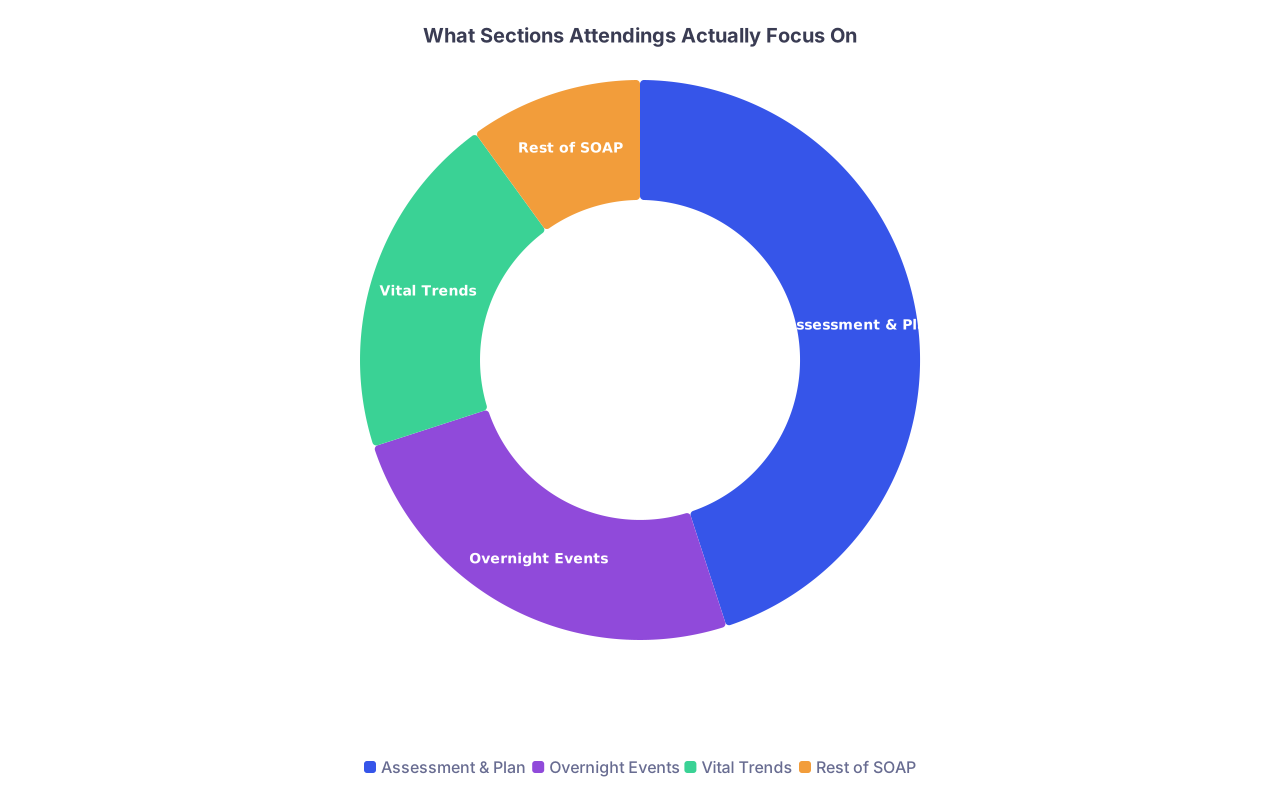
| Category | Value |
|---|---|
| Assessment & Plan | 45 |
| Overnight Events | 25 |
| Vital Trends | 20 |
| Rest of SOAP | 10 |
We know what you were thinking when you wrote:
“Discussed with attending; plan as above.”
Translation: “Don’t blame me for this.”
“Appreciate recs from [consult service].”
Translation: “They made the decisions; I’m just documenting them.”
“Patient reports feeling ‘fine.’”
Translation: either they’re minimising or you didn’t push on any specifics.
The humor runs both ways. Your note is often your first attempt at sounding like a Real Doctor. Attendings are reading the tension between your professional tone and your obvious panic.
The Meta-Joke: When Notes Contradict Reality
This is where attendings quietly lose it.
We do something students rarely do: we hold the picture of the actual patient in our head while we read the note. So when the chart and the human don’t match, it’s unintentional comedy.
Examples I’ve actually seen (and yes, other attendings see similar):
- Patient asleep, snoring, with soft wrist restraints; note says, “Alert and oriented x3, NAD, conversant.”
- Patient on 6L nasal cannula, sats 91%; note says, “On room air, breathing comfortably.”
- Patient refusing all meds; note says, “Tolerating medications without difficulty.”
We know how it happens. Notes are templated. Copied. Forwarded. Nobody cleaned up the boilerplate. Every time we see last week’s “Room air” still living in a note on the day they got intubated, we mentally mark you as “careless but salvageable.”
And we do laugh. Then we have a teaching moment about copy-forward abuse.
The Easter Eggs Attendings Slip In Too
Residents aren’t the only ones sneaking tone into notes. Attendings have their own subtle comedy.
You’ll see phrases like:
“Will respectfully disagree with prior assessment…”
Translation: “That note was wrong.”
“Case discussed at multidisciplinary rounds; consensus reached…”
Translation: “There was a 20-minute argument and this is the compromise.”
“Given the clinical context, low likelihood this is [zebra].”
Translation: “Stop chasing this weird diagnosis you found on Reddit and UptoDate.”
The best attendings write notes that are simultaneously:
- Legally defensible
- Clinically accurate
- Mildly sarcastic to anyone fluent in the language
You won’t catch it at first. Once you do, reading notes becomes more entertaining than Instagram during sign-out.
Future of Comedy: When AI Starts Reading Your Notes
You’re in the “Miscellaneous and Future of Medicine” bucket, so let’s talk about where this goes.
Right now, only humans laugh at “patient tolerated the procedure well” when they know there was a massive blood transfusion. In a few years, your hospital’s NLP system will flag that as “possible under-documented complication.”
Imagine an EHR scrubber that compares:
- “No acute distress”
- Vitals: HR 130, BP 82/40, RR 30
- Nursing note: “Patient crying, asking if they are dying”
The AI will not think it’s funny. It’ll flag it as inconsistent documentation.

| Step | Description |
|---|---|
| Step 1 | Resident writes note |
| Step 2 | Phrase detector |
| Step 3 | Store note as is |
| Step 4 | Check vitals and data |
| Step 5 | Flag for review |
| Step 6 | Vague or coded phrase |
| Step 7 | Match clinical data |
Right now, attendings are the ones matching your words to reality. We notice when “pain well controlled” appears in the same patient getting IV dilaudid q2h and still grimacing.
Soon, software will notice too.
Will that kill the comedy? Not entirely. The human tendency to polish reality for charts is older than EMRs. People were writing, “Post-op course unremarkable” in dictated notes long before Epic.
But it will change how sloppy you can be with your euphemisms.
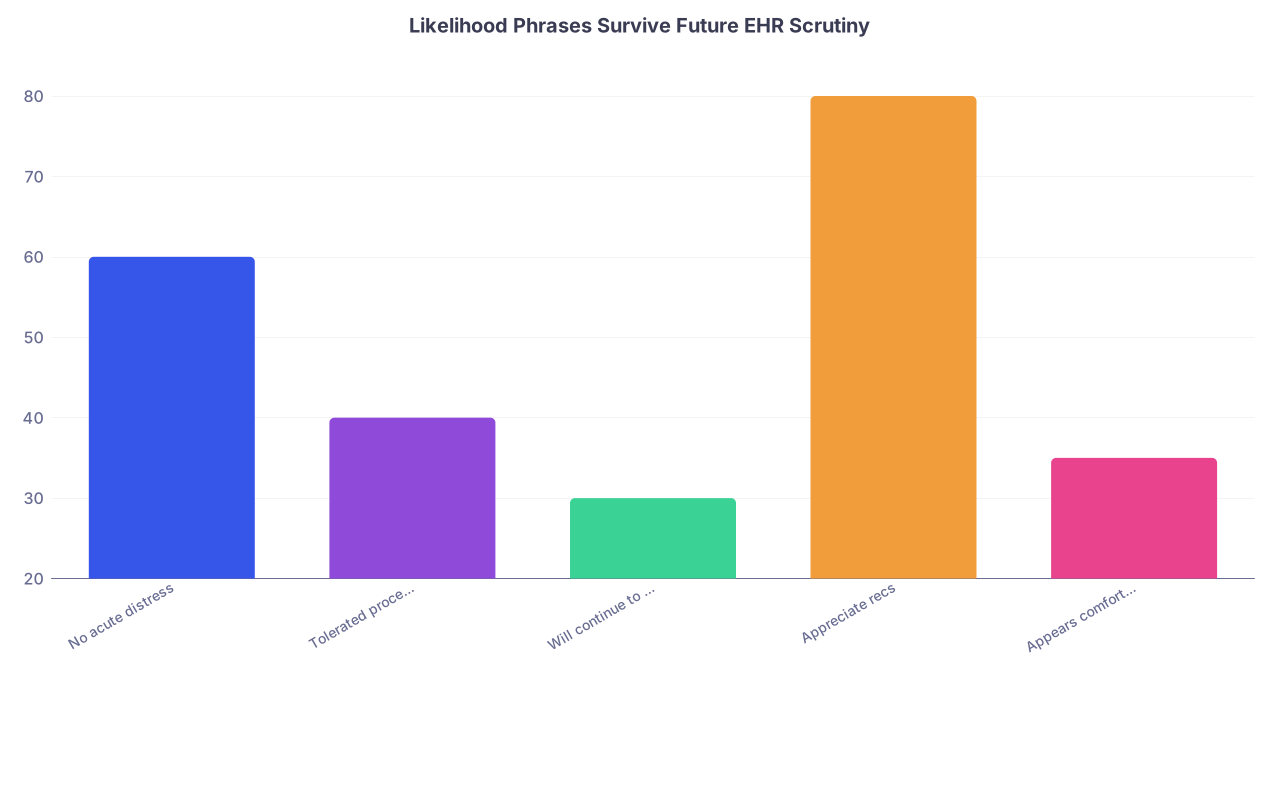
| Category | Value |
|---|---|
| No acute distress | 60 |
| Tolerated procedure well | 40 |
| Will continue to monitor | 30 |
| Appreciate recs | 80 |
| Appears comfortable | 35 |
High-scrutiny systems will force you to either:
- Actually describe what happened
- Or have every lazy phrase trigger a pop-up asking, “Document supporting details?”
That alone will kill half the fun.
How to Be Funny Without Being Unsafe
Here’s the line: comedy codes are fine; dishonest codes are not.
Attendings don’t care if you use the classic euphemisms. We care if your note makes it impossible to reconstruct what really happened.
You can be accurate and still show you’re in on the joke.
“Patient endorsed significant discomfort with dressing change, but declined additional analgesia when offered. Currently resting, appears more comfortable compared to prior assessment.”
That’s honest. And an attending reading it can hear the subtext: it sucked, I offered help, they were stubborn, now it’s better.
What we do not want to read: “Patient tolerated dressing change well, appears comfortable.”
Because we know it’s not true. And if something goes badly, that sentence ages poorly.
The attendings who really train you will push you toward:
- Less template garbage
- More actual description
- Less “monitor”
- More “if X then Y” plans
You still pick up the humor. You just stop lying to yourself.
How to Train Your Eye for These Codes
If you actually want to get good at this—and you should—do this on your next rotation:
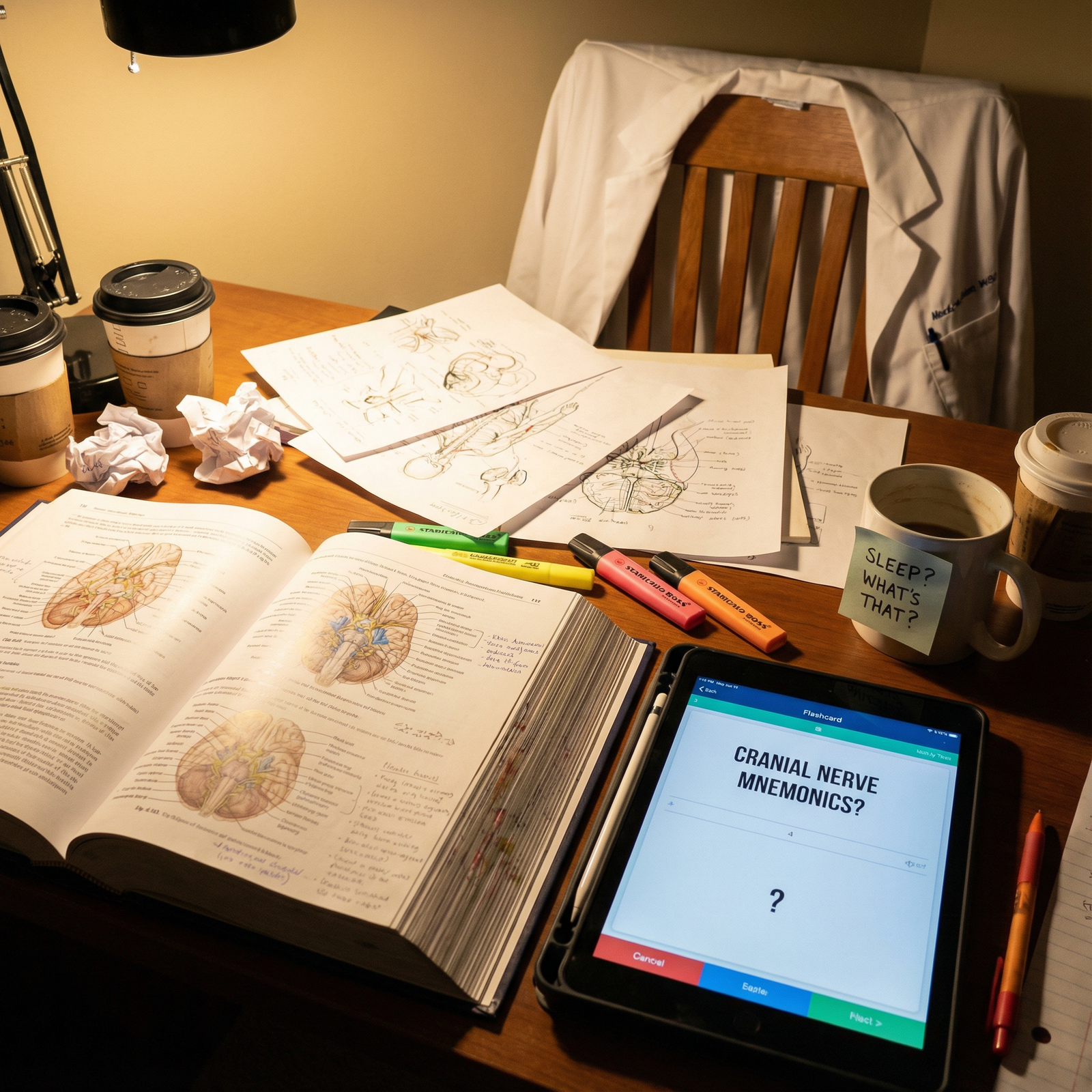
Read three days of notes on a single complex patient. Medicine, surgery, nursing, consults. Then go see the patient. Really see them. Listen to them for five minutes.
You’ll start to notice:
- Which phrases are always meaningless boilerplate
- Which attendings actually describe what’s happening
- Which residents are clearly hanging by a thread
Over time, you develop the same attending superpower: you can tell, from one note, how stressed the writer was.
And then one day, you’ll read a student note that says:
“Will continue to monitor.”
You’ll smile, because you know exactly how they felt when they wrote it. And you’ll sit them down and say, “Let’s talk about what that really means.”
They’ll roll their eyes. They’ll rewrite it. Then six months later, they’ll be the one laughing at someone else’s note.
That’s the hidden education: learning the comedy codes is part of becoming fluent.
Final Thought: Why This All Matters
This isn’t just about jokes.
Progress notes are how the profession talks to itself. The humor, the euphemisms, the code words—they’re byproducts of real pressure. Real uncertainty. Real fear of being wrong in writing.
Attendings notice the comedy because we’ve all lived the situations behind it. We remember the procedure where “tolerated well” was a miracle, and the “NAD” patient who crashed three hours later.
As you move through training, you’ll start seeing the double meanings. You’ll start writing them. Then, if you’re paying attention, you’ll outgrow the lazy ones and keep just enough of the shared language to show you’re part of the tribe.
With that lens in place, you’re finally ready for the next education: reading between the lines of consult notes and discharge summaries. That’s a much darker kind of comedy—but that’s a story for another day.