It’s 1:17 a.m. You’re in bed, blue light frying your retinas, scrolling back through three years of Twitter, Instagram, maybe a stray TikTok you forgot about. You just saw a Reddit thread saying programs do stalk applicants’ social media, and suddenly that half-funny, half-dead-inside meme you posted about “codes being cardio for residents” doesn’t feel so harmless.
Now you’re wondering:
Did that joke about admissions committees “loving trauma” get screenshotted?
Did someone see that photo where the caption was… a little too spicy for a future physician?
Did I just lose an interview over a meme?
Let me say this up front: you’re not the only one spiral-scrolling your own digital footprint and imagining PDs cackling while they blacklist you. I’ve watched multiple applicants go through this exact panic — usually in the dead zone between submitting ERAS and hearing back. It’s practically a rite of passage at this point.
Let’s talk about what’s real, what’s overblown, and what you actually should do right now.
Do Programs Actually Check Social Media Or Is This Just Scare Tactics?
Short answer: some do, some don’t, none will admit how often, and almost nobody uses it as carefully as you imagine in your nightmares.
Here’s what I’ve actually seen and heard:
Faculty “curiosity scrolling” is real.
I’ve sat in a workroom and heard:
“Hey, this applicant has a big YouTube channel.” clicks
Or: “They mentioned a podcast, let’s see.”
Or the brutal: “Someone sent me this applicant’s TikTok… yikes.”
Often it’s more like casual googling than a formal “social media screening process.” But in competitive specialties (derm, ortho, plastics, rads), people absolutely google applicants more often. Not always. But enough that you can’t pretend it never happens.
Where you can calm down a bit: they’re not hunting for one stray off-color joke to crush your career. They don’t have time. What gets people in trouble is patterns and obvious lapses in professionalism, not a single mediocre joke.
What Actually Gets Applicants In Trouble (And What Doesn’t)
Let’s separate harmless dumb stuff from career-torpedo-level content, because your brain is probably lumping them all into “my life is over.”
Stuff that very rarely sinks you by itself
These are the things that feel catastrophic at 1 a.m. but usually aren’t:
- Dark humor memes about burnout that don’t mention specific patients or places
- A salty comment about “med school being soul-crushing”
- Mild swearing in captions
- Old undergrad selfies with drinks, as long as it’s not clearly binge/drug culture central
- A sarcastic tweet about “hating rounds”
- Posting tired resident jokes like “Who needs sleep when you have norepinephrine”
Is this all “ideal”? No. But the average attending has seen way worse. Many of them have liked memes from @medicalvineyard or some chaotic med-Twitter account while on call at 3 a.m.
Stuff that can actually hurt you
These are the things that really do trigger consequences when admissions or PDs see them. I’ve seen or heard about applicants getting quietly dropped over this kind of content:
Anything that could be patient-identifying, even vaguely
“23-year-old with GSW came in tonight…” + timing + location = bad. HIPAA isn’t a vibe, it’s law.Making fun of patients or communities
Mocking BMI, intelligence, accents, mental illness, substance use. This is where people go, “If they tweet this, what do they say at 2 a.m. in the ED?”Openly trashing specific schools, programs, or faculty by name
“X Residency is toxic.” “That program director is trash.” They don’t forget that.Slurs or hateful content
Obvious, but I have absolutely seen screenshots of this get passed around.Bragging about cutting corners, cheating, or faking documentation
Even as a “joke.” People don’t always assume you’re joking.Really explicit partying / drug use stuff that screams “liability,” not “I once drank a beer”
If your “jokes” live in this second category? Then yeah, it’s worth being more than mildly nervous. That’s not doom, but it does need a deliberate clean-up.
The Nightmare Scenario You’re Playing In Your Head
You’re probably picturing something like this:
A committee of 12 attendings in suits.
Giant screen.
Your Instagram grid blown up like evidence at a trial.
A PD slowly zooming in on your caption: “another day, another code, where’s my therapist?”
Silence. Then: “Reject.”
That’s not how it works.
Here’s what’s more realistic:
One person on the team casually googles you, maybe after you caught their attention in a good way. They scroll your first page of results. Maybe click your Twitter or Instagram if it’s public and clearly you. They skim.
If they see something glaringly bad, they don’t usually launch an investigation. They just… move on. Or drop you a few spots. Or decide not to fight for your interview if you were already borderline.
Quiet, subtle damage. No dramatic confrontation. Just opportunity that never materializes. That’s the scary part, honestly — you rarely know.
But that also means: most of your borderline “eh” jokes are not enough to tank you on their own. They might make someone raise an eyebrow. They’re not usually the sole reason you don’t get an invite.
Are Medical Humor Accounts Doomed?
Let’s talk about the “med Twitter” / meme account world, since this is medical humor category and those accounts are landmines.
You know the ones:
“PGY-0 trauma gremlin,”
“@CodeBlueButMakeItFashion,”
or some anonymous-ish meme page where people are weirdly proud of how dead inside they are.
Here’s the uncomfortable truth:
A lot of residents and attendings follow and enjoy these.
A smaller but non-zero number on selection committees hate them.
What matters is: can your content be linked back to you and does it cross into “I wouldn’t trust this person with my patients” territory?
If your medical humor account:
- Never uses patient details
- Never mocks vulnerable groups
- Focuses on relatable med training pain
- Doesn’t name your hospital/attendings
- Isn’t tied directly to your real full name
Then honestly, most programs don’t care that much. Some will even think it’s kind of impressive you built an audience.
But if your bio says “MS4 at [Specific School], future [Specialty]” and the next tweet is “If you’re my patient, please don’t code after 6 pm I’m tired” …yeah. That can absolutely rub people the wrong way.
What You Should Do Right Now (Panic With A Plan)
Let’s get out of the spiral and into damage control. Here’s the triage:
Google yourself.
Use incognito. First three pages. Try your full name + “MD”, full name + school, full name + city. See what actually shows up, not what you think is out there.Identify what’s truly bad, not just “slightly cringe.”
Ask:
“If this screenshot was printed and put in front of a PD I respect, would I be ashamed or would I argue it’s fine?”
If your stomach drops? That one goes.Delete or lock down obvious risks.
Patient-adjacent posts, mocking anyone vulnerable, heavy partying/drug flexing, specific program trashing — delete. No hesitation.Set accounts to private where needed.
Instagram private. Old Twitter/X private. TikTok private if it’s not clean.
If you want a public professional presence, make a separate, clearly professional profile and keep it squeaky.Clean your bio.
Remove med school name, hospital name, “MS3 at ___,” etc., from your more chaotic accounts. Less linkability = less risk.Stop posting spicy stuff until after match.
I know. The content is great. The timing is not. Your future self can live without your hot take on program X for the next few months.
How Bad Is It If I Already Posted Something Questionable?
You’re probably doing a mental replay of That One Post.
Maybe you tweeted:
“Love when patients google their symptoms and think they know more than me lol.”
Or posted a meme that, in retrospect, can be read as mocking mental illness.
Or you referenced a patient in a way that wasn’t fully identifiable, but… didn’t feel great.
Here’s the harsh but hopeful take:
- If no one has called you out, reported you, or contacted your school, it’s unlikely it triggered a full formal meltdown.
- If an individual PD saw it and didn’t like it, you’ll probably never know. You’ll just not get an interview there. That sucks, but it’s not the end of your career.
- One bad post does not blacklist you nationwide. Programs are not a Borg collective.
What does matter is pattern and response.
If your history shows a ton of similar posts over time, it screams “this is how I think.” That’s worse than a single off-color attempt at humor surrounded by generally decent content.
If you’ve got one or two borderline things and you delete them, then consistently show maturity everywhere else? Most people would give you the benefit of the doubt — especially if your application otherwise screams “responsible human.”
The Future Of Medicine Is Watching You (But Not The Way You Think)
Here’s the weird thing: social media isn’t going away. And medicine pretending it doesn’t exist is a joke by itself.
We’re heading toward a world where being online as a physician is normal. Patients google you, students follow attendings on Instagram, people watch TikTok videos about ACLS before their exam. Some big-name attendings have entire brands built on medical humor and education.
So it won’t just be “Did my jokes cost me an interview?”
It’ll also be “Can my jokes coexist with being a respected physician?”
The future probably looks like:
- More schools explicitly teaching social media professionalism (beyond the boring HIPAA lecture).
- Programs expecting some online footprint and worrying a bit more if you’re a complete ghost.
- More residents and attendings leading with humor as an entry point to education and advocacy.
You being funny online isn’t the enemy. You being reckless online is.
If you can show emotional intelligence, empathy, and judgment and have a sense of humor? That’s actually an asset. You’ll connect with patients better. You’ll survive residency better. You’ll be a better colleague.
The line you have to walk is: “Could a reasonable person look at this and trust me alone in a room with their mother?” If the answer is consistently no, it’s not the system that’s the problem.
A Quick Reality Check: Did You Actually Lose An Interview Over This?
You’ll never have proof either way. That’s the worst part.
You send out 60 applications. You get 14 interviews. Your brain immediately tells you:
- Those 46 rejections?
Not Step score.
Not research.
Not class rank.
Obviously that one meme.
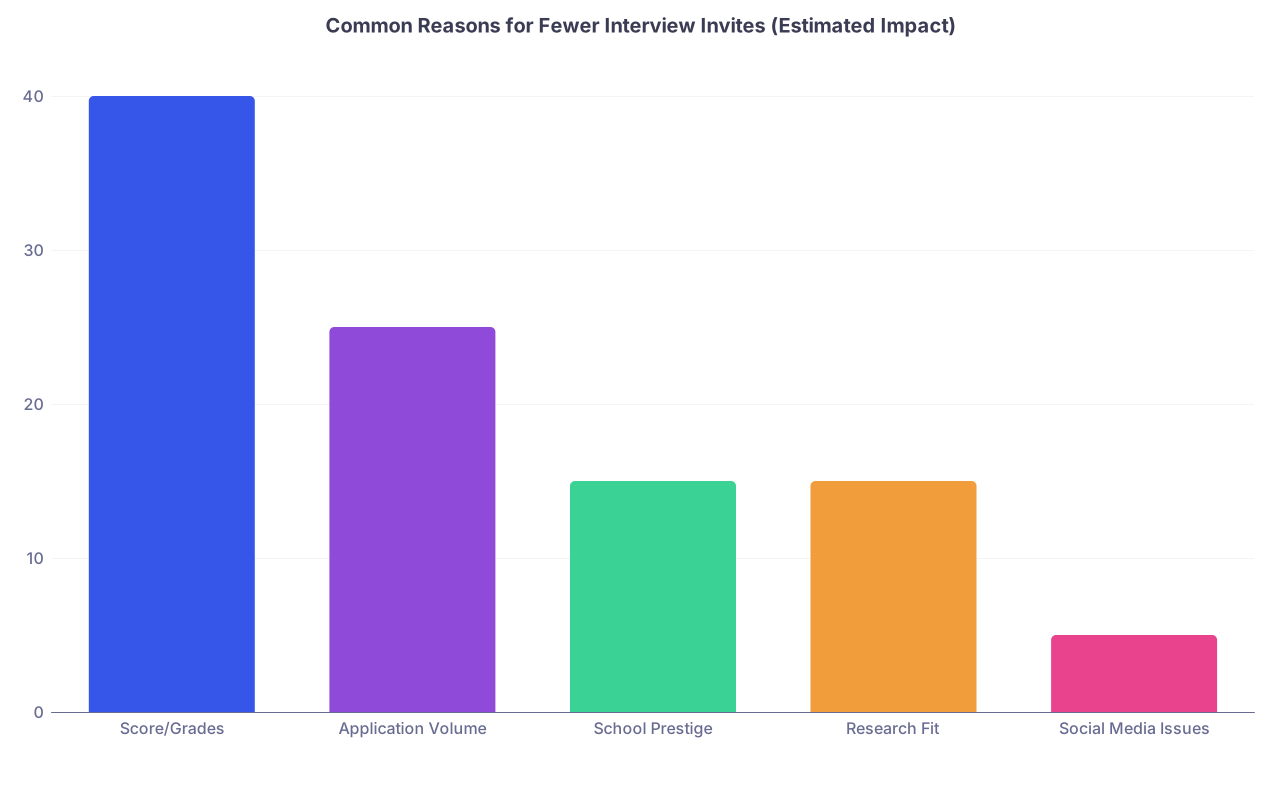
But the cold math looks more like this:
| Category | Value |
|---|---|
| Score/Grades | 40 |
| Application Volume | 25 |
| School Prestige | 15 |
| Research Fit | 15 |
| Social Media Issues | 5 |
Is social media in the mix? Yeah.
Is it the main driver for most people? No.
Most of the time, you didn’t get the invite because they had 900 apps for 12 interview slots and you were in the massive, undifferentiated middle.
So yes, clean up your stuff. But don’t give your Twitter more power over your future than your actual CV.
If You Want To Keep Doing Medical Humor Long-Term
If being funny about medicine is a real part of you (not just stress-relief shitposting), treat it with some structure instead of pretending it’s “just jokes.”
You can:
- Make a separate, clearly professional account for your name where you post harmless, inoffensive content (education, mild memes, advocacy).
- Keep any sharper humor fully anonymous with no bio links, no school tags, no faces. Better yet, tone it down and keep it human, not cruel.
- Assume anything you post can eventually be traced to you. If that thought terrifies you, don’t post it.
And if you ever blow up and people recognize you? You want your content to age like “this person sees the absurdity in medicine but still respects humans,” not “this person should not be allowed near a vulnerable patient.”
Mini Reality Timeline: If Something Was Truly Bad
Just so you stop imagining the vague horror, here’s what usually happens when social media actually crosses a big line:

| Step | Description |
|---|---|
| Step 1 | Problematic Post |
| Step 2 | Student or Colleague Sees |
| Step 3 | Reported to School or Program |
| Step 4 | Meeting with Dean or PD |
| Step 5 | Warning or Education |
| Step 6 | Disciplinary Action |
| Step 7 | Serious Violation |
If no one has contacted you.
If your school hasn’t dragged you into a meeting.
If you haven’t had any formal “we need to talk about your online presence” conversation.
You’re probably not in that pathway. You’re just in the anxious “what if” zone.
Quick Comparison: Jokes That Usually Survive vs. Jokes That Don’t
| Type of Joke | Risk Level |
|---|---|
| “I am so tired I might become a plant” jokes | Low |
| General burnout memes without targets | Low |
| Light self-deprecating jokes about training | Low |
| Mocking specific patient behaviors or groups | High |
| Patient-adjacent stories with details | High |
| Jokes implying negligence or cruelty | High |
What To Do Tonight So You Can Actually Sleep
Here’s your practical, bare-minimum checklist before you throw your phone across the room:
- Do a targeted clean-up of anything patient-related, hateful, or clearly unprofessional.
- Make risky accounts private and/or strip identifying info.
- Decide on one “public-facing, boringly safe” profile connected to your real name.
- Then stop looking at your old posts. You did your due diligence. Obsessing won’t change the past.
And yes, it’s possible that some PD somewhere saw something and silently downgraded you. That’s annoying, but not fatal. Programs are not unified. People disagree. Another PD might have scrolled the same account and thought, “Honestly? Relatable.”
You’re not being judged by one monolithic internet god. You’re being judged by a messy collection of human beings, many of whom have liked some extremely questionable memes themselves.

FAQs
1. Should I just delete all my social media until after Match?
Honestly? Overkill for most people, and it can look weird if you have zero online footprint and you previously had a visible one. Better strategy: lock down old/personal accounts, tighten up content, and maintain one mild, professional-ish public presence.
2. Is dark humor automatically unprofessional?
No. A ton of people in medicine survive on dark humor. The issue isn’t “dark” vs “light,” it’s “punching down on vulnerable people” vs “self-aware commentary on the system and your own struggle.” If the joke targets patients, marginalized groups, or suffering for laughs, that’s where you get into trouble.
3. Can I talk about being burned out or depressed online, or will that hurt me?
You can, but be smart. Thoughtful posts about mental health, boundaries, and burnout are increasingly respected, not punished. Chaotic, reckless, or “I hate all my patients and want to quit” rants… less so. Tone and context matter more than the topic itself.
4. What if a program directly asks about my social media during an interview?
Don’t panic and don’t lie. A straightforward answer like, “I’ve cleaned up old accounts and now try to use social media mostly for education and community; I learned where the line is,” shows maturity. If they reference something specific, own it briefly, acknowledge what you’d do differently now, and move on. Dragging it out makes it worse.
Key points:
You probably didn’t tank your entire interview season with one joke, but sloppy patterns and identifiable cruelty can absolutely hurt you. Clean up what you can, lock down what you can’t, and going forward, treat your online humor like it might someday be read out loud in a committee room. If you wouldn’t stand by it there, don’t post it here.