
The unspoken rule of modern medicine is brutal: assume every message you send will someday be read in an auditorium with your name on the screen.
If that sentence made your stomach drop, welcome. You’re my people.
I’m the one who drafts a joke in the team GroupMe, stares at it for 90 seconds, deletes it, rewrites a tamer version, sends it, and then spends the rest of the day convinced I’ve just personally ended my career. Over a meme.
Let’s talk about that.
The ugly truth: screenshots last longer than your rotation
Here’s the reality I wish someone had spelled out for me earlier: your group chats are not “private.” They’re just temporarily un-leaked.
Different world than the “old days” when people said dumb stuff out loud, it floated off into the air, and only lived on as gossip. Now:
- That “edgy” joke? One screenshot away from the professionalism committee.
- That rant about an attending? One forwarded message away from their inbox.
- That “dark humor” about a patient? One ethics complaint away from an investigation.
And no, it doesn’t matter that “everyone else is worse.” The person who gets reported is usually the unlucky one whose words are clearest, most screenshot-able, and easiest to yank out of context.
Let me be blunt: the medical humor line is not where you think it is. And the people who will judge you (PDs, deans, HR, lawyers) don’t share your “but we were just blowing off steam” brain.
The nightmare scenarios we’re all secretly imagining
You’re not crazy for catastrophizing this. The catastrophic scenarios actually exist.
I’ve seen:
- A student’s “private” GroupMe message about a patient’s weight end up in front of the dean. Someone in the chat thought it “crossed a line” and reported it with screenshots.
- A resident joking in a group text about “avoiding” certain admissions get dragged into a quality investigation because the family complained and someone connected dots.
- A meme about an attending go from a “funny” Snapchat story to an HR file after one person screen-recorded it and felt uncomfortable.
And the part that freaks me out the most? You don’t need to mean harm. You don’t even need to be the worst person in the chat. You just need to be:
- The most quotable
- The easiest to identify
- The one whose words look bad without all the verbal tone and “you had to be there” context
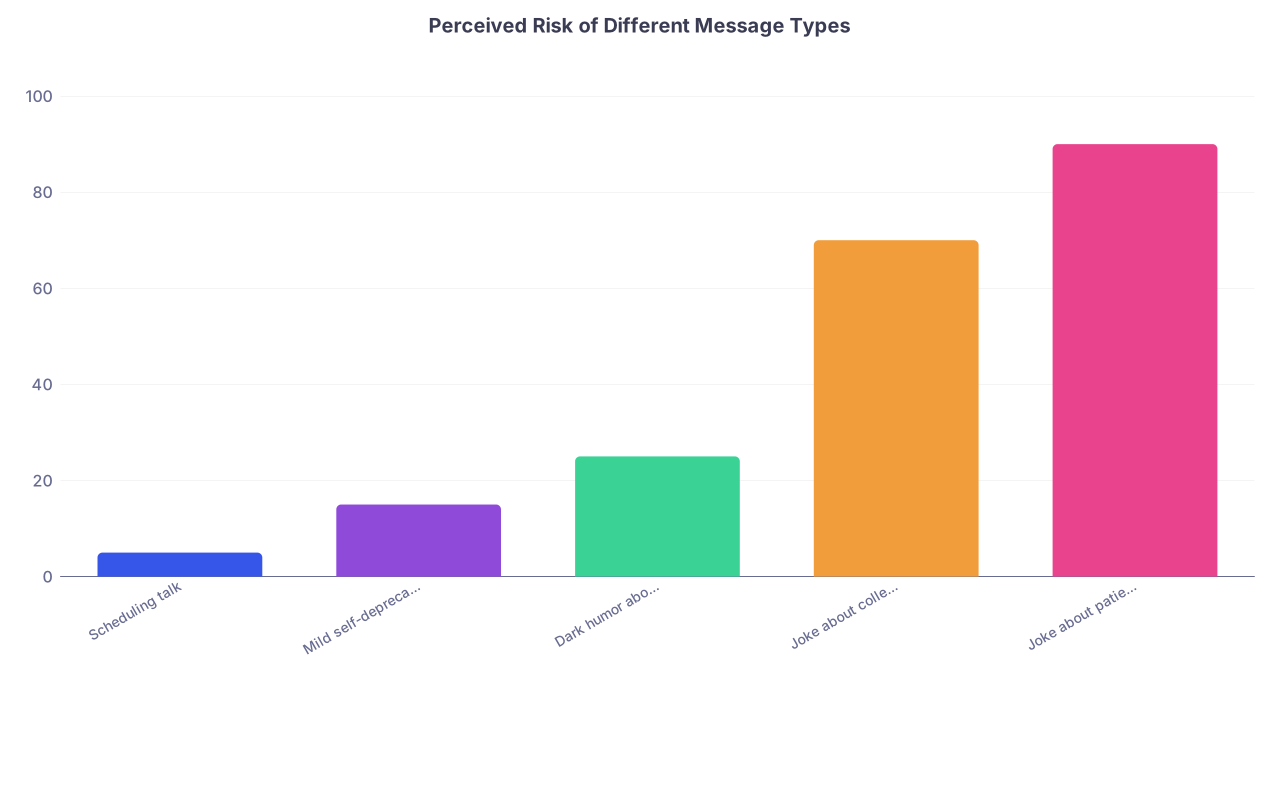
| Category | Value |
|---|---|
| Scheduling talk | 5 |
| Mild self-deprecating joke | 15 |
| Dark humor about yourself | 25 |
| Joke about colleagues | 70 |
| Joke about patients | 90 |
So when your brain says, “If I send this, will it ruin my career?” it’s not totally irrational. It’s just… miscalibrated. It treats everything like a “joke about patients” level risk.
We need to sort out what’s actually dangerous vs what just feels terrifying.
A brutal but useful rule: would this survive an ethics PowerPoint?
Here’s the filter I use now. It’s dark, but it works:
Imagine:
- Slide deck at a professionalism / ethics town hall
- Title: “Real Messages From Real Trainees”
- Your message. On the slide. With your name. Program director at the podium. People shifting in their seats.
If that scenario gives you “I’d be embarrassed but not destroyed,” it’s probably fine.
If that scenario gives you “I would move countries and change my name,” do not send it.
More concretely, I put messages into 3 buckets.
| Content Type | Risk Level |
|---|---|
| Logistics / scheduling / neutral info | Low |
| Harmless humor about yourself / medicine | Medium |
| Jokes about patients / colleagues / groups | High |
Low risk: the boring stuff
Scheduling. Links. “Anyone want coffee?” “I’m on 6E if you need help.” These are fine. No one’s career was ruined by “who has the work room key?”
Medium risk: your own suffering, your own chaos
“I just walked into the wrong patient room and introduced myself as cardiology. I’m on neuro. I’m going to dig a hole.”
This kind of self-deprecating humor is basically the safest “medical humor” you’ve got. You’re the target. You own the embarrassment. As long as there are no identifying details, it’s usually okay.
High risk: anything that punches down or targets someone else
This is the danger zone. Stuff like:
- “My patient in room 412 is such a train wreck lol”
- “Of course he’s noncompliant”
- “This attending is actually psychotic”
- “Classic [insert group] behavior”
- Any “joke” about a protected class (race, gender, religion, disability, etc.)
Even if everyone in the chat “knows you’re joking.” Even if “we all talk like this.” Even if “someone else started it.”
Those are the messages that live forever in screenshots and look absolutely awful when ripped out of your little venting bubble and dropped into a formal complaint.
The three questions I ask before hitting send
If you’re like me, you don’t want some vague “be professional” lecture. You want a concrete, anxious-brain-friendly checklist.
I use this:
Could this be read as disrespectful toward a patient, family, colleague, staff, or group of people?
If there’s even a whiff of “maybe,” I don’t send it. The bar is low. If my future exhausted self might someday look back and cringe? Gone.Could someone outside medicine read this and think I don’t deserve to be a doctor?
Not a co-intern. Not your funniest friend. I mean: your grandma. A journalist. A malpractice lawyer. If they could screenshot that line, strip all context, and make you look monstrous, it’s not worth it.Would I be okay explaining this message, line by line, to a professionalism committee?
Out loud. Face to face. With them reading it exactly as written, no tone, no “but I meant.” If I’d start sweating trying to justify it—delete.
If a message fails any of the three, it doesn’t go.
“But everyone else in my group chat jokes like this…”
Yeah. I know. You’re afraid of two things at once:
- Getting in trouble for a joke
- Being the weird, stiff one who never jokes and gets labeled “uptight” or “no fun”
So you’re stuck in that awful middle place: reading the chat, seeing the borderline stuff, fingers hovering over the keyboard thinking, “If I don’t say something, I’ll look lame; if I do say something, I’ll die.”
Here’s how I handle that now.
1. You can be funny without being risky
Stuff that’s usually safe:
Making fun of yourself
“Just introduced myself as the med student… on a day I’m the intern. Send help.”Making fun of the system, not people
“Epic just logged me out mid-note for the 4th time. This is a hostile work environment.”Shared suffering jokes
“Anyone else feel like the cafeteria coffee is 80% regret, 20% caffeine?”
None of those target a specific patient, colleague, or group. They’re universal “this job is ridiculous” jokes.
2. You don’t have to match the group’s risk level
Someone in every group is The Spicy One. The person who sends the most unhinged memes and skates on thin ice constantly. You are not required to match that energy.
If anything goes wrong, guess who admin will tolerate more:
- The person with a history of being borderline
- Or the person who’s consistently been measured and respectful?
You want to be the second one.
3. You’re allowed to mentally separate “them” and “me”
When others send questionable stuff, I literally think: “That’s their paper trail, not mine.”
You don’t need to police them (unless it’s really bad). You also don’t need to join in. Silence is neutral.
The special hell of memes, screenshots, and “it disappears” apps
Quick reality check on stuff that feels safer than it actually is.
“It’s just a meme”
Memes can be just as career-killing as text. Overlaying harmful content on a SpongeBob doesn’t make it less problematic.
If the joke wouldn’t be okay typed out as a sentence, it’s not magically okay in image form.
“It’s a private story / close friends list / Finsta”
All of that is screenshot-able. People age out of friend groups. People get mad. People grow a conscience. The screenshot doesn’t disappear when the story does.
“We use Signal / Telegram / disappearing messages”
End-to-end encryption does nothing against the oldest form of capture: another phone taking a photo of your phone. Or a screen recording. Or someone copying and pasting the text before it vanishes.
If something is too risky for iMessage, it’s too risky for “disappearing” anything.
Patient details: how vague is vague enough?
Another thing I used to spiral about: “If I say ‘my patient today,’ is that a HIPAA violation? What about ‘guy who swallowed 20 batteries’ if it’s a crazy case?”
Simple rule: if someone who knows the hospital and timeline could reasonably identify the patient from your description alone, don’t say it.
Risky patterns:
Specific room numbers + details
“The guy in 514 with the STI who keeps lying to his wife” → no.Rare presentation + timing
“We had a 23-year-old with Creutzfeldt-Jakob today, wild” in a small hospital → yeah, that’s basically outing them.Linking to anything externally visible
“Pretty sure the guy who was yelling in the lobby is my psych admit lol” → no.
I treat all actual patient stories as off-limits in group chats, except in the blandest possible form needed for patient care:
“Anyone free to help with a difficult conversation on 6E?” → fine.
“Lol you should hear what my patient said today” → not fine.
What about venting? Where does that go?
You can’t just swallow everything. That’s how people break.
I’m not going to pretend the right answer is “just don’t vent.” That’s fake and honestly dangerous. You do need places to offload.
Safest options:
- One trusted friend in person, away from devices
- A private journal that isn’t synced to a cloud account under your real name
- A therapist (literally part of their job, and covered by confidentiality laws)
Middling-safety options that require judgment:
- One-on-one texting with someone you deeply trust and who shares your values
Even then, I stick to the same rules: no targeting patients, no specific identifiers, no “if this leaked I’d be cooked” content.
Worst options:
- Big group chats with people you barely know
- Class-wide GroupMe / “sub-I gang” / “intern class 20XX” chats
- Anything with faculty or senior residents in it
Those large or hierarchical spaces are not “safe venting.” They’re social-professional arenas with witnesses.
If you’ve already sent something and are spiraling
Because I know your brain: you’re probably scrolling back through your message history now, picking out every slightly edgy thing and imagining hearing it read out in a courtroom.
Here’s what to do if you’re panicking about past messages.
Stop doom-scrolling the chat.
You won’t feel better finding more potential landmines.Ask: did someone actually react badly?
If no one has said anything and it’s been weeks/months, the odds that this one line will suddenly resurface are low. Not zero. But low.Decide what pattern you want going forward.
You can’t rewrite your history, but you can absolutely change your trajectory. A long pattern of respectful, neutral, supportive messages makes a single slightly dumb joke look more like a mistake than a character flaw.If it was genuinely bad, quietly stop that content.
No grand announcement. No “I’m so sorry for that thing I said last month” that reminds everyone of it. Just… raise your own bar from this point on.If you’re truly worried, talk to someone you trust.
A mentor, resident, or therapist. Not another anxious classmate who’ll co-ruminate with you into oblivion.
Tiny scripts you can actually use
Some low-stress, low-risk things to say in group chats when you want to be present but not doomed:
When the chat turns spicy:
“I’m gonna tap out before I get myself in trouble lol”
(Half-joke, half-boundary. People get it.)Safe humor when everyone’s miserable:
“Just saw my reflection in the call room window. I look like a discontinued action figure.”
“My brain at 3am admission: spinning wheel, no data.”When you don’t want to pile on about a colleague:
“Yikes, sounds rough. Hope tomorrow’s better for everyone.”
Neutral, empathetic, and you’re not throwing anyone under the bus.
Where medical humor actually is safe
You don’t have to become a humorless robot. Honest.
Places where you can enjoy medical humor without risking your license:
- Standup / podcasts / books by physicians and trainees who choose to put themselves out there and carefully curate what they share.
- Anonymous memes/accounts that don’t involve you directly (consuming, not contributing). Though obviously even those can cross lines, so… choose wisely.
- In-person joking with people you deeply trust, phones away. Still keep ethics and respect in mind, but the risk is much lower than a written, saved record.
And yes, I’m aware I sound like someone’s paranoid aunt. But honestly? I’d rather be the paranoid aunt who never shows up in a professional conduct slideshow than the cool one everyone quotes in remediation workshops.
FAQ (5 Questions)
1. Is it ever okay to joke about patients if I don’t use names or details?
I wouldn’t. “No names” isn’t a magic shield. You can still sound dehumanizing or cruel even without identifiers, and that’s what gets people in trouble professionally. If the humor relies on making fun of a patient’s condition, body, behavior, or background, it’s career-ruining territory in writing. Keep that stuff out of chats.
2. What about dark humor about myself or how messed up the system is?
That’s usually much safer—as long as the punchline is you or the absurdity of the system, not a patient or colleague. “I feel like a glorified fax machine” is fine. “My patient is a train wreck lol” is not. Dark humor about your own burnout, exhaustion, or confusion is generally okay if you’re not making light of someone else’s suffering.
3. If someone posts something really inappropriate in a group chat, what should I do?
Bare minimum: don’t react with a “haha” or join in. If it’s mildly inappropriate but not horrific, silence is enough. If it’s truly bad—racist, blatantly disrespectful to patients, or threatening—take screenshots and talk privately to a trusted faculty/mentor or ombuds office. You are not obligated to confront the person directly if that feels unsafe.
4. Can programs actually find and use my private messages against me?
They’re not hacking your phone, but anything someone else can see, they can screenshot. Once a screenshot exists and ends up in the hands of admin, yes, it can absolutely be used in professionalism reviews, promotions decisions, or even licensing questions if it’s bad enough. That’s why the safest assumption is: if more than one other person can see it, treat it like it might someday be read aloud.
5. How do I stop obsessing over every single message I send?
Use the three-question filter: is it disrespectful, would a layperson think I’m unfit, would I be okay reading this to a committee. If it passes, send it and force yourself not to reread it 12 times. Set a time limit: you get 10 seconds of anxiety per message, then you move on. Over time, you’ll build a pattern you trust—“I know I’m careful”—and that’s what quiets the spiraling more than any reassurance anyone can give you.
Key points:
- If a message would devastate you on a professionalism slide, don’t send it.
- Jokes about yourself and the system are far safer than jokes about patients or colleagues.
- Group chats are not private; write like anything you send could be screenshot and shown to someone who controls your future.