You are not your unit’s emotional cruise director. And you do not need a stand-up routine to belong.
This idea that every resident, nurse, or attending has to be “the funny one” to be liked or to “fit the culture” is not just wrong—it is quietly corrosive. To you, to psychological safety, and sometimes to patient care.
Let’s dismantle it properly.
The Myth: Humor = Connection (Or You’re Screwed)
There’s a common script in medicine:
- “You have to joke or you’ll never survive.”
- “Our team is dark-humor only—if you can’t hang, good luck.”
- “You’re too serious; people will think you’re uptight.”
I’ve watched interns start a trauma rotation and feel like they need to audition. Forced jokes on rounds. Awkward punchlines during codes. Laughing along with stuff that clearly makes them uncomfortable, because the alternative seems to be isolation.
Here’s what the data actually shows: humor can help, but it is not the core connector people think it is—and the kind of humor matters more than whether you’re “funny.”
What the research actually says
There’s a solid body of organizational psych and healthcare literature on this.
A few key threads:
Psychological safety predicts team performance far better than “fun” or “banter.” Amy Edmondson’s work on medical teams (ICUs, cardiac surgery) shows teams that feel safe to speak up—ask questions, admit errors—have better outcomes. She does not say “teams where someone cracks great jokes.”
Prosocial humor helps; aggressive and self-defeating humor hurts. Rod Martin’s humor style questionnaire research breaks humor into:
- Affiliative (light, inclusive, connection-focused)
- Self-enhancing (coping, perspective-taking)
- Aggressive (mocking, punching down)
- Self-defeating (putting yourself down to gain approval)
Only the first two consistently correlate with well-being and better relationships. Neither requires you to be “the funny one.” They require you not to be an ass.
Introverts and “quiet” clinicians are not worse teammates. Teamwork scales in healthcare consistently show communication quality, reliability, and openness matter more than extroversion or comedic flair.
That’s the pattern: trust > entertainment. Reliability > snappy one-liners.
You can be dry, understated, or barely humorous—and still be highly bonded to your team.
How Forced Humor Backfires in Real Medical Teams
Let’s get less theoretical and more “stuff I’ve actually seen.”
Residents who try too hard to be “the funny one” often fall into three traps: timing, target, and tone.
1. Timing: joking in the wrong moment
I watched a new intern on nights crack what they thought was “classic dark humor” after a failed code. The nurse at the bedside had just done 25 minutes of compressions on a teenager. The resident quipped something about “Well, at least the bed alarm won’t go off now.”
Silence.
That nurse didn’t page that resident for subtle changes for weeks. That’s not just social awkwardness—that’s a patient safety issue. The intent was coping. The impact was “you don’t respect what happened here.”
Timing is not optional. It’s a skill. And trying to force humor often means you mis-time it.
2. Target: punching the wrong way
Evidence from workplace studies is brutal here: when humor targets colleagues—especially along power gradients—it reliably lowers trust and increases burnout.
Typical offenders:
- Jabs at “sensitive” med students
- Gendered jokes about “nurses” as a monolith
- Specialty stereotypes weaponized, not playful
People might laugh. They usually laugh. But what the data shows is that they later rate team climate as less inclusive and are less likely to speak up about concerns.
So if you think being the “savage” funny one earns you connection, understand: you might be buying surface-level laughs at the cost of deep trust.
3. Tone: when “dark humor” becomes emotional cut-off
Emergency medicine and ICU folks love to tell you, “We cope with dark humor; it’s how we survive.” There’s truth there—but it’s half the story.
Studies on secondary traumatic stress and moral injury in healthcare show something uncomfortable: some “dark humor” actually functions as avoidance. It can be:
- A shield against feeling anything
- A way to signal you’re “tough enough” to belong
- A cue to shut down serious reflection
Teams that only process trauma with jokes and never with real debriefs have higher burnout and lower meaning scores. The jokes become armor, not true bonding.
You don’t have to play that game to be part of the group. In fact, someone who can say, “That case was rough; you okay?” without a punchline often becomes the real emotional center of the team.
What Actually Builds Bonding on a Medical Team (Spoiler: Not Your Tight Five)
Strip the mythology away and you’re left with a few boring-sounding but powerful behaviors. They are not sexy. But they’re what people actually remember.

1. Reliability under stress
You know who feels bonded to you? The nurse who knows that when they page you, you show up.
In almost every resident–nurse climate survey, the same features correlate with “I like working with this doctor”:
- Responds to pages
- Follows through on orders
- Admits uncertainty rather than faking it
- Communicates changes clearly
You can be stone-faced and still score high on all these. Reliability is social glue.
2. Micro-respect
Tiny, unsexy habits:
- Using people’s names (and pronouncing them correctly)
- Saying “please” and “thank you” on a chaotic shift
- Not talking over people during sign-out
- Backing a nurse up if another team member is disrespectful
That last one is huge. Standing up mildly—“Let’s keep it respectful”—does more to bond you to a team than any joke ever will. It signals: I see you, I’ve got you.
3. Consistent emotional tone
Not “happy.” Not “fun.” Just not volatile.
People bond with those whose emotional state they can predict. If every interaction requires a vibe-check—“Is she in a mood today? Is he going to snap?”—they hold back.
You can be dry, serious, even a little gruff. As long as it’s stable and fair, people adapt. What they can’t work with is performative highs and lows.
4. Low-key personal disclosure
Medical humor blogs love the “wacky resident stories.” That’s fine. But what actually connects you to your colleagues is often simple, honest, small disclosures:
- “I’m post-call and running on fumes, but I’m here.”
- “My kid has RSV; I might be slower on replies today.”
- “That case earlier really stuck with me.”
There’s empirical support here: self-disclosure—done gradually and appropriately—builds trust. You don’t need to be witty. You just need to be real.
The Four Useful Forms of Humor You Can Use (Without Being “The Funny One”)
I’m not anti-humor. I’m anti-performance.
Done right, humor is a tool, not an identity.
Here’s the version grounded in actual research, not TV hospital comedies.
| Humor Style | Risk Level | Usefulness on Team |
|---|---|---|
| Affiliative | Low | High |
| Self-enhancing | Low | Moderate–High |
| Aggressive | High | Low |
| Self-defeating | Moderate | Low–Moderate |
1. Observational, light affiliative humor
This is the gentle “we’re all in this together” style.
Examples:
- “I see the EMR is in its ‘chaos’ mood again.”
- “We’ve collectively walked 10k steps just looking for a Doppler.”
It doesn’t require a punchline. It just labels the absurdity everyone sees and creates a small shared smile.
2. Self-enhancing humor: coping without self-destruction
This isn’t “I’m trash.” It’s “this is hard and we can still breathe.”
Examples:
- “I definitely checked that potassium three times; I trust nothing at 3 a.m.”
- “My brain is buffering, give me 10 seconds.”
You’re not fishing for reassurance. You’re normalizing human limits. Colleagues often find this strangely relieving.
3. Simple callbacks and running gags
Teams bond over small ongoing jokes, not elaborate bits.
A surgical team I know had a running gag about “the cursed OR 7” where cases always ran late. Whenever the assignment list dropped, someone would groan, “OR 7 claims another soul.” That was it.
You don’t need to invent this stuff. You just need to be willing to lightly participate:
- A smirk
- A short echo of the phrase
- A single added line
That’s participation, not performance.
4. Quiet appreciation humor
This one’s underrated: mixing praise with a wink of humor.
- “You just saved me from writing the world’s longest progress note. I owe you caffeine for life.”
- “I had mentally accepted we’d never get that CT slot. Radiology, you’re my hero.”
It lands best when:
- The appreciation is real, not sarcastic
- The exaggeration is playful, not mocking
- You don’t overuse it
This version of “funny” builds more goodwill than any self-appointed meme lord on the team group chat.
For the Non-Funny: A Concrete, Evidence-Based Way to Bond
You might be thinking: Okay, but what do I actually do if jokes aren’t my thing?
Here’s a simple pattern that works and doesn’t ask you to be a comedian.

| Step | Description |
|---|---|
| Step 1 | Start Shift |
| Step 2 | Learn 2 Names |
| Step 3 | Do 1 Concrete Favor |
| Step 4 | Share 1 Small Truth |
| Step 5 | Offer 1 Genuine Thanks |
| Step 6 | End Shift With Check In |
Let me translate that into real behaviors:
Learn 2 names each shift.
Not just, “Hey nurse.” Try: “Hey, Maria, how’s your night?” People bond to those who remember them.Do 1 unnecessary but helpful thing.
- Grab the vitals sheet before someone asks
- Walk a patient to imaging when transport is swamped
- Put in that extra order the nurse is clearly hinting at
Reciprocity research is clear: small favors spark connection.
Share 1 small truth.
Not oversharing. Just a line or two: “That last admission was rough; thanks for bearing with me.”
Or: “I’m still learning this EMR, so I might be slow.”Offer 1 genuine thank you, specific not generic.
“Thanks for managing that agitated patient so calmly. That could’ve gone sideways.”End with a micro check-in.
“You doing okay after that code?”
Again, not a speech. One sentence.
Do this consistently for a month and you’ll feel more bonded than the loudest “funny one” who treats the unit like an audience.
The Future of Medicine: Less Performance, More Presence
Medicine is finally starting to take team culture seriously. Not the “we have pizza” version. The psychologically-safe, less-toxic, actually-functional version.
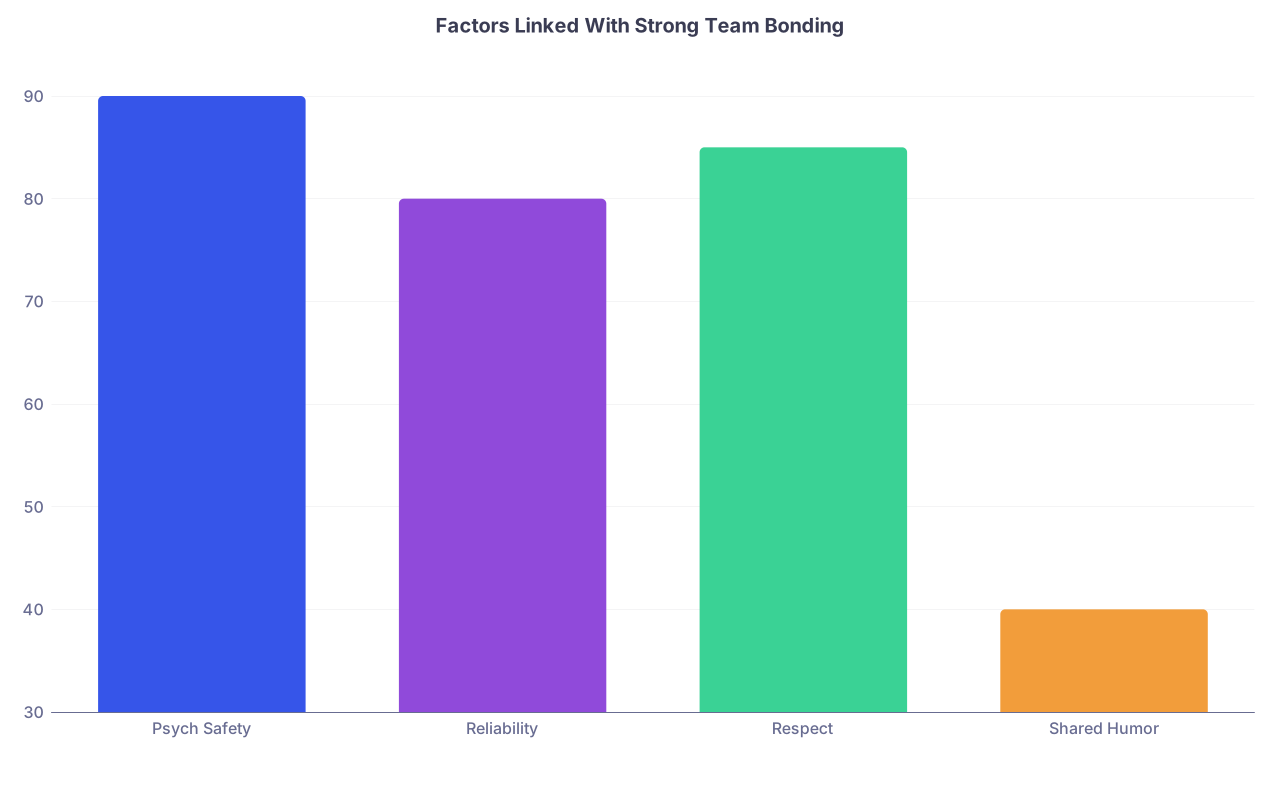
| Category | Value |
|---|---|
| Psych Safety | 90 |
| Reliability | 80 |
| Respect | 85 |
| Shared Humor | 40 |
When researchers look at what predicts lower burnout, better patient outcomes, and less turnover, the same pattern repeats:
High:
- Psychological safety
- Fairness
- Support from colleagues
- Feeling valued
Moderate:
- Shared light humor
Low:
- “Charismatic leaders”
- “Fun culture” in the superficial sense
So as medicine moves—slowly—toward more team-based, interprofessional care, the value of the “funny superstar” is dropping. The value of the steady, respectful, occasionally wry teammate is rising.
You don’t need to be the unit clown. You need to be the person people trust in the middle of a mess.

And if you’re naturally funny? Great. Keep it:
- Warm
- Inclusive
- Aware of timing
- Never the only tool in your kit
Humor should be seasoning, not the main course.
A Quick Reality Check
If you’re worrying you’re “not fun enough,” run this internal audit instead:
| Question | Good Sign |
|---|---|
| Do people page or message you early? | They trust your response |
| Do nurses vent to you sometimes? | They feel safe around you |
| Do colleagues ask your opinion on cases? | They respect your judgment |
| Do people relax when you arrive on shift? | You lower, not raise, tension |
If the answers are mostly yes, you’re already bonded. Regardless of how many jokes you tell.
If the answers are mostly no, working on reliability, respect, and basic human curiosity about your coworkers will outperform any attempt to become the next hospital comedian.

Key Takeaways
- Being “the funny one” is optional. Psychological safety, reliability, and respect are what actually bond medical teams.
- The type of humor matters more than being witty—affiliative and self-enhancing humor help; aggressive and self-defeating humor erode trust.
- You can build strong, authentic connections through small, consistent behaviors: learning names, doing small favors, sharing honest moments, and expressing specific gratitude—no comedy routine required.