
It’s 1:37 a.m. Night float. You’re in the call room “workroom” that’s really a glorified closet. Someone just made a joke about how the ICU vent alarms are basically a Spotify playlist for your nightmares. Half the room laughs, one person snorts, and the intern in the corner just stares at their screen and says, “Honestly if I code tonight just don’t bring me back.”
Everyone looks at the chief.
They laugh. But then they look at that intern for half a second longer than they need to.
That extra half-second? That’s what this is about.
Let me tell you a secret that’s not in any wellness module: chiefs and attendings listen to your dark humor like it’s a lab value. Tone, timing, who laughs, who doesn’t. It’s diagnostic. Crude, but often more accurate than the hospital’s “anonymous well-being survey” that 12 people and a bot fill out.
You think you’re just coping. They’re measuring the temperature of the team.
Why Dark Humor Is a Chief’s Unofficial Vital Sign
No chief will ever say, “I track team burnout using the darkness of their jokes.” But they do. I’ve watched this in medicine, surgery, EM, psych—doesn’t matter. The pattern is the same.
There are three big reasons.
First, dark humor is one of the only honest languages left in residency. The formal spaces are polluted: conferences, evaluations, “open-door policy” talks with the PD that everyone knows are…not fully open. But in the workroom at midnight, with 60 open notes and no patients in sight, the filter drops. That’s when the real stuff leaks out—rage, fear, fatigue, trauma—wrapped in jokes so it’s safe enough to say out loud.
Second, it’s incredibly sensitive to change. Chiefs don’t care about a single joke. They care about the trend. Two weeks ago your team was making gallows humor about Q4 call like, “At least the pagers are keeping my heart rate in the target cardio zone.” Annoyed but functional. Now you’re making jokes about how “If I collapse in the stairwell just chart me as ‘transitioned to hospice’ and move on.” That shift? That’s a signal.
Third, humor maps the group, not just individuals. Surveys and one-on-ones pick up one person at a time. Humor shows up in clusters. Who’s joking more. Who’s gone quiet. Who’s always the punchline now. Chiefs use that to see where the fire is starting.
They’d never phrase it like this on a faculty retreat slide, but it’s dead simple:
Dark, frequent, cynical humor with flat affect = you’re red-lining.
Dark, quick, shared, and then you move on = you’re tired but still in the game.
The “Dark Humor Scale” Chiefs Pretend They Don’t Use
No, there isn’t an official rubric. But they absolutely categorize what they’re hearing. Let me translate what’s running in the background of their brains when they’re hanging out in the workroom and “just joking with the team.”
At most programs, it roughly breaks into four zones.
Zone 1: Normal Cynical Banter
This is the bread and butter. Every functioning team has it. If they don’t, that program is either fake-saintly or lying.
Stuff like:
- “If it’s not in Epic, it didn’t happen—unless it was a mistake, then somehow it definitely happened.”
- “Hospital food is just prior-auth punishment in edible form.”
Content: Mildly dark, but mostly mocking the system. The target is bureaucracy, not patients and not themselves.
Chief interpretation: Team is bonded, annoyed but not broken. This is healthy. If anything, they get worried when this disappears and everything turns robotic.
Zone 2: Operational Gallows Humor
This is the routine trauma-buffering material. Codes, ICU disasters, impossible ED boarding, surgical complications. The jokes are darker, but they’re still “we survived together.”
Examples:
- “This ICU list is starting to look like a pre-req checklist for the morgue.”
- “Another 18 admissions tonight? Sweet, I was worried I might accidentally sleep.”
Usually followed by: eye rolls, shared groans, then people still get up and do the work.
Chief interpretation: Stress is high but still contained. People are tired, but there’s still some energy in the room. No emergency yet—but this is where chiefs start quietly tracking hours, call frequency, and who might need a golden weekend.
Zone 3: Self-Directed Collapse Humor
Now it gets clinical. Jokes that are primarily about the speaker’s own disintegration.
You’ve heard these:
- “If I get hit by a car on the way home, that’s not an accident, that’s a solution.”
- “My resting page PTSD is so bad I hear phantom beeps in the shower. Might be my soul trying to escape.”
- “If I ever smile in the morning sign-out, just assume it’s serotonin syndrome.”
The key thing: the laugh is slower, thinner. Often someone says, “No but seriously, I’m not okay,” then immediately follows it with another joke to cover it.
Chief interpretation: Yellow-to-orange alert. This person is telegraphing burnout, depression, or both but doesn’t feel safe saying it plainly. Chiefs who know what they’re doing don’t ignore this. They take mental notes. Who. How often. Has the content escalated in the last 2–3 weeks.
Zone 4: “I’m Done Existing” Humor
This is the point where dark humor stops being just a coping mechanism and becomes a warning flare.
Examples I’ve seen chiefs freeze at:
- “Honestly, if I flatline tonight, just let me go. Don’t you dare code me.”
- “If I jump off the parking garage and survive, that’s the worst-case scenario because then I still have to finish this rotation.”
- “The only reason I haven’t killed myself is I don’t have the energy to write a note about it.”
Some people will say, “That’s just residency, everyone says that.” No. They don’t. Not like that. Not repeatedly. Not without breaking eye contact and then laughing way too hard to cover it.
Chief interpretation: Red flag. At minimum: significant burnout. At worst: real suicidal ideation dressed up as a joke. A good chief will not let this ride. A bad chief will laugh, feel uncomfortable, and then go back to their notes because “well-being is the PD’s thing.”
What Chiefs Are Actually Listening For
When chiefs “laugh with you,” they’re usually also running a quiet assessment in the background. It’s not formal. It’s instinct built after watching too many of their own co-residents crash and burn.
There are a few specific patterns they hone in on.
1. Who Laughs, Who Doesn’t
One person makes a brutal joke. Four people laugh. One person looks physically pained. That “pained” person gets remembered.
Sometimes that’s the healthiest one on the team. Sometimes it’s the one too close to the line to find any of it funny. Chiefs watch to see if that person has also started showing up late, missing small tasks, or making more mistakes. Humor plus performance changes—that combo gets their attention.
2. The Repeat Track
Everybody has bad weeks. Chiefs don’t panic about a single offhand comment. They worry when the same person keeps making the same kind of “joke” over and over.
Three nights in a row:
- “If I die, just bury me in the clean utility.”
- “I’d jump out the window but that’d just delay my sign-out.”
- “If psych asks, tell them I’m ‘future oriented’ because I already scheduled my next call shift in hell.”
That repetition? That’s not random. That’s fixation wrapped in sarcasm.
3. When the Funny Person Stops Being Funny
Every team has a morale medic—the resident or intern who’s always got a one-liner ready to keep things from boiling over. Chiefs pay special attention to that person.
When the group clown suddenly goes quiet, or their jokes shift from clever to bitter, or they start snapping at nurses instead of gently roasting the system, experienced chiefs clock it instantly. It’s like the canary in the coal mine. If the canary goes down, everyone else is already hypoxic.
4. Patient-Directed vs System-Directed
Harsh truth: most chiefs will tolerate dark humor aimed at “the system” or at themselves. When the jokes slide into dehumanizing patients, alarms go off.
You’ll never see this in policy language, but I’ve watched it happen:
- First week: “Another 15-minute admission for a 40-year medical history. Love that for us.”
- Three weeks later: “Oh look, another nursing-home-to-ICU boomer delivery. Just print the death certificate now.”
That second line isn’t just burnout. That’s empathy erosion. Chiefs take that seriously, not just for wellness but because it’s a professionalism/complaint risk waiting to detonate.
How Chiefs Quietly Act On What They Hear
Nobody pulls you aside and says, “Your jokes are concerning me.” That’s not how this works. The response is almost always indirect, non-confrontational, and deniable.
Here’s how they actually move pieces behind the scenes.

| Step | Description |
|---|---|
| Step 1 | Hear dark humor |
| Step 2 | Monitor only |
| Step 3 | Check in 1 -1 |
| Step 4 | Adjust schedule |
| Step 5 | Alert PD or wellness |
| Step 6 | Level of concern |
They’ll do things like:
- “Hey, I swapped you off nights for a few days so you can reset. Figured you could use it.”
- “Take tomorrow post-call fully off. I’ll cover your noon discharge.”
- “I’m moving that heaviest service senior off GI and onto consults for a week. Just to cool the temperature.”
And then the discreet moves:
- Casual walk to the PD’s office: “Hey, just flagging—X has been off. Dark humor is getting pretty intense. Might be worth a ‘how’s it going?’ talk.”
- Email to wellness: “If you’re checking in on folks, Y might benefit. No acute safety concern, but I’m seeing signs.”
The better chiefs do it in a way that preserves your dignity. To you, it feels like “the schedule gods were kind.” In reality, your jokes about not wanting to exist pinged somebody’s radar.
The Differences Between Programs That Get This and Programs That Don’t
Let me draw a line between two types of places, because they absolutely exist.
| Culture Type | How Dark Humor Is Treated |
|---|---|
| Old-school malignant | Ignored or mocked |
| Performatively “wellness” | Discouraged publicly |
| Quietly healthy | Noted and acted on |
| Truly exceptional | Used proactively to intervene |
The malignant, old-school programs treat dark humor as either “weakness” or “just residency, deal with it.” Chiefs in those places are often too fried themselves to intervene. If you joke about jumping off the roof, someone says, “Make sure you do it after sign-out,” and that’s the end of it.
The performative wellness programs do this thing where they pretend dark humor doesn’t exist. They hang posters about resilience and mindfulness, then chastise residents for “unprofessional” comments in the workroom. Everyone just learns to shut up in public and keep the real jokes in encrypted group chats. The pressure doesn’t go away; it just goes underground. More dangerous, and chiefs lose one of their best early-warning tools.
Then there are the quiet, actually-functional programs. Dark humor lives in the workroom. Chiefs and attendings join in up to a point. But they watch the edges. They use that space to monitor the team. You’ll see small, smart interventions long before a crisis.
The truly exceptional places are rare, but they exist. There, chiefs and faculty will sometimes even name it in a safe way:
- “Okay, we’re all making more ‘I want to disappear’ jokes than usual. That tells me this month is hitting harder than normal. Let’s scale a few things back and see what’s actually adjustable.” Not touchy-feely. Just honest. Those are the programs where people survive residency with some soul left.
How You Can Read Your Own Jokes (And Your Co-Residents’)
You want a brutal but useful self-check? Pay attention to what comes out of your mouth after midnight.
If you notice:
- Your jokes are mostly about not wanting to be alive
- You no longer find anything funny, even when others are laughing
- Everything you say about patients is sneering, not wry
That’s not “haha residency.” That’s “I am burning out in real time.”
And for your colleagues: that one intern who keeps making increasingly explicit “I wish I died in this code” jokes? Do not assume the chief is catching it. Chiefs are also exhausted, buried in their own responsibilities. They miss things.
Pull that intern aside. No audience. No performance. “Hey, you’ve been making a lot of those ‘I don’t want to be here anymore’ jokes. I know we all cope like that, but I’m actually a little worried. Is any of that real?”
If your stomach drops just reading that sentence, that’s the problem. We’re more comfortable hearing a suicide joke than asking a direct question.
And if you’re the one making the jokes? Listen to yourself. If your dark humor is starting to sound more like a plan than a punchline, do not wait for a chief to decode it. Go to someone—friend, chief, PD, therapist, someone—and tell them, “I’m finding myself joking about dying a lot, and it’s closer to the truth than I’d like.”
It’s not dramatic. It’s not weak. It’s just honest medicine about the person you happen to be living in.
How This Might Evolve in the “Future of Medicine”
You’re in the “future of medicine” phase, so let me drag this forward a decade.
Right now, dark humor is an informal diagnostic tool. In 10–15 years, I would not be surprised if some genius tries to operationalize it: natural language processing on hospital chat logs, sentiment analysis on secure texting, burnout scores attached to “negative lexical tones.” Some wellness committee will think this is innovative.
That’s going to be a mess.
Because the content of the joke isn’t the only thing that matters. Context does. Who says it. Who laughs. Body language. Eye contact. History. All the nuance that algorithms are bad at and humans are, frankly, excellent at when they’re paying attention.
If we’re smart, we’ll keep the human layer. Chiefs tuned-in enough to hear the small shifts. PDs who trust those chiefs when they say, “I know it sounds like a joke, but I believe them.”
The future isn’t replacing that with AI or dashboards. It’s finally treating chiefs not just as scheduling machines, but as the emotional barometers they already are. And giving them the training and time to actually act on what they hear.
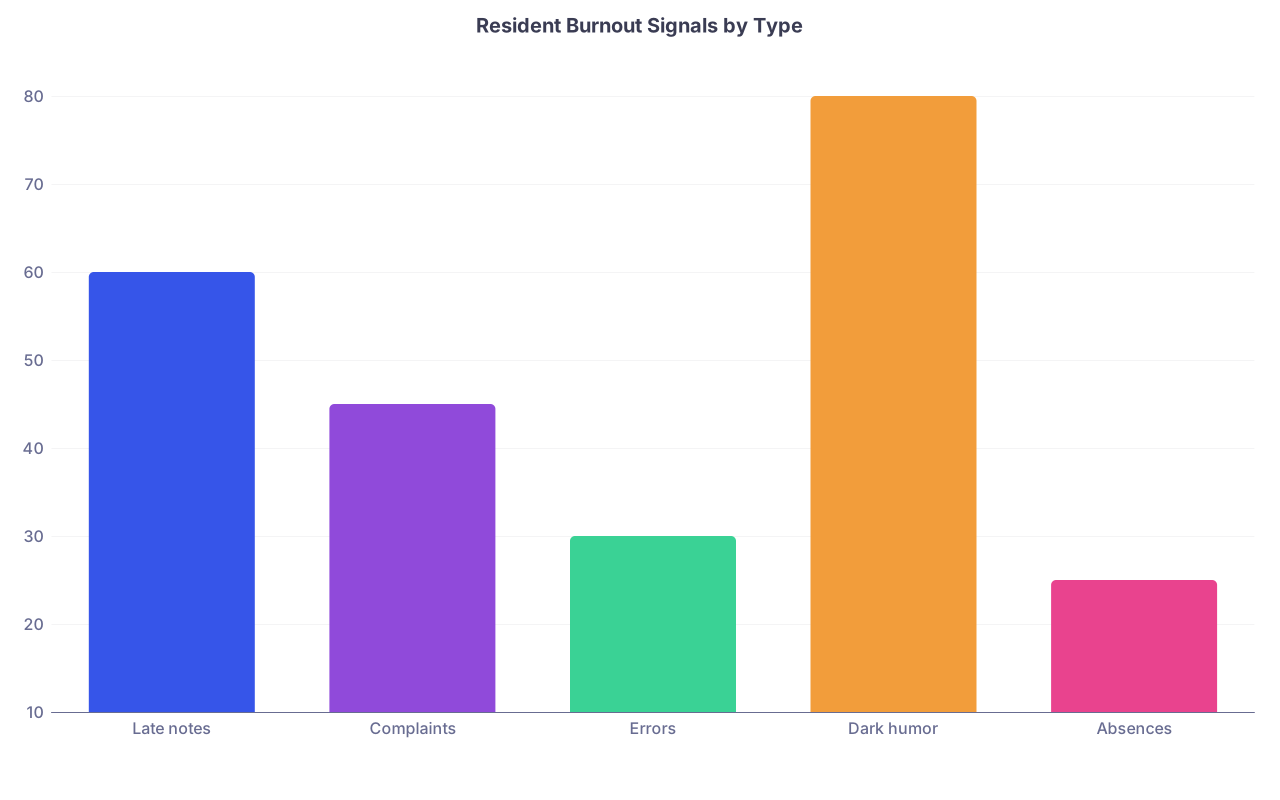
| Category | Value |
|---|---|
| Late notes | 60 |
| Complaints | 45 |
| Errors | 30 |
| Dark humor | 80 |
| Absences | 25 |

FAQ (Exactly 3 Questions)
1. Is dark humor always a sign of burnout?
No. Some level of dark and cynical humor is baked into residency culture and can actually be protective. It becomes a burnout signal when it escalates in intensity, frequency, and especially when it focuses on self-harm, hopelessness, or contempt for patients rather than frustration with the system.
2. What should I do if my chief laughs at my dark jokes but never checks in?
Assume they may be missing the depth of it or are overwhelmed themselves. Do not wait for them to decode your jokes. If your humor is covering real distress, pick one person—trusted co-resident, faculty, or mental health professional—and be direct: “I keep joking about not wanting to be here, but it’s actually how I feel.”
3. Can joking about suicide in residency get me in trouble?
If it’s overheard in the wrong context, yes—HR and risk management can get involved. But the bigger issue isn’t punishment; it’s safety. Chiefs who know what they’re doing are less interested in disciplining you and more in making sure you’re alive next month. If your jokes are explicit and frequent, expect someone to eventually escalate concern, and frankly, they should.
Two things to keep in your pocket:
Dark humor is not just noise. To good chiefs, it’s data.
If your punchlines are starting to sound like confessions, that’s not “just residency.” That’s your own warning sign—and you’re allowed to treat it like one.