
The belief that “if we joke about everything, it’s fine” is how careers die quietly in hospitals.
Dark humor in medicine is not harmless by default. It is controlled demolition next to a gas line. Used correctly, it vents pressure. Used carelessly, it blows up your reputation, your relationships with patients, and sometimes your job.
I have watched residents go from “well-liked and trusted” to “we should keep an eye on this person” over a single comment made in the wrong place, at the wrong time, to the wrong audience. No investigation. No write-up. Just a permanent mental note in everyone’s head: Do not trust their judgment.
This is what you are up against.
Let me walk you through the lines you cannot cross with dark humor in the hospital, and the mistakes that will haunt you if you ignore them.
1. The First Hard Rule: Never Punch Down at Patients
You will hear this excuse constantly: “I am not laughing at the patient; I am laughing at the situation.”
Most of the time, that is a lie we tell ourselves.
There is one non‑negotiable boundary:
You do not mock patients.
You do not dehumanize them.
You do not use their suffering as a punchline.
That means no “jokes” about:
- A patient’s appearance (obesity, hygiene, disabilities, facial features)
- A patient’s intelligence, education, or accent
- A patient’s mental health or psychiatric diagnosis
- A patient’s socioeconomic status (homelessness, addiction, Medicaid, “frequent flyer”)
- A patient’s culture, language, race, or religion
- A patient’s death or code outcome as a source of amusement
If your comment only works because you lower the patient’s dignity, you are not coping. You are failing.
Example you think is harmless:
“Bed 3’s BMI is like… planetary. No way we can get them to CT.”
What people actually hear:
- You see vulnerable patients as objects
- You are comfortable being cruel when they cannot hear you
- You might be equally dismissive when medical decisions are on the line
You might think everyone in the room “gets it” and is on your side. One person is not. That is the person who will never fully trust you again.
2. Timing: Joking While Families Are Suffering Is Career Suicide
Your stress is not more important than someone’s worst day of their life.
The mistake I see over and over:
Clinicians using dark humor in earshot of families or patients. Hallways, nurses’ stations, elevators, doorway corners. People forget how thin walls and curtains actually are.
Here are high‑risk moments where dark humor must be shut off completely:
- During or immediately after a code, in or near the room
- Just after delivering bad news (cancer, death, poor prognosis)
- In pre-op / PACU areas where families hover and listen to everything
- On pediatrics, anywhere near patient rooms
- In elevators, lobbies, parking shuttles, cafeterias — public and semi-public spaces
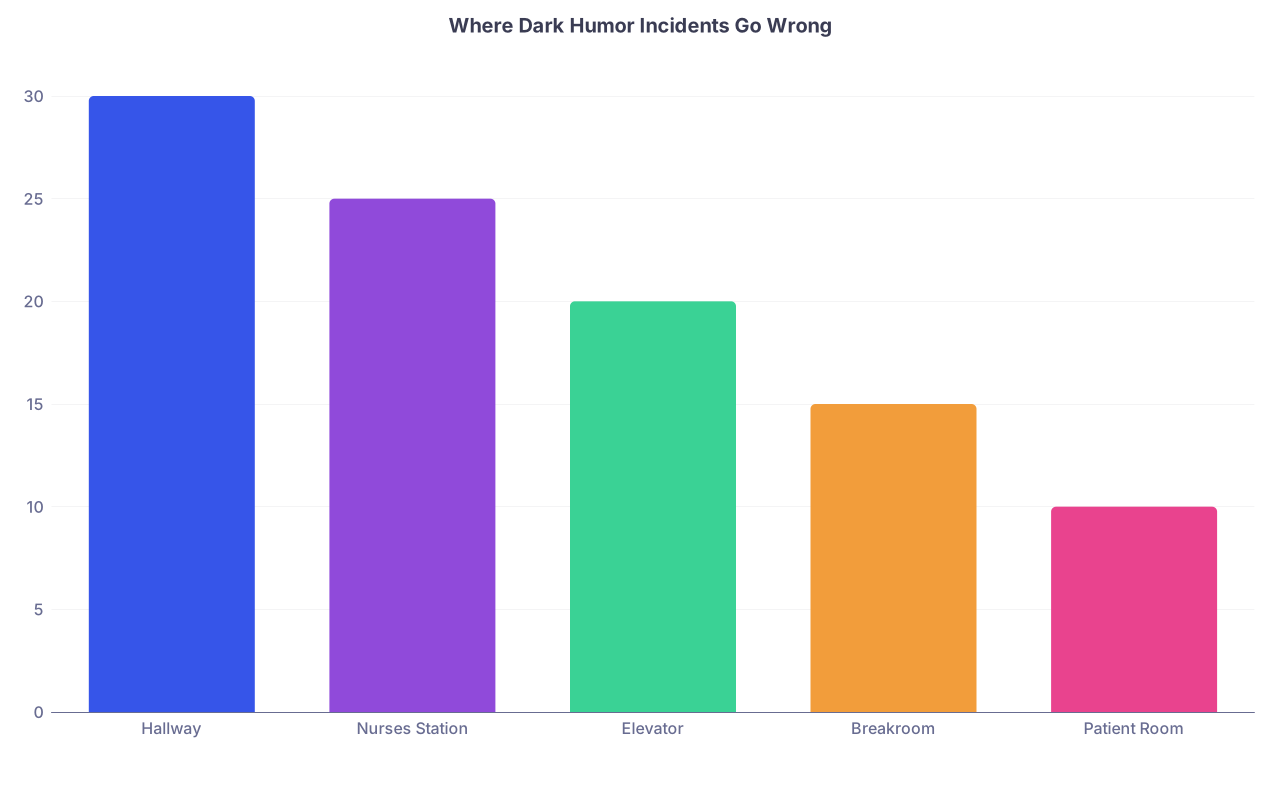
| Category | Value |
|---|---|
| Hallway | 30 |
| Nurses Station | 25 |
| Elevator | 20 |
| Breakroom | 15 |
| Patient Room | 10 |
Those “backstage” comments you think are private? Half the time, they are not.
Scenario I have seen:
- Team leaves a failed code
- Resident, trying to cut the tension, says in the hallway, “Well, at least bed 12 freed up a bed for once.”
- Family member is behind a curtain around the corner. Hears it.
- Complaint goes to Patient Relations. Now it is “unprofessional conduct, disrespect for deceased patient.”
No good explanation exists once someone is hurt. “We were just coping” does not make you look human. It makes you look reckless.
Internal rule to adopt:
If there is even a 5% chance a patient or family could hear, you are in professional mode. No dark humor. Period.
3. Identity-Based Humor: The Landmine Field You Cannot Walk Through
If you remember nothing else:
Any joke that touches race, gender, sexuality, religion, disability, or nationality is radioactive.
I do not care how “friendly” the team seems. I do not care if someone from that group is joking along. You cross this line, you are volunteering to be the example when HR does its next professionalism training.
Red‑line topics:
- Race and ethnicity stereotypes
- Immigration or “foreign doctor” comments
- Gender roles or “women surgeons / male nurses” jokes
- LGBTQ+ orientation or gender identity
- “Crazy,” “retarded,” “schizo,” “borderline” as throwaway adjectives
- Religion‑related remarks (Muslim, Jewish, Christian stereotypes, etc.)
- Disabilities or chronic illnesses (wheelchairs, blindness, hearing, cognitive)
Here is the trap:
You think you are being “edgy” and “real.” What everyone else hears is:
- This person has poor boundaries
- This person is willing to risk offending colleagues
- This person does not understand power dynamics
And if you are a senior (attending, chief, fellow), you are not just “joking.” You are exerting pressure. People may laugh because they feel they have to, not because they are amused.
Every hospital policy on harassment and discrimination will back the offended person, not your “but we were all laughing” defense.
4. Misreading the Room: Assuming Everyone Shares Your Coping Style
Dark humor is not a personality trait. It is a coping tool. Some clinicians use it. Others hate it.
The biggest mistake: assuming your way is normal and universal.
There are at least four types of people in any room:
- People who use dark humor and enjoy it privately
- People who tolerate it but do not contribute
- People who are silently uncomfortable and feel unsafe
- People who are directly offended and will avoid or report it
If you cannot identify who is who, you have no business unloading dark humor around them.

Signs you are misreading the room:
- Only one or two people actually laugh; the rest offer polite smiles
- Someone suddenly finds a “reason” to leave
- The nurse who is usually open with you becomes clipped and purely task-focused
- A junior stops volunteering to work with you after being present for “jokes”
Do not tell yourself stories like, “Everyone’s too sensitive now,” or “This new generation can’t take it.”
Maybe. Or maybe you just are not as funny as you think and your content is lazy and cruel.
Safer rule:
- Use dark humor sparingly
- Use it only with people you know very well
- Use it only behind closed doors
- And even then, keep it about situations and systems, not patients or identities
5. The Chart, the Record, and the Email: Permanent Evidence of Terrible Judgment
If you put your “joke” in something that can be audited, printed, or forwarded, you are gambling your career on your future self never being scrutinized.
Things that are absolutely off-limits for dark humor:
- EMR notes (“pleasant train wreck,” “frequent flyer,” “textbook alcoholic,” “drama queen”)
- Messaging systems (Epic chat, Teams, Slack, WhatsApp groups with work content)
- Email chains
- Incident reports
- Teaching slide decks that include demeaning nicknames or photos
| Location | Risk Level | Why It Is Dangerous |
|---|---|---|
| EMR Notes | High | Legal record, discoverable in court |
| Work Email | High | Auditable by institution |
| Team Messaging | Medium | Screenshots live forever |
| Breakroom Talk | Medium | Witnesses, gossip |
| Private 1:1 Chat | Lower | Still risky if screenshotted |
I have personally seen:
- A malpractice case where a throwaway sarcastic note line became exhibit A for “disrespect and bias”
- A resident pulled from a rotation because of an off-color joke in a group chat that got screenshot and shared
- A med student almost failed a clerkship after copying a preceptor’s joking phrase into a note
Write your notes like every patient and every juror is going to read them.
Because sometimes they do.
6. Using Humor to Mask Burnout Instead of Facing It
There is a flavor of dark humor that is really just exhaustion and despair with a punchline.
On the surface:
- “We are just joking about another completely preventable death because this system is broken.”
Underneath:
- You are numb
- You are starting to detach from empathy to protect yourself
- You are inching toward moral injury and burnout
Dark humor should release pressure, not hide a crack in the foundation.
Warning signs your “dark humor” is actually pathology:
- Jokes are getting darker, more frequent, less selective
- You feel nothing after traumatic events unless you are sarcastic about them
- You cannot “switch off” the cynicism even with friends or family
- Others have said some version of, “Are you okay? You sound… different lately.”
At that point, the mistake is not the jokes themselves.
The mistake is refusing to get help because “everyone does this.”
Healthy coping looks like:
- Debriefing honestly with a trusted colleague or mentor
- Using critical but non-dehumanizing language (“This system failed this patient”)
- Seeking counseling, therapy, or peer support
- Knowing when to say, “This one really got to me,” instead of “Guess that’s another one for the body count.”
7. The Power Gradient: Attending vs. Intern vs. Student
Same words. Very different consequences depending on who says them.
A dark comment from:
- A medical student → “concerning insight,” “lack of maturity,” maybe an evaluation comment
- An intern → “unprofessional,” watched more closely, maybe informal coaching
- A chief resident/fellow → potential for HR involvement if others feel pressured to laugh
- An attending → sets the culture, opens the door for others, might create a hostile environment
If you are senior:
- Your jokes are not neutral. They are norm-setting.
- You are training people what is “okay” to say about patients.
- You are also legally more exposed if someone interprets your humor as discrimination or harassment.
If you are junior:
- Copying the dark humor style of a jaded attending is a trap.
- They have decades of social capital; you have none.
- What is “classic Dr. X being Dr. X” in them is “red flag” in you.
Do not borrow someone else’s bad habits.
They might survive them. You probably will not.
8. The Wrong Audience: Patients Who Think They Are “In” on the Joke
Every so often, a patient or family member will crack a dark joke themselves.
- The cancer patient who jokes about “my useless lungs”
- The ICU family member who says, “At least he is quiet for once”
- The trauma patient who says, “Well, at least my tattoos distracted you from the blood”
Here is the mistake:
Thinking that because they can say it, you can say something equally dark back.
No. You cannot.
Your role and power are different.
Good responses:
- Reflect their tone without escalating: “You have a brutal sense of humor. I respect it.”
- Gentle pivot: “I hear you. Let us focus on keeping those lungs working as much as we can today.”
- Join the humanity, not the darkness: “You are going through a lot and still making me smile.”
Bad responses:
- “Yeah, your lungs really tanked on us. Almost gave up on you there.”
- “If he is quieter dead, at least the nurses will appreciate that!”
- “True, there was so much blood we barely noticed anything else.”
Patients can criticize and joke about their own situation. Clinicians do not get the same freedom. If you forget that, you look cold, not clever.
9. When the Team Culture Is Toxic and “Everyone Jokes Like This”
You will rotate through services where the culture is awful. Everyone roasts patients. Jokes about “drug seekers,” “train wrecks,” “dumping from outside hospitals.” Cruelty passed off as “veteran gallows humor.”
The pitfall:
Believing that joining in is the only way to belong.
Here is a better play:
- Do not perform outrage theater. You do not need to scold everyone.
- Just do not contribute the worst content.
- Keep your comments focused on the absurdity of the system, not the person.
Example:
- Acceptable: “Only in this hospital do we call four ICU transfers in an hour ‘a typical Tuesday.’”
- Not acceptable: “Only in this hospital do we get four useless train wrecks dumped on us in one night.”
If someone tries to pull you into patient-mocking, you can sidestep without drama:
- “Yeah, this case is rough. Lot going on medically and socially.”
- “This is exactly the kind of stuff that burns people out here.”
- “I am going to grab coffee before I say something I regret.”
You are sending a signal:
You see the chaos. You are not blind.
You are just not willing to torch your professionalism as entertainment.
10. A Simple Framework: How to Know If You Are Crossing the Line
You will not have time to analyze ethics in the middle of night float. Use a fast filter.
Before you say the “funny” thing, silently run this checklist:
Audience check
- Any chance a patient, family, or non-clinical staff could hear?
- Does everyone here actually know and trust me?
Target check
- Is the butt of the joke a patient, identity, or colleague? If yes, stop.
- Can I reframe the joke so the target is the system, the absurdity, or myself?
Medium check
- Will this live anywhere permanent (text, note, email, chat)? If yes, absolutely not.
Future-you check
- Would I be comfortable with this being read aloud in court, or in a resident evaluation meeting?
If any answer makes you pause, do not say it.
Silence has never been documented as unprofessional behavior.

| Step | Description |
|---|---|
| Step 1 | Think of dark joke |
| Step 2 | Do not say it |
| Step 3 | Talk to someone, not joke |
| Step 4 | Say it carefully or let it go |
| Step 5 | Patient or identity is target |
| Step 6 | Anyone outside trusted group can hear |
| Step 7 | Will this be recorded or written |
| Step 8 | Am I burned out and using sarcasm to feel anything |
11. The Quiet Consequences You Will Not See Coming
Most careers are not destroyed by a single, dramatic error. They erode by a thousand small judgments people make about you.
Unrestrained dark humor tells others:
- You are less safe with high‑stakes situations
- You may let bias creep into care decisions
- You might be a liability with families and patients
- You are not someone they want representing the department
Concrete fallout I have seen:
- A strong resident quietly dropped from consideration for chief because “language and professionalism are… inconsistent.”
- A fellow losing a letter writer because of one deeply inappropriate “joke” on rounds.
- A med student with top scores and honors receiving “borderline” professionalism marks, all from being “funny” about the wrong things.
No one sits you down and says, “It was your jokes.”
They just move opportunities away from you.
Final Takeaways: Where You Cannot Afford to Be Wrong
Keep dark humor out of these zones:
Never punch down at patients or identities.
Humor about systems, absurd logistics, and your own fatigue is one thing. Mocking vulnerable people is not coping; it is cruelty.No dark jokes where patients, families, or the record can reach.
Hallways, elevators, chart notes, group chats, emails — these are where “just a joke” becomes “pattern of unprofessional behavior.”If you are using darkness to feel anything at all, you need help, not a better punchline.
Burnout disguised as humor will not protect you. It will just make you numb and eventually unsafe.
You are allowed to cope. You are allowed to laugh.
You are not allowed to use someone else’s suffering as your entertainment and expect it to be consequence‑free.