
The fastest way to become the unintentional comic relief on an off-service rotation is to forget you’re walking into someone else’s culture.
You’re not just rotating. You’re immigrating. New tribe. New language. New gods (their attendings, not yours). And if you do not respect that, you will absolutely be the punchline of stories told at sign-out for months.
Let’s walk through the comedy pitfalls of off-service rotations—and how not to be the joke.
1. Thinking Your Home Specialty Is the Center of the Universe
This is the most common mistake, and it’s not subtle. I’ve watched it happen dozens of times:
The surgery intern on medicine who introduces every plan with, “Well, on surgery we…”
The medicine resident on anesthesia who narrates their thought process out loud like a Step 2 vignette.
The EM rotator on geriatrics who wants to dispo everyone in 45 minutes.
They all have the same disease: main-character syndrome.
On an off-service rotation, the room already has a main character. It’s not you.
How this goes wrong
You’ll sound ridiculous when you:
- Tell the ICU fellow, “On the floors we don’t use so many drips,” as if that’s helpful.
- Announce on L&D, “We don’t do it that way in the ED,” while they’ve safely delivered 2000 babies without your input.
- Lecture ortho on DVT prophylaxis when they literally have a protocol tattooed on their order sets.
No one cares what “you usually do” somewhere else. They care whether you can function here.
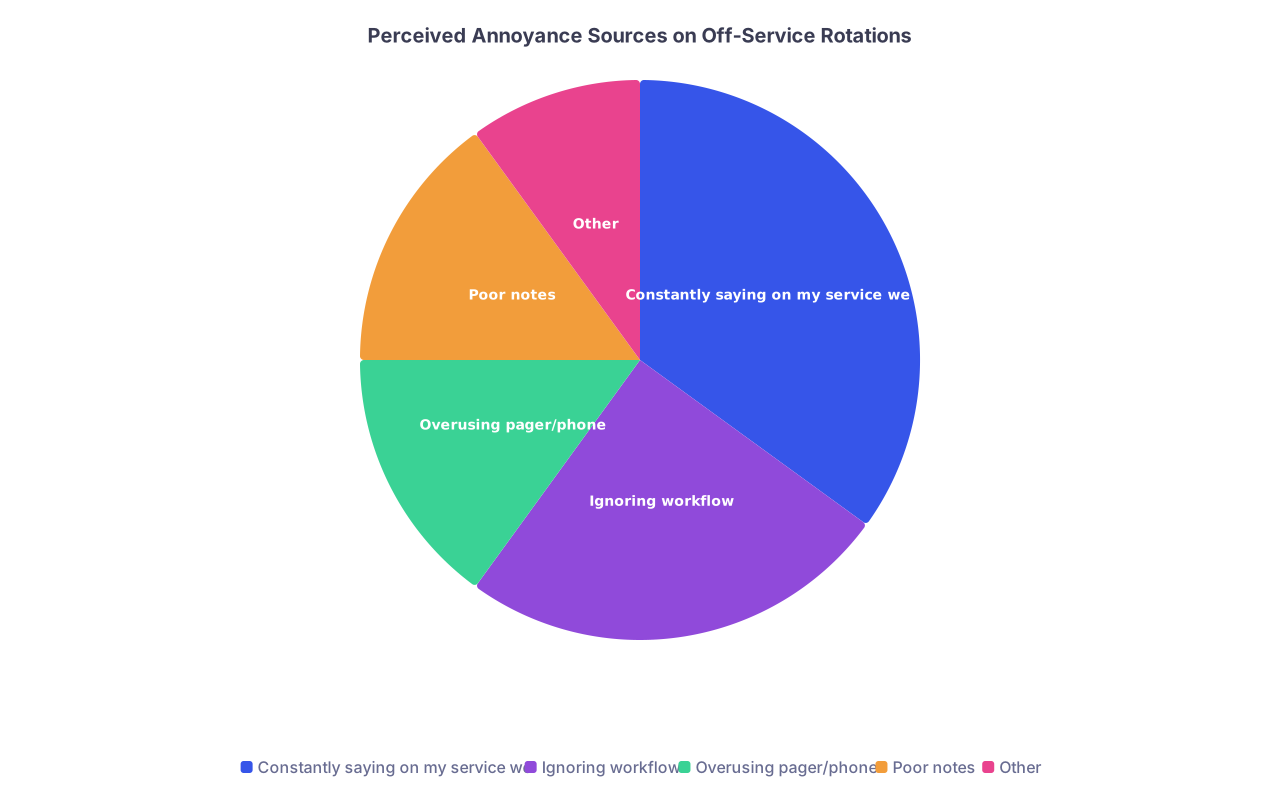
| Category | Value |
|---|---|
| Constantly saying on my service we | 35 |
| Ignoring workflow | 25 |
| Overusing pager/phone | 15 |
| Poor notes | 15 |
| Other | 10 |
How to avoid this
Keep your home specialty in your head, not on your name badge.
- Use “I’m used to…” carefully. Only when asked or when patient safety is at stake.
- Ask, “What’s your usual approach here?” instead of, “Why don’t you do X?”
- If your attending says, “We don’t do that on this service,” that’s the end of the debate. Smile. Adjust. Move on.
You’re there to learn a different culture, not colonize it.
2. Misreading the Local Humor Dial
Every service has its own brand of humor. Some are dark. Some are dry. Some have none at all and run entirely on caffeine and resentment.
If you misread that, you’ll either seem unhinged or inappropriately cheerful.
Classic misfires
I’ve seen:
- A surgery intern crack a “Well, they were old anyway” joke on geriatrics. Silence. Absolute silence.
- An EM resident make a “We’ll turf this to medicine” joke…to the medicine attending…at 2 a.m. At sign-out.
- A med student on psych say, “At least no one’s dying here!” during a suicidal ideation eval.
These aren’t just unfunny. They’re dangerous. You look insensitive, clueless, or both.

How to avoid this
Treat humor like a medication:
- Start low, go slow. For the first week, your jokes should be mostly self-deprecating and gentle.
- Read the room. If no one is making dark jokes, that is not your cue to introduce them.
- Avoid joking about: death, suicide, addiction, malpractice risk, patient intelligence, or turfing. Those are advanced-level topics, reserved for trusted colleagues who already know you’re not a psychopath.
Rule of thumb: if a joke would look bad in writing on an incident report, don’t say it.
3. Confusing Self-Deprecation with Self-Sabotage
A little “I’m the off-service person, teach me” energy is fine. The mistake? Turning yourself into the department idiot for the sake of laughs.
You’ve probably heard this:
“Hi, I’m the dumb medicine resident on surgery, I don’t know anything, just tell me what to do!”
It gets a chuckle. Once. Then people start believing you.
The hidden cost of being “the funny incompetent”
Here’s what actually happens when you brand yourself this way:
- You get trusted with less.
- You get written up as “shows limited independence.”
- You stop being asked what you think. You’re just told what to do.
- Your evals say you’re “pleasant” but “needs to improve knowledge base” even if you’re actually solid.
You trained for years to not be perceived as useless. Don’t throw that away for an easy laugh on day one.
How to do it better
There’s a difference between humility and self-erasure.
Better phrases:
- “This isn’t my home specialty, so I may need a bit more guidance initially.”
- “On medicine I’m used to managing X, but I’d like to learn how you approach it surgically/anesthesia-wise/OB-wise.”
- “I’m comfortable with A and B. I’ll need teaching on C.”
You can be honest without turning yourself into a clown character.
4. Underestimating the Off-Service Workload (And Then Making Jokes About It)
Another common pitfall: walking onto an off-service rotation assuming it will be lighter, then making jokes about how “chill” it is.
“Wow, this is like a vacation compared to the ED!”
“Only 10 patients? On medicine this would be a golden day.”
“So this is where work-life balance lives.”
People who’ve just finished 24 hours in-house don’t find that hilarious.
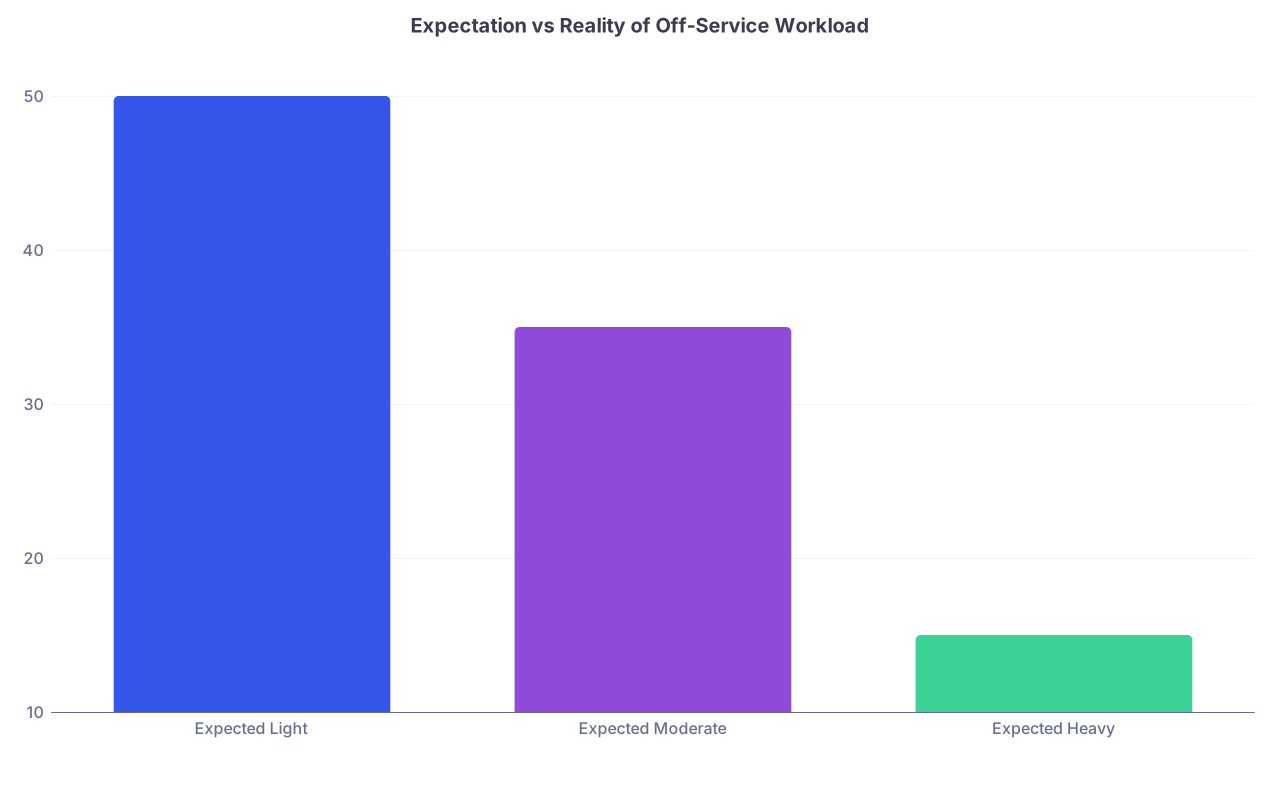
| Category | Value |
|---|---|
| Expected Light | 50 |
| Expected Moderate | 35 |
| Expected Heavy | 15 |
The problem isn’t just that you’re wrong (often you are). It’s that you’re insulting the people whose “easy” job you currently can’t even do unsupervised.
How to avoid this
Before you assume anything:
- Ask current residents: “What’s a typical day like here? What’s the hardest part of this rotation?”
- On day one, don’t say a word comparing workloads. You have no idea how much behind-the-scenes work is invisible to you.
- If the rotation is lighter, just quietly be grateful. Don’t narrate it. People have long memories.
The minute you imply another service is easy, you’ve marked yourself as naive.
5. Misusing the Pager/Phone and Becoming the Running Joke
There is always that one off-service rotator who pages constantly for non-urgent nonsense. Nurses and residents will remember your pager number the way people remember trauma codes.
Classic offenses:
- Paging “STAT” for Tylenol.
- Calling the fellow every single time a vital sign slightly moves.
- Texting three separate questions in three separate messages instead of one coherent communication.
- Calling at 3 a.m. to ask, “Do you want a BMP in the morning or just CBC?”
On your home service, maybe they tolerate this. On an off-service rotation, you’re just “that person.”

How to avoid becoming pager folklore
Basic rules:
- Before calling: ask yourself, “Will this change what we do right now?” If not, can it wait for rounds or a bundled update?
- Learn the local thresholds: when do they want to be called? BP cutoffs? O2 ranges? Post-op issues? Ask the senior on day one.
- Bundle communication: “Three quick updates: 1) labs back, 2) pain control issue, 3) family question.”
And never, ever label something as “STAT” because you feel anxious. “STAT” is not a mood.
6. Overperforming the Wrong Thing
You want to impress on your off-service rotation. Fine. Just don’t try to impress them with the wrong skill set.
Examples I’ve seen:
- Medicine resident on anesthesia reciting the entire CHF guideline, while forgetting to check if the patient is NPO.
- Surgery intern on psych writing a beautiful 3-page SOAP note for someone in acute crisis, while not telling anyone the patient is escalating.
- EM resident on inpatient peds seeing patients “efficiently” but not rewriting or understanding the daily plan.
You look like someone doing flexes at the wrong gym.
| Rotation | Impresses Most | Common Annoyance |
|---|---|---|
| ICU | Owning data, anticipating | Vague presentations |
| Anesthesia | Preparation, NPO, airway plans | Long-winded medicine talk |
| OB/L&D | Availability, note brevity | Arguing about admission |
| Psych | Safety focus, collateral | Minimizing risk |
| Ortho | Clear plans, efficiency | Overcomplicated medicine |
How to avoid this
Figure out what they care about:
- Ask seniors directly: “What makes a great off-service resident here?”
- Pay attention during sign-out—what do they praise? What do they critique?
- If your “big brain” contributions are routinely ignored, you’re solving the wrong problem.
On off-service, being reliable, concise, and aligned with their workflow is more impressive than showcasing subspecialty trivia.
7. Violating Sacred Workflow Rituals
Every service has sacred rituals: sign-out style, rounding order, pre-op routine, OR etiquette, clinic flow. Violating those isn’t just a faux pas—it becomes comedy material.
People don’t forget:
- The off-service resident who started seeing post-ops before pre-ops on a surgery day.
- The one who showed up late to sign-out but early to the cafeteria.
- The person wandering into the OR without eye protection asking, “So where do I stand?”

| Step | Description |
|---|---|
| Step 1 | Start Rotation |
| Step 2 | Assume Your Way Is Standard |
| Step 3 | Break Unwritten Rule |
| Step 4 | Awkward Silence and Side Eye |
| Step 5 | Realize There Is a Different Culture |
| Step 6 | Ask and Adapt |
| Step 7 | Become Part of the Team |
How to avoid stepping on landmines
On day one, explicitly ask about:
- Sign-out expectations (length, structure, required data).
- Rounding order and “never be late” times.
- OR rules: when to pre-round, when to see patients, documentation.
- Pager expectations during procedures or clinics.
Then, for the love of your evals, follow through.
If they say pre-rounding starts at 5:30, and you roll in with coffee at 5:45, you’re not just late. You’re the joke.
8. Turning Patients into Props for Your Stories
This happens a lot on off-service rotations where you feel out of place. You compensate by framing patients as “crazy cases” to tell your friends later. It’s tempting. It’s also gross.
Examples:
- On psych: “You will not believe this hallucination…”
- On OB: “The delivery was insane, we almost…” then turning it into a slapstick moment.
- On peds: mimicking an anxious parent’s accent or tone for laughs.
You will absolutely find colleagues who laugh along. That doesn’t make it okay. And it’s exactly the kind of behavior that gets remembered when someone decides your “professionalism” comment needs to be less than glowing.
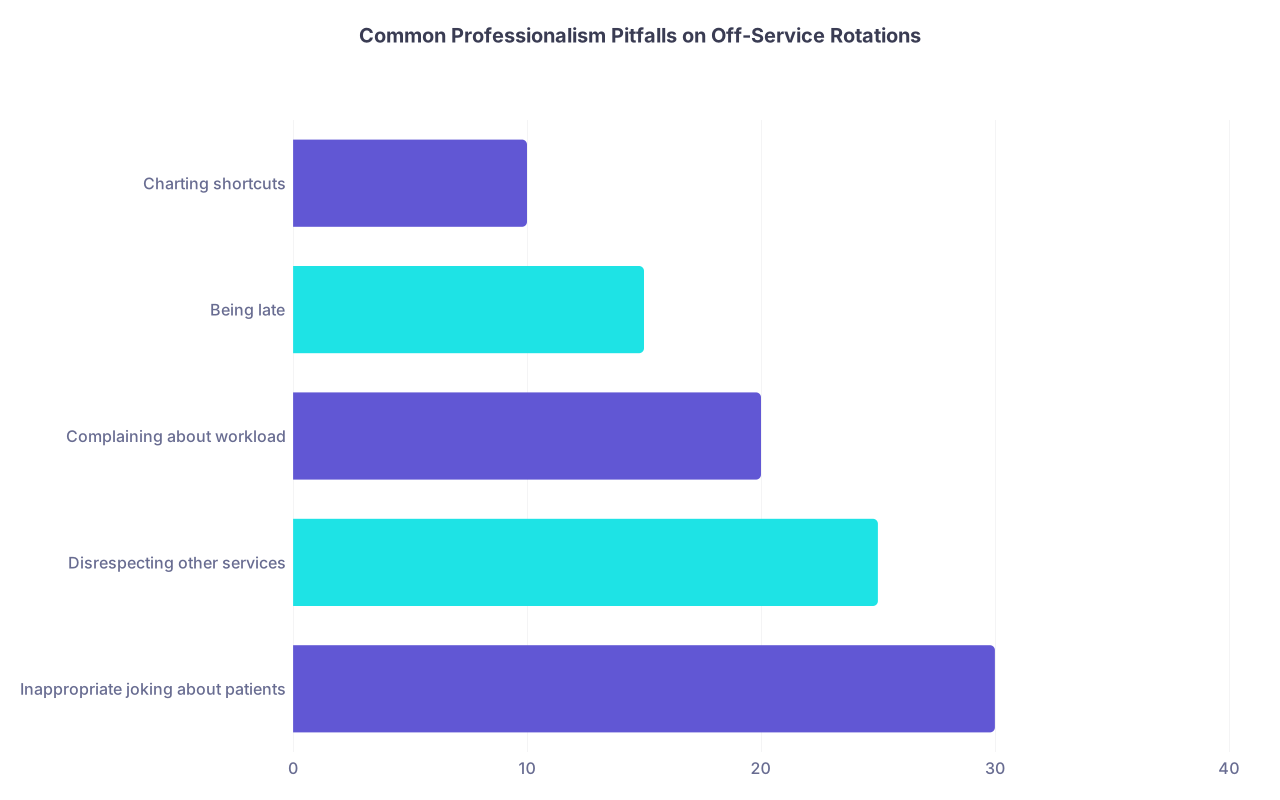
| Category | Value |
|---|---|
| Inappropriate joking about patients | 30 |
| Disrespecting other services | 25 |
| Complaining about workload | 20 |
| Being late | 15 |
| Charting shortcuts | 10 |
How to avoid this
Ask yourself two things before you tell a story:
- Would I tell this story if the patient or family were standing behind me?
- Would I be comfortable if this sentence appeared quoted in my eval with my name attached?
If the answer to either is “no,” it’s not a funny story. It’s a red flag.
9. Misunderstanding Who Actually Has Power Over You
On an off-service rotation, you may assume your only “boss” is the attending. Wrong. Your evaluation is often heavily shaped by:
- The senior resident who sees your work all day
- The fellow who fields your calls overnight
- The charge nurse who quietly mentions “they’re safe” or “they’re reckless”
- The coordinator who notices if you constantly switch clinics or show up late
You might think you’re joking with them when you’re actually joking at them.
Examples:
- Mocking the number of consults they accept.
- Rolling your eyes in front of the intern when the fellow says, “We should admit.”
- Joking to nurses about how “this service admits everything.”
They all talk. You are not the only one collecting impressions.

How to avoid this
Operate under one assumption: everyone you work with can either slightly help or slightly hurt your reputation. Most won’t go out of their way to do either. But they will answer honestly when asked, “How was it working with them?”
Make it easy for them to say: “They respected how we do things, they worked hard, they fit in.”
Not: “They were funny, I guess, but kind of dismissive.”
10. Forgetting That Humor Doesn’t Fix Bad Fundamentals
If your notes are late, your pages go unanswered, or your pre-rounding is sloppy, no amount of charm will rescue you. People might like you personally and still give you mediocre evaluations.
Off-service rotations are where a lot of residents try to “coast.” Bad idea. Those evals follow you.

| Step | Description |
|---|---|
| Step 1 | Show Up On Time |
| Step 2 | Do Reliable Work |
| Step 3 | Communicate Clearly |
| Step 4 | Respect Local Culture |
| Step 5 | Add Light Humor Carefully |
Notice where humor sits: at the very end. It’s an add-on, not the foundation.
If you’re using jokes to distract from the fact that you haven’t checked your labs or updated a family, people notice. And they don’t find it funny.
FAQ (Exactly 5 Questions)
1. Is it okay to make any jokes at all on an off-service rotation, or should I just be serious the whole time?
You don’t need to be humorless; you need to be calibrated. Start small and safe: self-deprecating comments about your confusion with the new EMR layout, gentle jokes about getting lost in the hospital, or light comments about coffee dependence. Let them set the tone. If the team clearly jokes openly, you can loosen up. If it’s all business, follow their lead. Humor should never punch down (at patients, nurses, other services) or minimize risk or suffering.
2. How do I recover if I already made a bad joke and the room went silent?
Do not double down. Don’t try to “explain” why it was funny. Briefly acknowledge it and pivot. Something like, “That came out wrong—sorry. Anyway, the plan for this patient is…” Most people will let it go if you don’t make it a pattern. If you really stepped over a line (e.g., joked about a death or a serious complication), pull aside the attending or senior later and say, “I realized that was inappropriate. Won’t happen again.” They’ll remember your correction more than the misstep.
3. What’s the single best way to make a good impression on an off-service rotation?
Be relentlessly reliable and low-maintenance while clearly interested. Show up early, know your patients well, anticipate basic needs, ask focused questions, and respect the way they do things—even when you’d do it differently at home. If they never have to chase you down, never have to beg you for notes, and never have to correct you twice for the same thing, you’ll be considered an excellent off-service resident, even if you’re not the funniest or the smartest in the room.
4. How do I handle it when my home-service culture openly mocks this rotation’s specialty?
Keep that garbage at home. Do not carry in-jokes like “psych just babysits” or “ortho is carpentry” into someone else’s space. If your colleagues bait you (“You having fun babysitting on psych?”), you can shut it down with, “They actually deal with stuff we punt all the time; I’m learning a lot.” That sounds mature, protects you if anyone overhears, and signals you’re not the kind of resident who needs to put other fields down to feel important.
5. What if I genuinely think their way of practicing is unsafe or wrong? Am I supposed to just go along with it to fit in?
No. Culture does not trump safety. But there’s a difference between “different style” and “unsafe.” If you think something is dangerous, address it respectfully and specifically: “I’m worried that if we discharge them without X, they may decompensate because Y.” If you’re still concerned, escalate up the proper chain—usually your supervising resident or attending. Just don’t dress your concern in sarcasm or jokes. Safety conversations deserve seriousness; that’s how you get taken seriously when it matters.
Key points to keep: you’re entering a new culture, not doing a guest performance; your humor is background music, not the main act; and the people you’re trying to impress will remember how you worked far longer than they’ll remember any joke you told.