You can tank a trainee’s reputation in three words: “Great sense of humor.”
Not because humor is bad. Because in written evaluations, humor is almost always misunderstood, misquoted, and misused. And once it’s in the record, you do not control how it’s read.
This is where well‑meaning attendings, residents, and even students themselves get burned. They try to be clever in evaluations, comments, or letters, forget that these are legal documents and career artifacts, and end up sounding flippant, judgmental, or outright unprofessional.
Let me walk you through the landmines so you do not become the story people whisper about in the residency office.
The Core Problem: Evaluations Are Not Group Chat
Your brain lies to you in the moment: “They know I’m joking.” “Everyone loves her, this will be funny.” “It’s obvious I’m being playful.”
No. It is obvious now, in the room, with tone, timing, and shared context. But evaluations are:
- Stripped of tone
- Stripped of facial expressions
- Stripped of context
- Read by strangers 6–36 months later
And often read by people in positions of power: CCC members, promotions committees, PDs, credentialing offices, lawyers.
So that clever one‑liner you dashed into the narrative comments?
- “Would trust him with my dog… not yet my grandma”
- “Could be a great surgeon once he learns where the OR is”
- “Keeps the team laughing, sometimes more than working”
On a screen in a promotions meeting, it doesn’t sound like a joke. It sounds like: unsafe, clueless, unprofessional.
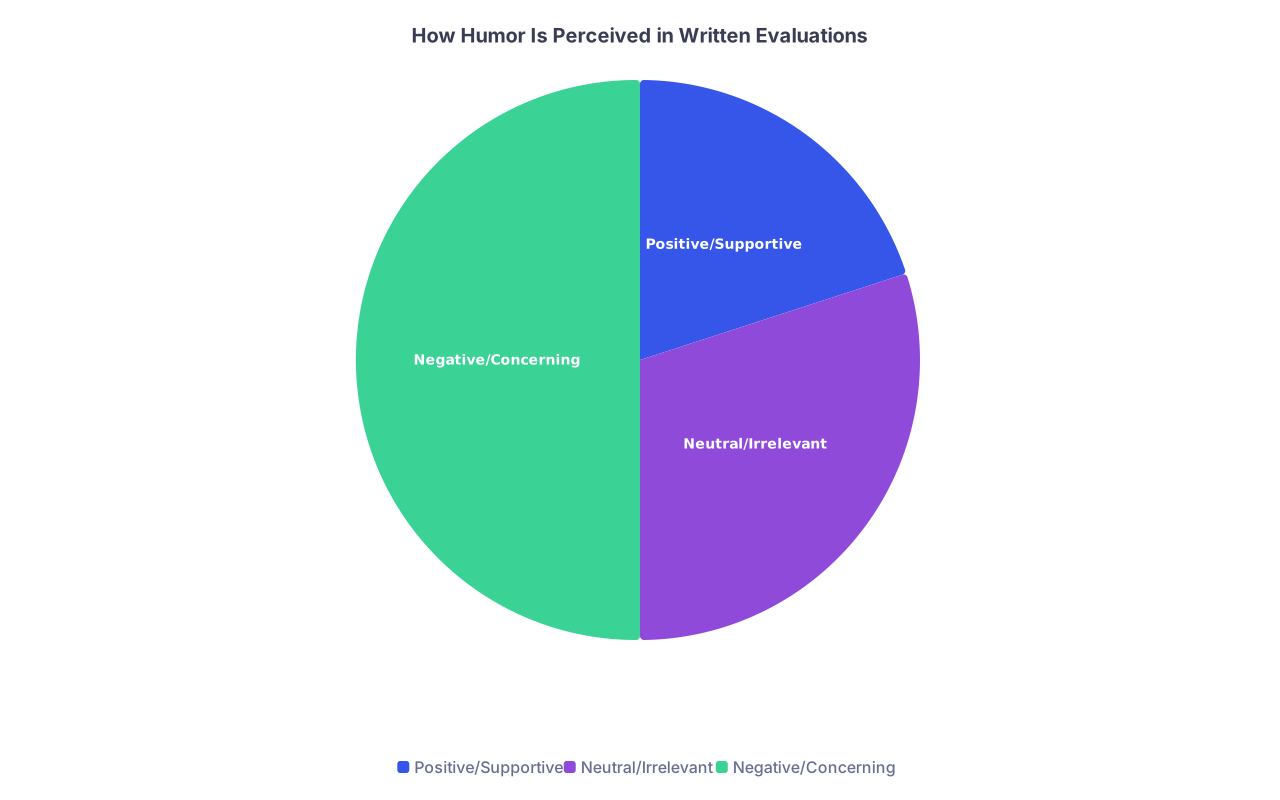
| Category | Value |
|---|---|
| Positive/Supportive | 20 |
| Neutral/Irrelevant | 30 |
| Negative/Concerning | 50 |
Half the time, humor in comments is interpreted as negative or concerning. Yet people keep doing it.
Stop.
Types of “Funny” Comments That Age Terribly
You’ll see the same patterns over and over. Some of them seem harmless in the moment. They’re not.
1. The “Compliment” That Undercuts Competence
These sound nice while still planting a red flag.
- “Great personality, will do well once knowledge base catches up.”
- “Patients love her, even though she’s still figuring out the medicine part.”
- “Always upbeat, even when not totally sure what’s going on.”
You think you’re saying: “Nice person, early learner.”
The reader hears: “Nice, but unsafe.”
Worse versions:
- “Fun to have on the team, not who I’d pick on a code.”
- “Would be a great colleague… in a less acute setting.”
You just told a committee you would not trust them clinically. That sticks.
2. The “Inside Joke” That Outs You as Unprofessional
These are jokes that make sense only to your team:
- “Our unofficial snack captain and meme officer.”
- “Chief of Vibes, still working on chief of Notes.”
- “Med student most likely to be found at the nurses’ station with coffee.”
You might be trying to show they’re social and well-liked. On paper, this reads as: not serious, not working, not at the bedside.
I’ve seen comments like: “Our favorite TikTok doc” or “Influencer energy.” That’s cute on Instagram, not in a faculty evaluation that might be subpoenaed.
3. The “Roast” That Becomes Evidence
Roasting a trainee is popular on some teams. Fine in private if you all truly have that relationship. Fatal in a formal document.
- “Still finds new ways to get lost in the hospital daily.”
- “Known to ask the question everyone else already knows the answer to.”
- “Somehow survived the rotation despite the pager.”
Read as: disorganized, slow to learn, overwhelmed by normal workload.
And the ugly subcategory: humor about safety.
- “Almost ordered KCl IV push… we had a good teaching moment about that.”
- “Learning not to hang up on critical lab value calls.”
- “Will be a great intensivist once we get him to answer rapid response pages the first time.”
You think you’re illustrating growth and learning. All you’ve actually done is document unsafe behavior in a semi-permanent record.
4. Innuendo, Stereotypes, and “Playful” Bias
This is where people really destroy their credibility.
Examples I’ve personally seen or heard recited:
- “Very caring, has classic ‘mom’ energy with patients.”
- “Brings the intensity you’d expect from a neurosurgeon.”
- “Impressively calm for a pediatrician.”
- “Sometimes too nice, but that’s the OB in her.”
- “Can be a little dramatic — she is a dancer after all.”
Or the wildly inappropriate:
- “Easy on the eyes, patients love him.”
- “Has a good relationship with nursing (maybe too good?).”
- “Smile could cure half the diseases on the floor.”
These are not harmless. They’re biased, sometimes sexist, and always unprofessional. They can be used against you too, by the way, if anyone ever questions your judgment or professionalism as an evaluator.
How Humor Gets Weaponized Against Trainees
The real danger isn’t that someone will read your funny comment and chuckle. The danger is that one flippant line becomes:
- The quote on a slide during a Clinical Competency Committee meeting
- The justification for remediation: “There are concerns about reliability”
- The line pulled by a PD scanning for red flags in an application
- The sentence cited in a legal review after an adverse event

Picture this meeting. A file is opened. Someone scrolls to narrative comments. Out of 30 bland, professional evaluations, one of yours pops up:
“Great to have at 2 a.m., always brings food and jokes, sometimes slow with notes but vibes are immaculate.”
Nobody is laughing.
What they see:
- Prioritizes social interaction over work
- Documentation is delayed
- Evaluator didn’t take the evaluation seriously
That might be the only narrative comment anyone actually remembers about that trainee. Because it’s weird enough to stand out.
Specific Phrases That Sound Harmless but Hurt
Here’s a small, ugly sampling of things I’ve seen or heard about. If you’ve written anything close to these, change how you do evaluations tomorrow.
| Category | Problematic Phrase |
|---|---|
| Undercutting Competence | "Great personality, knowledge pending" |
| Questioning Reliability | "Shows up... eventually" |
| Social Over Clinical | "Always chatting with staff" |
| Appearance/Charm Focus | "Patients love his smile" |
| Safety Minimization | "Gave us some good near-miss stories" |
The danger pattern: compliment + knife.
“Great X, but/though/sometimes Y.”
If Y is anything about safety, reliability, or professionalism, you just marked them as risky.
The Student Side: Self‑Humor That Backfires
You’re not off the hook as a trainee either. You can sabotage yourself in:
- Self‑evaluation comments
- Personal statements
- CV “interests” sections
- ERAS supplemental essays
- “Tell me about yourself” responses
Common self-directed humor mistakes:
Making light of serious issues
- “Step 1 and I had a toxic relationship but we’re back together now.”
- “Survived surgery by living on coffee and trauma.”
- “Known to occasionally get lost in the hospital, but I always find the coffee cart.”
Undermining your own work ethic
- “Procrastination has always been my superpower, yet I still made it here.”
- “I’d be a great radiologist — I love sitting in the dark.”
Turning real concerns into bits
- “I’m basically allergic to mornings but somehow show up for pre-rounds.”
- “Still learning to say no, so feel free to page me for everything.”
You might think you’re showing humility and personality. On paper, it reads: unreliable, disorganized, not serious, poor boundaries.
If you want to mention a weakness, treat it like a professional talking about a skill gap, not like a stand‑up set.
Why Humor Fails in Medical Documentation
This is not just about being “too serious.” There are structural reasons humor falls flat in evaluations.
1. Asymmetric Power
Attending joking about a med student = power difference.
Even if the student laughed with you on rounds, they did not consent to that joke being frozen in their record. It’s not a fair exchange. You control their grade; they do not control your pen.
2. Intermittent Context
Evaluations are read:
- By people who never met the trainee
- In bulk, under time pressure
- While searching for “issues”
Nobody is reading every line with generous charity. They’re scanning for risk.
Humor, sarcasm, and exaggeration all look like risk.
3. Cultural and Generational Gaps
What lands as “obviously a joke” for you does not necessarily read that way to:
- An older faculty member
- A lawyer
- A dean from another country
- A PD with a different sense of humor
There is no shared cultural baseline in a national match committee. Your sarcastic “crushed the dopamine drip like a champ” isn’t safe.
How to Be Positive Without Sounding Silly
You don’t have to write robotic garbage. You just have to stop using jokes as shortcuts.
Instead of:
- “Great vibes on night float, always keeps team laughing.”
Try:
- “Maintained morale on night float while staying focused on patient care and timely tasks.”
Instead of:
- “Our code brown specialist.”
Try:
- “Comfortable managing challenging situations and remains calm under pressure.”
Instead of:
- “Most likely to bring snacks to the team.”
Try:
- “Contributed to a supportive team environment and checked in on colleagues’ well‑being.”
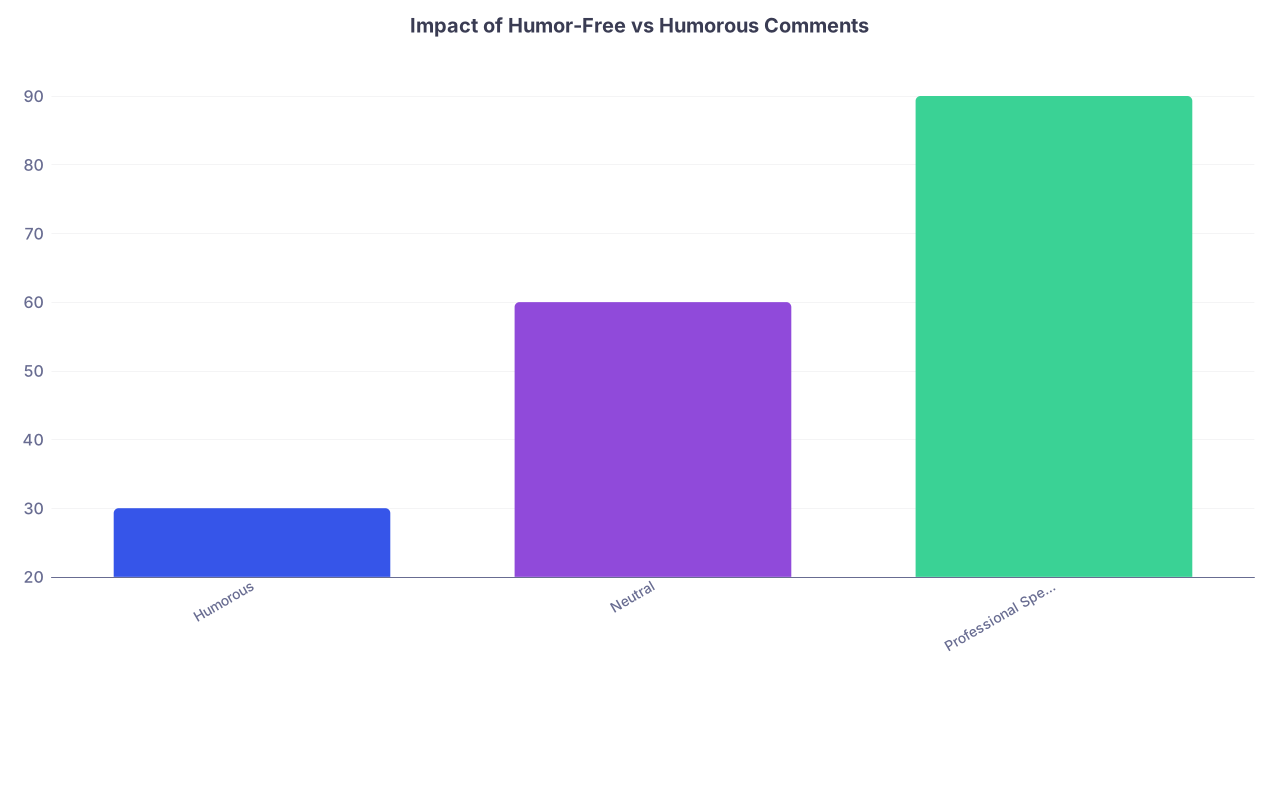
| Category | Value |
|---|---|
| Humorous | 30 |
| Neutral | 60 |
| Professional Specific | 90 |
The more concrete and professional your phrasing, the more useful and safe it is.
Simple Rules to Keep You Out of Trouble
If you remember nothing else, follow these.
Rule 1: No Jokes About Safety, Reliability, or Judgment
None. Zero. Not even “obviously sarcastic” ones.
- No “almost killed the patient but didn’t” stories
- No “still learning to answer pages” bits
- No “if I ever need a doctor, I’ll call someone else” lines
If it touches patient care, treat it as serious.
Rule 2: Avoid Commenting on Appearance or Charm
No matter how “positive” it seems:
- “Looks very young”
- “Attractive, patients enjoy interacting with her”
- “Has a disarming smile”
This is how bias creeps in, and it makes you look unprofessional.
Rule 3: Don’t Try to Be the Funny Evaluator
The evaluation is not about you. It’s not your personality showcase. It’s not where you prove you’re the “cool” attending.
Your job in that box is to:
- Document observed behavior
- Comment on strengths and areas for growth
- Provide information that will hold up if ever reviewed formally
That’s it.
Rule 4: If You Wouldn’t Say It in Front of a Dean and a Lawyer, Don’t Type It
Picture this scene:
- Dean of Students
- Program Director
- Risk Management
- The trainee
Now read your draft comment out loud in your head. Still sound clever? Then maybe it’s actually okay. Most of the bad jokes will die right there.

| Step | Description |
|---|---|
| Step 1 | Write Comment Draft |
| Step 2 | Delete or rewrite |
| Step 3 | Keep and submit |
| Step 4 | Mocks, minimizes, or jokes about safety or reliability |
| Step 5 | References appearance, charm, stereotypes |
| Step 6 | Would I read this aloud to dean and lawyer |
What To Do If You Already Wrote Something Stupid
You might be thinking: “Cool, but I definitely wrote ‘vibes immaculate’ in three evals last month.”
Options, depending on your role and system:
If your institution allows addenda:
Add a brief, professional clarifying comment:
“To clarify my prior comment: I found Dr. X to be a positive presence on the team while consistently completing tasks on time and providing safe patient care.”If you’re asked to write a summative letter later:
Do not repeat the joke. Emphasize concrete strengths and fix any misleading impressions.If you’re a trainee and the comment hurts you:
Talk to your advisor, program leadership, or student affairs. Sometimes there’s a way to respond or contextualize in your file.
But most importantly: Change how you write from now on. The best damage control is not creating more.
Humor Does Belong in Medicine — Just Not There
Let me be clear: I’m not against humor. Dark humor, gallows humor, shared laughter — it’s part of survival in medicine.
Appropriate places for humor:
- Team rooms
- Debriefing sessions
- Off‑the‑record mentorship conversations
- Comedy nights, podcasts, anonymous Twitter (within reason)
Very high‑risk places for humor:
- Evaluations
- Letters of recommendation
- EMR documentation
- Email chains with leadership cc’d
- Official complaint or incident reports
It’s not that humor is morally wrong there. It’s that it’s strategically stupid. You are trading 2 seconds of clever for years of possible misinterpretation.
The Future: AI, Big Data, and Your Dumb Joke
One more reason to stop doing this: evaluation comments are being mined for:
- Natural language processing “professionalism” scores
- Predictive analytics for burnout or risk
- Automated summaries in MSPEs and promotion packets
Do you really want your one sarcastic line to be the sentence an algorithm pulls out as “representative”?
“Great vibes, slow notes, always joking.”
You think that will net you “team player” points? Or “unprofessional” flags?
As evaluation systems get more automated, you will have less control over how text is sliced, quoted, and scored. That means your safest move is boring, specific, professional language.
Pretty much the opposite of jokes.
FAQ (Exactly 4 Questions)
1. Is it ever okay to include any humor in an evaluation?
Rarely, and only if it’s extremely gentle, clearly positive, and would still make sense out of context. Even then, I’d ask: what does this add that a clear, specific compliment does not? If it doesn’t strengthen the trainee’s case in a serious room, it’s probably not worth the risk.
2. What about “funny but true” comments, like saying someone should go into a certain specialty?
Those can backfire too. “Should be a surgeon” might sound like praise to you, but to another reader it telegraphs “not detailed,” “too intense,” or overly procedural, depending on their biases. Keep specialty predictions out unless directly relevant and expressed professionally: “Shows strong aptitude for procedural work and critical care settings.”
3. As a trainee, how do I push back if I get an unfair ‘funny’ comment in my evaluation?
Document it. Save a copy. Bring it to your advisor, program director, or student affairs and say, calmly: “I’m concerned this comment might misrepresent my performance.” Ask if an addendum, clarification, or alternate evaluation is possible. Don’t attack the evaluator’s character; focus on impact and accuracy.
4. How do I keep evaluations from sounding generic if I strip all the humor?
Use specifics instead of style. Replace personality with detail: concrete examples, observed behaviors, outcomes. “Led family meeting about goals of care” is stronger than “excellent communicator.” Your writing doesn’t need to be entertaining; it needs to be credible and useful. Specifics are how you get there without trying to be funny.
Open your last evaluation (or self‑evaluation) right now and scan for a single sentence that was meant to be clever. Then rewrite it in plain, professional language that would still help the trainee in front of a committee.