
The fastest way to make an attending question your judgment is not a missed lab or a slow note. It’s a bad joke at the wrong time.
You’re not just being “funny.” You’re signaling whether you’re safe.
Humor in medicine isn’t harmless. It’s read as data: about your judgment, your boundaries, your empathy, and whether they can trust you at 3 a.m. with a crashing patient. I’ve watched smart interns nuke their reputations in 10 seconds with a single attempt at “edgy” humor.
Let’s walk through the 10 humor missteps that quietly (or not so quietly) make attendings wonder, “Can I actually trust this person?”
1. Making Patients the Punchline
If you remember nothing else, remember this: joking about patients instead of around patients is the cardinal sin.
The mistake looks like this:
- Calling a patient “trainwreck,” “dumpster fire,” “cirrhosis special,” “frequent flyer,” or “drug seeker” with a smirk.
- Laughing about a patient’s poor health choices, BMI, hygiene, or social situation.
- Doing a mocking imitation of a confused or anxious patient for the team.
You may think you’re “just venting” or “using dark humor like everyone else.” You are not. What your attending hears is: this person dehumanizes sick people and thinks it’s funny.
That’s not “coping.” That’s a professionalism red flag.
Where this blows up:
- On rounds, you describe a patient as “purely a social admit” with an eye roll. The attending, who has spent years caring for homeless patients, goes very quiet. You don’t recover from that easily.
- In the workroom, you joke, “Mr. X could probably power the hospital with all his drama.” You don’t notice the attending sitting at the computer behind you. They notice you.
Safe alternative: If you need humor, turn it on yourself, the system, or the situation’s absurdity. Never the patient’s identity, dignity, or suffering.
Litmus test: If the patient or their family were standing in the doorway, would you cringe? If yes, it’s not “fine.”
2. “Dark Humor” That’s Actually Just Disturbing
Medicine has dark moments. And people cope with dark humor. That’s real.
But here’s the mistake: assuming your threshold for dark humor matches your attending’s, or thinking “we’re all in medicine so anything goes.”
Wrong.
Red-flag “jokes” that make attendings rethink your sanity:
- Joking about “practicing procedures” on dying or sedated patients.
- Laughing about how much blood someone lost, how “gnarly” a wound was, or how “this would be a sick Instagram story.”
- Casual death jokes: “Well, guess he won’t need follow-up anymore,” delivered with a smirk, not solemn irony.
I’ve watched a senior resident crack a “one less discharge to write” joke after a patient coded and died. The attending stared for a full three seconds, then said flatly: “That’s not funny.” That resident’s reputation never fully recovered with that faculty.
Dark humor rule of thumb:
- It should punch upward (at the system, the absurdity, bureaucracy).
- It should never delight in harm, death, or loss.
- If it requires “Whoa, I’m just kidding, relax,” it was a bad idea.
If you’re early in training, default: your dark humor stays in your head, not in front of attendings. And definitely not in charting messages (yes, people do that; yes, it comes back to haunt them).
3. Joking in Front of Families or Within Earshot of Patients
You’ll underestimate how far sound travels in a hospital. Then you’ll regret it.
The mistake:
- Making a light comment in the hallway right outside a room.
- Laughing loudly about something unrelated when a family just got bad news two doors down.
- Joking with a colleague during a transport, assuming a sedated or confused patient “won’t notice.”
Patients and families notice everything when they’re scared. Every laugh, every side comment, every smirk. And if they complain, your attending won’t be explaining that it was “taken out of context.” They’ll be asking why you thought that was an appropriate moment to be funny.
Things attendings absolutely hate:
- Jokes within earshot of a room with a comfort-care patient.
- Banter at the nurse’s station during a code down the hall.
- Smiling or laughing about anything as you walk into a room where a family is crying.
You might be decompressing. They see you as disrespectful.
Safer habits:
- If serious conversations or bad news are happening nearby, your humor goes to zero. Period.
- Keep voices low in hallways. You have no idea who’s lying behind that curtain.
- Assume every door is thinner than you think and every family member can hear you.
Attendings see those micro-moments and make fast judgments about your maturity.
4. Self-Deprecation That Sounds Like You’re Unsafe
Some self-deprecating humor is relatable. When you’re drowning in notes, saying “Epic owns my soul” is fine.
The misstep is when your “jokes” sound like you’re incompetent or dangerous:
- “I have no idea what I’m doing; don’t let me near that central line.”
- “If I order the wrong thing, just cancel it, I’m basically winging it.”
- “Hope I don’t kill anyone today, haha.”
You think you’re being humble. Your attending hears: you’re either unstable or using humor as a shield for genuine incompetence.
Red-flag phrases that make attendings sit up:
- “I’m horrible at ______.”
- “I always mess up ______.”
- “I’m terrified of nights, I’m going to crash and burn.”
Repeated enough, these don’t sound like jokes. They sound like truth.
Better version:
- “I’m still getting comfortable with X—can I walk through my plan with you?”
- “This is a learning edge for me; I’d appreciate your feedback.”
If you need to be funny, aim the joke at the workload or the system, not your ability to keep patients safe. The minute an attending worries you actually believe you’re unsafe, they’re going to treat you like you are.
5. Sarcasm That Reads as Disrespect
Sarcasm is advanced-level social maneuvering. Most people think they’re better at it than they actually are.
The mistake: using sarcasm around attendings who don’t know you well, or who are culturally, generationally, or personally allergic to it.
Examples that burn you:
- Attending gives feedback; you answer, “Wow, tell me how you really feel,” with a half-smile.
- After being assigned another admission: “Oh great, I was worried I might get to pee this shift.”
- On rounds, attending asks a basic question; you answer, “Nope, zero idea, guess I slept through that day of med school.”
Even if you’re “joking,” the tone lingers. They remember the edge, not the humor.
Risks with sarcasm:
- It doesn’t translate well across cultures or accents.
- It falls flat in email/pages/notes and looks outright hostile.
- It often comes out when you’re tired and frustrated, which is when your filter is weakest.
If an attending is new to you, assume they’ll read everything literally. You don’t want your joking comment written in their evaluation as “reactive to feedback” or “negative attitude.”
General rule: Wit is safer than sarcasm. Observation over attitude.
6. Humor About Boundaries, Sex, or Substance Use
Short version: jokes about sex, dating, drinking, or drugs around attendings are landmines. Don’t step on them.
I’ve seen this particular misfire during late-night admits or post-call delirium, when people feel “closer” than they actually are.
Examples that make attendings instantly tighten up:
- “I’m going to need 10 drinks after this call.”
- “If my Tinder matches knew I smelled like C. diff every day…”
- “At least if I get fired I can sell Adderall to the M1s.”
You think you’re just being real. They’re thinking: this might be someone I have to report someday.
Especially bad:
- Jokes that sexualize colleagues, nurses, or patients.
- Any humor that hints at diversion of medications.
- Laughing about how hungover/tired/drugged you are at work.
From an attending’s standpoint, those are nuclear-level concerns: impaired providers, harassment, potential compliance issues. Many will immediately distance themselves from you. Some will quietly flag you to leadership.
Your personal life is your business. Hinting at chaos through edgy humor is not clever; it’s professionally suicidal.
7. Using Humor to Dodge Accountability
You will make mistakes. So will I. So will everyone you work with.
The unforgivable move is joking when you should be owning it.
How this goes wrong:
- Attending: “Why was this critical lab not followed up?”
You: “Yeah, the system really wanted that one to slip through the cracks, huh?” (smirk) - Attending: “This order could have harmed the patient.”
You: “Guess that’s why I’m still in training, right?” (nervous laugh)
You are not easing tension. You’re confirming their worst fear: you don’t take your errors seriously.
Even “light” humor can undercut your credibility in those moments. Attendings don’t expect you to be perfect. They do expect you to drop the jokes when there’s risk to a patient.
Correct approach:
- “You’re right. I missed that. Here’s what I’ve done to fix it and how I’ll prevent it next time.”
- Full stop. No jokes. Not even a little one.
Once you’ve shown you’ll take accountability cleanly, you’ve earned more leeway for humor elsewhere. Reverse that order and people will be quietly done with you.
8. Performing for Peers While Forgetting Who’s in the Room
Residents often get into trouble not because they’re awful, but because they forget the attending is physically present or within earshot.
Classic scenarios:
- Post-call sign-out where someone is trying to be “the funny one” for their co-residents.
- Late-night ED board review with gallows humor flying and an attending at the computer behind you.
- Group laughing about consults, nurses, or another service while your attending is scrolling through labs nearby.
To your peers, you’re being entertaining. To your attending, you’re broadcasting your values under low inhibition. They’re watching who you are when you think it “doesn’t count.”
Things that especially poison the well:
- Joking about “dump services” or “garbage admits.”
- Mocking another specialty by name (e.g., “Cards will consult GI who will consult Heme and nothing will happen”).
- Making fun of a specific nurse, consultant, or ancillary staff member.
You’re not just telling a joke. You’re signaling you’ll trash colleagues behind their backs. Attendings know exactly how that story ends when you’re unsupervised someday.
Baseline safety rule: If you wouldn’t say it with the program director in the doorway, don’t say it when any attending is in the room. Because sometimes they are.
9. Using Humor to Mask Burnout or Mental Health Issues
Here’s an uncomfortable truth: your “jokes” about wanting to disappear, crash your car on the way to work, or hoping for a code so you “feel something again” do not land the way you think they do.
You may be half-joking, half-crying for help. Attendings hear:
- “This person might hurt themselves.”
- “This person might be unsafe at work.”
- “This person needs more support than this environment can give.”
And they are ethically obligated to act.
Common problem phrases:
- “If I have another 28-hour call, I’m just going to step in front of the ambulance.”
- “Sleep is for people who want to live.”
- “The only thing keeping me going is the pharmacy.”
You think you’re expressing how bad it feels. They’re wondering if they need to escalate to wellness, GME, or a formal evaluation.
Do not turn real suffering into edgy humor. Talk about it plainly with someone you trust. Your attending would much rather hear, “I’m not okay and I need help” than try to decode a suicidal joke in the middle of sign-out.
And if you hear others doing this constantly? That’s not “funny intern culture.” That’s a department full of ignored distress.
10. Misreading Attendings Who Do Use Dark or Edgy Humor
This one trips up a lot of people.
You meet an attending who’s sarcastic, uses dark humor, and casually jokes about how “medicine is a scam.” You think, “Finally, my people.” Then you mirror them. And it goes badly.
Here’s the trap: power dynamics.
An attending with 20 years of credibility, a national reputation, and strong evaluations can get away with things you cannot. Unfair? Yes. Real? Absolutely.
Ways this backfires:
- Attending jokingly calls a frequent-flyer patient “our hotel guest” on rounds. You chime in, “Yeah, at least they’re racking up points.” The room goes cold.
- They make a sardonic comment about admin. You add, “Yeah, leadership is useless.” They never joke around you again.
What they can say and what you can say are not the same. They know the line. You don’t. Not yet.
If an attending has a dark or caustic style, your safest move:
- Keep your humor light, observational, and primarily self-directed.
- Match their energy (relaxed, un-stiff) but not their edginess.
- Let them set the tone. You don’t escalate it.
Some attendings also use humor as a pressure test: they push a little and see whether you join in mocking patients, nurses, or colleagues. Fail that test and they will quietly label you as unprofessional.
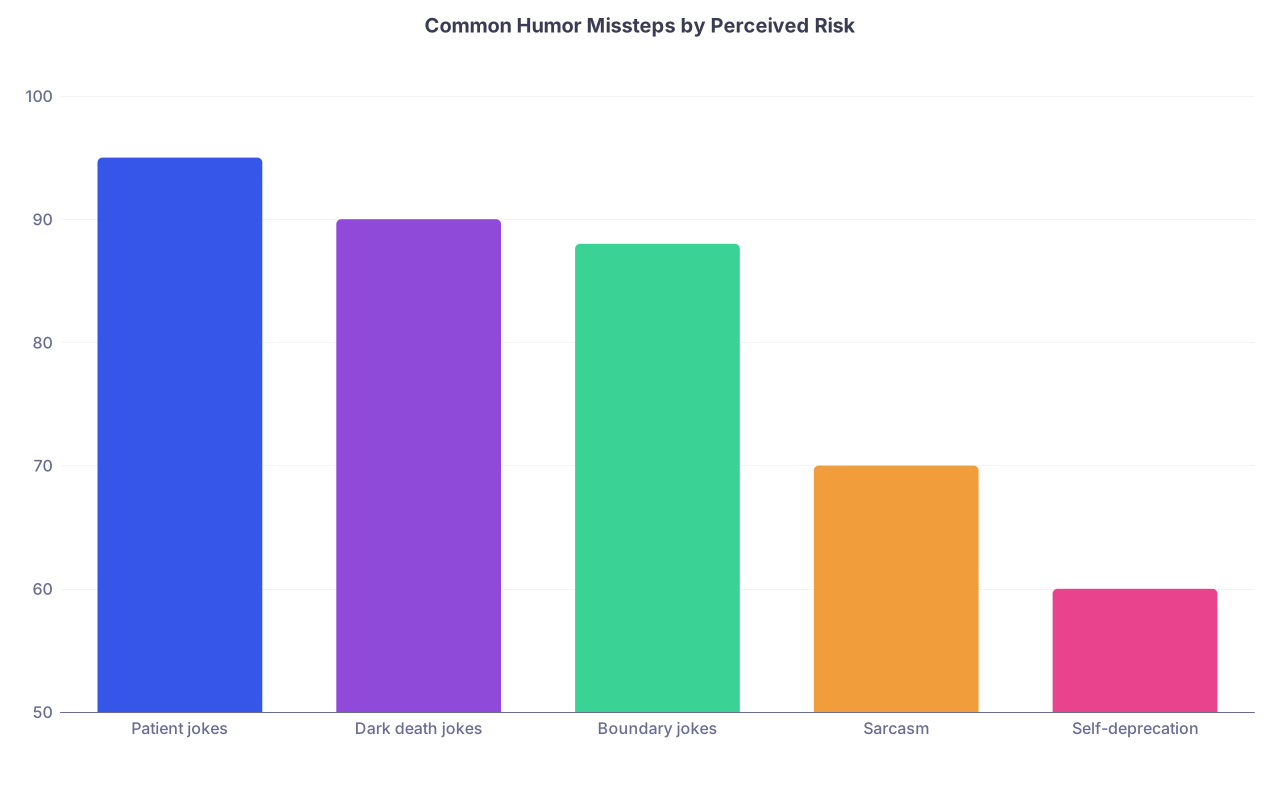
| Category | Value |
|---|---|
| Patient jokes | 95 |
| Dark death jokes | 90 |
| Boundary jokes | 88 |
| Sarcasm | 70 |
| Self-deprecation | 60 |
Quick Reference: Safe vs. Risky Humor Targets
| Humor Target | Usually Safe Early On | High Risk | Comment |
|---|---|---|---|
| Yourself | Yes | No | As long as it does not imply danger |
| The system/bureaucracy | Yes | Low | Keep it respectful, not toxic |
| The situation’s absurdity | Yes | Low | Avoid minimizing suffering |
| Patients/families | No | Yes | Just do not |
| Colleagues/nurses | Rarely | Yes | Can sound like bullying |
| Substance use/sex | No | Yes | Massive professionalism risk |

| Step | Description |
|---|---|
| Step 1 | Think of joke |
| Step 2 | Do not say it |
| Step 3 | Probably safe |
| Step 4 | About patient or family |
| Step 5 | Could it imply I am unsafe or impaired |
| Step 6 | Serious conversation or bad news nearby |
| Step 7 | Would I say this in front of PD |

How to Use Humor Without Getting Burned
Humor is not banned. It just needs guardrails.
Safer patterns that rarely cause trouble:
- Gently mocking your own confusion with guidelines, not your core competence.
- Laughing with patients at their jokes, not setting up jokes about them.
- Observing the absurdity of hospital bureaucracy (“It took 4 clicks to find the vitals”) without dripping contempt.
- Using warmth and lightness: “This is a lot, but we’re going to walk through it together.”
And remember: silence is always an option. You do not have to be the funny one. Many of the best trainees I’ve seen are quietly kind, occasionally wry, and almost never “on.”
If you’re not sure whether a joke is safe, the answer is simple: don’t say it.

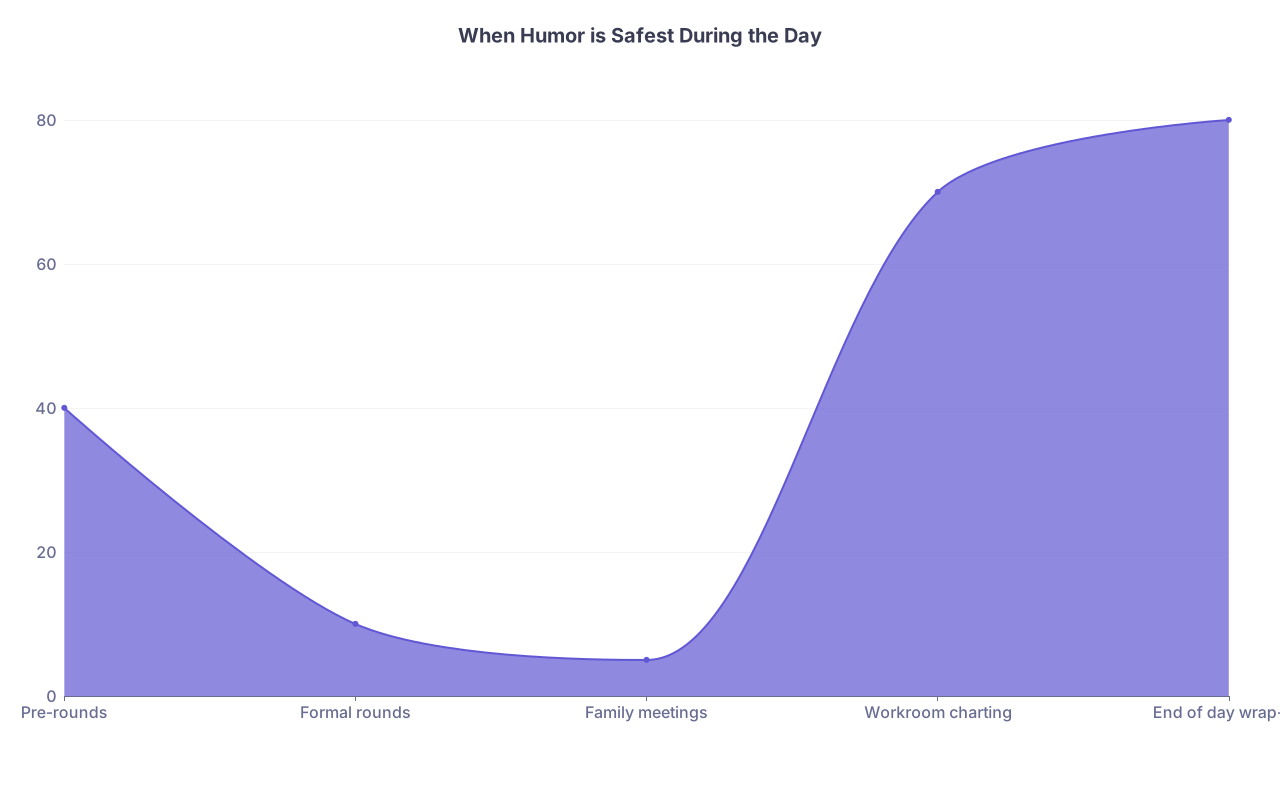
| Category | Value |
|---|---|
| Pre-rounds | 40 |
| Formal rounds | 10 |
| Family meetings | 5 |
| Workroom charting | 70 |
| End of day wrap-up | 80 |

FAQs
1. My attending makes edgy jokes all the time. Won’t I seem uptight if I don’t join in?
No. You’ll seem professional. You can smile, give a small chuckle, and keep your own comments mild. “I’m still figuring out my professional filter, so I try to stay on the safe side” is a perfectly acceptable stance if it ever comes up. Most attendings respect restraint more than forced edginess.
2. Is it ever okay to use dark humor with co-residents?
Privately, with people you know well, behind a closed door, not about specific identifiable patients, and not when anyone is actually in crisis—maybe. But even then, it’s easy to cross a line. Assume anything you say could be repeated or misheard by someone not in on the context. If the joke would look horrifying in an email screenshot, you probably should not say it out loud either.
3. What if I already made one of these mistakes—am I doomed?
One misstep usually won’t sink you, but patterns will. If you know you crossed a line and an attending clearly didn’t like it, tighten up immediately. A simple, “I realize that comment wasn’t appropriate—won’t happen again,” can go a long way. Then actually stop. People watch what you do next more than the original slip.
4. How can I tell if my humor is landing badly if no one says anything?
Watch for micro-reactions: sudden quiet, forced half-laughs, quick subject changes, or people avoiding eye contact right after you speak. If an attending stops including you in side conversations, goes formal with you, or their body language closes off when you start talking, your humor may be part of the problem. When in doubt, dial humor down by 70% and focus on being clear, kind, and competent.
Key takeaways:
- Jokes about patients, death, impairment, or boundaries don’t make you look strong—they make you look unsafe.
- Humor is a tool; used wrong, it convinces attendings your judgment is questionable. Used sparingly and thoughtfully, it can actually build trust.