
The casual sarcasm you think is “just how medicine works” is quietly gutting your team’s trust.
Not dramatic. Not obvious. But corrosive. Drip by drip. Comment by comment.
If you are on rounds—attending, fellow, senior resident, intern, student—and you treat sarcasm as your default communication style, you are making a serious, repeated professional mistake.
Let me walk through how this actually plays out. Because I have watched smart, well-meaning people wreck team culture with “jokes” they barely remember 10 minutes later—but the intern remembers for years.
The Hidden Problem With “Just Kidding” Culture
You know the lines:
- “Great plan… if we were still practicing in 1980.”
- “Sure, order that. I will just cancel it after rounds.”
- “Did you read any of the chart or just vibes?”
- “Remind me, are you a med student or a TikTok influencer?”
Everyone laughs. Or at least pretends to.
Here is the mistake: you assume shared understanding and shared power. You assume they know you are joking. You assume they feel safe enough to laugh. You assume your status gives you a free pass.
You are wrong.
What you actually teach your team:
- Real questions will be met with ridicule.
- Imperfect answers are dangerous.
- Vulnerability is ammunition.
- The safest move is to stay quiet, nod, and disappear.
That matters on rounds. It matters much more at 2 a.m. when a scared intern is deciding whether to wake you up or “figure it out on their own.”
Humor vs Sarcasm: Stop Confusing Them
Humor builds connection. Sarcasm—especially downward, from power to less power—builds distance.
- Sharing a self-deprecating story about your first code blue? Good.
- Turning a student’s wrong answer into a punchline for the team? Bad.
- Laughing together about how impossible Epic’s interface is? Fine.
- Mocking a resident’s documentation in front of the team? Not fine.
If the laugh comes at the expense of the least powerful person in the group, it is not harmless.
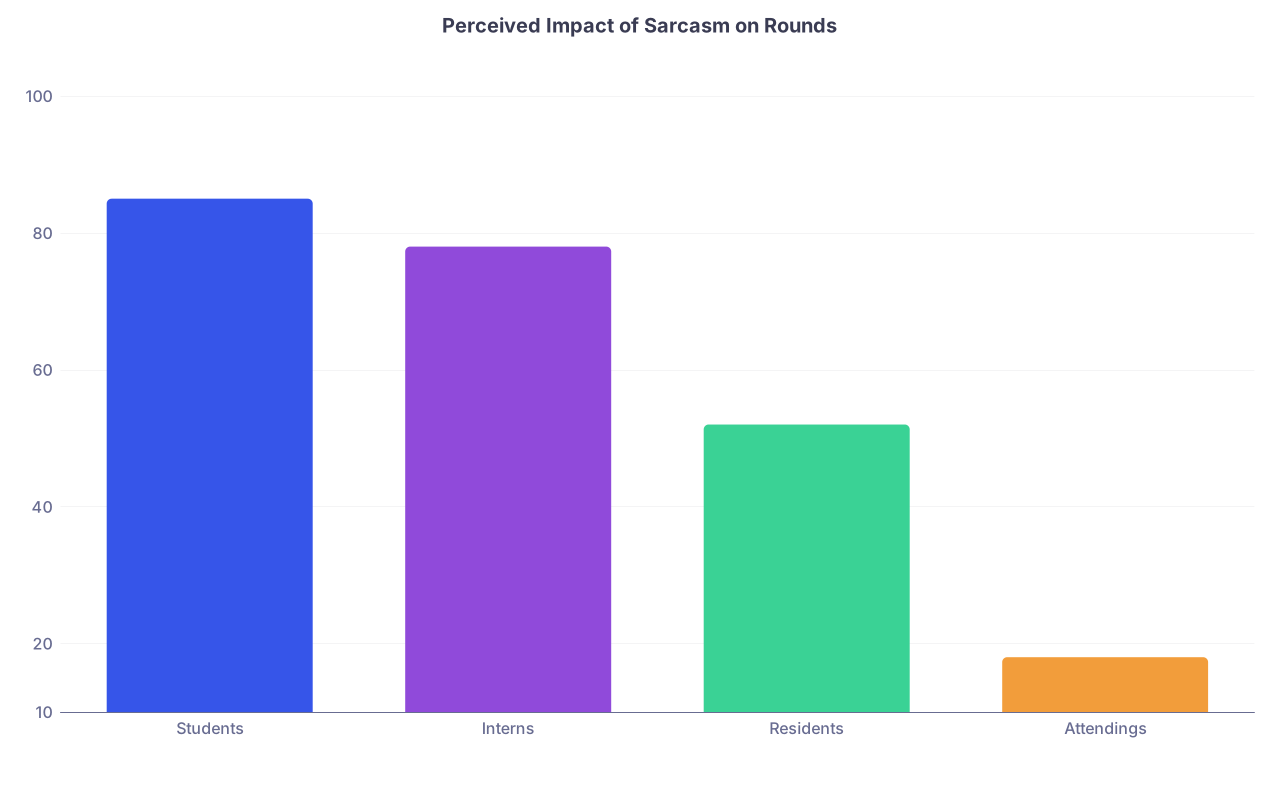
| Category | Value |
|---|---|
| Students | 85 |
| Interns | 78 |
| Residents | 52 |
| Attendings | 18 |
The people most hurt by sarcasm are the ones least likely to tell you.
How Sarcasm Specifically Destroys Trust on Rounds
Trust in medicine is not abstract. It is painfully practical. It is:
- “Can I admit I am over my head?”
- “Will I call for help before I am sure this is a disaster?”
- “Can I say ‘I do not know’ without being humiliated?”
Sarcasm is a direct attack on all three.
1. It Punishes the Three Most Important Phrases
The three most protective phrases in training:
- “I do not know.”
- “I am not comfortable.”
- “I need help.”
Now imagine each one immediately followed by a sarcastic hit:
- “You do not know? Did you go to medical school or YouTube University?”
- “Not comfortable? Should we get you a weighted blanket too?”
- “Need help? Already? It is 8:15 a.m.”
You just taught that person:
- Next time, guess.
- Next time, avoid eye contact.
- Next time, fix it alone.
And then people wonder why errors do not get escalated early.
2. It Turns Learning Into Performance
Rounds are already theater. The chart is the script, the attending is the critic, everyone else is trying to avoid getting publicly roasted.
Sarcasm takes that anxiety and supercharges it.
A sarcastic attending or senior creates a game:
- Answer quickly, perfectly, confidently.
- Do not ask “dumb” questions.
- Protect your ego at all costs.
So what do people do?
- Parrot buzzwords they do not understand.
- Give overly certain answers.
- Hide uncertainty.
You think you are building “toughness.” You are actually building pretend competence—which is just a nice phrase for unsafe.
3. It Erodes Psychological Safety—Fast
The term “psychological safety” gets thrown around so much it sounds like an HR slogan. Strip away the jargon and it is simple:
Do people believe they can speak up without being punished or humiliated?
Sarcasm is a micro-punishment for speaking at all.
- You answer? Risk a sarcastic hit.
- You admit confusion? Risk a sarcastic hit.
- You suggest a plan that is not perfect? Risk a sarcastic hit.
After a week, your team talks 50% less. After a month, they talk only when forced. After a year, they will avoid working with you if they can.

Common Defenses People Use to Excuse Their Sarcasm
If you are already getting defensive reading this, pay close attention. I have heard every justification in the book. Most are flimsy.
“That is just my sense of humor”
Translation: “I prioritize my entertainment over your safety and learning.”
If your humor:
- Punches down the hierarchy
- Targets individuals, not situations
- Leaves people more guarded than before
…then it is not “just your sense of humor.” It is a leadership failure.
You can be funny without being cutting. You are in medicine, not onstage at a roast.
“They need to toughen up; this is medicine”
No, they need to be competent, accurate, and honest.
You do not train honesty by punishing it. You do not train rapid escalation by humiliating early escalation attempts. You do not train resilience by making the learning environment hostile.
The people who “survived” brutal, sarcastic training are a biased sample. The ones destroyed by it left quietly. Burned out. Or switched fields.
Stop using survivor bias as justification for replicating bad behavior.
“Everyone knows I am joking”
You know who “everyone” is?
- Your co-attending who has known you for ten years.
- The fellow who rotated with you last year.
- The senior resident who has seen both your joking and your serious mode.
You know who does not know?
- The terrified MS3 on their second day of clerkships.
- The IMG intern whose first language is not English.
- The resident on a remediation plan wondering if every comment is a veiled threat.
Sarcasm relies heavily on tone, context, and relationship. Rounds are a mess of hierarchy, stress, and mixed messages. That is not a safe place to gamble on “they know I do not mean it.”
The Subtle Ways It Shows Up (That You Are Probably Missing)
Not all sarcasm is a dramatic one-liner. Some of the most damaging stuff is quieter, sneakier, and socially acceptable.
Watch for these patterns in yourself:
1. “Compliments” With a Knife in Them
- “Nice presentation. I almost thought a resident had written it.”
- “That is actually a decent note… for a student.”
- “Good catch. Maybe there is hope for this team.”
It sounds like praise. It feels like a put-down. The learner hears: “You are normally not good enough.”
2. Exaggerated Eye-Roll Narration
You do not have to say much. The team watches you:
- Roll your eyes when someone asks you to repeat an explanation.
- Exchange a smirk with the fellow when the intern fumbles.
- Sigh loudly when a student starts presenting “too much detail.”
You might think you are subtle. You are not. Everyone sees it. And they notice who you do it to.
3. Group Laughter as Social Weapon
You throw a sarcastic line. The room laughs.
The target laughs too—nervous, tight laugh. You see “they are fine.” I see someone calculating in real time:
- “If I do not laugh, I look oversensitive.”
- “If I say something, they will call me unprofessional.”
- “If I pretend this is funny, maybe they will like me more.”
When group laughter becomes a defense mechanism, your culture is already broken.
| Scenario | Sarcastic Response | Constructive Alternative |
|---|---|---|
| Wrong answer on exam question | "Bold strategy, lets not try that" | "Not quite, walk me through your thinking" |
| Missed lab value overnight | "Glad someone finally opened the chart" | "We missed this; how can we catch it earlier next time?" |
| Nervous student presenting | "Take a breath, we have all day" | "Pause for a second, you are doing fine" |
| Over-ordering tests | "Are we auditioning for radiology?" | "Tell me what you want to learn from this test" |
The downstream consequences you actually care about: patient care and your reputation
If you do not care about feelings, fine. Let us talk outcomes.
1. You Will Hear About Problems Later—Or Not At All
Teams that fear sarcasm:
- Delay telling you when a patient looks worse (“maybe I am overreacting”).
- Soften concerning findings (“they are a little hypotensive”).
- Avoid calling you overnight (“they will make a comment about this”).
Delays = harm. It really is that simple.
2. Your Evaluations Will Be Quietly Brutal
You might think, “They all laugh, no one complains.” Look at your evals. The coded language appears:
- “Sometimes unapproachable”
- “Feedback style can be harsh”
- “Rounds can feel intimidating for learners”
Those phrases are the watered-down version of what they actually say about you in the workroom.
Over a career, that reputation follows you:
- Fewer people eager to work with you.
- Less honest feedback reaching you.
- More mistakes repeated because no one is willing to tell you how you actually come off.
3. Your Best People Will Say Nothing—and Then Leave
The high performers. The conscientious ones. The people you want in your specialty.
They do not usually confront you. They self-sort:
- They rank other programs higher.
- They pick different attendings for electives.
- They move toward teams where they are not the punchline.
You are left surrounded by people who tolerate your behavior. You call it “team fit.” It is just selection pressure doing its job.
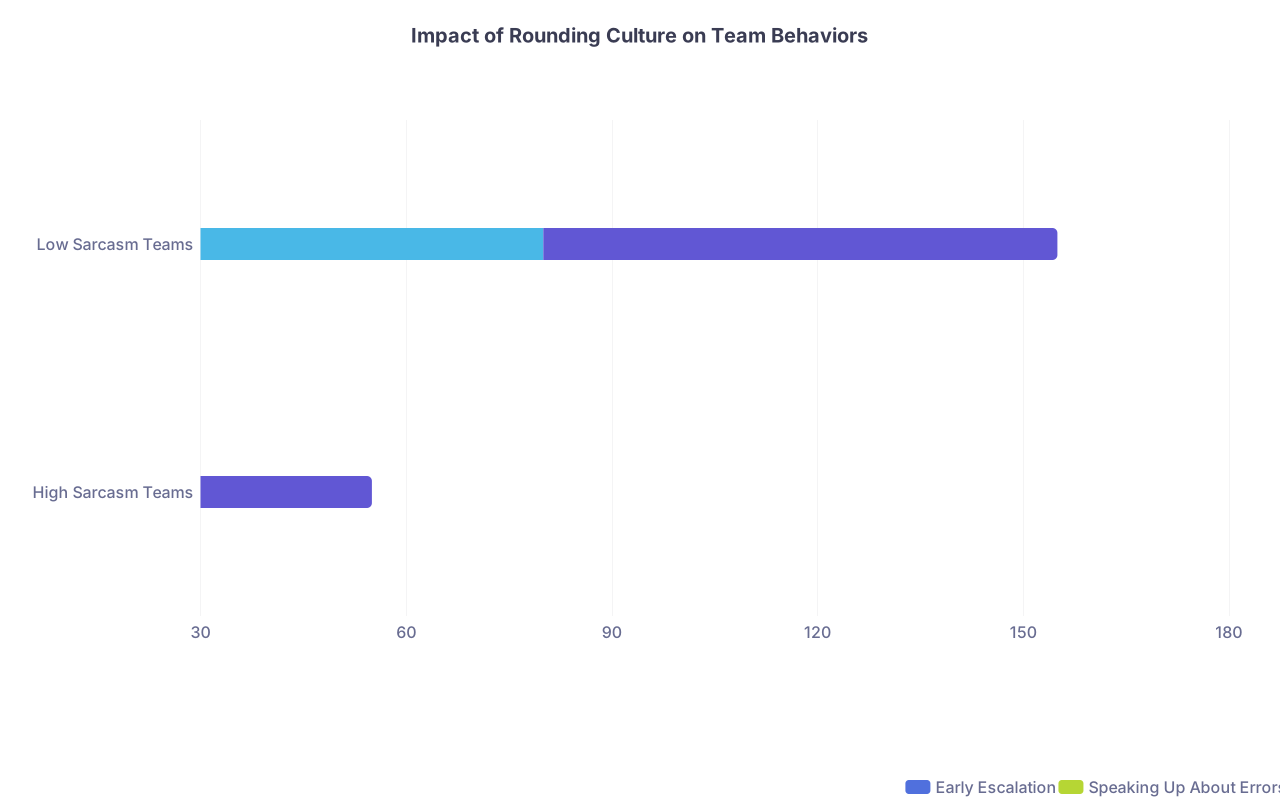
| Category | Early Escalation | Speaking Up About Errors |
|---|---|---|
| High Sarcasm Teams | 30 | 25 |
| Low Sarcasm Teams | 80 | 75 |
If You Want to Avoid This Mistake, Do These Specific Things
Do not just “try to be nicer.” That is vague and useless. Change concrete behaviors.
1. Ban One-Liner Put-Downs From Your Rounds
Set a personal rule:
No humor that targets a person on the team. Only humor that targets:
- The system
- The situation
- Yourself
Examples you keep:
- “Only Epic could make three clicks feel like a full workout.”
- “I definitely missed this exact thing as a resident; my attending still reminds me.”
Examples you drop:
- “You sure you are not actually a surgical intern with that note?”
- “I would ask you to interpret the EKG, but I want the patient to live.”
2. Make “I do not know” a Protected Phrase
Explicitly say on day 1:
“On this team, ‘I do not know’ is always acceptable. You will never be mocked for it. You will only be pushed if you fake it.”
Then back it up:
- When someone says “I do not know,” respond with curiosity, not sarcasm.
- When someone fakes an answer, call that out—gently but firmly.
3. Fix It in Real Time When You Slip
You will slip. Old habits are sticky. What matters is what you do next.
Scenario: You make a sarcastic comment, see the student’s face fall.
Repair immediately:
- “Hold on—let me reset. That came out snarkier than I intended. Your question is valid. Let us walk through it.”
That single move teaches the team:
- You are aware of your impact.
- You are willing to own mistakes.
- It is possible to repair in this culture.

| Step | Description |
|---|---|
| Step 1 | Notice sarcastic impulse |
| Step 2 | Stop and rephrase |
| Step 3 | Check for safety |
| Step 4 | Proceed with joke |
| Step 5 | Use neutral or self directed humor |
| Step 6 | About a person? |
| Step 7 | Could it embarrass someone? |
4. Ask for Specific Feedback on Your Style
Not “Do I seem mean?” That is too blunt and socially loaded. Try:
- “On rounds, does my humor ever make it harder for you to ask questions?”
- “Is there anything I say that lands differently than I intend?”
And then do the hardest part: do not argue. Do not explain. Listen. Thank them. Adjust.
The Future of Medicine: This Crap Will Not Fly Much Longer
You may think, “This is how it has always been. People are just more sensitive now.”
What is actually happening:
- More data on psychological safety and patient outcomes.
- More programs tracking learning environment metrics.
- More accrediting bodies caring about “professionalism” in a serious way.
The “sarcastic but brilliant” attending archetype is dying. Slowly, but inevitably.
Future leaders in medicine will be judged not just on:
- RVUs
- Publications
- Technical skill
But also on:
- How many people they train well.
- How many people stay in the field after working with them.
- How open and honest their teams are under stress.
Sarcasm-heavy culture will not survive that shift.

Quick Self-Audit: Are You the Sarcastic One?
Run through this checklist. If you answer “yes” to more than two, you have a problem.
- Do people laugh when you speak, but rarely voluntarily bring you questions later?
- Do you often start feedback with “I am just kidding but…” or “In all seriousness though…”?
- Do you tell stories about “destroying” or “pimping” a student and treat it like a funny war story?
- Do you think of yourself as “the honest one” or “the one who tells it like it is,” but your evals hint that you are “intimidating”?
- Do learners stop making eye contact with you after the first week?
If yes, you can fix this. But only if you stop telling yourself it is harmless.