
It is 11:47 p.m. on a post‑call evening. You are half‑awake, scrolling through X/Instagram/Threads. Someone posted a meme about consults being useless or about “dumping” patients on night float. You tweak it, slap on a caption about your hospital, and hit “post” from your public account with your real name and “Internal Medicine PGY‑2” in your bio.
You get 50 likes in 10 minutes. Someone comments, “Say it louder!” You go to bed feeling clever.
Now fast‑forward nine months. You are sitting in a fellowship interview. The program director is unusually quiet, shuffling papers. Then they say it:
“We have some concerns about your professionalism online.”
They turn a print‑out toward you. It is your “funny” post. Time stamp. Username. Hospital clearly identifiable.
You feel your stomach drop.
That is the scenario I want you to avoid.
This is not hypothetical. I have watched outstanding residents lose interviews, get quietly dropped down rank lists, or have entire selection committees side‑eye their application because of one ill‑judged “joke” online. Not a pattern. One post.
Let me walk you through the mistakes people keep repeating and how to not be that story.
Mistake #1: Assuming “Everyone Knows It’s a Joke”
The most dangerous sentence in residency and fellowship applications: “But it was obviously a joke.”
No, it was not. Not to the person who screenshots without context. Not to the PD scrolling at 5 a.m. between pre‑rounds. Not to the applicant reviewer who has just read a professionalism probation note in your MSPE and then sees your meme about “faking vitals to get out early.”
Humor online is missing three vital components: tone, audience, and control.
- Tone: Sarcasm does not translate reliably in text.
- Audience: You imagine co‑residents. In reality, you have patients, attendings, past fellows, and future PDs watching.
- Control: Once posted, you do not decide who saves, shares, or reframes it.
Here is how committees actually read your “obvious joke”:
- “Maybe they cut corners.”
- “Do they treat nurses like that in person?”
- “If they are this loose on Twitter, what are they like in the hospital?”
- “Do I want this person representing my program’s name online?”
I have been in a room where someone pulled up a highly liked meme from a popular resident account. The candidate thought it was harmless. The committee called it a “professionalism red flag” and moved on to the next application. Zero debate.

Mistake #2: Thinking You Are Anonymous (You Are Not)
“Relax, I use a burner account.”
I hear this a lot. It is naive.
Here is how “anonymous” accounts get unmasked in real life:
- You mention your exact call schedule or rotation blocks.
- You reference a very distinctive institutional policy, EMR, or internal nickname.
- You post a photo from a specific ward with a mural or window pattern everyone at that hospital recognizes.
- You share your own publication or conference poster and link it to the same handle.
- Someone from your program recognizes your writing style and tells one other person. That is all it takes.
The medical world is small. Fellowship worlds are microscopic. Transplant. Cardiology. GI. Critical care. Same national meetings. Same Twitter circles. Same echo chamber. If your “anonymous” account mocks attendings, trashes certain patient populations, or makes lazy jokes about overdose patients, word gets around.
And here is the kicker: you do not need to be definitively “proven” as the author for it to damage you. If even two people on a selection committee believe a certain toxic account is probably yours, they will often just quietly err on the side of not ranking you.
This is the unspoken rule: plausible association is enough to hurt you. Not fair, but real.
Mistake #3: Posting Anything That Looks Like a Patient, Ever
You already know you should not post identifiable patient information.
What people underestimate is how low the bar is for “identifiable.”
“Middle‑aged man with advanced lung cancer who codes on his birthday and his dog is brought into the ICU so he can say goodbye” with a blurry photo of the dog’s collar and the hospital unit in the background?
I have seen stories like this posted with “no face shown” and the resident insisting “it is de‑identified.” It is not. Anyone who was on that unit that day could recognize the scenario. Family could recognize it. That is enough.
Here is where you step on the land mine:
- Screenshots of the EMR (even blurred). Someone will unblur or reconstruct.
- Photos with unique tattoos, clothing, or room decorations in the background.
- “Funny” screenshots of patient messages, MyChart messages, or consult texts.
- Stories that combine rare condition + exact time frame + institutional descriptor.
HIPAA aside, fellowship reviewers use this as a trust metric. If you compromise patient privacy for engagement online, they assume you will compromise judgment in clinic when stressed.
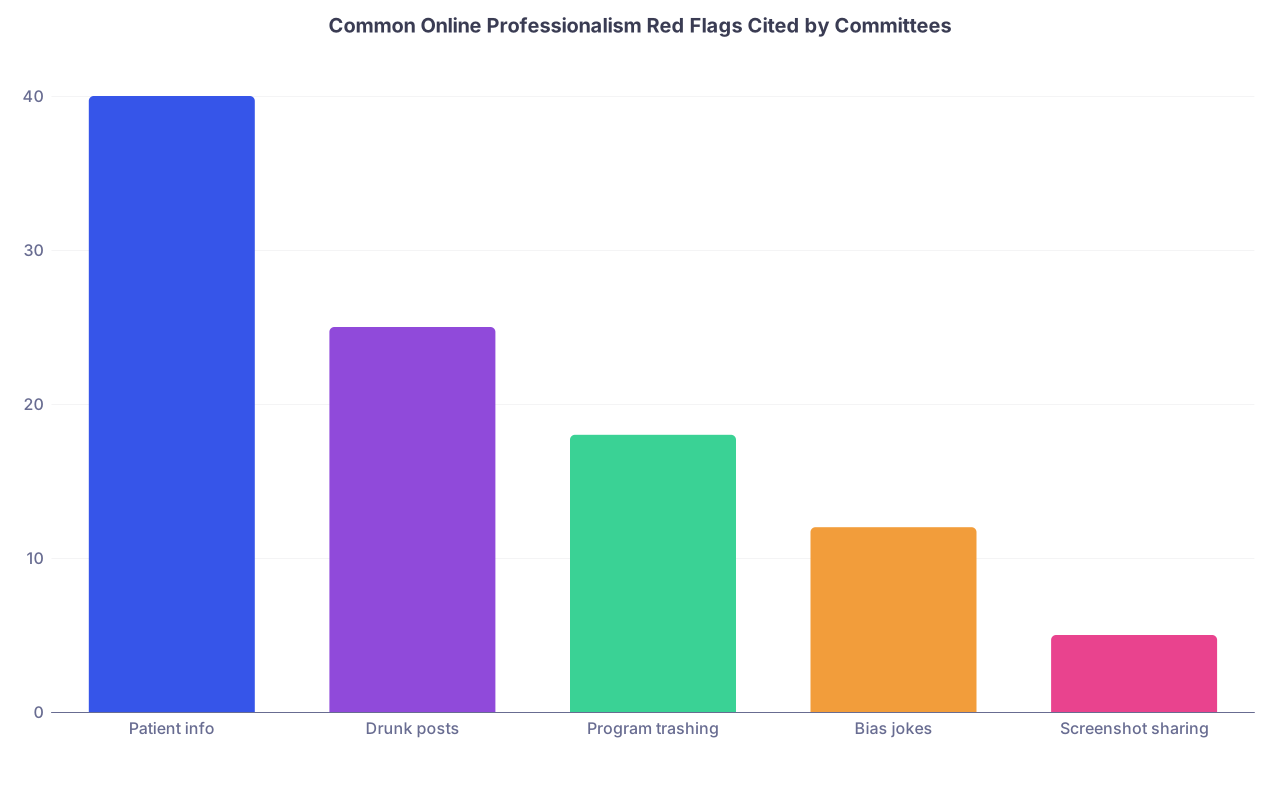
| Category | Value |
|---|---|
| Patient info | 40 |
| Drunk posts | 25 |
| Program trashing | 18 |
| Bias jokes | 12 |
| Screenshot sharing | 5 |
Quick rule: if a patient (or their family) saw your post and could plausibly recognize themselves, you have already crossed the line.
Mistake #4: Confusing “Medical Humor” With Punching Down
“Medical humor” that trashes systems, paperwork, call schedules, and bureaucracy? Usually fine.
“Medical humor” that demeans patients, nurses, specific specialties, or vulnerable groups? That is where you start wrecking your reputation.
Patterns that program directors hate:
- Repeated jokes about people with substance use disorders “always lying.”
- Comments about certain patient populations being “noncompliant” as a punchline.
- Dark jokes about suicide attempts, self‑harm, or eating disorders.
- “Humor” that makes light of disability, obesity, or mental illness.
Translated into committee language, this is “lack of empathy,” “implicit bias,” “possible professionalism risk,” “questionable fit with our culture.” You may think they are being too sensitive. They do not care. They have 400 other applicants to choose from who did not make that mistake publicly.
Punch line hierarchy:
- Punch up: systems, insurance companies, ridiculous workflows, prior auth, EMR pop‑ups. Safer.
- Sideways: your own exhaustion, your own mistakes (tastefully), the absurdity of training. Usually fine if not self‑incriminating.
- Punch down: patients, vulnerable groups, nurses, techs, staff, or junior trainees. Career poison.
You want to be the person who clearly directs their frustration toward systems, not toward the humans stuck inside those systems with you.
Mistake #5: Forgetting That Fellowship PDs Absolutely Search You
I have heard residents say: “They do not have time to look at my Twitter.”
Yes, they do. Some do it personally. Some have a coordinator or chief resident do it. Some just Google your name and click whatever appears. It takes 60 seconds.
And it is asymmetric. One bad post outweighs 100 neutral or good posts.
I sat once with a PD who had printed three screenshots for one candidate:
- A meme calling a specific surgical specialty “brain‑dead monkeys.”
- A jokey thread about “gaming” the system to get out of work earlier.
- A drunk photo with a hospital badge fully visible and open bottles lining the table.
The application itself was otherwise solid: strong letters, good scores, solid research. The decision around the table: “Too risky.” No phone call. No warning. Just a hard pass.
I am not trying to scare you straight for fun. I am telling you how people actually talk when your file is not in the room.
| Check Type | How Often It Happens (Realistically) |
|---|---|
| Google your full name | Very common |
| Search on LinkedIn | Very common |
| Search on X/Twitter | Common in academic fields |
| Look at Instagram bio | Common if public & easy to find |
| Deep-dive all old posts | Less common but happens for red flags |
Assume someone will look. And assume they will look when they are tired, short on time, and disinclined to give you the benefit of the doubt.
Mistake #6: Underestimating How Long Digital Footprints Last
Deleted does not mean gone.
People screenshot. Archive. Repost. Quote‑tweet. Use third‑party tools. Ask anyone who has been “ratioed” for a bad take how quickly control evaporates.
The worst timing for an old post to resurface is right when:
- Your name is announced as chief resident.
- You receive a major award.
- You match to a high‑profile fellowship with a media presence.
Because increased visibility invites scrutiny. People search your old handle. They scroll back years “just to see.” A post from M2 where you made a cheap joke about a marginalized group can blow up when you are PGY‑4 trying to match heme/onc.
And yes, some committees will quietly search your old usernames if they pick them up from screenshots or mutual followers. I have seen a PD say, “This account was deleted last month, which is…interesting.” Translation: they suspect you scrubbed something.
Better approach: do not post material that you would be terrified to see next to your real name five years from now. That is the standard. Not, “Can I delete it later?”
Mistake #7: Letting Alcohol or Burnout Drive Your Posting
Bad posts are rarely made at 10 a.m. after coffee.
They are made:
- At 1:32 a.m., post‑call, furious about an “unreasonable” family.
- After three drinks, venting about your program.
- In a group chat that someone later screenshots and shares publicly.
- During a spiral of feeling unappreciated, you go looking for validation online.
You know this already in a different context. You would never write a note in the EHR after two beers. But people will absolutely live‑tweet their anger with their real name visible.
Common “heat of the moment” mistakes:
- Naming your hospital while complaining about unsafe staffing.
- Calling out a specific attending or service.
- Using slurs or derogatory language that you would not use sober.
- Oversharing your own mental health struggles in a way that feels concerning to reviewers.
Let me be clear on that last one: having mental health struggles is not the problem. Blurring the line between personal processing and public spectacle is. Committees will wonder: “If they are this unfiltered online when in crisis, what happens under pressure in our ICU?”
You are allowed to have private, honest conversations. With friends. With a therapist. With trusted co‑residents. Public performative oversharing with your professional identity attached is a different thing.
Mistake #8: Believing “But I Need My Authentic Voice” Is a Defense
You will hear this counter‑argument: “We should be allowed to be real online. Policing our speech is toxic.”
I agree on the first part. You should be real. But “real” does not require you to be reckless.
Fellowship directors are not against authenticity. Some of them are on social media themselves. They are against liability. Headlines. Patient complaints. HR investigations. Angry emails to the Dean about their trainee’s viral post.
Your “authentic voice” is not more important than a sick patient’s sense of safety. Or your colleagues’ trust. Or your sponsoring institution’s reputation. That is the hierarchy whether you like it or not.
You can be funny, sharp, and honest online without:
- Degrading patients.
- Violating privacy.
- Broadcasting unprofessional behavior.
- Exposing your program or colleagues.
If your brand of authenticity requires all of the above, that is not authenticity. That is poor judgment wrapped in defensiveness.
Mistake #9: Not Separating “Personal” From “Professional” Enough
You do not need to be a monk online. But if you are serious about fellowship, you must draw some clean lines.
Practical ways people screw this up:
- Bio lists hospital, PGY level, and specialty, then feed is filled with explicit party content and vulgar jokes.
- Same handle is used to network at conferences and to subtweet your chief.
- Professional headshot as profile photo, but pinned tweet is about how you “called in sick to get a beach day.”
This is what it signals: “I want the credibility of my professional affiliation when it helps me, but I refuse accountability when my public behavior reflects badly on it.”
Programs notice the mismatch. They infer entitlement.
Safer architecture:
- If you want a professional presence: separate account, real name, very cautious content, networking, publications, advocacy.
- If you want a private personal presence: private account, locked, minimal identifiers, and you still avoid anything that would be catastrophic if leaked.
Split does not guarantee safety, but it reduces surface area. Right now many residents have one messy hybrid account that does everything poorly.
Mistake #10: Assuming “Everyone Else Is Doing It and They Are Fine”
You see high‑follower accounts posting spicy content and think, “They got away with it, so I will too.”
You are missing the survivorship bias. You notice the success stories. You do not see the people who:
- Never got interviews at dream programs because of a quiet veto.
- Had offers rescinded and were told “fit issues.”
- Had to explain a viral post at every single interview, burning half their time defending themselves.
- Became “that resident from Twitter” in their faculty’s minds, overshadowing their actual work.
I know of a resident who lost a spot on a very competitive fellowship’s rank list specifically because one vocal faculty member on the committee felt their online presence “reflected poor professionalism and judgment.” The rest of the room shrugged and moved on. The candidate never knew.
The downside risk is huge. The upside of that one sarcastic, edgy post? A few likes and fleeting validation.
Terrible trade.
What To Do Instead: Safer Ways To Use Medical Humor Online
I am not telling you to disappear from the internet. I am telling you to stop playing with matches near oxygen.
If you want to stay in “medical humor” spaces without tanking your future, tighten your rules:
- Never post anything that even potentially identifies a patient or family.
- Never mock a patient population, vulnerable group, or mental illness.
- Avoid talking about your specific institution in ways that are critical or mocking.
- Treat every post as if it will be read aloud in your fellowship interview.
- If there is alcohol or anger involved, do not post. At all.

| Step | Description |
|---|---|
| Step 1 | Have an idea for a joke |
| Step 2 | Do not post |
| Step 3 | Probably safe to post |
| Step 4 | Involves patient or family? |
| Step 5 | Targets vulnerable group? |
| Step 6 | Mentions institution or colleague? |
| Step 7 | Could seem disrespectful? |
| Step 8 | Ok if PD sees it? |
If you want to push boundaries with dark humor, do it in private group chats with people you trust. Not on platforms where strangers, bots, and future employers live.
And if you already have questionable posts up? Start cleaning. Not with panic, but with judgment. Remove anything:
- Patient‑adjacent
- Overtly derogatory
- Obviously incompatible with the professional you want to be
Then, going forward, stop making new messes.
FAQs
1. I already posted something borderline. Should I delete it or leave it so I do not look like I am “hiding” something?
Delete it. Immediately. The idea that committees will be more suspicious because you removed an unprofessional post is fantasy. They are far more likely to never see it at all if it is gone. If someone already screenshotted it and confronts you later, own it: “I realized it was inappropriate and removed it.” That is still better than leaving it up.
2. Can I safely participate in anonymous meme pages or residency confession accounts?
“Safely” is a strong word. If your content is non‑patient, non‑derogatory, and system‑targeted, risk is lower. But you are never truly anonymous. If the tone is toxic or mocking patients, consider that anyone could leak your association with that account at the worst possible time. If you would be ashamed to be publicly linked to it, do not contribute.
3. What about sharing my burnout or mental health struggles online? Will that hurt my fellowship chances?
Talking about burnout and mental health can be valuable and destigmatizing. The line you must not cross is turning acute crisis into public spectacle with your professional identity attached. If you are posting in the middle of a breakdown, log off and get help offline. Thoughtful, reflective posts written from a stable place and with boundaries are very different from raw, alarming threads that make reviewers question your stability under pressure.
4. Is it okay to joke about attendings, consultants, or other specialties?
Light, good‑natured ribbing that does not call anyone incompetent, lazy, or useless is usually fine, especially if detached from real names or institutions. The moment your “joke” implies actual incompetence, malice, or stupidity in colleagues, you are telegraphing that you are a poor team player. Fellowship programs care deeply about how you function on interdisciplinary teams. Do not give them reason to doubt you.
5. I want to build a professional social media presence for networking and advocacy. How do I avoid land mines?
Treat it like an extended CV with a human voice. Use your real name, share your work, comment on literature, advocate for patients and trainees, and join professional discussions. Before posting, ask: “Would I be comfortable with my PD, my fellowship director, my future employer, and my sickest patient all reading this?” If yes, post. If no, rework it or keep it offline.
Key points to carry forward:
- One “funny” post can carry more weight in a fellowship decision than you think; do not trade your future for cheap engagement.
- Patients, colleagues, and institutions are never safe targets for your public jokes; punch up at systems, not down at people.
- Assume every post is permanent, searchable, and printable in an interview—if that thought makes you queasy, do not post it.