You’re closer than you think to being the resident people roast in the private group chat.
Not because you’re evil. Because you’re oblivious.
Most of the residents who get turned into screenshots aren’t monsters. They’re mildly self-absorbed, stressed, and unaware of how they come across. But medicine is a small world with long memory. The “lol look at this text from my resident” screenshots stick.
Let’s make sure you’re not that resident.
1. The Screenshot Trifecta: Texts, EMR Notes, and Group Messages
If you remember nothing else, remember this: anything written can be screenshotted. And it will be.
There are three main danger zones:
- Direct texts / DMs
- EMR notes and orders
- Group chats and broadcast messages
You only need one bad moment in any of those to become That Resident.
1.1 Texts & DMs: Where your mask slips
The classic mistake: you think you’re “being efficient” or “just direct.” Everyone else reads it as hostile, condescending, or unhinged.
Examples I’ve actually seen passed around:
- “Hey, I need you to stop leaving before 7. You’re an intern, not a med student.”
- “Next time you page me at 3am for something like that, I’m not answering.”
- “Read about it.” (as the entire response)
- “This isn’t hard. Just use common sense.”
You know what all of those have in common?
They were screenshotted. Instantly. And sent to 3–5 separate chats.
How not to be the screenshot:
Don’t text while angry, tired, or humiliated.
If you’re feeling your heart rate go up, don’t text. Call. Your voice is almost always kinder than your typing.Avoid “you” + judgment words:
- “You should know this.”
- “You’re an intern now.”
- “You clearly didn’t look.”
Replace with neutral, task-focused phrasing:
- “Next time for this, check X, Y, Z first, then page me if still unclear.”
- “For cross-cover overnight, use this order set; if anything seems off, page.”
Never weaponize “read about it.”
It’s the “go Google it” of medicine. If you want them to learn, give one specific term, paper, or resource:- “Quick read: UpToDate on hyperK management, start with the algorithm section.”

1.2 EMR notes: The screenshots that last forever
You think nobody screenshots EMR notes? That’s cute.
- The 45-line tirade about “noncompliant patient”
- The note calling another service “unhelpful”
- The passive-aggressive aside: “Reviewed with night team who did not document exam”
Those live forever. And yes, attendings, nurses, consultants, and occasionally risk management see them.
Don’t be that note:
Never type anything angry into the EMR.
Not even in the “temp save” draft. That’s still discoverable in many systems.Avoid blamey language:
- “Nurse failed to…”
- “Family refused to listen…”
- “ED missed…”
Replace with neutral, legal-safe language:
- “Family declined X after discussion of risks/benefits.”
- “ED workup did not include CT head; obtained this morning.”
Assume any sentence could be read in court, in a deposition, and in three group chats.
If your note makes you feel emotionally satisfied, it’s probably inappropriate.
2. Abuse of Power (a.k.a. Pager Bullying in 2026 Clothes)
The fastest path to group chat infamy? Abusing whatever tiny scrap of power you think you have.
No one screenshots, “Thanks, good catch.”
They screenshot the nonsense.
2.1 The “I suffered so you must too” resident
This one is everywhere.
Common behaviors that make you instantly screenshot-worthy:
- Bragging about how late you stayed (“I never left before 9 as an intern”)
- Guilt-tripping people who go home on time
- Shaming someone for taking a sick day
- Making “back in my day” comments as a PGY-2. Relax.
You think you’re building a culture of toughness.
Everyone else sees a fragile ego that needs their suffering validated.
Better move: Acknowledge the system is broken without reenacting the abuse.
- Wrong: “We all did this, you just suck at time management.”
- Right: “The workload is rough. Let’s look at how to streamline your pre-rounding so you’re not here till 8.”
2.2 Weaponizing the schedule
Yes, residents talk about who makes the schedule. They talk more if it’s bad.
Red flags that your schedule is getting screenshotted:
- One person consistently getting the worst call blocks
- You always having the “cush” rotations
- Passive-aggressive punishment scheduling after conflicts
- Posting the schedule late and then acting shocked people made plans
You’ll never please everyone. But do not be opaque. Do not be obviously self-serving.
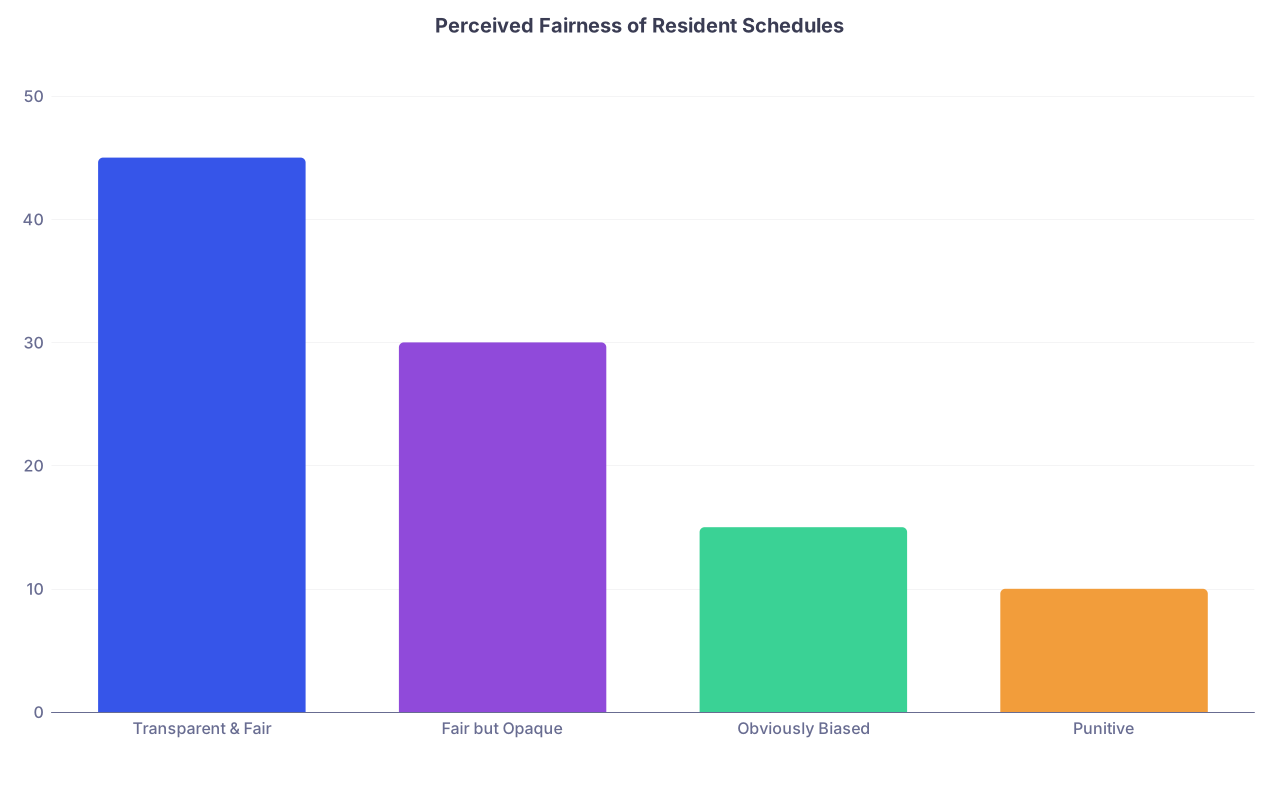
| Category | Value |
|---|---|
| Transparent & Fair | 45 |
| Fair but Opaque | 30 |
| Obviously Biased | 15 |
| Punitive | 10 |
You know which column gets screenshotted the most.
Protect yourself with:
Clear rules (in writing) for:
- Call distribution
- Holidays
- Switching shifts
A paper trail:
- Email: “Here’s the call schedule, here’s how I assigned it, let me know if anything looks off.”
When people see you trying to be fair, they vent less. Or at least they don’t turn you into meme material.
3. The Performance Resident: All Optics, No Substance
You know the type:
- Loud on rounds
- Loud about “patient safety”
- Weirdly quiet when it’s time to help with discharges at 4:30 pm
This person always ends up in screenshots. Because they’re annoying and obvious.
3.1 Over-flexing knowledge in public, under-teaching in private
You absolutely can teach on rounds without humiliating people. The ones who don’t? They get immortalized.
Things that get quoted in group chats:
- “Wow, you don’t know that?”
- “This is basic.”
- “Did you even read the signout?” (in front of the attending)
- “What did you even do last night?”
You’re trying to impress the attending. But the attending leaves in a year. The interns don’t forget.
Safer pattern:
- Ask: “What’s your current framework for X?”
- If they don’t know: “No problem, let’s build one.”
- Save any hard feedback for a quick 1:1: “Hey, you seemed unsure on the hyperK management. Tonight, just review X so you feel better next time.”
That style never gets screenshotted with a “look at this jerk.”
At worst, you get a “honestly, they’re intense but fair.”
3.2 The “tone-deaf in crisis” resident
Real cases I’ve seen people rage-text about:
- Patient just died, and the resident says, “Ok, let’s move, still 14 notes to do.”
- Code just ended and they ask, “Who’s covering my clinic this afternoon?”—in front of the family.
- Someone’s crying after a bad outcome and they say, “You’ll get used to it.”
No one expects you to be a therapist. But fake efficiency in the middle of emotional shrapnel? Gets you screenshotted and resented.
Bare minimum:
- Pause. One beat.
- Say something human: “This was a lot. Let’s take 3 minutes, then regroup.”
- Don’t narrate your own heroism. Ever.

4. Group Chats: The Double-Edged Sword of Modern Residency
Let’s talk about the actual group chats. Because you’re probably in 5–10 of them:
- Official “residency class” chat
- Rotation-specific threads
- Night float memes
- Specialty gossip threads
- “Do not die on this rotation” survival chats
You cannot fully control what people say about you there. But you can control your own chat presence so you’re not the one they roast.
4.1 The Over-Poster
This is the resident dropping 25 messages in a row at 1 a.m.:
- Memes
- Rants about nurses
- Complaints about specific attendings
- Screenshots of patient names and stories (HIPAA violation, by the way)
No one is impressed. They mute you. And quietly save your worst ones.
Rules to not be That Guy:
Don’t put anything in writing you wouldn’t want:
- Read on a morbidity and mortality slide
- Emailed to your PD
- Shown to a patient’s family
Never drop:
- Patient initials + rare disease + time stamp
- Names of attendings / staff with insults
- Rants while post-call and sleep-deprived
Save the dark humor for in-person, not timestamped and searchable.
4.2 The Ghost or the Narc
Two extremes that both earn you digital side-eye:
The Ghost
- Never answers call-for-help messages
- Never confirms coverage switches
- Reads everything, replies to nothing
The Narc
- Screenshots the chat to leadership
- Treats every controversial comment like a reporting opportunity
- Weaponizes “professionalism” against people they don’t like
Both get screenshots. Just different groups.
Middle path:
Respond when:
- Someone’s genuinely stuck with a sick patient
- There’s schedule confusion
- People are trying to solve a real problem
Ignore / do not amplify:
- Petty rants
- Obviously spicy comments that will self-destruct
- Passive-aggressive jabs between people who hate each other
If something in the chat actually crosses into dangerous territory (racist, abusive, unsafe), don’t screenshot-blast it. Speak up directly or go through appropriate channels, not gossip circuits.
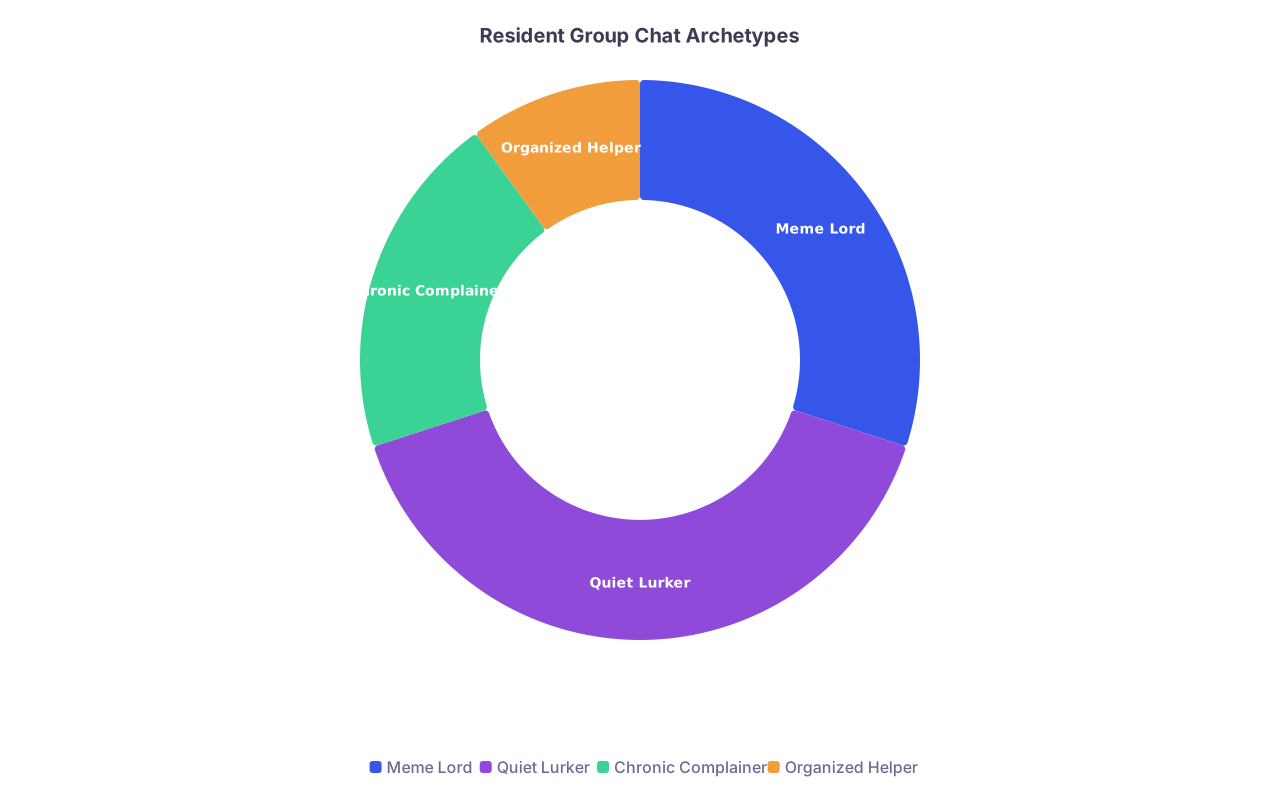
| Category | Value |
|---|---|
| Meme Lord | 30 |
| Quiet Lurker | 40 |
| Chronic Complainer | 20 |
| Organized Helper | 10 |
Aim to be “Organized Helper.” People rarely roast that one.
5. Interactions with Nurses, Consultants, and Everyone Who Outranks You Socially
Here’s the part many residents underestimate: the strongest group chats are not yours.
They’re:
- The nurse chats
- The pharmacist chats
- The consultant group threads
- The “admin + chief” side channels
And yes, they screenshot residents too.
5.1 Nurses: The amplification network
If nurses think you’re:
- Condescending
- Lazy
- Unsafe
…you’re in at least three chats you’ll never see.
Behaviors that get you dragged:
- Answering every question with “It’s in the note”
- Refusing to come to bedside for clearly concerning changes
- Writing snarky notes about “nursing did not…” instead of a quick conversation
- Snapping during 3 a.m. pages instead of clarifying
Guardrails:
- For any question that could indicate a sick patient: go see the patient. It’s faster than the fallout.
- If you’re annoyed, start with: “Help me understand what you’re seeing.”
- If you disagree, use “I” language, not “you messed up”:
- “I’m concerned about X, so I’d prefer we do Y before Z.”
You don’t have to be friends with everyone. But if nurses basically think “they’re fair and they show up,” you’re safe.
5.2 Consultants: The cross-service gossip stream
Consults get screenshotted constantly:
- “Please see for hyponatremia, Na 132.”
- “Needs stat GI for anemia, Hb 8.9, stable.”
- “Rheum to weigh in on positive ANA, otherwise stable.”
Then:
- “This consult is insane.” → Screenshot → Forwarded.
| Behavior | How It Gets Shared |
|---|---|
| Vague, lazy consult question | Mocked for incompetence |
| Aggressive paging frequency | Labeled as “that intern” |
| Blaming consult for delay | Forwarded to friends |
| Friendly, clear consult | Rarely screenshotted |
Basic anti-screenshot strategy:
Ask a real question:
- Bad: “Renal consult for AKI.”
- Good: “Renal consult for AKI in setting of sepsis, baseline Cr 0.9, now 2.3. Question: help with volume status and diuretic vs fluid strategy.”
Don’t spam-page. If you need something urgently:
- One proper page
- Reasonable wait
- Follow-up call if actually emergent
Consultants absolutely send “look at this consult” screenshots. You want to be the rare pleasant one.
6. Reputation Management: What People Actually Remember
Your goal isn’t to be universally loved. That’s impossible and exhausting.
Your goal is simple: stay out of the “can you believe this resident” screenshots.
What people remember long after they forget your Step score:
- Did you embarrass them in front of others?
- Did you throw them under the bus to look good?
- Did you create more work for everyone because of ego?
- Were you reliable when things were actually scary?

| Step | Description |
|---|---|
| Step 1 | Resident Behavior |
| Step 2 | On rounds, EMR notes, group chats |
| Step 3 | 1 to 1 texts, calls |
| Step 4 | Screenshots and gossip |
| Step 5 | Trusted teacher |
| Step 6 | Quiet respect |
| Step 7 | Public vs Private |
| Step 8 | Humiliating or fair |
| Step 9 | Supportive or hostile |
If you consistently:
- Give credit
- Take blame up the chain
- Avoid public humiliation
- Admit when you don’t know
…people may still vent about you occasionally. But you won’t be the legend they meme for years.
7. Concrete Phrases That Get You Screenshotted (and What to Say Instead)
Let me save you some pain. Here’s a quick translation guide.
| Don’t Say This | Say This Instead |
|---|---|
| “You should know this by now.” | “Let’s review this once so you feel solid next time.” |
| “This is basic.” | “This comes up a lot; I’ll show you my approach.” |
| “Read about it.” | “Look up X tonight; start with the management section.” |
| “Why did you do that?” (accusatory) | “Walk me through what you were thinking at the time.” |
| “Stop paging me for this.” | “For things like this, check A/B/C first, then page me.” |
Print that in your brain. Your future self will thank you.
FAQs
1. How do I know if I’m already “that resident” in people’s group chats?
Signs you might be in trouble:
- Multiple people have told you you’re “intense” or “scary,” and not as a compliment.
- You keep hearing, “Oh, I heard about that…” about situations you thought were private.
- Interns and students stop asking you questions and only ask co-residents or nurses.
If that’s you, don’t spiral. Start small:
- Ask 1–2 people you trust for blunt feedback: “What’s one thing I do that rubs people the wrong way?”
- Fix that one thing first. Then another. You don’t need a personality transplant, just fewer landmines.
2. Isn’t this all just people being too sensitive? Shouldn’t we be focusing on patient care?
That’s the trap. The “I care about patient care so I can treat humans however I want” defense. It’s lazy.
Patients don’t benefit when:
- Nurses are afraid to call you
- Interns hide mistakes because you explode
- Consultants roll their eyes at your name on the pager
Psychological safety isn’t fluff. It directly affects patient outcomes. If you dismiss that as “people being soft,” you’re not hardcore. You’re dangerous.
3. How do I balance being efficient and not coming across as fake-nice or weak?
You can be direct without being cruel. People don’t need you to sugarcoat. They need you to not humiliate or belittle.
Try this framework for almost any interaction:
- State the task: “We need to get these three discharges out today.”
- State the reason: “Otherwise the ED will be stuck with holds all night.”
- State your support: “I’ll handle X and Y; can you take Z? If you’re drowning, tell me early.”
That’s not weak. That’s leadership.
Open your phone right now and scroll through your last 10 work-related messages. If someone screenshotted any one of them and dropped it in a group chat without your name attached, would you be proud of how it sounds—or embarrassed? Fix the ones that make you wince, and don’t send another message until you’re the version of yourself you’d be okay seeing on someone else’s screen.