
What’s the one joke you think is harmless now that could quietly kill your eval… or even your residency chances?
If you’re even thinking “but I’m the funny one on my team,” this is for you.
Humor on rotations is a minefield. Not because humor is bad. It isn’t. Teams need it. You need it. But the wrong joke, at the wrong time, in the wrong place, to the wrong person? That’s how students get quietly labeled “unprofessional,” “poor judgment,” or the kiss-of-death phrase: “I have concerns.”
I’ve watched this play out in real time. A student quips, the team chuckles, one person doesn’t. That one person emails the clerkship director. The student never hears the exact complaint, just sees a mysteriously lukewarm eval and a professionalism flag they spend the next year trying to explain away.
Let’s walk through the biggest humor mistakes on rotations that get you in trouble—so you never become that cautionary story people whisper about at pre-rounds.
1. The “Dark Humor Like the Residents” Trap
You will see this pattern over and over: residents and attendings make dark jokes, gallows humor, sarcastic comments about admin, sometimes even about patients (yes, it happens). You’ll think, “Oh, this is how we all cope. I can join in.”
Do not make that mistake.
There’s a brutal double standard in medicine that no one admits out loud:
- Residents and attendings are “coping”
- Students are “unprofessional”
Same words. Same room. Different fallout.
You’re not in the club yet. You don’t have any social capital. You have no track record to balance against. So when you throw in your edgy line about “the frequent flyer in room 12,” what a chief resident might get away with at 2 a.m. in the call room can stain your reputation for months.
Here’s how this plays out:
- Night float on medicine. Everyone’s exhausted.
- Intern jokes: “If I see one more CHF exacerbation from dietary ‘noncompliance’ I’m admitting myself.”
- Team laughs.
- You add: “Well, at least they’re giving us job security.”
- Silence from half the team.
- The pharmacist on the computer hears that and later repeats, “The student said patients are just job security.”
- Guess whose words get recorded, not the intern’s?
The resident is “burnt out.”
You are “lacking empathy.”
If you remember nothing else: you do not get to mirror the darkest humor you hear. Even if they invited you in, even if they laughed yesterday. You’re being evaluated; they’re venting.
Safe rule: tone shift, not tone match
Match their work ethic. Match their level of engagement.
Do not match their darkest jokes.
If the team goes edgy, you stay two notches safer. Always.
2. Patient-Related Jokes: The Career Suicide Category
This is the category where people think they’re being “just honest,” “just clinical,” or “just joking,” and they end up in professionalism remediation.
Patient-related “humor” that will get you destroyed:
- Jokes about patient weight, smell, hygiene
- Comments on noncompliance, addiction, or social issues
- Anything mocking mental health, cognition, or confusion
- Using memes or TikToks to “joke” about specific patient types on social media
If a bystander could possibly interpret it as:
- “They were laughing at the patient”
- “They don’t respect this population”
- “They’re biased or discriminatory”
…then you have a problem.
I’ve watched a student say, in an elevator, “Our scabies census is really thriving,” to make the intern laugh. A nurse in the back heard it, emailed the clerkship director. The student had no idea until they were called into a meeting about “derogatory humor about patient conditions.”
Was the student malicious? No.
Did it matter? Also no.
You cannot control who overhears you. You cannot control how they retell the story. You can control whether the words ever come out of your mouth in the first place.
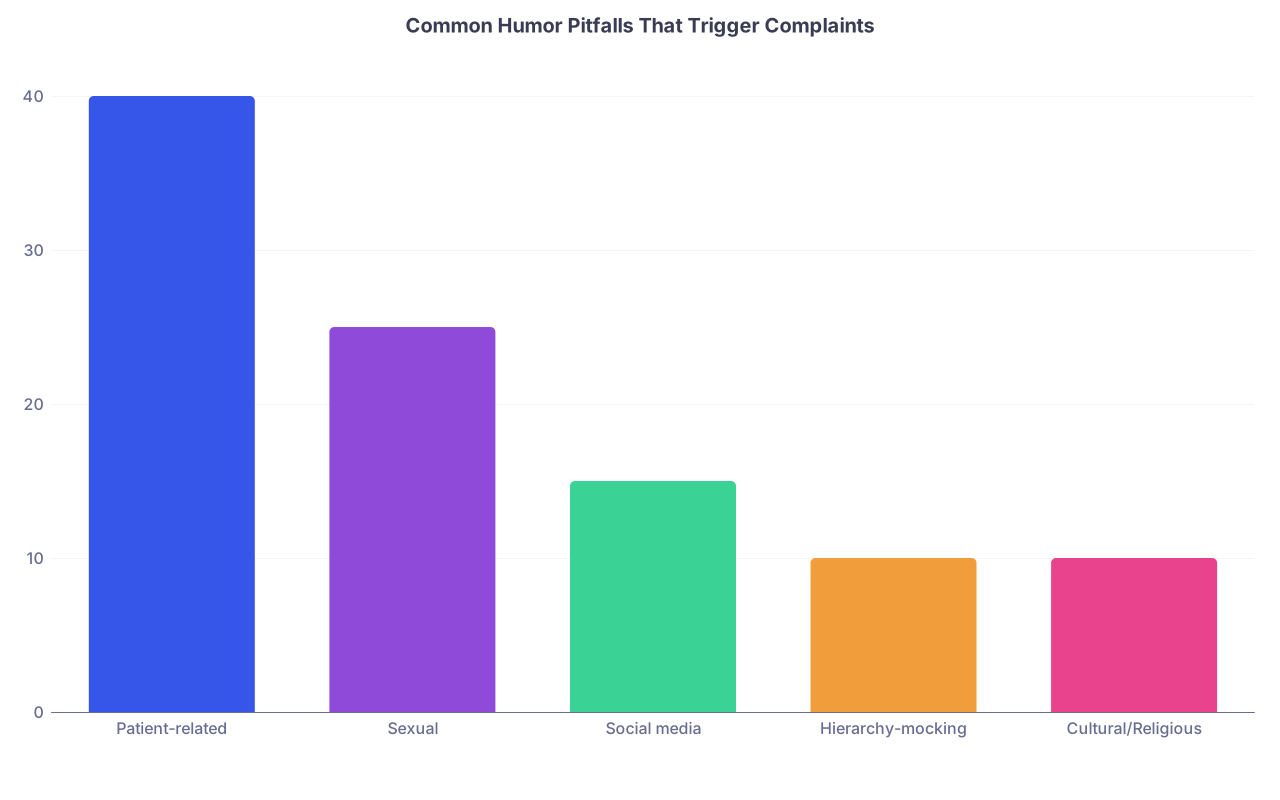
| Category | Value |
|---|---|
| Patient-related | 40 |
| Sexual | 25 |
| Social media | 15 |
| Hierarchy-mocking | 10 |
| Cultural/Religious | 10 |
Hard rule: no jokes about patients. Period.
You can joke about:
- Yourself
- The EMR
- Your coffee addiction
- How many times you got lost finding the CT scanner
You cannot joke at vulnerable people who depend on you. That includes:
- Diagnoses
- Presenting complaints
- Their body
- Their life situation
If there’s a power imbalance (and with patients there always is), assume humor at their expense is off-limits.
3. Sexual Humor: The “HR Would Fire You For This” Zone
Let me be blunt: any sexual joke, innuendo, or comment about appearance at work can wreck you. Even if no one confronts you in the moment. Even if “everyone laughed.”
What gets people into trouble here:
- Commenting on how “hot” someone is (nurse, consultant, staff, another student)
- Jokes about “gyne clinic being awkward” with explicit humor
- Laughing about sexual history details right after leaving a room
- Saying things like, “Well, at least this rotation improves my dating life,” about coworkers
I saw a student on OB casually say, in the workroom, “I guess nobody uses condoms anymore, huh?” after back-to-back unplanned pregnancy consults. The midwife in the room later told the clerkship director the student was “disparaging and immature about patients’ sexual health choices.”
The student thought it was just banter.
You need to mentally assume you’re already in an HR office. If you would never say it in an HR interview, don’t say it in a hospital. You’re not just on a team; you’re in a workplace with legal and reputational risk.
4. Making Fun of Other Professions (Yes, That Includes Nurses)
Another trap: you hear a resident complain about nurses, or a consultant taking forever, or “radiology being allergic to the phone.” You think joining in makes you “part of the team.”
No. You’re digging your own grave.
The second you start joking about:
- Nurses
- Respiratory therapists
- Consultants (radiology, surgery, anesthesia, psych, etc.)
- Case management/social work
- Admin/front desk
…you’re signaling two things no one wants in a trainee:
- Disrespect for the team
- Poor emotional control
Even if your attending just joked about “calling neurology and waiting until retirement for a callback,” you’re not on equal footing here.
What you say as a student gets remembered differently.
I’ve seen this exact thing:
- Student in the ED: “At least when we call ortho we know they’ll say ‘admit to medicine.’”
- The ED attending chuckles.
- The ortho resident walking past hears it, remembers their name.
- That same student rotates on ortho later and finds everyone “oddly cold.”
- Their eval: “Student appeared dismissive of other services.”
Medicine is a small town. Rotations talk.
If you want to protect your future self, drop the cross-discipline jokes. You gain nothing, and the downside is massive.
5. Timing Fails: Good Joke, Wrong Moment
Sometimes the content of your humor isn’t even terrible. The timing is.
Moments where joking is usually a bad idea:
- Just after a code, bad outcome, or family meeting
- Pre-op or immediately post-op when tension is high
- During sign-out, especially when others are behind schedule
- When the attending’s clearly stressed, behind, or frustrated
I watched a med student finish presenting a complicated ICU patient, nail the differential, and then try to lighten the mood by saying, “So yeah, not the healthiest 45-year-old in the world,” with a half-smile. The attending had just come from telling a different family their loved one wasn’t going to make it.
The attending didn’t yell. They just wrote in the eval: “Struggles with tone and timing; occasionally makes light of serious situations.” That line stings.
You cannot always read the emotional backstory of the room. So when in doubt after serious events, lean quiet and serious for longer than feels natural. If they joke, you can smile. You don’t need to add your own punchline.
6. The “I’m Just Kidding” Defense (It Doesn’t Work)
If you ever hear yourself following up a comment with:
- “I’m just kidding.”
- “Relax, I was joking.”
- “You know what I mean.”
- “Wow, tough crowd.”
You already messed up.
The “just kidding” defense does not erase:
- The words someone heard
- The impression someone formed
- The email someone already drafted about you
You don’t get evaluated on your intent. You get evaluated on what people experienced.
If a joke lands badly, the smart move is not to double down—it’s to step back:
- “Sorry, that came out wrong.”
- “I didn’t mean that how it sounded.”
- “Let me rephrase that.”
Short, clean, no argument. Then stop trying to be funny for a while. Retreat to neutral.
7. Social Media “Jokes” About Rotations or Patients
This one takes people down every year.
You cannot assume anonymity. You cannot assume your classmates won’t screenshot you. And you absolutely cannot assume “I didn’t say their name” protects you.
Typical disasters:
- Posting “funny” stories about patient encounters (even anonymized)
- Memes about certain patient populations you “always see in the ED”
- Jokes about how incompetent another service is
- TikToks from hospital areas with badges, logos, or patient info in the background
If any classmate or staff member can recognize the day, the service, or the type of patient, you’re already too specific. I’ve seen deans pull up posts students thought were private and say, “Explain how this aligns with our professionalism standards.”
Spoiler: it doesn’t.

If you want to do medical humor online, make it:
- Completely de-identified
- Generic experiences (e.g., “every call night ever”)
- Not aimed at specific groups of patients, staff, or programs
And honestly, while you’re still a student on core rotations, it’s safer to under-share than over-share.
8. Punching Down vs. Punching Up (And Why You Don’t Get to Punch Up Yet)
Comedy rule: “Punch up, not down.”
In medicine, that’s trickier. Because for you, as a student, almost everyone is “up” in the hierarchy. So trying to “punch up” by lightly mocking your attending or institution is just… dumb.
Bad ideas that feel clever in the moment:
- Sarcastic comments about “attending rounds” running late or being useless
- Jokes about “the ivory tower” on academic services
- Calling any attending “chill, for a surgeon” in front of other surgeons
- Jabs at your own school or program in front of visiting faculty
You’re not John Oliver. You’re the lowest rung who still needs grades, letters, and interview invites.
Where you absolutely cannot punch down:
- Patients
- Nurses, CNAs, techs
- Housekeeping, security, front desk
- Students more junior than you
If your joke relies on belittling someone else to land, it’s a bad joke for work. Save the sharper stuff for friends outside the hospital, with phones put away.
9. The “Funny Student” Identity Problem
There’s always one student who walks in deciding, “My thing is that I’m funny. That’s how I’ll stand out.”
That’s a strategic error.
What actually gets noticed and remembered positively:
- “Hardworking”
- “Prepared”
- “Calm under pressure”
- “Good with patients”
What gets remembered as a warning sign:
- “Always joking”
- “Doesn’t read the room”
- “Tries too hard to be liked”
If someone had to describe you in three words on your eval, you do not want “funny” to be one of them. You want “reliable,” “teachable,” “professional.” Your friends can know you’re hilarious. Your attendings need to know they can trust you.
Let the humor be background color, not your headline trait.
10. What Is Usually Safe? (So You Aren’t a Robot)
You don’t have to be humorless. Having no sense of humor at all can make teams cautious in a different way.
Safer territories:
- Self-deprecating jokes that don’t question your competence
(“I was so proud I finally found the CT scanner without getting lost.”) - Harmless observational humor
(“Epic has like 12 different ‘sign this’ alerts and I’m scared of all of them.”) - Shared suffering that doesn’t blame people
(“Post-call brain is 90% caffeine and 10% vibes at this point.”)
Also, nonverbal humor is underrated:
- A small smile at a resident’s joke
- Gentle sarcasm about your own note-writing marathon
- Light-hearted comments about how many stairs you’ve climbed today
| Category | Usually Safer Example | Risky Example |
|---|---|---|
| Target of joke | Yourself | Patients, nurses, other services |
| Topic | EMR, pages, your confusion | Diagnosis, body, mental health |
| Timing | End of day, low-stress moments | After a code, during sign-out, family meetings |
| Medium | In-person, small group you know well | Social media, recorded content |
| Style | Light, brief, self-aware | Sarcastic, biting, mocking |
If you’re not sure, err boring. “Boring but safe” never shows up in a professionalism file.
FAQs
1. My residents make dark jokes all the time. Won’t I seem uptight if I don’t join in?
You’ll seem professional. That’s the goal.
You can smile, give a small chuckle, and keep your mouth shut. No one is going to fail you for not being the second comedian in the room. But people absolutely will ding you for a poorly judged comment that crosses a line.
If someone ever calls you out for “not being fun,” your answer is simple: “I just try to be careful about joking at work.” That’s defensible. “I made that joke because everyone else did” is not.
2. Is it ever okay to make fun of a patient’s behavior if they were rude or abusive?
No. Vent to a trusted friend or therapist later, off-site, with no identifiers. In the hospital, you stay professional.
Abusive behavior gets documented and addressed through policy, not punchlines. If staff hear you joking about a rude or noncompliant patient, they don’t think, “Wow, relatable.” They think, “Will this person talk about me or my family like that?”
3. What if I already made a bad joke and I’m worried it hurt my eval?
You can’t un-say it, but you can control what happens next.
Be on your absolute best behavior after. Show maturity, reliability, and judgment in every other interaction. If you sense tension with a resident or attending, you can briefly say, “I realized that comment earlier wasn’t appropriate. I’m sorry about that,” and then move on. No long speeches. No arguing your side.
Sometimes what rescues you isn’t perfection; it’s how you handle your own misstep.
4. How do I know if a joke is okay before I say it?
Use a quick mental filter:
- Would I say this with the clerkship director standing behind me?
- Would I be okay seeing this quoted in my MSPE?
- Could anyone in earshot interpret this as mocking, biased, or dismissive?
If any answer is “not sure,” do not say it. Rotations are not your open mic night. You’re there to build trust, not test out material.
Key points to remember:
- You’re evaluated on impact, not intent. If a joke can be misread, it eventually will be.
- Never joke at the expense of patients, other professions, or vulnerable groups. Aim harmless or not at all.
- You don’t need to be the funny one. You need to be the safe one—the student no one has to file a professionalism story about.