
The stereotype that “old school attendings are humorless dinosaurs” is lazy, mostly wrong, and not even supported by the data we actually have on physicians and humor.
Let me be blunt: older physicians are not less funny. They’re playing a different game, with different rules, in a different risk environment than residents and interns scrolling meme accounts between consults. You’re not watching less humor; you’re watching filtered, context-aware, malpractice-aware humor.
You’re also forgetting how unfunny a lot of trainee humor looks to patients.
Let’s pick this apart properly.
What the Data Actually Says About Age, Personality, and Humor
We do not have a randomized controlled trial of “attending age vs number of jokes per round.” But we have a pile of related data: on physician personality profiles, burnout, communication style, and generational attitudes.
The popular myth goes like this:
Gen X / Boomer attendings = rigid, serious, “back in my day we weren’t allowed to smile” types.
Millennial / Gen Z = loose, meme-literate, patient-friendly banter machines.
Reality is not that clean.
Personality research on physicians across age groups (lots of work using the “Big Five” traits) shows something important: agreeableness and conscientiousness tend to stay high throughout a medical career; neuroticism and impulsivity often decrease with age. Translation: older physicians are, on average, calmer and a bit more emotionally regulated. That does not kill humor—it often refines it.
There’s also decent literature on “humor styles” in healthcare—affiliative (bonding), self-enhancing (coping), self-defeating, and aggressive. What tends to shift with seniority is not whether clinicians use humor but how:
- Seniors move away from aggressive or “punching down” humor.
- They use more self-deprecating jokes and situational irony.
- They redirect gallows humor away from patients and families and into private, trusted spaces.
In other words, over time physicians are less likely to crack the loud, edgy joke in front of a patient and more likely to toss a dry one-liner to a colleague outside the room.
That looks “humorless” if your benchmark is TikTok anesthesia memes. It’s not. It’s adaptive.
Here’s the kind of shift I’ve watched repeatedly:
Intern: “Well that was a total disaster lol.”
Old-school attending: “We learned a few ways not to do that.” Deadpan. Residents laugh. Patient doesn’t panic. That’s skill.
The Generational Culture Clash: Different Channels, Not Different Human Beings
A big part of the myth is simply a platform mismatch.
Younger trainees live in visible humor: memes, group chats, TikToks, #medtwitter, residency IG accounts. Older attendings came up in hidden humor: hallway comments, cafeteria tables, quiet eye-contact jokes during a disastrous family meeting.
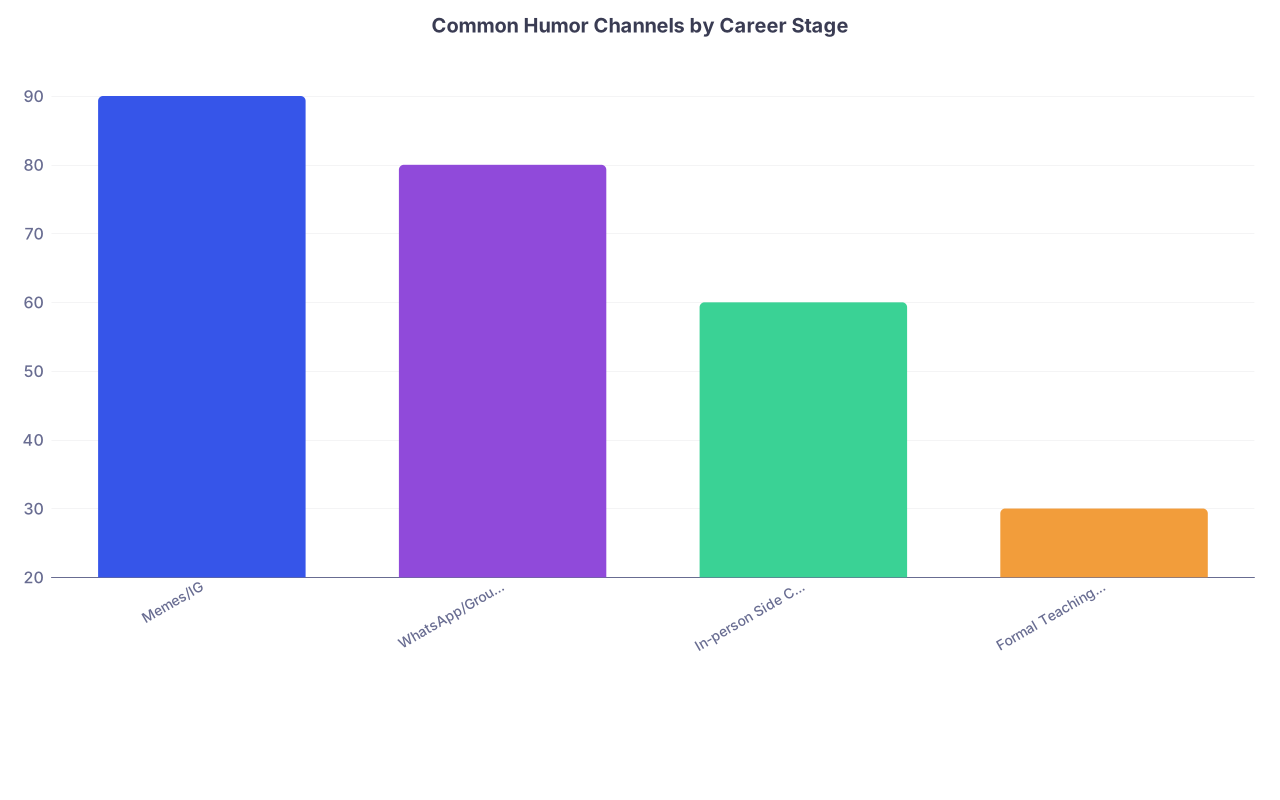
| Category | Value |
|---|---|
| Memes/IG | 90 |
| WhatsApp/Group Texts | 80 |
| In-person Side Comments | 60 |
| Formal Teaching Jokes | 30 |
Among interns and residents, nearly everyone is plugged into digital humor; among older attendings, most of the humor never hits a screen, so you never see it unless you’re in their inner circle.
And then there’s risk. An attending has:
- Their license on the line.
- Their name on every chart.
- Decades of “that joke did not land” scars.
- A much better sense of how unpredictable patients and families can be.
So they do something very sensible: they reduce overt, high-risk humor in front of anyone who can sue them, report them, or write a Yelp-style review.
Residents misinterpret this as “see, they hate fun.”
No. They like paying their mortgage and not talking to lawyers.
The Patient Perspective: Who Actually Sounds Humorless?
I’ve watched this play out on rounds more times than I can count.
Resident walks in, in full “relatable” mode:
- “You and me both hate these 4 am vitals, right?”
- “We’ll bust you out of here as soon as they let us.”
- “Well the computer says you’re alive, so that’s good!”
Patient smiles politely. Doesn’t fully know how to read it.
Then the “old school” attending walks in, appears “serious,” listens carefully, and delivers one calm, targeted, empathetic joke that actually fits the patient’s vibe:
- To a retired construction worker who just made a self-deprecating comment: “Look, you’ve poured enough concrete for one lifetime. You can let us do the heavy lifting this week.”
- To a grandmother who calls herself “a bad patient”: “Trust me, I’ve had some truly terrible patients. You are not making the Top 10 list.”
And suddenly the room relaxes. Family laughs. Trust goes up.
Who was funnier by any metric that matters? The one who scored an upvote in the team GroupMe, or the one who used humor as a clinical tool?
There’s data here. Studies on clinician-patient communication repeatedly show:
- High-quality communication and appropriate, empathic humor correlate with higher satisfaction and adherence.
- Younger physicians tend to use “social” or “self-presentational” humor more; older physicians lean on “relational” humor—subtle, context-sensitive.
So if your standard is “who would destroy at a meme roast?”, older attendings may lose.
If your standard is “who uses humor to make patients feel safer and listened to?”, they usually win.
Why Older Attendings Look Humorless: Three Boring, Evidence-Backed Reasons
This is where the myth really falls apart.
1. Burnout Warps Everybody’s Vibe
Burnout rates are high across all ages, but the flavor changes. In big surveys, mid-career and late-career physicians often report emotional exhaustion and depersonalization that looks like “flat affect” to trainees.
You: “Our attending never smiles.”
Reality: That attending is on their fourth system-wide EMR transition, third CEO in five years, and just lost clinic time to another mandatory “resilience” module.
There’s evidence that humor decreases during periods of intense burnout—not because people become humorless, but because they’re depleted. The dark irony? They might still have tons of humor left in the tank; you’re simply not seeing it at 6:45 a.m. on a Monday when they’ve already signed 30 notes.
2. Power Distance Kills Open Joking
The more power someone has, the more their joking gets misinterpreted.
An offhand sarcastic line from a co-intern is just that—sarcasm. The same line from a powerful attending can feel like humiliation, even if they meant well. Older attendings figure this out the hard way over decades.
So they self-censor. They default to dry, often understated comments. They save “real” humor for people they know very well, one-on-one or outside formal evaluations.
If you mostly see them in:
- Pre-round huddles
- Patient rooms
- Formal teaching sessions
…you’re seeing their “safe,” flattened, litigation-proof persona, not the person who is actually hysterical over coffee with peers.
3. Taste in Humor Actually Shifts With Age
There’s general psychology research on this one: as people age, they often prefer more narrative, subtle humor and less slapstick or shock value. Sarcasm can go down. Irony and story-based jokes go up.
That lines up with what I’ve seen in hospitals:
- Intern: “OMG I’m dead” (after a long call)
- Attending: “I prefer my residents alive for sign-out.”
It reads dry, but it’s humor. Just not your language.
The “Old School” Attendings Who Are Secretly the Funniest People in the Building
Let me guess who runs the best teaching stories on your service. The best “war stories,” the most ridiculous “I once saw a guy who…” tales, the most unexpected savage one-liners that make the whole team wheeze?
Not the PGY-1 who just discovered Reddit. The older attending who has:
- 30 years of absurd consults, bizarre complications, and off-the-wall family meetings.
- Enough distance from their ego to laugh at their own failures.
- Enough security in their career that they’re not trying to impress anyone.
Those “old school” folks are often masters of delayed comedy: one perfectly deployed line after an hour of seriousness. You remember their jokes because they’re rare and targeted, not constant background noise.
I’ve watched a gray-haired, very “serious” cardiologist calmly close a brutal end-of-life family meeting, walk out into the hall, and quietly say to the team: “If anyone needs me, I’ll be in my office, rethinking my life choices.” The timing, tone, and context made it extremely clear that he was defusing tension, not dismissing what just happened.
Residents cracked up. Tension dropped. Nobody got harmed.
That’s humor with a scalpel, not humor with a sledgehammer.
Generational Data: Who’s Actually “Too Serious”?
Let’s zoom out.
Surveys of medical trainees vs attendings consistently show:
- Trainees report more overt irreverent humor, especially online.
- Attendings report more internalized coping mechanisms, including private jokes, storytelling, and reflective writing.
- Both groups use humor heavily to cope with stress, but in different environments and with different audiences.
| Group | Public Jokes (on rounds) | Private Jokes (offstage) | Digital Humor Use |
|---|---|---|---|
| Med Students | Medium | High | Very High |
| Residents | High | High | Very High |
| Young Attendings | Medium | High | Medium |
| Older Attendings | Low-Medium | Very High | Low-Medium |
So the visible part—the public joking—is highest among residents and young faculty. That’s what you see, so you assume they’re the “fun” generation. The older crowd has simply pushed more of their humor into private, off-chart spaces.
And then there’s one more inconvenient detail: patients and families often prefer what trainees interpret as “serious.” Multiple communication studies show older physicians are rated as more “professional,” more “trustworthy,” and, yes, occasionally more “caring,” despite less overt joking.
Do they sometimes overshoot into stiff and cold? Of course. Some really are humorless. But so are some interns who’ve decided their entire personality is UWorld and a hydroflask.
The myth is lazy because it turns a style difference into a character flaw.
If You Actually Want to See Their Sense of Humor
Stop waiting for them to be your co-intern. They never will be. The hierarchy prevents that.
Instead:
Ask about an early-career disaster they survived.
Ask about the weirdest consult they’ve ever gotten.
Ask: “What’s the sickest thing anyone’s ever said to you on call?”
And then shut up and listen.
That’s when they uncork the stories that make the whole stereotype collapse. They’ll usually include:
- The attending who did something so insane it’s still whispered about.
- A time they almost quit.
- A patient who roasted them so hard they remember the line 20 years later.
You discover quickly that “old school” does not mean humorless. It means they have better filters, longer memories, and zero interest in turning their professional life into a brand.
FAQ: Five Quick Myths, Five Quick Corrections
1. Are older attendings actually less likely to use humor at the bedside?
They’re less likely to use obvious or edgy humor in front of patients. Studies suggest they favor subtle, empathic, and relational humor. So you may perceive “less,” but patients often perceive “safer.”
2. Is “gallows humor” only a trainee thing?
Not even close. Senior physicians have always used dark humor to cope. The difference is that older attendings are usually better at containing it to safe contexts—back rooms, private conversations—not patient areas or social media screenshots.
3. Does burnout make older doctors more humorless than younger ones?
Burnout affects everyone. Older physicians often carry more administrative and financial stress, which can blunt their affect. But younger trainees under extreme pressure can be just as flat—or resort to brittle, forced humor. Age is not the deciding factor; system stress is.
4. Are younger doctors actually better at “therapeutic” humor with patients?
Not automatically. Younger docs are more comfortable being casual, but casual is not the same as therapeutic. Older physicians tend to have more experience reading the room and calibrating when a joke helps versus harms. Skill usually beats vibe.
5. Is it worth trying to “loosen up” an old-school attending?
Not by pushing memes on rounds. If you want to see their humor, invite stories, show you can handle a bit of dark honesty, and—crucially—demonstrate professionalism. Once they trust you won’t blast their offhand comment into the group chat, you’ll see a very different side.
Key points?
Old attendings are not humorless; they’re filtered, risk-aware, and often funnier than you once you adjust for context.
What looks like “no humor” is usually a mix of burnout, hierarchy, and a different humor style—not a personality defect.
If you want to learn real clinical humor—the kind that calms patients and keeps you sane over decades—you should probably be watching them, not mocking them.