
The claim that “humor is unprofessional in medicine” is wrong. Not debatable. Wrong. And the data from patient studies backs that up far more clearly than most attendings’ hand‑wavy “keep it serious” lectures.
Let me be blunt: a lot of what passes for “professionalism” around humor in medicine is driven by fear, hierarchy, and risk management—not evidence. Patients, on the other hand, consistently report that appropriate humor improves trust, satisfaction, and even perceived competence.
Notice that word: appropriate. Because the real question isn’t “Is humor unprofessional?” The real question is, “Whose humor, in what context, and with what boundaries?” The science actually has answers to that, if you bother to look.
Let’s dismantle the myth properly.
What Patients Actually Say About Doctors Who Use Humor
When you strip away faculty opinions and hospital memos, all that matters is this: how do patients experience humor?
Multiple observational and experimental studies across outpatient, inpatient, oncology, and primary care settings point to the same pattern: patients usually like it when their clinician uses respectful, affiliative humor—and they do not see it as unprofessional.
A few patterns show up repeatedly:
Patients who report their clinician used “gentle” or “warm” humor are more likely to rate:
- Higher satisfaction
- Better communication
- Greater trust and willingness to disclose
Humor often serves as an icebreaker. Patients describe it as making the clinician seem “human,” “approachable,” and “less intimidating.”
The objection isn’t to humor per se. It’s to misaligned humor: sarcasm, ridicule, or jokes that minimize suffering.
To be concrete, imagine this: a primary care visit where a 55‑year‑old with long‑standing diabetes walks in, clearly tense. The physician says, “I see you survived my waiting room again. We should put that under ‘resilience’ in your chart.” The patient laughs, shoulders drop, and suddenly the conversation about adherence isn’t a cross‑examination, it’s a collaboration.
Studies using recorded visits show exactly that kind of sequence. Humor → visible patient relaxation → more open dialogue.
So where does the “unprofessional” myth come from? Not from patients. From us.
The Data: Humor and Patient Outcomes
Let’s look at what the literature actually shows instead of recycling hallway opinions.
1. Communication quality and trust
In multiple observational studies of real clinical encounters (yes, with audiotapes and coding), clinicians’ use of light, affiliative humor is associated with better-rated communication and higher patient satisfaction scores.
Patients describe humorous clinicians as:
- More caring
- More attentive
- Easier to talk to about sensitive topics
And here’s the twist that makes old-school “no joking” dogma look especially outdated: in several studies, patients did not interpret appropriate humor as lack of seriousness about their illness. Quite the opposite—they viewed it as a sign the clinician was comfortable and competent enough to connect as a human.
Humor signals psychological safety. If the doctor can joke a little, maybe I can admit I missed half my meds last month without being judged.
2. Anxiety, pain, and physiological markers
No, humor is not going to cure cancer. But pretending it does nothing is just as wrong.
In oncology and procedural settings, studies where staff intentionally used light humor (and sometimes clown interventions in pediatrics) showed:
- Reduced self‑reported anxiety
- Less perceived pain or discomfort
- More positive affect during procedures
Do the effect sizes rival midazolam? Of course not. But for low-cost, non-pharmacologic, low-risk interventions, these effects are not trivial—especially in chronic care or repeat-procedure populations.
3. Clinical relationship continuity
Longitudinal primary care studies show something any intern on continuity clinic learns in three months: patients are more likely to stick with clinicians they feel comfortable with.
Humor, used consistently and respectfully, helps build that long-term bond. Patients describe it as “we have our little jokes,” “he remembers what I like,” “she always makes me smile at least once.” That relational glue matters when you’re trying to convince someone to start insulin, stop smoking, or consider palliative care.
Is humor the only factor? Of course not. But it’s a real and measurable one.
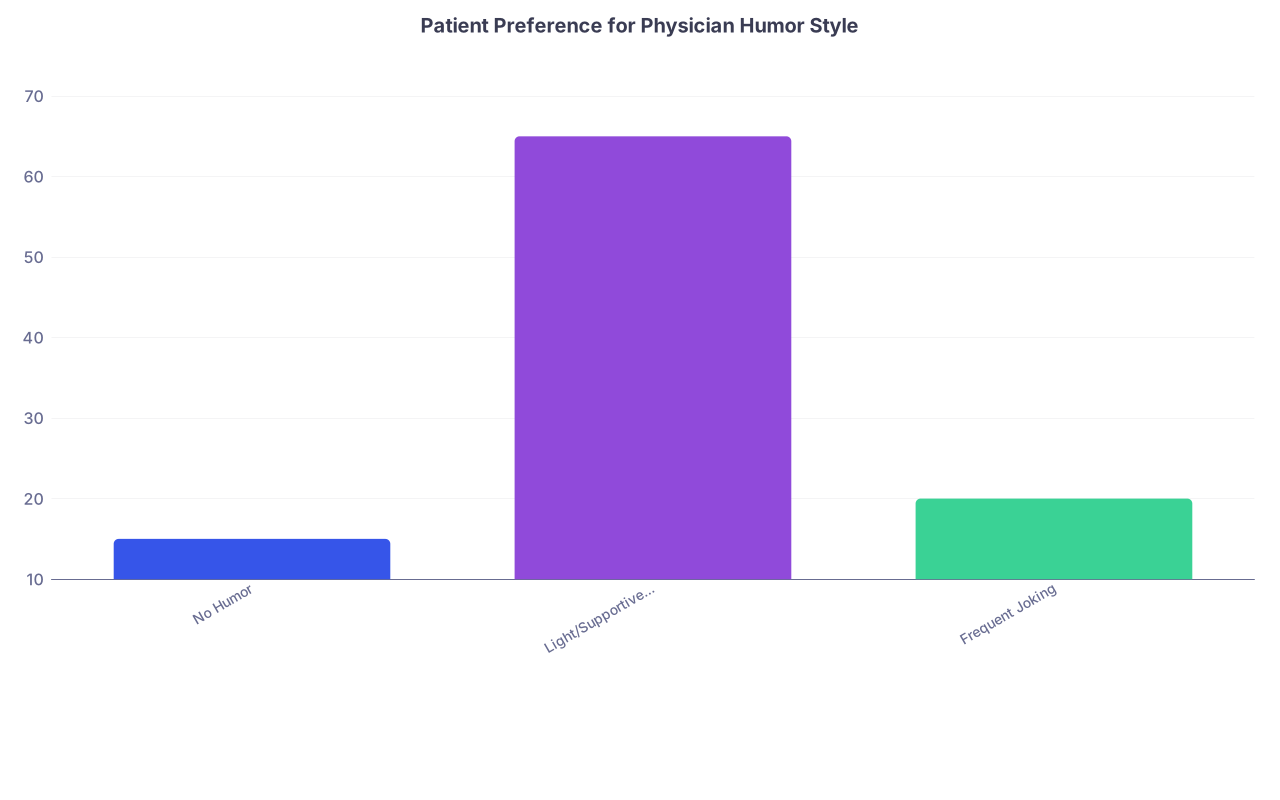
| Category | Value |
|---|---|
| No Humor | 15 |
| Light/Supportive Humor | 65 |
| Frequent Joking | 20 |
This is roughly how survey data tends to look: a minority prefer strictly serious interactions, a majority prefer light, supportive humor, and a smaller group dislikes when humor is overdone or constant. “Never joke” is simply not aligned with the middle 60–70% of patients.
Where Humor Goes Wrong: The Styles Patients Actually Hate
Here’s where people get confused. They see bad humor and conclude all humor is bad. That’s intellectually lazy.
Psychology research on humor styles is actually helpful here. Broadly, you can think of four styles:
- Affiliative: warm, inclusive, building connection
- Self‑enhancing: using humor to cope, often about yourself, not others
- Aggressive: sarcasm, ridicule, punching down
- Self‑defeating: you as the ongoing butt of the joke to gain approval
Patients tend to respond well to affiliative and some self‑enhancing humor. They dislike, and sometimes are hurt by, aggressive and self‑defeating humor.
Concrete examples I’ve watched go sideways:
A surgeon joking, “If this goes badly, you won’t be around to be mad at me anyway.” That’s aggressive and fear-amplifying. I watched the spouse’s face drop.
A resident constantly saying, “I’m the dumb intern, don’t ask me anything.” That self‑defeating line might get a chuckle from peers, but it erodes patient confidence. One patient literally asked later, “Can I see a real doctor?”
A clinician making weight jokes with an obese patient under the guise of “tough love.” That kind of “humor” is just stigma wrapped in a punchline. And yes, patients remember.
What gets labeled as “unprofessional” 90% of the time is not humor itself but these styles: punching down, minimizing suffering, undermining your own credibility, or over-joking to avoid serious topics.
So if you’re looking for a rule, here’s the data-driven version: humor that builds the relationship tends to help; humor that protects you at the expense of the patient tends to hurt.
Cultural, Power, and Context: The Real Landmines
Now for the part no one wants to talk about because it’s uncomfortable: humor interacts with power, culture, and identity. And medicine is drenched in power asymmetry.
That asymmetry alone means: your joke hits differently coming from the white‑coat side of the bedrail.
Patients’ comfort with humor varies by:
- Age
- Culture
- Prior trauma or illness experience
- Setting (ICU vs primary care vs ED)
For example, older patients in some studies actually prefer a bit of light humor from doctors—they grew up in a more paternalistic medical culture, and a doctor who relaxes that edge earns points. Meanwhile, a younger patient with a history of medical gaslighting may interpret the same joke as dismissive.
Then add identity. A young female resident making a dry joke is more likely to be labeled “inappropriate” or “unprofessional” by staff than a senior male attending doing the exact same thing. I’ve seen it in evaluations. Humor gets policed unevenly.
So you end up with this absurd situation: the very groups in medicine who already face bias (women, IMGs, underrepresented minorities, junior trainees) are sometimes told “better not joke at all”—not because patients hate it, but because evaluators might.
That’s not evidence-based professionalism. That’s fear-based conformity.
What Patients Call “Professional” Isn’t What Committees Assume
Here’s the uncomfortable gap: institutional definitions of professionalism don’t always match patient definitions.
Patients routinely describe their “most professional” doctors with words like:
- Kind
- Calm
- Listens
- Doesn’t rush
- Easy to talk to
- “Down to earth”
You’ll notice that none of those inherently exclude humor. In fact, when patients elaborate, they often bring up small humorous moments that made the doctor feel “real,” like joking about sports teams, weather, kids, or clinic bureaucracy.
What patients do not list as “professional”:
- “Never smiled”
- “Always serious”
- “Very formal”
Those sound more like the unofficial rules of a risk-averse HR department than actual patient priorities.
If your professionalism framework penalizes a physician who uses sensitive, connection-building humor because “it makes the encounter too casual,” but ignores the one who is technically perfect yet emotionally unavailable, your framework is misaligned with patient-centered care.
The Medicolegal Boogeyman (And What Actually Gets You in Trouble)
Whenever humor comes up, someone says, “Well, what if it ends up in court?” Let’s be precise.
There are extremely rare legal cases where “joking” comments in the OR or procedural settings were documented and used to show disregard for patient dignity or consent. But those are almost always examples of:
- Sexual jokes
- Racist or discriminatory humor
- Mocking the patient
In other words: gross misconduct, not nuanced bedside humor.
There is no wave of malpractice losses because a hospitalist quipped, “This gown is terrible, I know, they don’t let me choose the fashion line.” What does get you in trouble—ethically, professionally, and sometimes legally—is demeaning a patient while they’re vulnerable, or joking in ways that clearly conflict with respect for persons.
The risk management argument against any humor at all is lazy overgeneralization. The real rule is much narrower: don’t be abusive, discriminatory, or minimizing. That’s not about humor; that’s about basic ethics.
A Practical, Evidence-Aligned Way to Use Humor
If you’re waiting for a 40‑page guideline on when you’re “allowed” to be funny, you’ve missed the point. But there are patterns that emerge from the research and from years of watching clinicians who are genuinely good at this.
Think of it like this:
Start with micro‑humor that targets you or the situation, not the patient. “These forms multiply overnight; I swear there’s a paper factory in the back office.”
Watch closely. Does the patient’s face soften? Do they respond or offer something back? If yes, you’ve got permission to use a bit more. If not, shift gears, no ego.
Return to seriousness explicitly when the topic demands it. “On a serious note, though, your scan does show…” This contrast is actually reassuring. It signals you can hold both warmth and gravity.
Avoid humor that could plausibly be misunderstood in a transcript without tone: sarcasm about their condition, treatment, prognosis, or fears.
In other words, the skill is not “being hilarious.” It’s reading the room and modulating. That’s clinical judgment, not stand‑up.

| Step | Description |
|---|---|
| Step 1 | Neutral start |
| Step 2 | Try light situational comment |
| Step 3 | Continue occasional gentle humor |
| Step 4 | Return to neutral tone |
| Step 5 | Shift to serious for key info |
| Step 6 | Check understanding and comfort |
| Step 7 | Patient responds positively |
The Future: AI, Virtual Care, and Sanitized Interactions
Let’s zoom out. As telemedicine and AI tools eat more of the transactional parts of care, what do humans bring that algorithms do not? Exactly the thing we’re trying to over-sanitize: real emotional connection, which includes shared laughter.
If we design “professional” AI chatbots that are perfectly neutral, always serious, never playful, fine. They can handle refills and appointment scheduling. But when you’re telling a 42‑year‑old parent they have metastatic disease, or trying to convince a teenager to consider rehab, or sitting with a family planning to withdraw life support, what patients consistently value is human presence.
And human presence sometimes looks like a small, well-timed joke that lets the room exhale.
If medicine doubles down on a sterile, zero‑humor vision of professionalism while the rest of the world gets more comfortable with authentic, emotionally mixed communication—even in serious contexts—we risk becoming both less effective and less trusted.
| Setting | Typical Patient Preference | Risk of Misinterpretation |
|---|---|---|
| Primary Care | Moderate, relational humor | Low–Moderate |
| Oncology | Very light, patient-led | Higher if prognosis unclear |
| ICU | Minimal, mostly with families | High |
| Pediatrics | High, play-based humor | Low–Moderate |
| Telemedicine | Light, to break distance | Moderate |
The right question going forward isn’t “Should we ban humor?” It’s “How do we teach clinicians to use it well?”
That means professionalism curricula that:
- Show real clips of effective versus harmful humor
- Teach cultural and power awareness, not blanket avoidance
- Encourage reflective practice: when did a joke land? When did it not? Why?
Because pretending that “serious at all times” is safer is a fantasy. It’s also not what most patients want.
The Bottom Line
Three things you should walk away with:
The evidence from patient studies is clear: appropriate, affiliative humor is usually experienced as more professional, not less. It improves trust, communication, and comfort.
What’s actually unprofessional isn’t humor; it’s disrespect—sarcasm, ridicule, and jokes that minimize suffering or exploit power differences. Blaming “humor” lets bad behavior hide behind a false debate.
As medicine moves into an AI-heavy, hyper-standardized future, the ability to use real, human humor skillfully will be one of the few things that keeps clinicians indispensable. If you flatten that out in the name of “professionalism,” you’ve lost the plot.
So no, humor is not inherently unprofessional in medicine. Ignoring what patients actually tell us about it—that’s the real unprofessional move.