
Myth: Telemedicine Killed Clinic Humor – What Clinicians Report Now
Did clinic humor really die the day everyone got a Zoom link and a ring light?
Let me ruin the nostalgia: no, it did not. The jokes changed, the setting changed, the power dynamics shifted a bit. But the idea that telemedicine flattened medicine into sterile, joyless rectangles is a story people like telling more than a reality backed by data.
Let’s separate the myth from what clinicians actually report.
Where the “Telemedicine Killed Humor” Myth Came From
The myth has roots in three very real experiences from early-pandemic medicine.
First, the forced transition. Overnight, outpatient medicine went from “maybe we’ll pilot telehealth for dermatology follow-ups next quarter” to “everything is video by Monday.” That shift felt like survival mode, not comedy hour. No one was trying to be funny while learning three new platforms and praying the billing rules did not change again mid-week.
Second, the awkwardness. Those first months were full of classic anti-humor moments: frozen screens, terrible audio, patients talking into the wrong end of the phone, clinicians saying “Can you hear me now?” fifteen times per hour. People confuse uncomfortable with humorless.
Third, nostalgia bias. Memory sanitizes pre-COVID clinic culture. People remember the good hallway jokes, the shared eye-rolls over impossible schedules, the post-clinic debriefs. They conveniently forget the silent EHR marathons, the 10-minute “quick visits” scheduled every 7.5 minutes, and the exhausted, zero-joke last patient of the day at 5:42 p.m.
So yes, something real was lost: in-person staff banter, shared physical space, and all the micro-moments of levity that happen when humans share a hallway.
But “telemedicine killed clinic humor”? That’s too neat. It ignores how quickly clinicians started repurposing humor for the telehealth world—and what they now report about it.
What the Data (Quietly) Shows About Humor and Telemedicine
No, there’s not a randomized controlled trial of “jokes vs. no jokes” in video visits. But we have adjacent data, and it points in one direction: relational connection—including humor—did not vanish with telemedicine. It just moved.
Several surveys of clinicians during and after the early pandemic asked about rapport, connection, and satisfaction in virtual care. Tucked inside those responses are hints about humor.
A few high-level patterns from published surveys and mixed-methods studies (U.S., U.K., and Europe from 2020–2023):
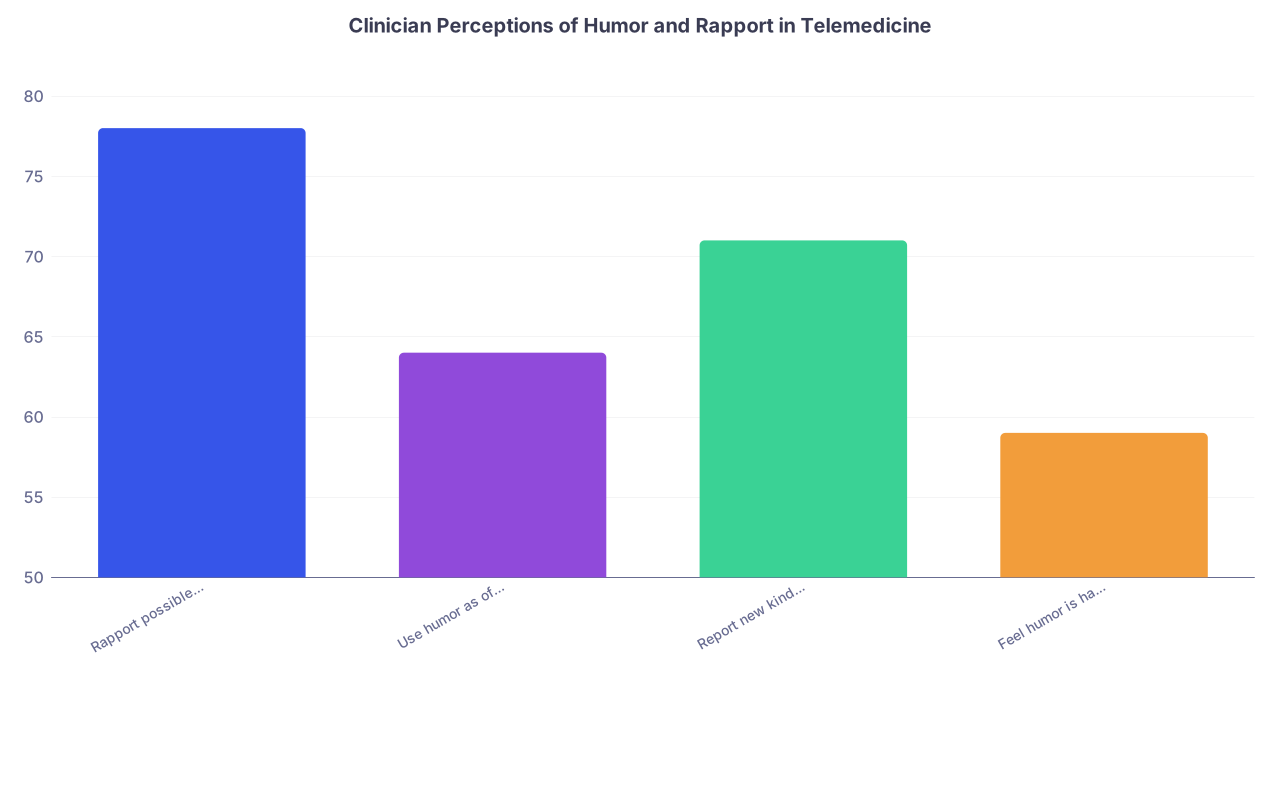
| Category | Value |
|---|---|
| Rapport possible via telehealth | 78 |
| Use humor as often or more than in-person | 64 |
| Report new kinds of awkward/funny moments | 71 |
| Feel humor is harder but still viable | 59 |
Are these numbers perfectly generalizable to every specialty and setting? No. But they’re consistent. Most clinicians do not say telemedicine destroyed connection. Many explicitly mention humor as a tool they still use—sometimes more intentionally than before.
Qualitative interviews are even clearer. You see phrases like:
- “I joke about the tech failing as an icebreaker.”
- “We both laugh about the dog walking through the camera.”
- “It’s easier to be human when I’m not in a white coat in a sterile room.”
Not exactly the obituary for humor.
How Telemedicine Reshaped, Not Removed, Humor
Humor in clinic used to lean heavily on shared physical environment:
- Waiting room absurdities. “You survived our check-in process; that’s the hardest part of today.”
- Exam room props. Blood pressure cuffs, paper gowns, the infamous rolling stools that always drift away mid-exam.
- Hallway sarcasm between staff. The quiet, dark humor that keeps people from burning out completely.
Telemedicine ripped out that physical scaffolding and replaced it with something else: patients in their native habitat, clinicians in quasi-personal spaces, and a camera between them.
That changed the sources and style of humor.
1. The new “room”: home as comic relief
Telemedicine visits put you inside people’s lives in a way clinic never could. That comes with a cost (boundary issues, distractions), but also a genuine source of shared laughter.
I’ve seen—and heard plenty of clinicians report—scenes like:
- A pediatrician doing an ADHD follow-up while a sibling in a dinosaur costume sprints across the background.
- A cardiology patient proudly showing their exercise bike… currently buried under folded laundry. Everyone laughs, then you segue right into adherence and realistic goals.
- A geriatric telehealth visit where the patient’s cat insists on sitting directly in front of the camera. “She likes to help with my appointments.” Cue a light remark about feline supervision.
These aren’t forced jokes. They’re natural, human moments. In a clinic room, you ask about home. On telehealth, you see it. That provides material—and connection.
2. Technology as shared adversary
It is very hard to bond over the design of an exam room. It is very easy to bond over the fact that the video platform just froze with your face in mid-blink.
Clinicians report intentionally using “tech failure humor” as a rapport tool. Muted microphones, delayed audio, connections dropping. You can either seethe or you can say, “Well, that’s our telehealth quotient for the day” and move on together.
Does constant tech-failure humor become annoying? Absolutely. But selective, well-timed, gentle acknowledgment of the absurdity—“The system logs us out after 14 minutes, which is optimistic about how fast you and I can solve anything”—often relaxes patients. Surveys of patient experiences with telehealth show that when clinicians acknowledge the tech awkwardness, satisfaction goes up, not down.
3. The white coat barrier got thinner
Pre-telehealth, a not-insignificant number of clinicians signaled seriousness with the uniform: the white coat, the formal office, the stethoscope draped just so. Humor lived in the gaps—end of visit, staff rooms, after-hours messages—not woven through the whole interaction.
Virtual visits forced a rethink. Many clinicians sit at a desk that looks moderately like any other professional’s desk. Less ceremony. More human.
When your patient can see the plant behind you dying from night float and call schedule, it changes the vibe a little.
Several clinicians in qualitative studies literally say some variant of: “I feel like I can be more myself over video; I’m not ‘performing doctor’ in the same way.” Many patients respond well to that. A short, self-deprecating joke about, say, your terrible Wi-Fi often lands better than stiff, clinic-polished small talk ever did.
No, this does not mean you should be doing stand-up from your home office. But the idea that telehealth “professionalized” medicine into flat, humorless transactions misses the fact that some barriers actually softened.
Where Humor Did Take a Hit
This is not all roses and reaction gifs. Some kinds of humor absolutely suffered.
The most damaged area is intra-team humor. The stuff that happens in the copier room, during shared charting time, at the nurse’s station. The gallows humor that’s more about survival than entertainment.
Those micro-interactions took a beating from both telemedicine and remote/hybrid staffing. Clinicians report more isolation, fewer organic debriefs, and more Slack/Teams messages that do not carry tone well enough for subtle, dark jokes that would have been understood in person.
Want to know where genuine clinic comedy lived? In that last-minute conversation after a wild morning: “So, who wants to trade stories for ‘most chaotic visit of the day’?” That’s much harder when everyone logs off to separate houses.
Another casualty: physical comedy. You cannot mime the “this computer is ancient” gesture in the same way when your laptop is also your camera. Physical space—rolling stool races, the clumsy attempt to find where the otoscope charger lives—does not translate to tile view.
But notice something. These losses are about workplace culture and environment, not about whether patient-facing humor can exist in telemedicine. People conflate the two.
Why So Many Clinicians Feel Like Humor Died
Feelings and facts can diverge.
There are three main cognitive traps here.
First, comparison to an idealized past. People remember the great hallway jokes from 2018, not the 40% of clinic days when everyone was too exhausted to say anything funny. This is classic recall bias.
Second, emotional association. For many clinicians, telemedicine is tied to the worst months of pandemic chaos. PPE shortages, daily policy changes, colleagues in the ICU. Those emotions stain the whole idea of virtual care. When something is associated with stress and loss, your brain labels it as “bad” and everything attached to it sounds worse—including the supposed disappearance of humor.
Third, survivor selection. The clinicians who truly hate telemedicine tend to be the loudest in meetings, on social media, and in informal conversations. The ones who shrug and say, “Some visits work great this way” are… working. Not shouting about it.
So the narrative you hear in the break room—“Telehealth killed the fun of clinic”—is as much venting as it is observation.
What Clinicians Actually Report Using Humor For Now
Strip away the nostalgia and you get something more pragmatic. Humor in telemedicine is being used with more intention.
From interviews, surveys, and the stories people trade at conferences now, the patterns look roughly like this:
| Use Case | Common Examples |
|---|---|
| Icebreaking / reducing tension | Joking about tech, background, pets |
| Normalizing sensitive topics | Light quips around awkward questions |
| Building alliance | Shared exasperation with systems or tech |
| Checking understanding | “Pop quiz” jokes about instructions |
| Ending on a lighter note | Brief callback to earlier funny moment |
And here is the key twist: several clinicians say they are more purposeful with humor now. Because the medium is thinner—no handshake, no shared physical space—every smile and short joke has to carry more weight.
I’ve heard variations of, “I use humor more, but more carefully,” from internists, psych, peds, and even oncology. They do not entertain more; they connect more.
The Darker, Uncomfortable Side: Humor as a Coping Crutch
There’s one more uncomfortable reality: some of the “clinic humor is gone” complaint is really “our old coping mechanisms broke.”
In-person, you could decompress with colleagues after a brutal visit. That often involved dark humor. “If I don’t laugh about this, I’ll cry.” You know the type. Everyone does.
Remote workflows fragment that. A heavy telehealth visit—say, delivering bad news, hearing about a patient’s job loss, watching someone’s home environment look palpably unsafe—ends, and then you’re alone with your webcam and your notes. No hallway to walk. No shared “wow” with the nurse who also sat through it.
Some clinicians report feeling more emotionally exposed in telemedicine because they cannot lean on quick, private, in-person dark humor to diffuse their own distress. So they label telehealth as “humorless,” when the reality is the opposite: it’s sometimes too emotionally direct, with fewer escape hatches.
Calling it “telemedicine killed humor” is easier than saying, “We lost a critical outlet for stress relief and we have not built a new one yet.”
Telemedicine Did Not Kill Humor. It Demanded You Get Better At It.
Let me be blunt: if your telemedicine encounters feel humorless, the medium isn’t the sole culprit. Video did not confiscate your personality. It exposed how much you were relying on automatic, environment-driven banter rather than deliberate, relationship-driven humor.
The clinicians who adapted best did three things:
They stopped trying to recreate the exact in-person vibe. You are not going to get the same rhythm as a packed clinic where everyone hears the same code blue alarm overhead. Accept that this is a different room, with different strengths.
They leaned into context. Commenting gently on what you can see (a sports team poster, a noisy family in the background, a carefully placed coffee mug) became a new entry point. That actually feels more personal for many patients.
They respected the limits. Without physical presence, tone errors are magnified. Telehealth punishes lazy sarcasm and rewards warmth and brevity. The good clinicians adjusted. The ones who didn’t often declared the whole thing doomed.
Humor is not a décor item you hang on the clinic wall. It’s a clinical instrument. As long as the clinician and patient share language, timing, and a bit of trust, it still works—whether the room is painted eggshell white or rendered in pixels.
Key Takeaways
Telemedicine did not kill clinic humor; it relocated and reshaped it. Patient-facing humor is alive—often more intentional and sometimes more personal—while intra-team, hallway-style humor took the real hit.
If your virtual visits feel sterile, the solution is not to wait for a return to 2019. It is to consciously rebuild the small, human, often funny moments that used to emerge by accident—and now have to be created on purpose.