
The idea that only extroverts can use humor well with patients is wrong. Not just a little wrong—backwards.
Extroversion doesn’t predict whether your jokes land in clinic. It predicts how loud you’ll tell them.
Let’s separate the personality-myths from what actually helps (or hurts) when you try to be funny with patients.
The Extrovert Myth: Loudness ≠ Connection
You’ve heard some version of this, probably from a preceptor or senior resident:
- “I’m just not funny, I’m more introverted.”
- “You have a great personality for patients—you’re outgoing.”
- “I could never joke with patients like Dr. X, I’m too quiet.”
Underneath that is a lazy assumption: humor with patients = performative, high-energy, talkative, always-on banter. In other words: extrovert territory.
Reality check: personality psychology doesn’t back that up.
Research on humor styles and personality (e.g., Martin et al., 2003 and follow-ups) consistently shows:
- Extroversion is modestly associated with using more humor in social situations.
- But the type and impact of humor are not owned by extroverts.
- Affiliative, gentle, connection-building humor is used by people across the spectrum—introverts included.
- Aggressive, attention-seeking humor (the “roast your buddy” style) is more often tied to extraversion and narcissistic traits than to empathy.
In clinical care, the humor that helps is not “life of the party” humor. It’s:
- Low-risk
- Patient-centered
- Situational
- Often subtle
You don’t need to be the comedian of the team for that. You need to be observant, attuned, and willing to risk a small, human moment.
Those traits do not belong to extroverts.
What the Data Actually Shows About Humor in Medicine
Let’s look past the vibe and talk evidence.
There are three separate questions that get blurred:
- Is humor helpful in clinical care?
- What kind of humor helps rather than harms?
- Does being extroverted give you special access to the “good kind” of humor?
The literature is messy but consistent on the key points.
1. Humor can help. But only when it’s not about you.
Studies in oncology, palliative care, and primary care show that appropriate humor can:
- Reduce reported anxiety
- Increase perceived warmth and approachability of the clinician
- Improve recall of information in some settings
- Build rapport faster, especially in repeated encounters
But “appropriate” does a lot of heavy lifting there.
What actually works:
- Humor that reflects shared reality
(“This waiting room could host a Netflix series at this point.”) - Self-deprecating humor that lowers hierarchy, not confidence
(“I promise my handwriting is better in the EMR than on prescriptions.”) - Gentle observational humor about the situation
(The IV pump that beeps at the worst possible moment. The gown that never quite closes.)
None of those require you to be chatty or outgoing. They require timing and empathy.
What reliably backfires:
- Humor about the diagnosis (especially cancer, miscarriage, mental illness)
- Humor about the patient’s body, weight, culture, or religion
- Dark humor to patients that really belongs in the break room (and even there, it’s risky)
That last category is often more tempting for overconfident extroverts than quiet introverts. So if anything, being very outgoing may increase your odds of overshooting the line.
2. Patients don’t care if you’re extroverted. They care if you’re attuned.
When patients rate “good bedside manner,” they mention:
- “Listens to me”
- “Doesn’t rush”
- “Explains things clearly”
- “Feels human, not robotic”
Humor, when mentioned, is almost always described like this:
- “Light sense of humor”
- “Made me feel comfortable”
- “Not stiff or cold”
Notice what’s missing: “Told a lot of jokes” or “So outgoing and bubbly.”
In other words, they want you to be human, not a late-night host.
Four Humor Styles: Only Two Belong in the Exam Room
Extroverts often dominate one type of humor; introverts often quietly excel at another. The research literature on humor styles divides them into four basic types:
| Humor Style | Typical Use in Clinic | Clinical Value |
|---|---|---|
| Affiliative | Shared light jokes | High |
| Self-enhancing | Private coping | Moderate |
| Aggressive | Teasing, sarcasm | Low/Negative |
| Self-defeating | Putting self down | Low/Contextual |
Affiliative humor is your friend with patients: sharing a light chuckle that says “we’re in this together.” That’s the “this gown design is definitely an intern’s fault” energy.
Self-enhancing humor is mostly internal: your ability to see absurdity in the chaos, to stay afloat mentally. You might occasionally let a little of it out in a safe, self-aware way.
Aggressive and self-defeating humor? That’s where harm lives.
Sarcasm about other staff. Mocking remarks about “frequent flyers.” Tearing yourself down so severely that patients start to doubt your competence.
Here’s the key myth-busting point:
Extroversion correlates more with quantity of outward humor, including aggressive styles. It does not inherently give you better affiliative, patient-centered humor.
Introverts, with their tendency to observe and think before speaking, are often better at the precision humor that actually matters in clinical relationships.
How Introverts Quietly Win at Patient Humor
Let me spell out the thing nobody says out loud: the best patient humor often comes from the quietest people on the team.
I’ve watched:
- The soft-spoken intern in heme-onc who never raised his voice but would say, when a patient apologized for “bothering him”:
“You’re literally the reason I get paid. Please, keep bothering me.”
Patient laughed. Shoulders dropped. - The very reserved palliative care NP who would look at the ridiculous, tangled IV tubing, sigh dramatically, and say, “I swear it multiplies when I leave the room.”
Families smiled in the middle of hellish days.
Neither of those people were extroverts. But they were:
- Attentive to shame, fear, and tension
- Comfortable with silence
- Willing to risk one small, kind, funny line
Introverts tend to excel in four areas that are gold for clinical humor:
Listening carefully
Humor that lands often comes straight from something the patient just said. You echo it, lightly exaggerate, or reframe it kindly. You can’t do that if you’re busy performing.Reading the room
Introverts often track micro-cues: tight shoulders, forced smiles, eyes that glaze over. That sensitivity tells you when not to joke… which is half the skill.Selecting your shots
Because you’re not talking constantly, patients experience your humor as thoughtful, not random. One well-timed line can do more than ten scattered quips.Being okay with subtlety
Not every “humorous” interaction needs laughs. A half-smile, a shared eye roll at the blood draw that took five tries—that’s often enough.
The myth that “I’m introverted, so I can’t be funny with patients” is usually code for one of two things:
- “I think humor means performing and I don’t want to perform.”
- “I’m afraid I’ll say the wrong thing.”
Both are fixable. Neither requires you to change your personality.
What Actually Matters More Than Extroversion
You want a useful checklist? Here’s the real stuff that predicts whether your humor will help or hurt:
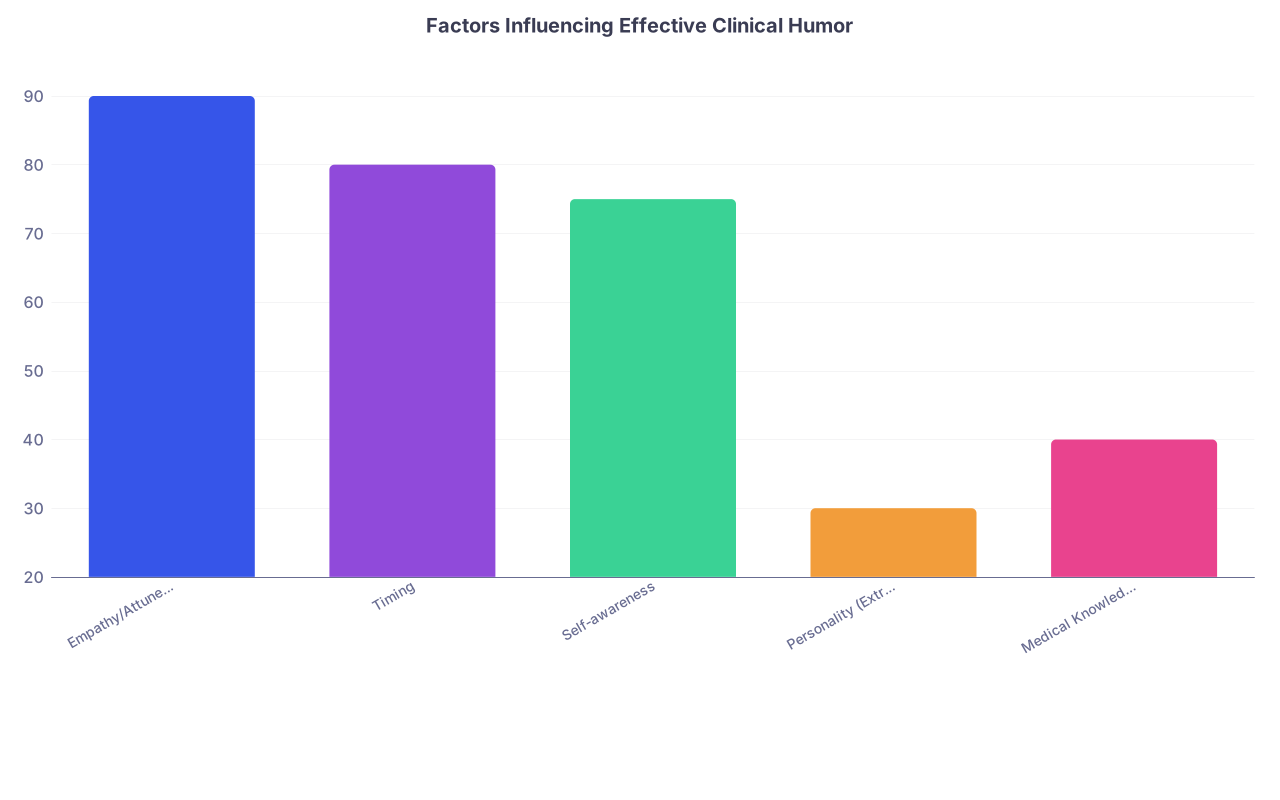
| Category | Value |
|---|---|
| Empathy/Attunement | 90 |
| Timing | 80 |
| Self-awareness | 75 |
| Personality (Extroversion) | 30 |
| Medical Knowledge | 40 |
Roughly speaking:
- Empathy and attunement: absolutely critical.
- Timing: almost as important. The right joke at the wrong moment is just wrong.
- Self-awareness: knowing when you’re performing for yourself instead of helping the patient.
- Personality traits like extroversion: tertiary at best.
- Raw medical knowledge: indirectly relevant (if you seem clueless, your jokes just feel uncomfortable).
Let’s dismantle the biggest misconceptions directly.
Misconception #1: “Extroverts make patients feel more comfortable, so their jokes work better.”
False. Patients feel uncomfortable with:
- Over-familiarity too fast (“We’re like besties now!” after 5 minutes)
- Intrusive personal questions disguised as “friendly”
- Humor that clearly signals, “Look how fun I am”
Comfort comes from emotional safety, not entertainment. A calm, reserved, slightly awkward doctor who genuinely listens and then makes one gentle joke will win over an overbearing extrovert nine times out of ten.
Misconception #2: “Introverts don’t speak enough to build rapport with humor.”
Also false. You don’t need high volume. You need high signal.
A 10-second exchange like:
Patient: “I’m probably your most annoying patient.”
You: “Not even top five. And I’ve had some real competitors.”
…does more relational work than three minutes of extroverted small talk about the weather and sports.
Misconception #3: “Being funny is an innate trait. You either have it or you don’t.”
This is where people hide from growth. There are learnable skills:
- Pacing: pause, then say the line.
- Framing: aim the joke at the situation, not the person.
- Consent: test with a very light comment before risking anything more colorful.
- Recovery: if it doesn’t land, you name it and move on instead of doubling down.
These work for quiet and loud personalities alike.
Practical Playbook: Using Humor as an Introvert (or a Thoughtful Extrovert)
Humor with patients is a clinical tool. If you treat it that way, your personality stops being the main driver.
Here’s a simple, evidence-aligned framework that works across the introvert–extrovert spectrum.

| Step | Description |
|---|---|
| Step 1 | Notice tension or anxiety |
| Step 2 | Focus on basics and listening |
| Step 3 | Try very light comment |
| Step 4 | Drop humor and continue clinically |
| Step 5 | Use occasional small jokes |
| Step 6 | Keep jokes situational and patient centered |
| Step 7 | Is patient engaged? |
| Step 8 | Any positive response? |
Step 1: Notice tension, not silence
Don’t ask: “Is this room too quiet?”
Ask: “Does this person look overwhelmed, ashamed, scared, angry, bored?”
Humor is for easing tension and humanizing the interaction, not filling silence. Introverts usually excel at detecting tension. Use that.
Step 2: Test the water with something 1/10th funny
Not a joke. More like a wink at reality.
Examples:
- “Medicine is very glamorous, as you can tell from this blood pressure cuff that never works on the first try.”
- When the computer freezes: “The EMR is just making sure I remember how to use pen and paper.”
If they:
- Smile, chuckle, or visibly relax → green light for occasional gentle humor.
- Stay flat, look confused, or change the subject → they may not want humor from you today. Respect that.
Step 3: Keep it near the situation, far from the person
Aim your humor at:
- The system (beeping pumps, gowns, waiting times)
- Yourself (minor self-deprecation that doesn’t undermine confidence)
- Shared human experience (no one likes colonoscopy prep)
Not at:
- The patient’s body, weight, accent, background
- The diagnosis
- “Frequent flyer” stereotypes
This is where extroverts sometimes overstep because they’re used to light roasting in social circles. Clinic is not your friend group. The rules are different.
Step 4: Use your natural style instead of imitating someone else
An introvert’s humor often works best as:
- Dry
- Understated
- Observational
- Short
An extrovert might naturally use:
- More expressive tone
- Bigger facial reactions
- Slightly more narrative jokes
Both are fine. Forced style is not.
If your default mode is quiet, then a simple “I promise this needle looks scarier than it feels” with a conspiratorial half-smile is 100% enough.
Where This All Points for the Future of Medicine
As we move toward team-based care, telemedicine, and algorithm-suffocated practice, the “personality myth” around humor will become even more obviously wrong.
Look ahead a bit:
- AI will cover more of the pattern-recognition and protocol-driven tasks.
- Patients who can get lab results on their phone in two clicks will come to you for what software can’t do: empathy, nuance, and humanity.
- That includes knowing when to use a tiny bit of humor to puncture fear, shame, or isolation.
Humor in medicine will shift from “nice personality extra” to “core communication competency.” Not because everyone needs to be hilarious, but because:
- You need to know how to reduce threat and increase connection.
- You need to know how to use lightness without trivializing suffering.
- You need to recognize when not to joke.
That’s not about being extroverted. It’s about being emotionally literate.
And emotional literacy does not care where you fall on a personality inventory.
The Real Question You Should Be Asking
The question isn’t “Am I extroverted enough to be funny with patients?”
The question is:
“Am I willing to be human enough to risk a small, kind, imperfect moment of shared reality?”
If yes, you can learn humor that helps. Whether you’re the quiet intern in the corner or the resident everyone hears from down the hall.
Years from now, your patients will not remember whether you were chatty or reserved. They will remember whether, in the hardest moments, you made them feel less alone—and maybe, just for a second, let them laugh without feeling guilty for it.