
The jokes that actually matter in residency never make it onto Twitter.
They happen at 2:37 a.m. in a cramped workroom, when the ED just paged with “one more admit,” the code pager is still warm, and someone looks up from Epic and says something so dark, so dry, and so accurate that the whole room breaks for a few seconds. Then everyone goes back to work. And that’s when attendings like me quietly take note.
Not all humor is the same. And in residency, the type of jokes you tell (and laugh at) are one of the fastest, most reliable tells of who’s going to thrive and who’s going to quietly implode by PGY-3.
Let me walk you through what we actually see.
The Unwritten Rule: Your Humor Is Your Coping Strategy
Program directors will never put this in a recruitment brochure, but humor is one of the first and best proxies we use for emotional resilience.
We observe three things constantly, even if we do not say it out loud:
- What you laugh at
- What you joke about
- Who you aim your jokes at
You think you’re just “being funny.” We’re assessing whether you’re safe to put on nights with a fragile intern, whether we’re comfortable sending you into a family meeting alone, whether you’re going to hold up during a run of three difficult deaths in one week.
Residents who do well long‑term tend to converge on a few specific humor patterns. Residents who crash and burn lean on very different ones.
Let me show you both.
The Jokes That Predict You’ll Survive (And Probably Lead)
These are the jokes that quietly make attendings relax a little around you. Not because they’re “nice,” but because they show you’re processing the insanity of residency without dehumanizing yourself or everyone around you.
1. The “We’re All Ridiculous” Jokes
This is the resident who comes back from a pre‑round and says, “I just cheerfully told the patient we’d ‘monitor their BMP closely’ as if I wasn’t the same person who forgot to check my own inbox for three days.”
The target of the joke: themselves and the system.
The effect: shared relief.
The subtext we hear:
“I see my limitations. I see the absurdity of residency. I’m not pretending to be omnipotent, and I’m not blaming everyone else either.”
Those residents:
- Ask for help before they’re in real trouble.
- Don’t crumble when they’re corrected.
- Can acknowledge mistakes without defensiveness.
Over a decade, I’ve watched these people become chiefs, fellowship directors, the attendings everyone wants to work with. Their humor is self‑aware, not self‑destructive.
2. The “System Is Broken, Let’s Survive It Together” Jokes
Classic example:
You’re an intern, it’s the fifth prior authorization of the day, someone mutters, “Great, I love faxing like it’s 1998. Next they’ll ask me to page them on a beeper.” The room laughs, then people share shortcuts, templates, ways to work around nonsense.
This flavor of humor punches up at bureaucracy, not down at patients or nurses.
What attendings actually think when they hear this:
“Good. They see what’s wrong and are still trying to make it work. They’re not numb, but they’re not in open revolt either.”
These residents become the unofficial problem solvers. They make better QI leaders, better administrators later on, and they burn out slower because they don’t internalize every broken process as a moral failure.
3. The Quiet, Surgical One‑Liners
You know the type. The resident who doesn’t talk much all night, then drops one perfect, dry comment that lands so hard the whole team cracks up. Not cruel. Just precise.
Example from an ICU night:
RT: “Do you want to change these vent settings?”
Exhausted resident: “At this point I’d like to change careers, but we can start with the vent.”
We hear:
“This person is tired, not lost. Their thinking is intact. They’re frustrated but still engaged.”
Residents with this style usually:
- Stay calm during chaos.
- Notice the details (you can’t craft dry humor without being observant).
- Don’t need to be the center of attention.
If they’re making sharp jokes but still triple‑checking orders and following up on phone calls, I don’t worry about them much.
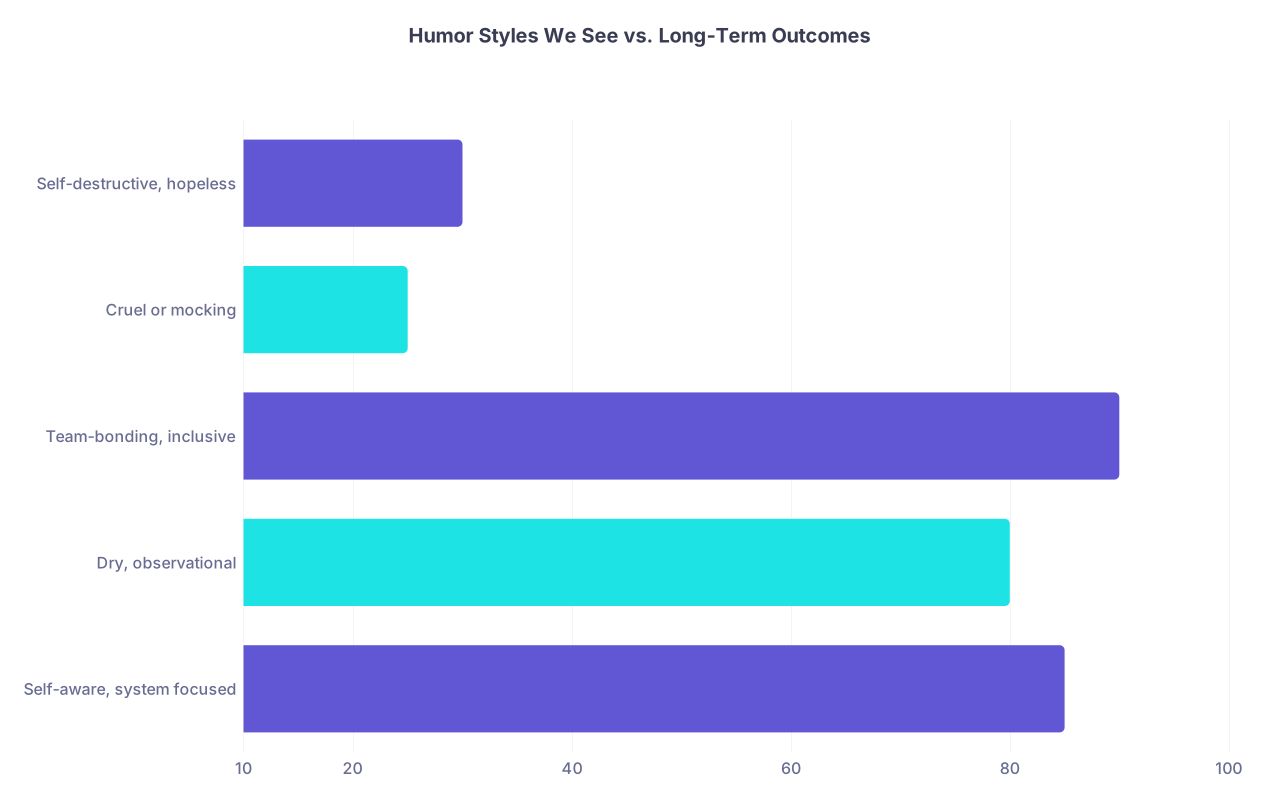
| Category | Value |
|---|---|
| Self-aware, system focused | 85 |
| Dry, observational | 80 |
| Team-bonding, inclusive | 90 |
| Cruel or mocking | 25 |
| Self-destructive, hopeless | 30 |
4. The “Inclusive Roasting” That Builds, Not Breaks
There’s a kind of teasing that, done right, is diagnostic of emotional intelligence.
PGY‑3 to intern, after the intern accidentally orders a full workup instead of a single lab:
“Bold choice. Just personally funding Epic’s stock price today.”
Everyone laughs. The intern laughs. Then the senior sits down and says, “Ok, let’s walk through how to fix this.”
Key difference: the joke is specific, time‑bound, and immediately followed by support.
We interpret this as:
“This senior can keep morale up, keep standards high, and not humiliate people. I can trust them with a shaky intern. I can trust them on nights.”
These are your future chiefs. The ones PDs fight to keep as faculty.
5. The Existential But Not Hopeless Jokes
The ones that sound like:
“Wild that we went through 4 years of med school to become highly trained discharge summary authors.”
Delivered with a smirk, not a dead stare.
This is the resident who can look straight at the absurd meaninglessness of parts of the job and still show up. They’ve made peace with the mismatch between what medicine promised and what Epic demands.
I’ve sat in plenty of workrooms where, after a run of bad cases, someone finally says something like, “Man, if I end up as a hospital slide in someone’s M&M deck, at least spell my name right.” Morbid? Sure. But the room exhales. Shadow acknowledged. People move on.
If the jokes are a pressure valve and not their main diet, they’re usually fine.
The Jokes That Make Us Quietly Red‑Flag You
Let’s flip the lens. There are humor patterns that make attendings and PDs go still for a second and think, “We need to watch this one.” We might not say it. But you’d be naive to think we’re not thinking it.
1. Cruelty Disguised as “Just Kidding”
The resident who repeatedly jokes:
- About a patient’s body, smell, or social situation.
- About nurses being “lazy” or “dramatic.”
- About consultants being “idiots” every time they disagree.
Once? Maybe poor judgment. Repeatedly? It’s character.
I remember a PGY‑2 who made a crack during sign‑out: “Oh, that guy? He’s a frequent flyer. Probably here for his usual bed and breakfast.” The night nurse heard that. So did the intern. The tone in the room shifted.
Attending feedback that week? “Technically fine. Professionalism concerns.” That resident never fully recovered their reputation. Not because we’re fragile, but because if you can dehumanize with jokes, you can cut corners with care. It’s the same muscle.
2. The “Everything Is Pointless” Humor
This one sounds smart the first few times. Then it gets dark.
The intern who jokes, “Why study? We’re all going to miss something anyway.”
Or, “If I make it to 40 without an ulcer it’ll be a miracle.”
At first, people laugh and nod. Because yes, we all feel like that sometimes. But when every joke is about futility, exhaustion, and despair, it’s no longer humor. It’s untreated burnout in costume.
We watch for:
- Jokes about not caring if patients live or die.
- Jokes about wanting to be hit by a bus instead of coming in.
- Constant references to quitting medicine as a punchline.
When that becomes your go‑to bit, attendings start sending discreet emails: “Have you checked in with them lately? They’re getting darker.” PDs notice. Wellness people get looped in. Nobody says “because of the jokes,” but everyone knows that’s the trigger.

| Step | Description |
|---|---|
| Step 1 | Resident makes recurring joke |
| Step 2 | May signal self-awareness |
| Step 3 | Professionalism concern |
| Step 4 | Possible burnout |
| Step 5 | Normal coping |
| Step 6 | Watch for distress |
| Step 7 | Feedback to resident |
| Step 8 | Quiet check-in or referral |
| Step 9 | Who or what is target |
| Step 10 | Frequency |
3. The “Too Cool To Care” Snark
This one irritates attendings the most.
Resident rolls eyes and says, “Oh sure, let me just drop everything for yet another family who ‘just has some questions’.” Smirk. Maybe a laugh from another jaded resident.
We hear:
“I’m above this. Patient needs are an inconvenience. My time is the only thing that matters.”
Yes, sometimes families are demanding. Yes, some consults are ridiculous. But when your humor consistently broadcasts contempt for the work—not the system, not the inefficiencies, but the actual caring part—that’s a strong prediction of either early exit or lifelong misery.
The residents who lean into this style often become That Attending later: bitter, transactional, and mysteriously unable to keep nurses or trainees on their side.
4. The “Winning the Dark Humor Olympics”
Every program has at least one resident competing in the “Who Can Make the Most Disturbing Joke” category. They think this shows they’re hardened, part of the in‑group. It doesn’t.
I remember a trauma resident joking mid‑night, after a horrific case, “Well, at least the OR team got their practice.” The room went silent. Nobody laughed. He doubled down: “What? Too soon?” He thought that was edgy. PD heard about it by morning.
Here’s the real rule:
If your joke makes the medical student look physically uncomfortable, you’re not as funny as you think. You’re broadcasting your own unprocessed trauma and lack of filter.
Is there a place for dark humor in medicine? Absolutely. We all use it. But the ones who do well know where the line is. And they notice the room. If people go quiet, they don’t escalate. They back off.
How Faculty Actually “Score” Your Humor (Even If We Never Say So)
We’re not formally tallying your jokes in MedHub. But we are doing something close in our heads.
We’re basically categorizing residents along a few axes whenever we work with them:
| Dimension | “Does Well” Pattern | “Concern” Pattern |
|---|---|---|
| Target of humor | Self, system, shared struggle | Patients, nurses, “stupid families” |
| Tone | Wry, lightly cynical, still caring | Contemptuous, mocking, nihilistic |
| Frequency | Intermittent, situation-appropriate | Constant, every interaction |
| Impact on team | Relieves tension, builds connection | Creates discomfort, divides the team |
| Flexibility | Can switch off, can be serious when needed | Stays “on bit” even in serious moments |
We notice, for example:
- The resident who is hilarious in the workroom, then walks into a patient’s room and becomes grounded, clear, kind.
- Versus the resident who brings the same sarcasm into family meetings and bedside conversations.
Guess which one we write glowing comments about.
Residents who do well long term can code-switch their humor. They can share the absurdity with colleagues without bleeding it all over patients.
The Future: Humor Will Matter Even More In the Next Era of Medicine
Here’s the part nobody’s talking about. As medicine gets more algorithmic—AI decision support, standard pathways, metrics for everything—the places where you’ll differentiate yourself won’t just be knowledge or technical skill. It’ll be how you function as a human in an inhuman system.
Humor is going to be a huge part of that.
Why?
Because the pressures are getting worse, not better. More patients. More documentation. More monitoring of your notes, your metrics, even your “professionalism footprint” online. The residents who can tactfully, intelligently use humor to:
- Create team cohesion in overburdened settings
- Push back against nonsense without self‑destructing
- Protect their core empathy while compartmentalizing tragedy
…are the ones who will still be standing with intact marriages, some joy, and options at 45.
Think of it this way: AI will handle more and more of the rote thinking. But it will not handle the 3 a.m. conversation in the workroom when your intern just saw their first bad outcome and is quietly shaking. Your response in that moment—the mix of seriousness, kindness, and the right light touch of humor—is leadership. Full stop.
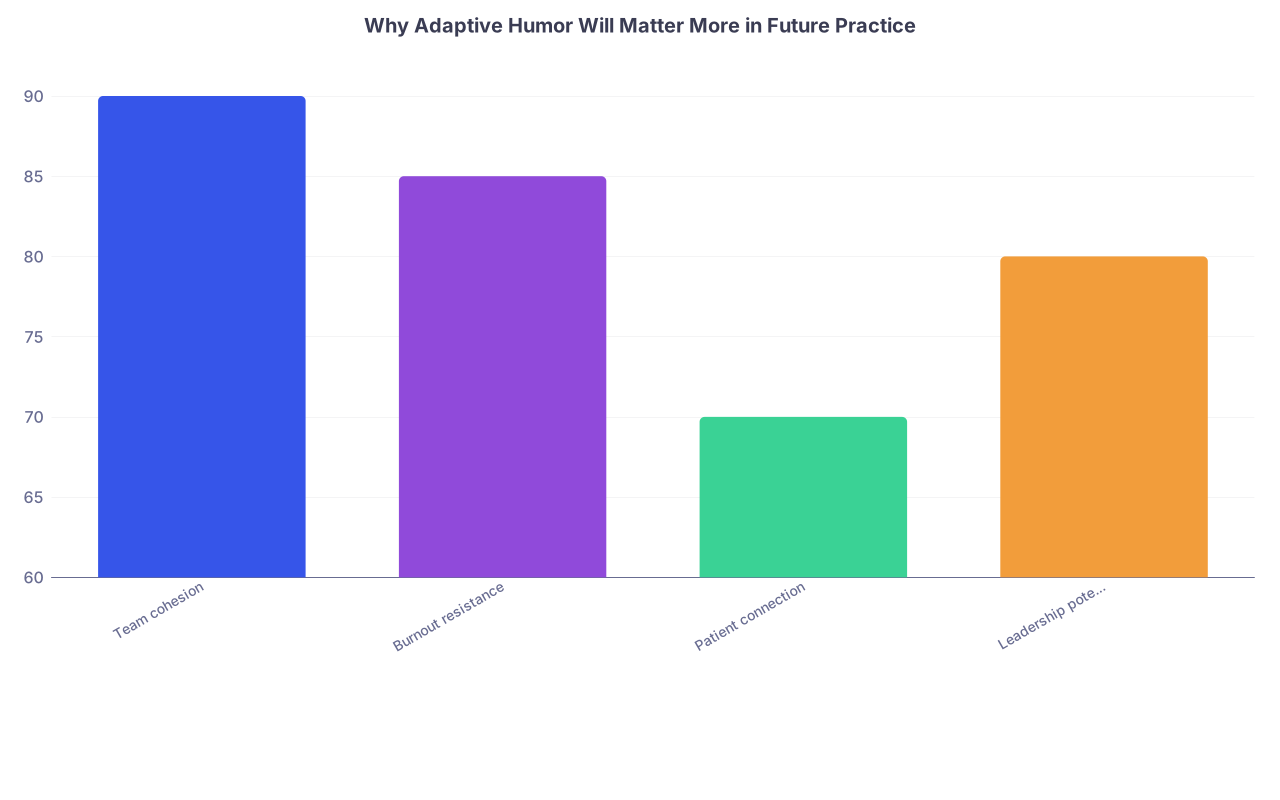
| Category | Value |
|---|---|
| Team cohesion | 90 |
| Burnout resistance | 85 |
| Patient connection | 70 |
| Leadership potential | 80 |
How To Shift Your Humor Without Becoming Fake
You do not need to become squeaky clean or neutered. Nobody trusts the resident who never laughs at anything. That’s its own red flag.
What you need is calibration.
Pay attention to three simple things over the next month:
Who flinches when you joke?
If it’s usually students, nurses, or quieter residents, your radar is off. You’re making them carry your stress.Do people laugh with you or just go silent?
Silence is data. Especially the awkward kind. The best residents learn from that quickly.Can you hit the brakes?
If you feel the urge to escalate a joke when nobody laughed at the first one, that’s exactly when to stop. Say “ok, that was dark, my bad” and move on. You’d be shocked how much respect you gain by reading the room and self‑correcting in real time.
You won’t get a lecture titled “Your Humor Needs Work.” We’re more subtle than that. But feedback will show up as:
- “Can be more professional”
- “Needs to be more mindful of comments around the team”
- “Occasionally comes off as negative”
Those phrases are often about your jokes, not your notes.
FAQs
1. Is dark humor always a problem, or is some of it normal?
Some dark humor is absolutely normal. Everyone who’s done real clinical work has said something in a call room they’d never say in public. The key is context: who hears it, how often you lean on it, and whether it moves the group toward relief or awkward silence. Occasional dark jokes in safe spaces with trusted colleagues are not what worries faculty. Constantly going for the darkest possible punchline, especially around juniors or non‑physicians, is a concern.
2. Can joking about patients ever be ok?
You’re human. You’re going to vent. But there’s a line between venting about behavior (“I got yelled at for not refilling someone’s antibiotics from last year”) versus mocking traits they can’t control (weight, smell, mental illness, poverty). The former is about your frustration with the situation. The latter is dehumanizing. When it becomes a pattern, it changes how you see and treat people—whether you admit it or not.
3. My program is super sarcastic. How do I fit in without crossing lines?
Every program has its culture. You can still fit in without being the loudest cynic. Aim your sarcasm at the system, not individuals. Make yourself the butt of the joke more than others. And watch how the people you respect most—usually the residents everyone trusts—use humor. Mirror their boundaries, not the edgiest person in the room.
4. Can my humor actually affect my evaluations and fellowship chances?
Yes, indirectly. Nobody writes “bad jokes” in your summative evaluation. But they absolutely write “occasional professionalism concerns” or “team feedback about comments on rounds.” Remember, fellowship directors call program directors and ask, “Would you hire them as faculty?” If your name is associated with cutting, demoralizing humor, that answer gets softer. If your name is associated with keeping teams steady on brutal nights, that answer is loud and fast.
5. I think my jokes have been too negative. Is it too late to change how people see me?
No, but you have to be deliberate. Dial it back fast. When you catch yourself saying something harsh, correct in real time: “Ok, that was more cynical than I meant, I’m just tired.” Start using more self‑aware humor and less contempt. People notice shifts. Attendings in particular are quick to update their mental file on you if they see consistent improvement over a few months. The narrative can change from “kind of negative” to “really grew during residency.” That follows you in a good way.
To boil it down:
- The jokes that signal you’ll do well punch at the system and at yourself, not at patients and colleagues.
- Faculty are constantly, quietly reading your humor as a proxy for resilience, empathy, and leadership potential.
- You don’t need to be less funny. You need to be sharper about what your humor says about you when you think we’re “just joking.”