
What If My Interviewer Didn’t Laugh at My Story? Reading the Room
What if you dropped your “funny” story in the interview, paused for the laugh you’ve ALWAYS gotten before… and your interviewer just stared at you?
Yeah. Let’s go straight into that social horror.
Because I know exactly the spiral: “They hate me.” → “I’m socially incompetent.” → “I’m definitely not matching.” → “Should I start looking at other careers? Dentistry? Tech support? Goat farming?”
Let’s slow that car crash down.
First: No Laugh ≠ You Failed
Here’s the uncomfortable truth I’ve had to remind myself: you’re not in a comedy club. You’re in a medical interview. Their job is not to validate your sense of humor. Their job is to evaluate whether they can trust you with a pager, a narcotics log, and a human being’s life at 3 a.m.
So yeah… sometimes they just sit there.
I’ve seen this exact moment:
You: “So I told the attending, ‘Well, at least I didn’t needle myself this time!’” You do the little half-smile. Waiting. Interviewer: blank face, scribbling notes, maybe one stiff nod.
And your stomach just drops.
Here’s what that might actually mean, in plain language:
They’re trying not to bias themselves.
Some interviewers go into full “judge mode.” Neutral expression, minimal feedback. It feels cold, but it’s intentional. They don’t want to give huge reactions to one candidate and not another.They’re focused on content, not delivery.
You’re busy thinking, “Was it funny?” They’re thinking, “Did this person show insight? Professionalism? Self-awareness?” They might not care that your story gets a laugh with your friends; they care what it says about you.They don’t find medicine funny. At all.
Some people are just… dry. Or tired. Or having a bad day. Or the last applicant made an inappropriate joke, so they’ve shut down their light-hearted side.They’re older / from a different culture / different humor style.
Your “sarcastic, self-deprecating” might not land with someone who trained when pagers were cutting edge and surgery residents got yelled at for smiling on rounds. Not a moral failing. Just a mismatch.
The thing that most applicants get flat-out wrong: we overestimate how much the reaction in the room equals our evaluation on paper.
They can think, “That was a good example of resilience,” and still not laugh. Those are not mutually exclusive.
Did I Just Come Off as Unprofessional?
Okay, here’s the part that really keeps me up: not just “they didn’t laugh” but “did they think my joke was inappropriate?”
This is the nightmare scenario looping in my brain:
“I made a joke.” “I accidentally disrespected a patient / nurse / attending.” “They think I’m unsafe.” “I’m blacklisted from medicine.”
So let’s be honest. There are ways humor can go sideways:
- Making fun of a patient, their condition, or their background.
- Making light of serious harm (“At least no one died, ha ha”).
- Joking about ignoring safety rules / HIPAA / consent.
- Anything remotely sexist, racist, ableist, etc.
- Throwing a colleague fully under the bus in a “funny” way.
If your story had any of that… yeah, that can be a problem. But usually, people know when they’ve crossed that line. You feel that sick, instant regret.
Most of us aren’t doing that. We’re making tiny, self-deprecating jokes like:
- “I was so nervous I checked the vitals ten times.”
- “I triple-checked the med order because I trusted myself exactly 0% at that point.”
- “I realized I was more anxious than the patient.”
These are usually fine. What interviewers actually care about: did you show you learned something, respected the team, and took patient care seriously?
If your story was essentially:
- “I messed up / almost messed up”
- “Here’s how I responded”
- “Here’s what I learned”
- “Here’s how I’ve been better since”
…then the lack of laughter is probably not about professionalism. It’s probably just about style.
How to Read the Room in Real Time (Without Melting Down)
The worst part is being stuck in the middle of the interview still replaying that dead-silent moment while you’re trying to answer the next question like a functional adult.
So, what do you actually do after your joke/story lands flat?
1. Immediately shift back to serious content
You don’t need to rescue the joke. Do not do the nervous “Wow, tough crowd” comment. That’s fine with friends; it’s risky in an interview.
You can do this instead, right after your line that you hoped was funny:
“…but in all seriousness, that moment really showed me how important it was to _____.”
This signals: I’m not here to be a clown; I’m here to show insight. It lets them mentally re-file your story from “attempted humor” to “mature reflection.”
2. Watch their questions, not their face
Faces are liars in interviews. Some people’s “interested” looks like fatigue. Or resting-serious-face. Or clinically depressed.
What actually tells you how they received your story is what they say next. Did they:
- Ask a follow-up question about your example?
- Nod and transition with something like, “That’s a good example of handling stress”?
- Move on briskly, but stay cordial?
That’s fine. If your story was truly a problem, you’d feel a shift in the room: colder tone, probing questions about judgment, maybe even direct pushback.
Silence + scribbling notes after your story often means: they’re writing down your example as evidence you meet a competency. Yes, while you’re dying inside thinking, “They hated it.”
3. Don’t double down on humor
This is the trap: the story didn’t land, and your brain goes, “Make another joke to fix this.” No. Stop. Your job now is to show you can modulate your tone like an adult.
If the interviewer seems serious, match them. Calm, straightforward, reflective. You don’t have to be grim. Just… no more auditioning for stand-up.
Is Humor Ever Actually a Plus in Interviews?
Yes. Carefully used, it makes you seem human, less robotic, more likable. But the bar in medicine is different than when you’re telling stories to friends.
Here’s roughly how “safe” various humor levels are in a med interview:
| Humor Type | Risk Level | Comment |
|---|---|---|
| Light self-deprecation | Low | Usually safe |
| Gentle situational humor | Low | If not at patient expense |
| Mild sarcasm | Medium | Depends on interviewer |
| Dark medical humor | High | Avoid in interviews |
| Jokes about patients | Very High | Just don’t |
Bar for what usually works:
- 90% serious, thoughtful, clear.
- 10% small, gentle humor that doesn’t punch down or trivialize.
If your “funny story” was about you being awkward, over-enthusiastic, or humbled, that actually tends to be okay. They may not laugh. But they’ll hear: “This person has some insight into themselves.”
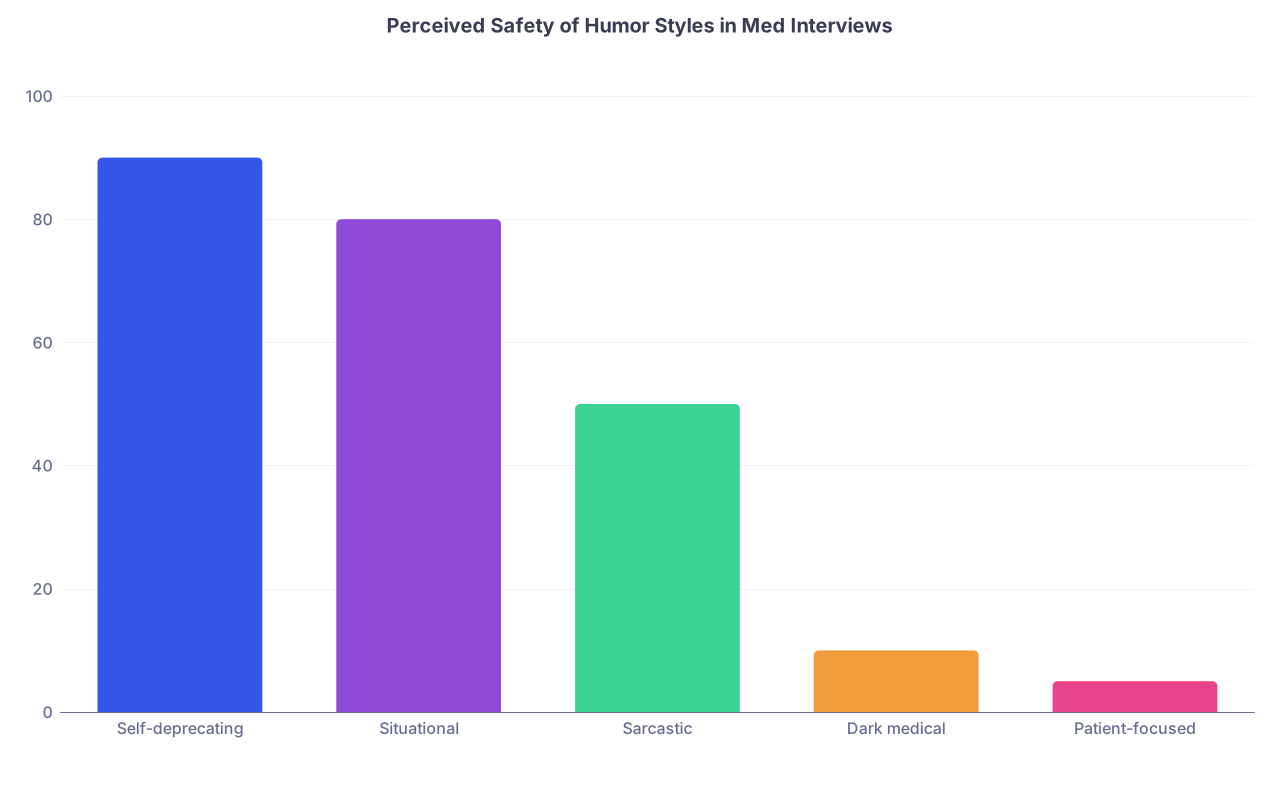
| Category | Value |
|---|---|
| Self-deprecating | 90 |
| Situational | 80 |
| Sarcastic | 50 |
| Dark medical | 10 |
| Patient-focused | 5 |
Reality Check: What Actually Gets You Rejected
This is the part I come back to whenever I start spiraling about The Joke That Didn’t Land.
People don’t get rejected because an interviewer didn’t laugh.
They get rejected because:
- Their answers show no insight or growth.
- They blame others constantly.
- They seem arrogant, dismissive, or unsafe.
- They can’t explain why they want this specialty beyond prestige.
- They say something clearly unprofessional.
If you walked out of that interview thinking:
- “I actually answered the questions logically.”
- “I gave specific examples.”
- “I was respectful and owned my mistakes.”
- “I didn’t insult anyone or trivialize harm.”
Then your “unfunny” moment is background noise, not a death sentence.
I’ve seen people match at great programs after interviews they were convinced they’d tanked because of one awkward joke. I’ve also seen people feel like they “crushed it” because everyone laughed — and then not get ranked highly because their actual substance was thin.
Programs don’t rank you on a “number of chuckles per 60 minutes” scale.
They rank you on: can we work with you and trust you?
What If I Keep Replaying It in My Head?
This is the part that’s hardest for me: the interview is over, but my brain keeps pressing the “replay” button like it’s getting paid per nightmare.
I re-hear the silence. I see their face. I remember every breath I took for 30 seconds after.
If you’re stuck there, try this:
1. Write the story down like a transcript
Literally. Word for word: what you said, where you paused, what they did next.
Then only allow yourself to judge what’s on the page, not the exaggerated version in your head. Most of the time, once it’s written, it looks way more tame and normal than it felt.
2. Ask: “Did I actually violate a core value?”
Not “was it awkward?” Awkward is not fatal. Ask:
- Did I disrespect a patient?
- Did I brag about ignoring safety rules?
- Did I minimize serious harm?
- Did I blame everyone else and take zero ownership?
If the answer is no, then this is social anxiety, not a catastrophe.
3. Turn it into a learning tweak, not a giant personality indictment
Maybe next time you:
- Soften the setup: “This was funny to me in retrospect, but at the time it was actually really humbling…”
- Shorten the joke portion, lengthen the reflection.
- Don’t aim for a big laugh. Aim for a small smile at most.
You’re not banned from using humor forever. You’re just… optimizing it for an audience that’s sleep-deprived, overworked, and thinking about call schedules.
Quick Reality Snapshot: What Interviewers Actually Remember
You know what most interviewers remember after a full day of meetings with applicants?
The one who:
- Was kind and didn’t trash-talk others.
- Had one or two clear, specific stories demonstrating resilience or growth.
- Seemed like they’d help carry the load at 2 a.m., not add drama.
They do not go back to the committee meeting saying, “Applicant #7 told a story that did not elicit laughter. Unacceptable.”
They say things like, “They seemed mature.” Or “They’ll fit well with the team.” Or “They handled that difficult situation thoughtfully.”
You’re inflating a 5-second micro-moment into a verdict. They’re compressing 60 minutes into a vibe and a few bullet points.
Two totally different scales.
If You Haven’t Interviewed Yet: How to Use This Preemptively
If you’re still ahead of your interviews and already worried about this (I see you), here’s what you do:
- Practice your “funny” stories with someone who does NOT laugh easily. If they still look engaged and say, “That’s a good example,” you’re fine.
- Build your stories so they still work even if nobody smiles. That means: the reflection and lesson are strong on their own.
- Get comfortable with neutral faces. Have a friend or advisor practice “interview poker face” while you talk so your nervous system doesn’t freak out the first time you see it.
And maybe accept this slightly depressing truth: most interviewers are not going to be your hype squad. They’re going to be tired humans trying to do their job. Your job is not to cheer them up. It’s to show them you’re safe, solid, and real.

| Step | Description |
|---|---|
| Step 1 | Tell story in interview |
| Step 2 | Interviewer does not laugh |
| Step 3 | Immediate panic |
| Step 4 | Replay moment 100 times |
| Step 5 | Reflect and adjust for future |
| Step 6 | Accept awkwardness as normal |
| Step 7 | Focus on overall performance |
| Step 8 | Did I cross a line |

Tiny, Honest Summary
If you’re still panicking, here’s the blunt version:
- Interviewers don’t have to laugh for your story to work. They care about judgment, not punchlines.
- One awkward, unfunny moment almost never sinks an application, unless it crosses a clear line of disrespect or unprofessionalism.
- You’re over-weighting the silence. They’re evaluating the substance.
You probably didn’t bomb. You probably just had a human moment in a very artificial situation. Welcome to medicine.