
The way most clinicians use self-deprecating humor is sloppy and risky. Used correctly, though, it is one of the fastest ways to lower a patient’s anxiety and build trust.
You are not a stand-up comedian. You are someone patients trust with their body, money, secrets, and time. That changes the rules. The goal is not “being funny.” The goal is: reduce threat, build alliance, and keep their confidence in you intact.
Here is how to use self-deprecating humor safely, on purpose, and with guardrails.
1. What Self-Deprecating Humor Is Actually For
Self-deprecating humor is not “I hate myself” humor. It is strategic status-lowering.
You are in a high-power position:
- White coat. Computer. Prescription pad.
- They are often half-dressed, scared, confused, in pain.
Self-deprecating humor, done well, tells the patient:
- “I see that this is awkward / stressful.”
- “I am human. I am safe.”
- “You can relax a notch. I am not here to judge you.”
Used badly, it tells them:
- “I am incompetent.”
- “I do not take this seriously.”
- “You are not safe. I am careless.”
The three legitimate uses
If your joke is not doing one of these three things, skip it.
-
- Example: Patient struggling with a gown.
- Line: “Whoever designed these gowns clearly never tried to wear one. I fail that tie three out of four times too.”
Normalizing vulnerability
- Example: Patient anxious about blood pressure on first visit.
- Line: “If someone checked my blood pressure the first time I met them while I was wearing this much polyester, I am pretty sure it would spike too.”
Humanizing authority
- Example: First-time visit with nervous teen.
- Line: “Do not worry, I was an incredibly awkward teenager. My hair choices alone could be classified as a medical condition.”
Anything that sounds like:
- Putting down your medical knowledge
- Dismissing the seriousness of their condition
- Making light of past medical errors
is off-limits.
2. The Core Safety Rules (Memorize These)
This is the part where I get strict. These rules keep you out of trouble.

Rule 1: Never joke about your competence
Do not say:
- “I have no idea what I am doing.”
- “Let us hope I pass this procedure.”
- “I am terrible at cardiology but we will see.”
Even if you are obviously joking, some anxious patients will not process the “obvious.” They will just hear: “Doctor is unsure.”
Safe alternatives:
- “This new electronic system still outsmarts me sometimes.”
- “I am better with stethoscopes than with these log-in screens.”
You can mock:
- The system
- The bureaucracy
- The technology
But not: - Your medical judgment
- Your procedural skill
Rule 2: Never make their problem the punchline
If the joke could be read as:
- Minimizing their pain
- Blaming them
- Mocking their appearance, culture, or coping
delete it from your repertoire.
Bad:
- “Well, that is what too many pizzas will do to you.” (re: obesity, diabetes, etc.)
- “Welcome to the old people club.” (to older patients about arthritis)
- “You and I both need to stop snacking after midnight.” (if their weight is a major distress point)
Better:
- Only use self-targeted humor that does not directly overlap their distress area.
For example, with a patient worried about weight:
- OK: “My own step counter keeps judging me at the end of clinic days. Apparently walking room to room does not qualify as real exercise.”
- Not OK: Anything about “we” being overweight or “we both need to lose 20 pounds.”
They may already be drowning in shame. Do not add another drop.
Rule 3: Check the room before you speak
Quick scan protocol (takes 3 seconds):
- Body posture: rigid, leaning away, arms crossed?
- Face: tearful, distant, angry?
- Context: just delivered bad news or discussing trauma?
If:
- They are actively crying
- You are disclosing serious or life-changing information
- There is clear unresolved anger toward the medical system
Drop the humor to near-zero. Your self-deprecation will feel like deflection or trivialization.
The only “humor” acceptable in those moments:
- Gentle, non-jokey humanity.
Example: slight smile as you hand a tissue and say, “These tissues are industrial strength. I use them when charting at night too.”
Rule 4: Keep it brief and then go clinical
One short line. Then straight back to solid, clear, confident medical communication.
Pattern:
- Quick self-lowering joke.
- Immediate transition into plan or explanation.
Example:
- “If you see me wrestling with this computer, I promise I am better with people than with software. Now, let me walk you through what I am seeing in your labs.”
If your joke turns into a story, or turns you into the main character for more than 10 seconds, you are no longer using humor therapeutically. You are just entertaining yourself.
3. A Simple Framework: The “3-L Filter”
You need something you can apply in real time. Here is the filter I teach residents.
Before using a self-deprecating line, ask yourself three questions:
Is it about Low-stakes?
- Topic: clothes, coffee habits, tech, paperwork, your awkwardness, mild forgetfulness (“I put my stethoscope down and lose it in under a minute.”)
Is it Likely to land?
- Based on:
- Their age
- Their culture
- Their level of distress
- Their language/communication style
- Based on:
Does it Leave their confidence intact?
- After the line, could they reasonably wonder if you are incompetent, careless, or cavalier?
- If yes, pull it.
If any of those three are not a clear yes, stay serious and straightforward.
4. Concrete Examples: Safe vs. Risky Lines
Let us make this real. Here is what I have heard in actual hallways and exam rooms, and how to fix it.
| Scenario | Risky Line | Safer Line |
|---|---|---|
| New EMR system | "I have no idea how to use this thing." | "This system and I are still learning to get along." |
| Running late | "I am the worst at staying on time." | "Thank you for your patience; clinic time and real time do not always match." |
| Teen visit | "I am too old to understand teenagers." | "When I was your age, my social skills were basically a medical condition." |
| Physical exam awkwardness | "I know this is weird, it is weird for me too." | "The glamorous life of medicine: I spend half my day asking people to say 'ah' and the other half apologizing for cold stethoscopes." |
| Complex medication list | "I can never keep all these drugs straight." | "These medication names are a Scrabble championship. Let me double-check them carefully with you." |
5. Timing: When Humor Helps and When It Hurts
You can be funny in the wrong five seconds and damage the next five years of rapport.
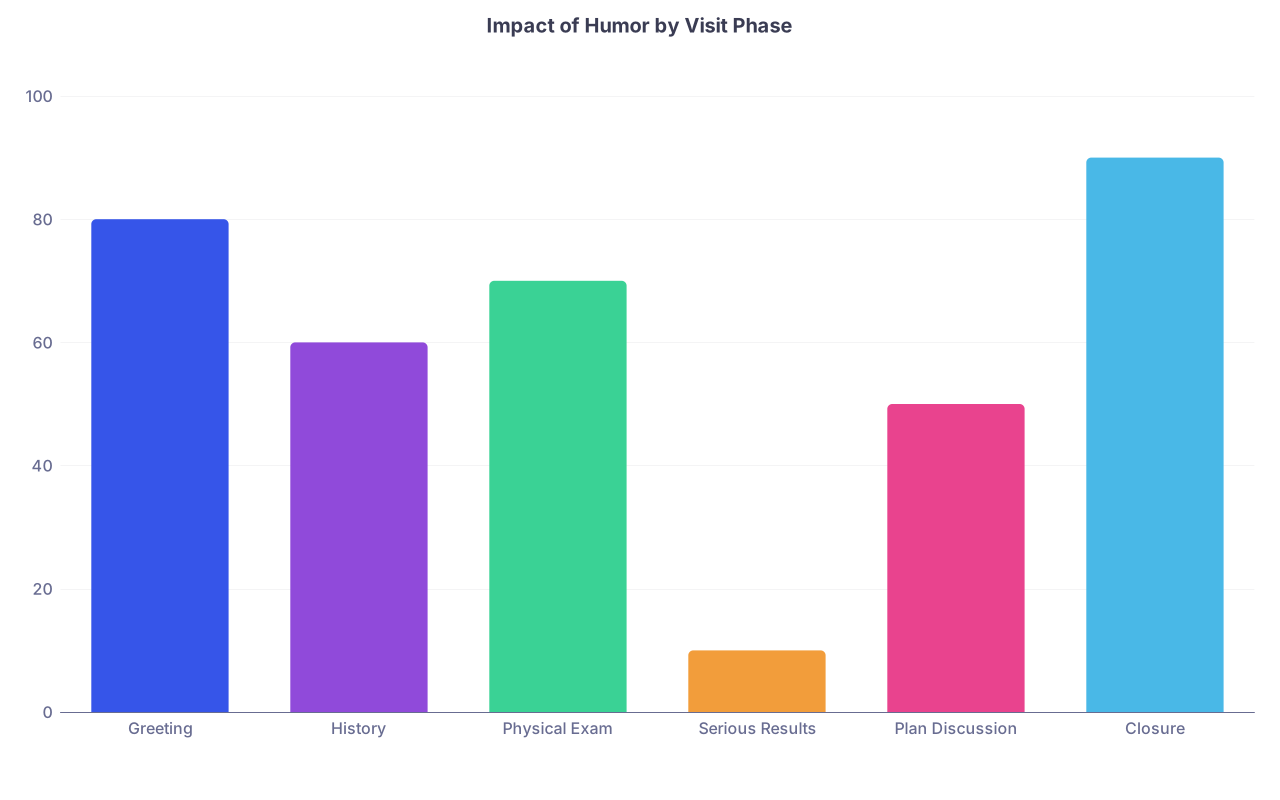
| Category | Value |
|---|---|
| Greeting | 80 |
| History | 60 |
| Physical Exam | 70 |
| Serious Results | 10 |
| Plan Discussion | 50 |
| Closure | 90 |
Interpretation (0 = never use, 100 = often safe if done right):
Greeting (80):
Prime zone for quick, light self-deprecation.- “If my coffee does not kick in soon, you might have to remind me what I just said.”
History (60):
Use sparingly, to ease into sensitive areas.Physical exam (70):
Great for lowering embarrassment. Keep it short and respectful.Serious results (10):
Basically no jokes. Maybe one very gentle, self-targeted comment only if they initiate levity.Plan discussion (50):
Can use humor to make instructions more memorable or reduce overwhelm, but never to undercut the seriousness.Closure (90):
Ideal for one self-humanizing line that leaves things on a warm, connected note.- “If you have questions later at 2 a.m., do not Google, just send a message. I Google too and it terrifies me.”
6. How to Adjust for Different Patient Types
You already do this intuitively with tone and speed. Apply the same calibration to humor.
The anxious patient
Goal: Safety, predictability, warmth. Avoid anything that might sound like loss of control or uncertainty.
Good:
- “I get anxious at appointments too when I am on the other side of the table. We will go step by step.”
Avoid:
- Jokes about forgetting, chaos, “winging it,” or “we will figure it out somehow.”
The angry or mistrustful patient
Humor is dangerous here. It can feel like you are not taking them seriously.
If you use any self-deprecating humor:
- Use it against the system, not yourself.
- “You are right, this process is ridiculous. I spend half my career apologizing for things the system makes way too hard.”
But do not:
- Mock other clinicians
- Undermine their previous care in a way that makes you sound like a hero savior. That will backfire later.
The very formal or older patient
Many older patients were raised with a strong “doctor as authority” script. Some will welcome humor; some will not.
Test line:
- Small, polite, very low-intensity.
- “I wish I could write a prescription for less paperwork. I would start with my own.”
Watch their response:
- Smile, shoulders relax: green light for a bit more.
- Neutral, stone-faced: keep it minimal. They may value gravitas over banter.
The adolescent or young adult
This is where many clinicians overdo humor and slide into trying to be “relatable.”
Guardrails:
- No slang that is not really yours.
- No joking about sex, substances, or risky behavior unless you are clearly using it to open the door to serious discussion.
Example:
- “My job is not to be shocked or to lecture. I have already heard everything. And I survived my own teenage years, which was an adventure.”
Then pivot:
- “Tell me what you have actually tried so we can keep you safe.”
7. Using Self-Deprecating Humor Across Cultures
You will not perfectly guess every cultural norm. That is fine. You need a default setting that is respectful and adjustable.
Safer cross-cultural moves
Focus jokes on:
- Shared human experiences (waiting, bureaucracy, technology, aging in a very general way).
- Yourself as an individual, not as a representative of their group or yours.
Avoid:
- Anything involving:
- Body size
- Intelligence
- Gender roles
- Religion or spiritual practices
- Money or social class
- Anything involving:
If you are uncertain, stay more neutral:
- “The hospital designers clearly never thought about how far these rooms are from the parking lot. I feel like I get my workout just walking in from the car.”
Low risk. High relatability.
8. Turning It Into a Repeatable Skill: A 10-Minute Practice Plan
You do not need to become a “funny person.” You need three or four reliable, safe lines you genuinely like and that sound like you.
Here is a simple way to structure it.

| Step | Description |
|---|---|
| Step 1 | Identify 3 common awkward moments |
| Step 2 | Write 1 safe self-deprecating line for each |
| Step 3 | Test with 3-5 patients and watch reaction |
| Step 4 | Keep what works, cut what falls flat |
| Step 5 | Review monthly and update lines |
Step 1: Identify your awkward moments
Think about the last week in clinic. When did things feel stiff, tense, or awkward?
Common ones:
- First 30 seconds of the visit
- When you are clearly running behind
- During sensitive exams (pelvic, rectal, genital, breast)
- When the computer is misbehaving
- When asking about substance use or sexual history
Step 2: Script one line per moment
For example:
Late to room
- “Thank you for waiting. I tried to clone myself but administration said no.”
Awkward exam
- “I will explain each step before I do anything. Glamorous it is not, but I will be quick and gentle.”
Computer glitch
- “The computer and I are having a disagreement. I will win eventually; it just enjoys the drama.”
Write them down. Say them out loud. Adjust until they sound like you, not like a script an HR department approved.
Step 3: Run small experiments
For 1–2 days:
- Intentionally use one line in appropriate situations.
- Pay attention to:
- Eye contact
- Micro-smiles
- Shoulder tension
- Verbal responses (“Oh, me too,” “Yeah, these systems are awful.”)
If the line:
- Consistently gets a small smile or visible relaxation, keep it.
- Gets blank stares, confusion, or seems to derail the visit, drop or revise it.
Do this a few cycles and you will have a tiny, powerful arsenal of safe one-liners that build connection without risk.
9. Documentation and Legal Reality Check
No, you do not chart your jokes. But your overall demeanor can become part of the record later if there is a complaint or legal issue.
Here is what helps protect you:
- Make sure the medical record:
- Shows you took concerns seriously.
- Reflects clear explanations and documented understanding.
- Does not include language that suggests you dismissed or minimized their issue.
If a patient ever says you seemed “flippant” or “did not take me seriously,” being able to point to:
- Detailed notes
- Clear safety counseling
- Documented shared decision-making
will matter far more than whether your self-deprecation landed.
The takeaway: use humor to support, not replace, careful communication and documentation.
10. Quick Do / Do-Not Cheat Sheet
Use self-deprecating humor to:
- Lower perceived power distance.
- Reduce embarrassment during exams.
- Make yourself more human and approachable.
- Acknowledge the absurdity of systems and processes (without sounding bitter).
Never use it to:
- Joke about diagnostic accuracy or procedural safety.
- Make light of their disease, pain, or disability.
- Change the subject away from their strong emotion because you are uncomfortable.
- Fill silence when they are thinking or feeling.
If you remember nothing else, remember this:
- The joke is about your humanity.
- The confidence is in your medicine.
You need both.