
The fastest way to destroy your credibility on rounds is not a wrong lab value. It is a joke that dies in front of your attending.
You know the moment. You drop a line you thought was light and clever. Silence. Maybe one nervous chuckle from the intern who feels bad for you. Your attending stares past you like they are reconsidering your existence. Your soul leaves your body.
Good. That means you are human. Now let’s fix it.
This is a playbook for what to do, step by step, from the exact second the joke bombs to how you prevent this mess from happening again. No fluff. Just tactics you can actually use tomorrow on rounds.
Step 1: Stabilize the Scene in the First 5 Seconds
The first few seconds after a failed joke decide whether this becomes:
- a forgettable blip
- or a long‑lasting “this student has poor judgment” narrative
Your only job in those 5 seconds: signal self-awareness and professionalism.
Here are three reliable recovery moves.
Option A: Soft Reset
If the joke was clean but just not funny:
“Okay, that one did not land. Back to the plan for today…”
Delivered calm, maybe with a half-smile. Not needy, not embarrassed. You basically label the moment as a harmless misfire and walk away from it.
Option B: Self-Own and Pivot
Useful when you can feel the awkwardness rising:
“That sounded funnier in my head. Anyway, the patient in 312…”
Short. Self-aware. Then immediately move to business. You are showing:
- You heard the silence
- You are not going to dig deeper
- You still prioritize patient care
Option C: Full Abort (No Comment, Just Move On)
If you realize mid-sentence “oh no this is inappropriate / misjudged / not the room,” shut it down immediately:
Stop. Neutral expression. Finish with something plain:
“…actually, never mind. The important thing is his troponin is down-trending.”
You do not need to complete the joke. Killing a bad joke halfway is less damaging than forcing it out and owning the consequences.
Step 2: Read the Attending Correctly (Not Your Co-Residents)
Residents and students will often laugh politely to keep things light. Attendings are the gatekeepers of “is this acceptable humor in this context.”
There are roughly four attending archetypes when your joke bombs:
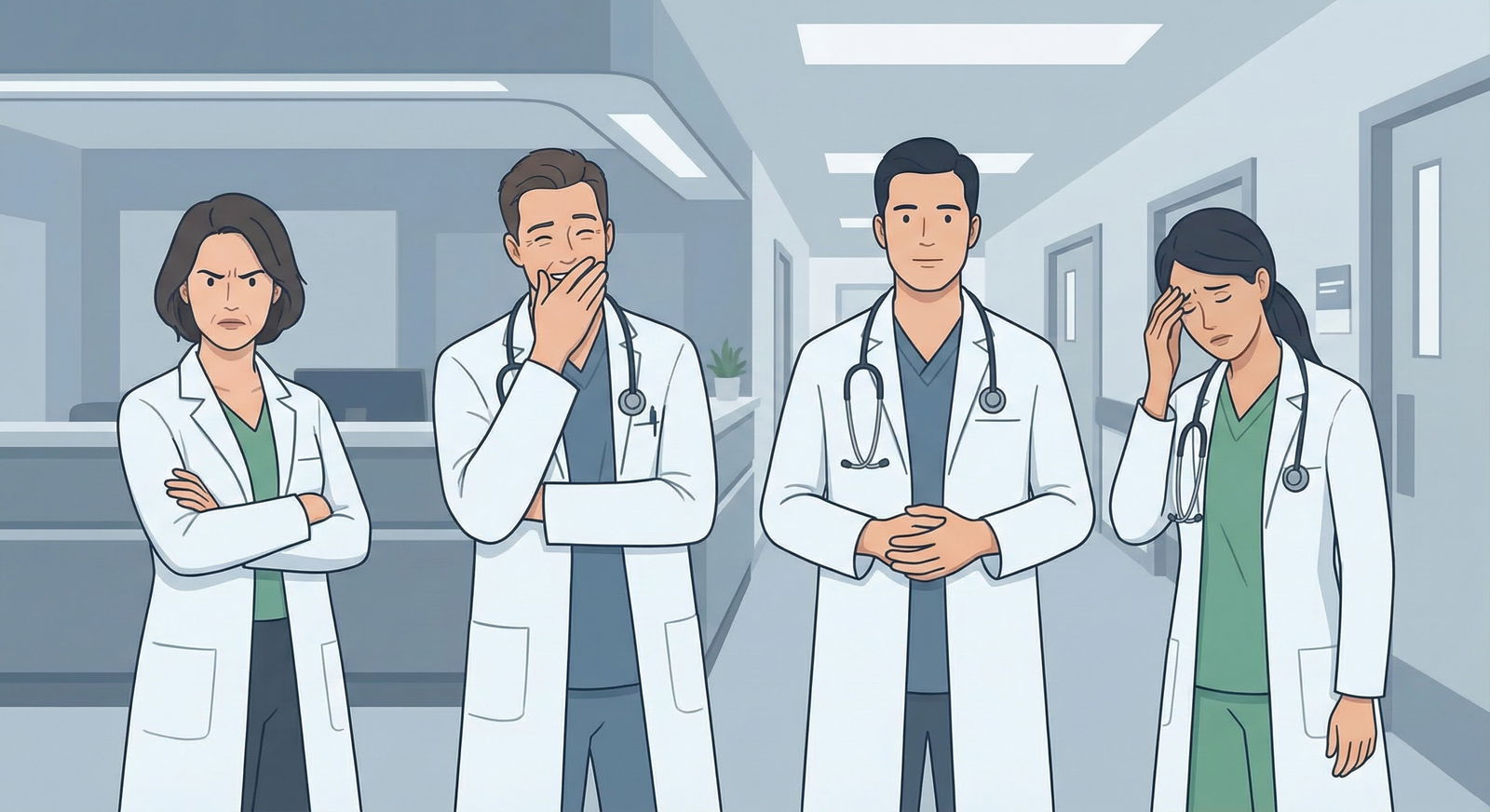
The Stone Wall
- Expression does not change
- Moves right on with patient care
- No comment about your joke
Interpretation: You misread the room. Humor is not forbidden, but you failed the “relevance / timing / tone” test.
Response: Dial humor down 80% with this attending. Focus on being solid and concise. Save your personality for 1:1 hallway conversations later, if at all.The Disappointed Teacher
- Raised eyebrow, slight frown
- Maybe a comment like “Let us keep it professional” or “This is a sensitive topic”
Interpretation: You crossed a line – content, timing, or respect. This is not about being unfunny; it is about judgment.
Response: You must repair. Short, direct:“You are right, I apologize. I will keep it focused on patient care.”
Then do exactly that, consistently.
The Mildly Amused but Silent
- Slight smirk, almost a smile
- No one laughs out loud, but you do not feel hostility
Interpretation: Wrong audience density. Maybe half the team got it, but nobody wanted to be first to laugh. Not catastrophic.
Response: Let it go. Do not try to “save” the joke. These attendings can handle light humor, but keep it softer and smaller.The Good Sport Who Tries to Help You
- They chuckle and make a small joke back
- You still feel like it did not fully work, but the mood is okay
Interpretation: You are safe. Joke just was not sharp.
Response: Take the gift. Laugh lightly, then move on:“Exactly. Anyway, labs this morning…”
The thing you absolutely do not do: argue with their reaction. If they think it was off, it was off. Their perception is what will end up in your evaluation.
Step 3: Decide If You Need a Direct Apology
Not every failed joke requires an apology. Forced apologies can make things more awkward.
Use this decision rule.

| Step | Description |
|---|---|
| Step 1 | Bad joke happened |
| Step 2 | Apologize same day |
| Step 3 | Brief apology later |
| Step 4 | Apologize and re-center on patient |
| Step 5 | No apology needed, just adjust behavior |
| Step 6 | Offensive or disrespectful? |
| Step 7 | Attending visibly bothered? |
| Step 8 | Patients or families heard it? |
You must apologize promptly if:
- The joke referenced:
- patient suffering
- a specific patient’s appearance, behavior, or social situation
- race, gender, religion, weight, mental health, substance use
- A patient or family member could clearly hear it
- Your attending directly calls it inappropriate
In those cases, use a simple 10-second script:
“I am sorry about that comment earlier. It was not appropriate for this setting and it will not happen again.”
Then prove it by not repeating the same mistake.
You probably should apologize if:
- Your attending got quiet and colder afterward
- A senior resident pulled you aside and said “probably not the best joke for rounds”
- You can feel that the vibe on the team shifted
Do it privately. Between patients, after rounds, or at the end of the day:
“Dr. Smith, I wanted to briefly acknowledge my comment during rounds. Looking back, it was not the right time or topic for a joke. I am working on better judgment around that.”
Short. Mature. No long explanation. No “I was just trying to lighten the mood.” The intent does not fix the impact.
You do not need an apology if:
- The joke was totally clean, just not funny
- Your attending showed no sign of discomfort
- No patient or family heard it
- People simply…did not laugh
That is normal. Not every attempt at humor will land. Adjust your approach, but do not create drama for something that was just socially flat, not harmful.
Step 4: Protect Your Reputation for the Rest of the Rotation
One bad joke does not ruin an evaluation. A pattern of poor judgment does.
So for the next few days with that attending, you run a “professional reset.”
1. Over-correct toward clinical substance
For at least 3–5 days:
- Be extra prepared on presentations
- Know your patients’:
- overnight events
- pending labs and imaging
- latest vitals, I/Os, and plans from consultants
- Volunteer for unglamorous tasks: discharge summaries, follow-up calls, calling families
You want the attending’s mental story to be: “Humor attempt was off, but this student works hard and takes care seriously.”
2. Temporarily cut humor during group rounds
You can still be human, warm, and kind with:
- Patients one-on-one
- Nurses and staff in casual, appropriate ways
- Co-residents in the call room, out of patient earshot
But during team rounds with that attending, you stick to:
- Clear data
- Concise assessment and plan
- Thoughtful questions
Let the attending re-learn that you can be trusted on the basics. Reintroduce mild humor much later, if it ever feels right again.
Step 5: Upgrade Your Internal “Humor Filter” for Clinical Settings
If you do not build a better filter, you will repeat the same mistake with a different attending.
Think of your humor in the hospital as running through a 5-step filter before you open your mouth.
| Filter Step | Question to Ask Yourself |
|---|---|
| 1. Topic | Is this joke about medicine, not patients? |
| 2. Target | Am I punching up, never punching down? |
| 3. Timing | Is the patient stable and the room calm? |
| 4. Audience | Would I say this in front of my PD? |
| 5. Recording Test | Would I be okay seeing this on social media? |
Walk through it quickly in your head:
Topic
Safe zones:- Your own confusion or mistakes (minor, non-harmful ones)
- Generic residency struggles (pages at 2 am, coffee dependency, pager PTSD)
- The absurdity of hospital bureaucracy
Dangerous zones: - Any joke about the content of a patient’s suffering
- Their social situation (homelessness, addiction, immigration, finances)
- Anything that touches identity (race, religion, weight, etc.)
Target
Simple rule: punch up, or punch at yourself; never punch down.Punching up examples:
- “I think the EMR was designed by someone who hates doctors and patients equally.”
- “If this prior auth were any slower, it would be radiology turnaround time on a Sunday.”
Punching down examples (never do these):
- “Classic noncompliant patient.”
- “Of course the uninsured guy needs the most expensive workup.”
Timing
Bad times for jokes:- Right after a patient has crashed or had a code
- When delivering serious news or discussing bad outcomes
- When the attending is clearly stressed, rushed, or behind
Better times:
- Walking between patients
- After rounds, debriefing with team
- During slower teaching moments, if someone else opens the door with mild humor first
Audience
Ask yourself: Would I say this in an email to my program director?
If the answer is no, probably do not say it out loud on rounds.Recording Test
If someone recorded this moment and posted it, would:- You feel comfortable defending it?
- Your attending feel comfortable having been present?
- The patient feel respected?
If not, shut up.
Step 6: What to Say If the Attending Brings It Up Later
Sometimes attendings circle back. End of day or end of week, you might hear:
- “About that comment earlier today…”
- “I wanted to give you some feedback about humor with patients.”
This is not a trap. It is an opportunity to show maturity.
Here is the script.
Listen without interrupting. Hands still, neutral face, eye contact.
Acknowledge:
“I appreciate the feedback.”
Own it:
“You are right, it was not appropriate for rounds, and I see how it could come across poorly.”
State your adjustment:
“I am going to keep things strictly professional on rounds from now on.”
Then do exactly that.
Do not do:
- “I was just trying to lighten the mood.”
- “Everyone else jokes like that.”
- “Nobody seemed to mind.”
Defensiveness tells the attending this is not a one-time gap; it is a pattern. That is how “funny student” turns into “unprofessional student” on your evaluation.
Step 7: Using Humor Safely Without Killing Your Personality
You do not have to become a humorless robot. You just need to stop using the hospital as an open-mic night.
Here is how to keep your personality without blowing up your evaluations.
1. Shift from “Jokes” to “Lightness”
Jokes are high risk, high reward. Lightness is low risk, and it actually builds connection better.
Lightness looks like:
- Smiling when you greet patients and staff
- Small, human remarks:
- “This EMR really does not want us to succeed.”
- “I think my coffee needs a consult with cardiology.”
- Warmth with anxious patients:
- “If my blood pressure was being checked this often, it would be high too.”
Notice these are not punchlines. They are gentle comments that create some shared humanity without targeting anyone.
2. Use Questions Rather Than Jokes
Instead of dropping lines, invite small shared humor.
With a patient:
- “We made you NPO again, and I can see you are ready to file a complaint with the breakfast committee. What is the first thing you want to eat when we are done with all this?”
With residents:
- “On a scale from 1 to ‘I’m going back to engineering,’ how was your night?”
The other person often supplies the humor. You just set it up. Much safer.
Step 8: How to Not Spiral Mentally After a Bombed Joke
You will be tempted to replay that moment all day. That is useless. Channel it productively.
Use a 3-part mental protocol:
Label it.
In your head (or notes): “Humor misfire on rounds – judged as unprofessional / just unfunny / timing off.”Extract a rule.
Example rules:- “No jokes within earshot of patients.”
- “No humor during first week with a new attending.”
- “Never joke about noncompliance or social issues.”
Move on deliberately.
Ask: “What is the next concrete thing I can do that improves my standing today?”- Check on a patient again
- Clean up your notes
- Help a co-intern with scut
You replace rumination with action. That is how you keep one bad moment from infecting the rest of the day.
Step 9: Practical Examples – Bad, Safer, and Best
Let me give you some concrete before-and-after examples so you can calibrate.
Scenario: Patient with multiple readmissions for COPD exacerbation
Bad joke on rounds:
“Frequent flyer card is almost full.”
Why it is bad:
- Dehumanizing
- Sounds like you are irritated with the patient for being sick
Safer lightness (in team room, no patients):
“This is our third COPD admit this week. I am starting to dream in DuoNeb schedules.”
Best version (patient-facing):
“I know you are tired of being back here again. Let us see if we can adjust your inhalers so we keep you home longer this time.”
Scenario: Long list of admissions overnight
Bad joke:
“I think the ED is just dumping everyone on us so they can go home.”
Why it is bad:
- Thrown at another service
- Implies lack of respect for colleagues
Safer humor (with trusted resident, not on rounds):
“I swear the ED and I are in a toxic relationship. They never call, and then suddenly 6 admits at once.”
Best neutral version on rounds:
“We had a busy night with six new admissions. I will keep my presentations concise.”
Scenario: New attending you just met today
Bad move:
First patient, first 3 minutes, you open with a sarcastic comment about hospital food.
Better move:
- Zero jokes day 1
- Watch how they use humor (or do not) with staff and patients
- Match their level gradually, one small light comment at a time once you understand their style
Step 10: Long-Term – Building a “Professional Humor” Style
If you enjoy being funny, there is a way to do it well in medicine. It just has to be a professional style, not a stand-up comedy style.
Patterns I have seen in attendings who are genuinely funny and respected:
- They almost never joke about patients. They joke with patients.
- Their self-deprecation is aimed at:
- their age
- their computer skills
- their coffee addiction
Never at their competence or caring.
- Their humor usually:
- reduces anxiety
- creates connection
- makes patients feel safer, not mocked
You can get there, but only if you respect the boundary that patient care and team trust come first. Always.
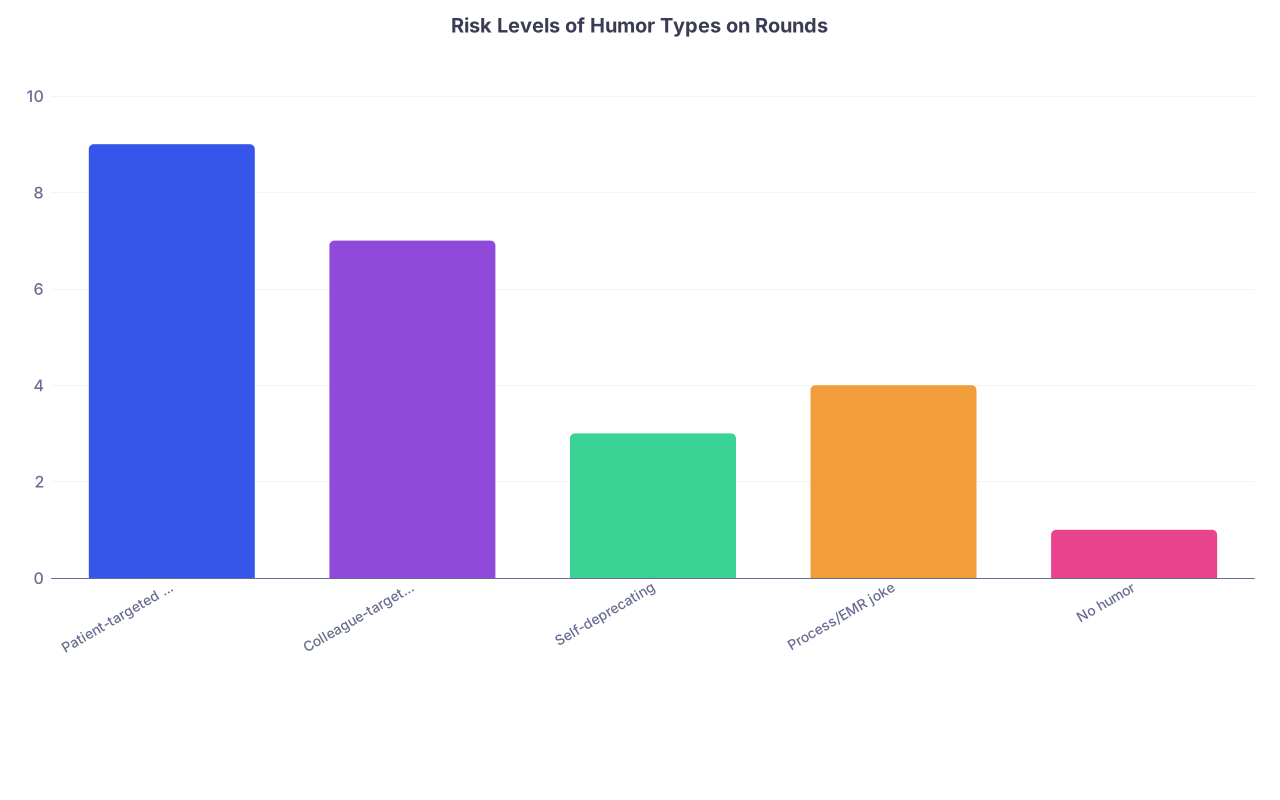
| Category | Value |
|---|---|
| Patient-targeted joke | 9 |
| Colleague-targeted joke | 7 |
| Self-deprecating | 3 |
| Process/EMR joke | 4 |
| No humor | 1 |
Key Takeaways
- When a joke bombs, stabilize fast: brief self-awareness, then pivot to patient care. Do not dig the hole deeper.
- Decide calmly whether it needs an apology, then over-correct with professionalism for the next several days so the story about you is “solid clinician, one misstep,” not the reverse.
- Upgrade your humor filter: punch up or at yourself, never at patients; avoid sensitive topics; and remember that in medicine, your primary job is not to be funny. It is to be trusted. The rest is optional.