
The fastest way to destroy trust in a bad-news conversation is to use the wrong joke at the wrong time.
You already know that. The problem is not that clinicians are reckless clowns. The problem is that no one has ever given you a clear, practical framework for when humor actually helps, when it is dangerous, and what to do instead.
That is what I am going to fix.
The Core Rule: Humor Is a Technique, Not a Right
You do not have a “right” to be funny in a bad-news conversation. You have a responsibility to reduce suffering and preserve dignity. Humor is one possible technique. That is all.
Here is the core rule I teach residents:
You may use humor only if it clearly serves the patient’s needs, not your anxiety.
If you cannot defend a joke or a light comment as explicitly helpful to:
- Reduce the patient’s distress
- Increase the patient’s sense of control or connection
- Clarify something hard to say
…then you are probably doing it for yourself.
The rest of this article is a structured way to answer one question in real time:
“Is humor safe and useful here?”
And if the answer is “yes,” how to do it without blowing up the room.
A Simple 4-Stage Framework
Think of bad-news conversations in four stages. Humor has a different job (or no job) at each stage.
- Pre-Conversation: Check Yourself
- Opening: Zero Humor Rule
- Middle: Patient-Led Lightness Only
- Closing and Follow-Up: Gentle Normalization
We will go through each stage with specific language, red flags, and a simple decision tree.

| Step | Description |
|---|---|
| Step 1 | Pre-Conversation |
| Step 2 | Opening |
| Step 3 | No humor - stay grounded |
| Step 4 | Patient-led lightness |
| Step 5 | Use small, safe humor |
| Step 6 | Deliver info and empathize |
| Step 7 | Closing and Follow Up |
| Step 8 | Patient shows coping signals |
If you remember nothing else, remember the decision diamond in the middle: “Is the patient clearly showing coping signals?” If not, do not initiate humor. Period.
Stage 1: Pre-Conversation – Control Your Own Anxiety First
Most bad humor during serious conversations is a symptom of clinician anxiety leakage. Nervous laugh. Awkward pun. Forced “lightening the mood” because you cannot stand the silence.
Fix that before you walk in.
Quick 60-Second Self-Check
Right before you enter the room, run this mini-protocol in your head:
Name your own emotion
- “I am dreading this.”
- “I feel guilty that we do not have better options.”
- “I am exhausted and impatient.”
When you name it, you are already less controlled by it.
State your goal for this conversation
One sentence:- “My job is to be clear and kind.”
- “My job is to reduce their confusion, not their sadness.”
Set your humor threshold
Decide before you walk in:- “I will not initiate any humor.”
- “If they joke, I will acknowledge lightly but stay grounded.”
If you are very anxious, over-tired, or angry at the system, assume you are not safe to lead with humor. You are too likely to mask discomfort with jokes. When in doubt, strip your language down and slow down.
Stage 2: Opening – The Zero Humor Rule
The opening is where you can do the most damage with a single misplaced attempt at lightness.
So here is the guideline:
No humor until the bad news is clearly stated and clearly heard.
Not:
- When you enter the room
- Not during the first vitals chit-chat
- Not when you are choosing a chair
You can be warm. You cannot be funny. The patient’s nervous system is on high alert, even if they appear calm.
What a Good Opening Looks Like
Elements:
- Sit down (if appropriate)
- Use the patient’s name
- Warning shot (“I am afraid I have some difficult news”)
- Silence allowance
Example:
“Mr. Lee, thanks for waiting. I am afraid I have some difficult news about the scan. I want to go through it clearly and then leave time for your questions.”
Then stop. Let the weight land. No follow-up like, “But we will get you through this!” or “Let’s rip the Band-Aid off.” Those are pseudo-jokes that try to dilute reality before you even describe it.
The “No Cute” Rule
During the opening, avoid:
- Playful exaggerations (“The computer hates us today”)
- Cliché jokes (“No one likes hospital food, right?”)
- Deflections (“I wish I had better jokes today, but…”)
You are creating a serious container. Trust me: you will need that container ten minutes from now.
Stage 3: Middle – Patient-Led Lightness Only
After the news has been clearly delivered and acknowledged, the conversation shifts. This is where the nuance starts.
Now you ask:
- How are they reacting?
- Are they using any humor themselves?
- Are they asking for space, for information, or for connection?
Step 1: Read the Room Like a Professional
Look for four types of signals.

A. Shutdown signals (No-humor zone)
- Staring into space
- Monosyllabic answers
- Long silence with tearful or flat face
- “I need a minute” or “I don’t want to talk about it right now”
Here, humor of any kind is risky. Even “gentle” humor can feel like intrusion or minimization.
B. High-intensity distress
- Sobering, visible crying
- “How could this happen?”
- “Are you sure?”
- Repeated “This cannot be real”
Your job: containment and empathy.
Lines like:
- “I can see this is a shock.”
- “This is not the news you were hoping for. I am here with you.”
No humor. Not yet.
C. Controlled but engaged
- Making eye contact
- Asking specific questions
- Taking notes
- Steady voice, no obvious jokes yet
This is the watchful waiting zone. You still do not initiate humor, but you are watching for patient-initiated lightness.
D. Patient-initiated humor (the only safe on-ramp)
Examples I hear all the time:
- “Well, I always knew I was special, just not cancer-special.”
- “My wife is going to say ‘I told you so’ about those cigarettes.”
- “So I guess that marathon next month is off, huh?”
Now you can gently, briefly join their style, if it feels aligned with their emotion, not above it.
Step 2: The “Echo, Then Anchor” Technique
If the patient initiates humor, you respond in two moves:
- Echo lightly – Stay at or slightly below their level of humor.
- Anchor emotionally – Follow quickly with something validating or grounding.
Examples.
Patient: “Well, there goes my modeling career.”
You (echo): “We might have to postpone the runway debut, yes.”
You (anchor): “I know this is a lot to take in. How is this landing for you right now?”
Patient: “So I get the deluxe cancer package, huh?”
You (echo): “You definitely drew the complicated package, unfortunately.”
You (anchor): “We are going to walk through what that means and what our options are.”
Why this works:
- You respect their coping style (you are not shutting them down).
- You make sure the main emotional message stays clear: “I see you. I am not using humor to escape your pain.”
Step 3: Use “Micro-Humor,” Not Comedy
You are not auditioning for a stand-up set. Bad-news conversations call for micro-humor:
- A small smile at their joke
- A one-line shared observation
- A gentle self-deprecating line when appropriate
Micro-humor rules:
- No sarcasm about their condition
- No mocking anyone (family, other clinicians, the system)
- No dark humor unless they clearly go there repeatedly and you are absolutely sure they want a co-pilot
If you are going to err, err on the side of too little.
Concrete Examples: Good vs Bad Use of Humor
Here is where people usually mess up. They try to “lighten the mood” because the silence feels unbearable.
| Situation | Bad Response | Better Response |
|---|---|---|
| New metastatic cancer diagnosis | “Well, I wish I had a happier script for you today!” | “I wish I had better news. I am so sorry. Let me walk you through what we found.” |
| Patient crying after hearing prognosis | “Hey, at least your hair looks great!” | “I can see this is overwhelming. We can take this step by step, and I am not going anywhere.” |
| Patient makes a mild joke | (Ignoring it completely) | Echo briefly, then validate their feelings |
| Long, heavy silence | Joke about how quiet it is | “We can sit in silence for a bit if you need. We do not have to fill it with words.” |
If your joke could be rewritten as “I am uncomfortable and want this to be less intense,” do not say it.
Special Case: Families and Group Dynamics
Humor gets messier when there are multiple people in the room.
You have to track:
- The patient’s coping style
- The spouse’s or child’s style
- The power dynamics
I have seen this scenario dozens of times:
- Patient makes a light joke.
- Spouse glares and looks furious.
- Clinician laughs with the patient and instantly loses the spouse’s trust.
Here is the rule:
You are responsible to the most vulnerable and least amused person in the room.
If the patient is joking but the spouse looks devastated, anchor to the spouse first.
Patient: “Guess I finally have an excuse to skip family dinners.”
Spouse: Tearful, quiet.
You: Small smile to patient, then to spouse: “I can see this is really hard to hear. How is this for you right now?”
You are still acknowledging the patient’s humor, but you align yourself with the person whose distress is highest.
Dark Humor: Keep It Out of the Room
Let me be blunt: dark humor between clinicians is normal and often healthy. People who pretend otherwise are lying to you. It is a pressure valve.
But it belongs:
- In the workroom
- With peers who understand the context
- Away from patients and families
The risk is that you get so used to using dark humor to cope that it leaks. A comment that would be fine on night float at 3 a.m. becomes catastrophic when even half of it slips in front of a family.
Concrete rule:
- Zero dark humor in any patient-facing space.
- That includes elevators, hallways, nurses’ stations within earshot.
If you catch yourself thinking, “This would be funny to my co-resident,” that is your sign to shut up immediately around patients.
What Humor Can Actually Do For You (When Used Right)
Used properly, lightness can do three useful things in a bad-news context:
- Signal alliance
- “We are in this together. I see you as a person, not just a diagnosis.”
- Reduce shame and isolation
- Especially around topics like bodily functions, sexual changes, or loss of independence.
- Give people a breather
- A 10-second shared smile can help someone take the next emotional blow.
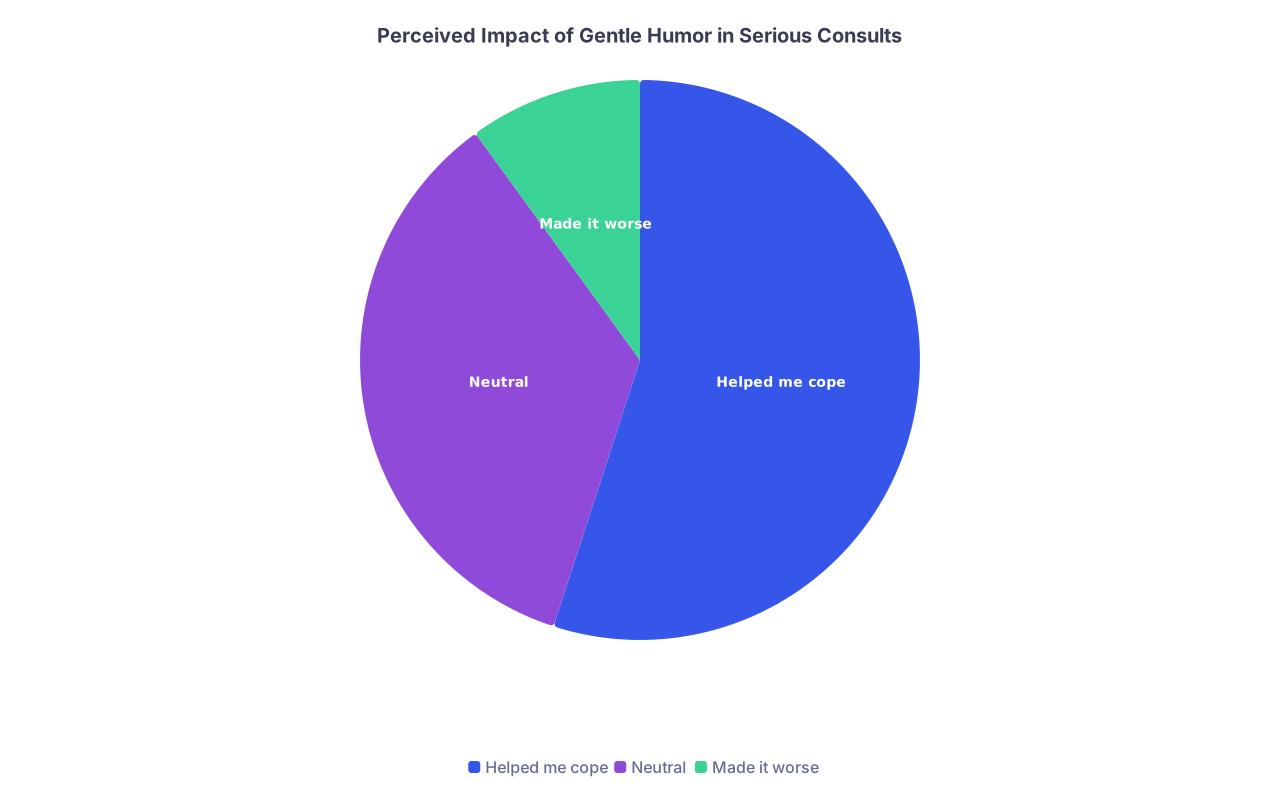
| Category | Value |
|---|---|
| Helped me cope | 55 |
| Neutral | 35 |
| Made it worse | 10 |
The numbers here are illustrative, not from a specific single study, but they reflect what multiple communication studies and palliative care reports show: when patients initiate or welcome it, gentle humor often helps.
But the 10–15% of people who feel it made things worse? Those are the ones who write complaints, disengage from care, or silently decide you are not their ally. That is why the threshold for using humor must be high.
Practical Scripts You Can Steal
Here are some “safe” lines you can adapt. These are not jokes themselves. They are guardrails around whatever small humor does show up.
When you are unsure if humor is welcome
- “Sometimes people use humor to cope. Others prefer to stay serious. How is it for you?”
- “You made a joke there—should I stay on that level with you or keep it more straightforward?”
You are asking permission. Explicitly. Most patients respect that.
When a patient makes a big self-deprecating joke
- “I hear you using humor there. Part of me smiles with you, and part of me knows this is really painful. Both are allowed here.”
This validates both the joke and the pain behind it.
When you accidentally say something that lands badly
This will happen. You are human.
- “I can see that did not come out right. I meant to support you and I missed. I am sorry. Let me say that again more clearly.”
Then stop trying to be funny for the rest of that encounter. Your trust account is overdrawn; it is time for pure clarity and empathy.
Humor with Children and Adolescents
Different game.
Kids and teens:
- Use humor more openly
- Test adults with sarcasm
- Often prefer a mix of silly and serious, as long as you respect their intelligence
But the same skeleton rules apply:
- Do not initiate humor before the bad news is clear.
- Follow their lead in style and intensity.
- Always anchor back to reality after a light moment.
Example with a teenager:
Teen: “Well, there goes my NBA career.”
You: “The NBA may have to wait, yes.” Small pause. “We are going to focus on getting you through this treatment as safely as we can. What are you most worried about right now?”
The humor acknowledges their identity and loss. The anchor keeps you out of “everything’s fine” territory.
Training Yourself: A Simple Practice Plan
You do not get better at this by reading. You get better by deliberate practice and feedback.
Here is a realistic four-step plan.
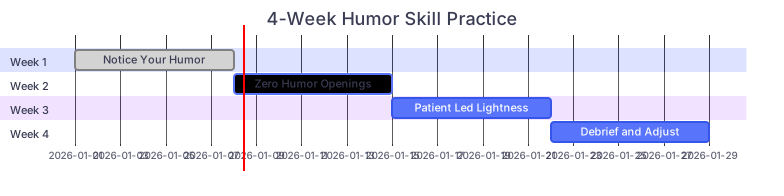
| Task | Details |
|---|---|
| Week 1: Notice Your Humor | done, 2026-01-01, 7d |
| Week 2: Zero Humor Openings | active, 2026-01-08, 7d |
| Week 3: Patient Led Lightness | 2026-01-15, 7d |
| Week 4: Debrief and Adjust | 2026-01-22, 7d |
Week 1: Just Notice
- In every serious conversation, mentally note whenever you:
- Make a joke
- Use a light comment
- Laugh while speaking
Afterwards, ask:
- “Whose need was I serving?”
- “Did the patient lean in or pull back?”
Week 2: Zero Humor Openings
- Commit: No humor of any kind in the first 5 minutes of any bad-news or high-stakes talk.
- Focus on clarity, empathy, and silence.
- Ask a colleague to observe if possible and give feedback.
Week 3: Patient-Led Lightness Only
- Decide: You will only use humor when the patient clearly initiates it.
- Practice “echo, then anchor” every time they do.
Week 4: Debrief with Peers
- Grab a colleague, palliative care consultant, or communication coach.
- Run through:
- One conversation where humor helped
- One where humor felt off
- Ask: “What could I have said instead?”
Over time, you will build a felt sense of when lightness fits. That tacit knowledge is more valuable than any checklist.
Systems-Level Fix: Make Space for Staff Humor (Away from Patients)
If your team has zero safe places to use dark or irreverent humor, it will leak into patient care. That is predictable.
So at the unit or department level:
- Normalize debrief rooms / spaces where staff can talk freely.
- Have explicit norms:
- “Nothing we say in this room leaves this room.”
- “We never repeat dark jokes in front of patients or trainees who are uncomfortable with it.”

Ironically, protecting staff-only humor makes patient-facing humor safer and more intentional.
When In Doubt, Use Respectful Candor Instead of Humor
There will be moments where you almost say something funny, then hesitate.
That hesitation is a gift. Use it.
Replace the half-joke with:
- A naming of the tension:
- “I am trying to find the right words here.”
- An honest admission:
- “I wish there were an easier way to say this.”
- A simple reflection:
- “This is so much to carry. You should not have to handle this alone.”
You will never get in trouble for not making a joke in a bad-news conversation. You absolutely can get in trouble for making one.
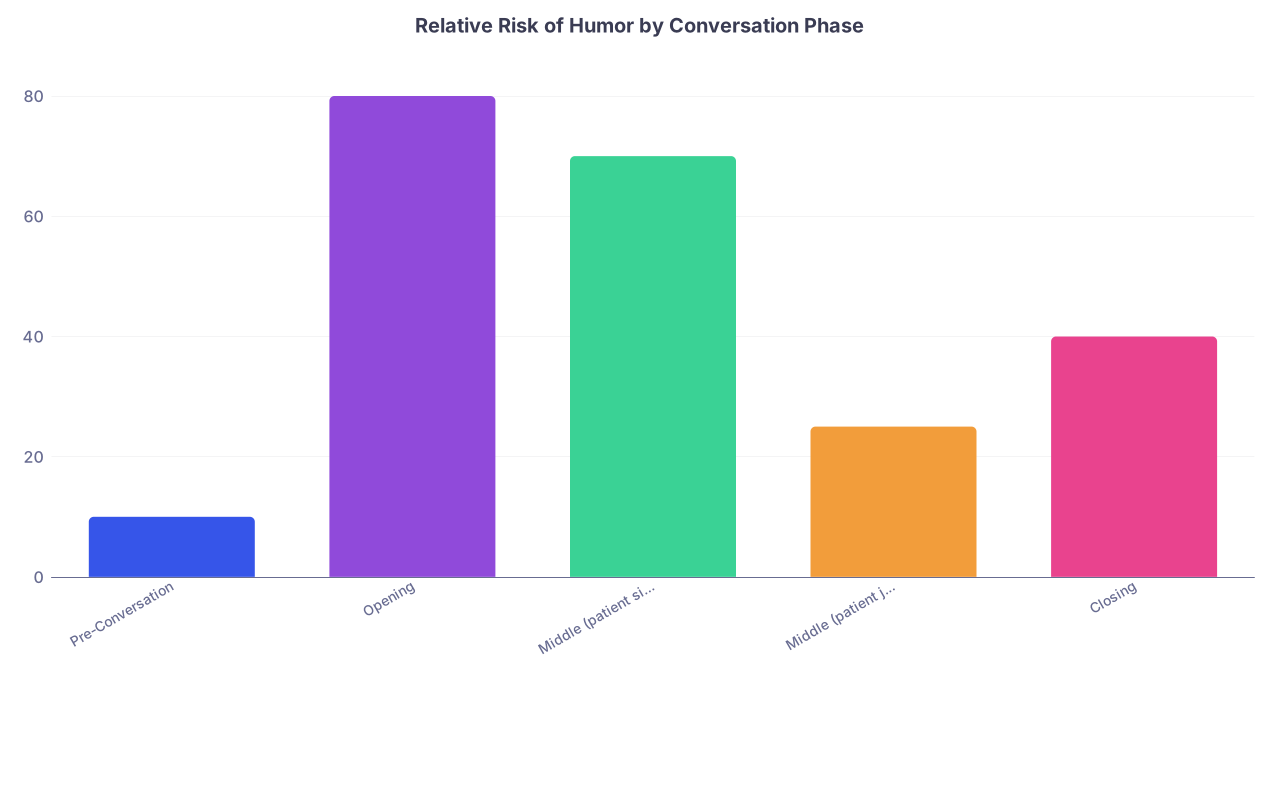
Visual Summary: Safe vs Risky Humor Zones
| Category | Value |
|---|---|
| Pre-Conversation | 10 |
| Opening | 80 |
| Middle (patient silent) | 70 |
| Middle (patient joking) | 25 |
| Closing | 40 |
Interpreting this:
- Lower value = safer for very limited, intentional humor
- Higher value = higher risk of causing harm or misunderstanding
The safest zone: middle phase after the patient has clearly used humor themselves.
The most dangerous: the opening and middle while the patient is distressed but not joking.
Last Piece: Your Own Tolerance for Pain
Many clinicians overuse humor because they cannot stand:
- Seeing people cry
- Long silences
- Anger directed at them
So they slip into “cheerleader” mode. Or they joke to break the tension. It feels kind in the moment. It is not.
If any of this stings, good. It means you care.
Work on:
- Letting people cry without fixing it
- Sitting in silence up to 30–60 seconds
- Hearing anger without getting defensive or deflecting with humor

Those are harder skills than making a clever remark. They also matter more.
Key Takeaways
- Do not initiate humor in the opening or when distress is high. Deliver the bad news clearly and hold the emotional space first.
- Use patient-led lightness only, with “echo, then anchor.” Briefly meet their humor, then return to empathy and clarity.
- If you are unsure, do not joke. Replace the impulse to be funny with honest, respectful candor. You will never regret that.