
The way most residency programs handle humor is lazy, dangerous, and completely fixable.
You would never let your team reuse central line kits “because we’re busy,” but you are probably reusing stale, borderline-toxic jokes on every call shift. That is how you end up with a burned‑out class, a few HR complaints, and a lot of people silently thinking, “I hate it here.”
You need a “Comedy Hygiene” plan. A deliberate system for how your class uses humor to survive training without:
- Punching down
- Violating professionalism
- Destroying trust with nurses, patients, or each other
Let’s build that. Step by step. Like you would a sepsis protocol—only this one is for your collective sanity.
What “Comedy Hygiene” Actually Means
Comedy hygiene is to humor what hand hygiene is to infection control: not “be perfect,” but “have a minimum standard so things don’t rot.”
Here is the working definition I use with residents:
Comedy Hygiene = A shared, explicit agreement about what kinds of humor your group will use, won’t use, and how you’ll handle it when someone crosses a line.
It has three goals:
- Protect morale
- Protect people
- Protect your professional butt
If your class does not define this, someone else will—usually the most burned‑out PGY-3 on nights, whose coping style is “roast everything that moves.”
Step 1: Audit Your Current Humor Culture (No, Really)
Before you “fix” anything, you need to know what you are already doing.
Take one week and pay attention. Not to cases, to jokes.
A. Do a 7‑Day Humor Field Study
Grab two or three classmates who are trusted and moderately self-aware. Each of you keeps a quick log on your phone for a week:
- Where did the joke happen? (work room, OR, patient room, group chat, sign‑out)
- Who was the target? (yourself, the attending, the system, a patient group, a colleague group)
- How did it land?
- People relax / laugh
- People go quiet / change subject
- One person laughs way too hard
You are not compiling evidence for HR. You are mapping culture.
At the end of the week, meet for 30 minutes—pizza or post-call coffee—and sort what you saw into three buckets:
- Healthy coping – “That was dark but actually made us feel better / closer.”
- Harmless filler – Dad jokes, bad puns, the usual.
- Corrosive – People looked uncomfortable or resentful, or you would be horrified if a patient overheard.
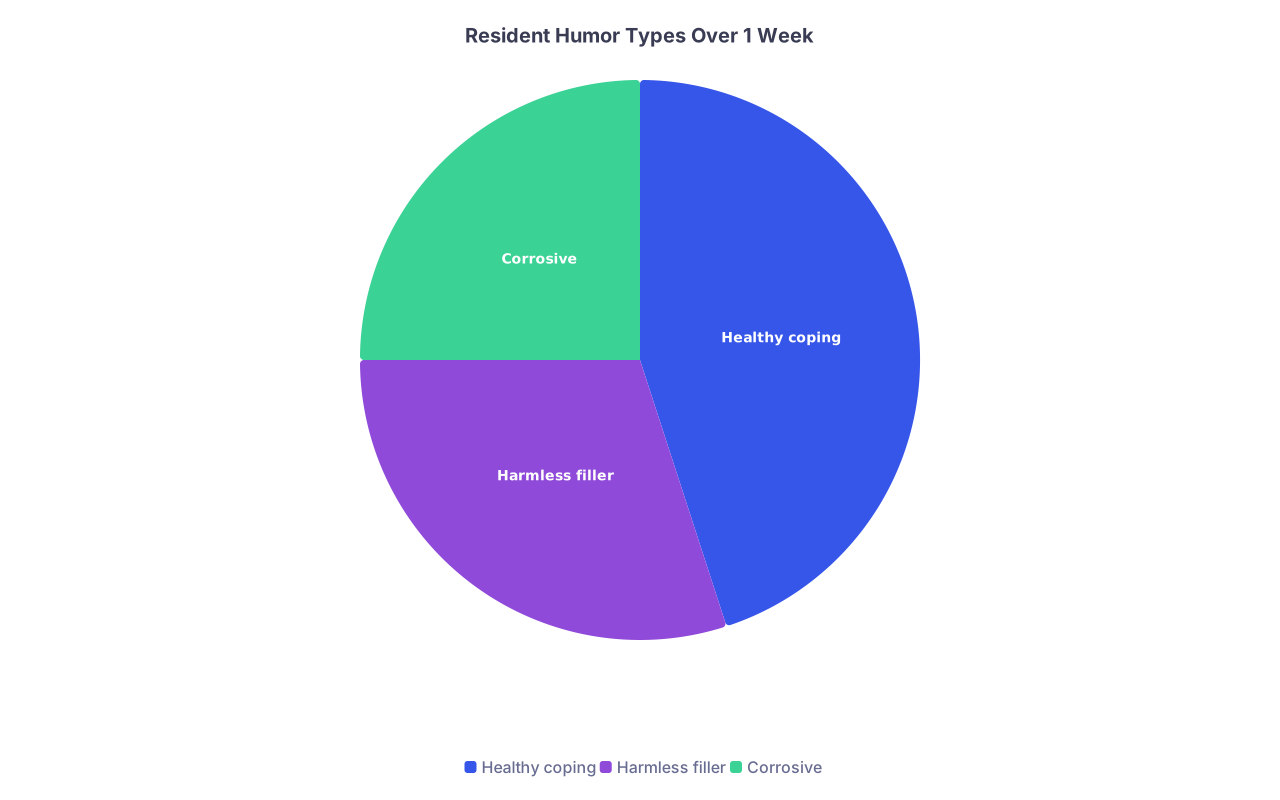
| Category | Value |
|---|---|
| Healthy coping | 45 |
| Harmless filler | 30 |
| Corrosive | 25 |
If your corrosive slice is more than 20–25%, you have a problem. Not an apocalypse. Just something that will cost you relationships and maybe your career if you ignore it.
B. Name the Repeat Offenders (Joke Types, Not People)
Patterns you will usually see:
- Complaints disguised as jokes
- “Guess we’re just an unstaffed ICU with vibes.”
- Punching down at vulnerable patients
- Substance use, obesity, mental illness, language barriers.
- Group‑based cheap shots
- Nursing, psychiatry, hospitalists, night float.
- Self‑hatred dressed up as humor
- Constant “I’m an idiot” / “I hope I die” jokes.
You do not need a thesis. Just a short, honest list of “this is the kind of humor that leaves a bad taste.”
That list is your raw material.
Step 2: Draft a “Class Comedy Charter” in One Page
This sounds corporate. Fine. But the programs that bother to do this? They have fewer blown-up group chats and fewer awkward PD meetings.
You are going to write a one‑page “Comedy Charter” for your class. Not for the whole hospital. For your core peer group: the people you actually work and text with.
A. The Four Clauses That Matter
Your charter needs exactly four sections:
Why we use humor
- Example: “We use humor to survive residency, connect with each other, and release pressure so we can take good care of patients.”
What is off-limits in our group
- Explicit is better than “you know it when you see it.”
- Example bullets:
- No jokes about patient race, gender, sexuality, disability, immigration status, or religion.
- No mocking patients’ bodies, intelligence, or socioeconomic status.
- No jokes that target nurses, techs, or other staff as a group.
What is fair game
- Give people safe zones to play in.
- Common “fair game” categories:
- Yourself
- The system (EMR, prior auth, bed shortages)
- Shared suffering (call, notes, pager chaos)
- Absurdity of medicine (consults, acronyms, protocols)
How we will course‑correct
- One sentence that makes it safe to say “hey, not that.”
- Example: “If a joke lands badly, anyone in the group can say ‘let’s retire that one’ and we will drop it without drama.”
That’s it. Four sections. One page.
Do not try to optimize it to death. You can revise later.
B. Run It By the Group Like an Order Set
Treat it like a new order set you are beta‑testing. Send it to your class GroupMe / WhatsApp / email:
“Hey all – three of us pulled together a one‑page ‘Comedy Hygiene’ charter so we do not accidentally nuke each other’s mental health (or careers) with humor. Take 3 minutes to read. If there’s anything you strongly disagree with, comment by Friday, then we’ll finalize.”
Be open to:
- Someone wanting a new off-limits category (e.g., fertility struggles, pregnancy loss).
- Someone worrying you are “killing all the fun.”
For the second group, be clear: you are not banning dark humor. You are aiming it where it does the least harm.
Once revised, treat it like a standing policy. Pin it in your class chat.
Step 3: Build “Safe-Target” Humor Habits
The best fix is not “stop joking.” The best fix is “aim better.”
You want humor that:
- Acknowledges reality
- Builds connection
- Leaves no one in the room or on the unit feeling like collateral damage
Here are categories that work reliably in medicine.
1. Self‑Deprecation With Limits
Self‑deprecating humor works because it is disarming. But it turns toxic when it becomes self‑erasure.
Healthy version:
- “I wrote ‘see note above’ in a note where there is literally no note above.”
- “Just introduced myself to the same nurse three times this week. My hippocampus is on strike.”
Unhealthy version:
- “I am actually the dumbest resident in this program.”
- “Honestly my patients would be better off if I never came back.”
Quick rule: if you would be concerned hearing a patient talk about themselves that way, it is not a joke anymore.
2. System‑Focused Dark Humor
Residents everywhere do this:
- Paging “admit 5 more” when you are already drowning.
- Calling EMR downtime “the purge.”
This is usually safe as long as:
- You do not attach it to a specific patient’s tragedy.
- You do not frame preventable harm as “lol medicine.”
Good example:
- “The bed czar giveth, the bed czar taketh away.”
Bad example:
- “At least when the system failed that guy, we got an open bed.”
You can grieve and be angry without turning the patient into a punchline.
3. Shared-Suffering Jokes
These build solidarity. You are not laughing at a person; you are laughing at a miserable situation together.
- “This consult note is longer than my personal statement.”
- “Our sign‑out list is now a novella. Should submit to the Booker Prize.”
You know this is healthy if afterward, people go, “Yeah, this sucks, but at least we’re in it together.”
4. Absurdity and Wordplay
Safe, generally non‑problematic, and actually funny when done well:
- Weird dictation errors.
- Autocorrect disasters in orders (fixed before signing).
- Hospital signage that makes no sense.
Make the target the absurdity, not the patient or the nurse who got confused by it.
Step 4: Implement a “Two-Word Interruption” System
Here is where most groups fail: they talk a big game about being “open to feedback,” then freeze when someone tries to give it.
You need a pre-agreed, low-friction way to tap the brakes on a joke in real time.
A. Choose Your Phrase
Pick a short, neutral phrase the whole class will use. Example options:
- “Comedy check.”
- “Time out.”
- “Retire that.”
Avoid anything that sounds like a formal reprimand. You want something that can be said lightly but still means “pause.”
B. Agree on the Rules
Set expectations explicitly:
- Anyone can call it. Intern to chief.
- You do not argue the call in the moment.
- You can ask to debrief later one-on-one if you want clarity.
That is it. Three rules.
C. Rehearse It Once (Yes, Out Loud)
During orientation, wellness half‑day, or a resident meeting, actually practice:
- One person says a deliberately borderline joke (“At least this patient did not…” etc.)
- Another says, “Comedy check.”
- First person replies, “Got it—retiring that one.”
Takes 3 minutes. Instantly raises the odds it will actually happen at 3 a.m. when it matters.
Step 5: Guardrails for Digital Humor (Your Future Self Will Thank You)
The place comedy hygiene really saves you is not the workroom. It is your phone.
Screenshots live forever. Group chats get subpoenaed. HR does not care that “it was just a joke between friends.”
You need explicit digital rules.
A. Set Channel‑Specific Norms
Different channels, different stakes:
| Channel | Risk Level | Guideline |
|---|---|---|
| In‑person room | Medium | Follow charter, use time-outs |
| Private 1:1 text | Medium | Still assume screenshots possible |
| Small group chat | High | No patient‑related dark humor |
| Email/Slack | Very High | Keep humor mild and professional |
Practical default: if it would be a problem on the front page of a lawsuit or your PD’s inbox, do not type it.
B. Hard Digital “No” List
As a class, agree on a short, absolute list:
- No joking about specific patients, even de‑identified, in text.
- No screenshots of charts, images, or patient identifiers with commentary.
- No staff‑bashing in written form.
You will be tempted. You will be tired. Having a pre‑agreed “we never do this” standard makes it easier to say no.
Step 6: Use Humor Intentionally to Fight Burnout
If you only focus on what not to do, everyone ends up tense and awkward. You also need proactive, structured ways to use humor for good.
A. Build Micro‑Traditions
Simple, repeatable bits that become part of your culture:
- “Ridiculous Consult of the Week” – anonymized, system‑focused, shared in a safe channel.
- “Pager Poetry” – one haiku about your pager each Friday (“Code blue, code blue, code / it was just low battery / I aged five more years”).
- Meme Rounds – one resident per week shares a PG‑13 meme roasting the EMR, the call schedule, or something non‑patient‑related.
Tiny, yes. But they signal: it is okay to laugh; in fact, it is expected.
B. Use Humor in Teaching Without Undermining Anyone
Faculty will appreciate this part if you model it well.
- When presenting a brutal night:
- “We admitted 8, my will to live admitted 0, but here is what I learned.”
- When teaching a pearl:
- “This is one of those ‘future you will write an angry note if you forget’ details.”
You are using humor as a delivery system for seriousness. Like coating a bitter pill.
C. Distinguish Between “Joking” and “Signaling Help Needed”
One dangerous pattern: residents embedding cries for help inside jokes so no one feels invited to respond seriously.
Examples:
- “Haha I sleep 3 hours a night and drink 6 Red Bulls a day, it’s fine.”
- “If I get one more admit tonight I am running into traffic, lol.”
Class rule you can adopt:
If someone makes a self-harm, “I hope I crash my car,” or similar joke more than once, at least one person checks in seriously afterward.
Script:
“Hey, you joked twice about wanting to crash your car this week. That is on our list of ‘we do not treat this as just a joke.’ How are you actually doing?”
You will save someone doing this once every few years. That is worth a little awkwardness.
Step 7: Review and Adjust Every 6 Months
Like any protocol, this thing will drift if you never revisit it.
Twice a year, attach “comedy hygiene” as a 15‑minute item on a resident meeting or wellness session.
Agenda:
- What is working / what people like.
- Any new off-limits topics we should add (people’s lives change—new parents, losses, etc.).
- Any recurring patterns that feel bad (e.g., constant jokes about one specialty, or one person always being the butt of the joke).
Run it like morbidity and mortality for jokes. No blame, just: did this humor practice cause harm, and how do we prevent it?
Example: A Simple Class “Comedy Hygiene” Plan
To make this less abstract, here is a concrete example of what a PGY-1 class could implement over a year.

| Step | Description |
|---|---|
| Step 1 | Week 1 - Humor Audit |
| Step 2 | Week 2 - Draft Charter |
| Step 3 | Week 3 - Present to Class |
| Step 4 | Week 4 - Choose Phrase Comedy Check |
| Step 5 | Month 2-3 - Practice in Real Time |
| Step 6 | Month 4 - Add Digital Rules |
| Step 7 | Month 6 - First Review |
| Step 8 | Month 12 - Annual Update |
You do not need a committee. Two or three residents can kick‑start this and then just… keep it alive.
Pitfalls You Absolutely Want to Avoid
Let me save you from some predictable mistakes I have watched programs repeat.
1. Turning This Into a Policing Project
If people feel like you are the Humor Police, they will:
- Stop joking in front of you.
- Move all the questionable stuff to side channels.
- Resent you.
Stick to:
- Modeling better humor.
- Using the agreed two‑word check when needed.
- Bringing patterns to the group, not calling out individuals in public.
2. Writing a Charter and Then Ignoring It
The charter is not a poster. It is muscle memory.
You build that by:
- Actually using the interruption phrase.
- Bringing it up in real discussions: “Hey, this feels off‑charter.”
- Praising good examples: “That was a perfect example of dark humor done right.”
People follow what is reinforced, not what is emailed.
3. Confusing “Everyone Laughed” With “No Harm Done”
Here is the thing: plenty of people laugh when they are uncomfortable, shocked, or scared.
Your check is not “did people laugh?” Your check is:
- Did anyone go quiet?
- Did anyone change the subject quickly?
- Did anyone bring it up later like, “That was kind of messed up”?
If yes, log that mentally as a near miss and adjust.
A Quick Visual: Where to Aim Your Humor
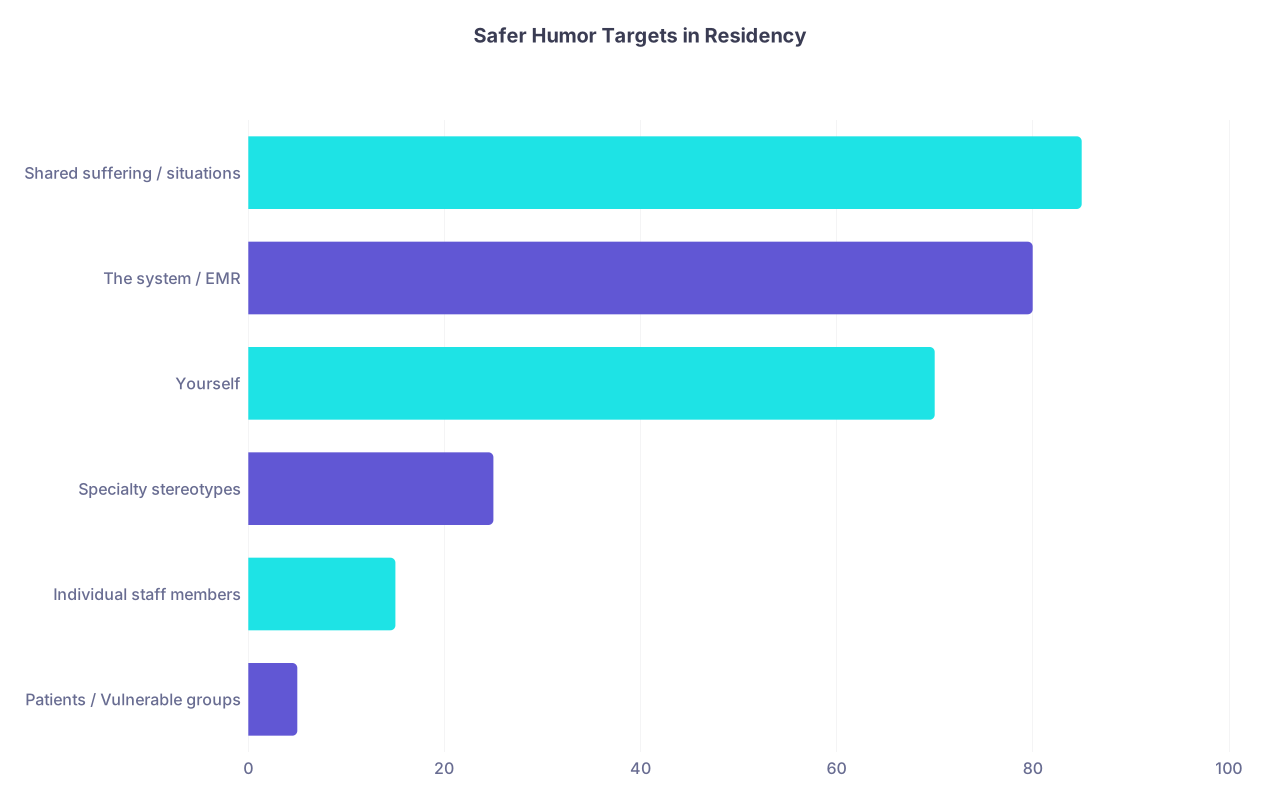
| Category | Value |
|---|---|
| Patients / Vulnerable groups | 5 |
| Individual staff members | 15 |
| Specialty stereotypes | 25 |
| Yourself | 70 |
| The system / EMR | 80 |
| Shared suffering / situations | 85 |
Higher scores = safer targets. Aim right.
FAQ (Exactly 3 Questions)
1. Is dark humor ever “okay,” or should we just get rid of it?
You will not get rid of dark humor in medicine. Nor should you. It is one of the few pressure valves residents actually use. The key is directing it at the absurdity and cruelty of the system, not at the patients who are already paying the price. Your plan should protect space for dark humor while putting guardrails around targets that routinely cause harm.
2. What if a senior or attending constantly violates our comedy hygiene norms?
You do not have to fix your entire department. Start with what you control: your class culture. If a specific attending or senior is consistently problematic and it affects safety or morale, document specific examples and bring them confidentially to your chief, program leadership, or GME office. Frame it as a professionalism and culture issue, not “they told a bad joke one time.” Meanwhile, you can still use your own class standards among peers.
3. How do we handle someone who says we’re being “too sensitive” or “killing all the fun”?
Be clear about your goal. You are not banning fun; you are protecting the kind of humor that actually sustains people instead of grinding them down. You can say something like, “We are not asking you to stop joking, just to avoid a few categories that consistently hurt people or create risk. If the only way something is funny is by punching down, it probably is not that good a joke.” Often, skeptics come around once they see the group is still laughing—just without collateral damage.
Open your class group chat today and float one simple proposal: “Can we try a one‑page ‘Comedy Hygiene’ charter and a two‑word phrase to pause jokes that land badly?” Then volunteer to draft version 1. Do that, and you have just taken the first real step toward making residency survivable—without burning your sense of humor to the ground.