
The way most clinicians use humor in teaching is lazy, unsafe, and wastes one of the most powerful learning tools you have.
You can do much better. With a simple, repeatable mini-lesson template, you can make humor intentional, not accidental—and suddenly your learners remember your key points instead of just your “funny story about the confused patient.”
Let’s build that system.
Why You Need Intentional Humor, Not “I Just Wing It”
You have seen all three of these people:
- The attending who kills the vibe with a “joke” about psych patients or nurses.
- The painfully serious lecturer who drains the life out of an actually interesting topic.
- The rare faculty member who makes you laugh and somehow you still remember their teaching three years later on night float.
Only the third one is using humor as a teaching tool.
Unintentional humor is:
- Jokes tossed in when you remember them
- Stories that go on too long
- Sarcasm that sometimes lands and sometimes burns
Intentional humor is:
- Planned, short, and tied directly to a learning point
- Built to be safe for all learners and patients
- Repeatable—something you can use every month, not once in a blue moon
Humor does three things for teaching that are hard to replace:
- Lowers anxiety so learners think more clearly
- Increases attention and recall
- Humanizes you, which makes feedback and coaching easier later
But only if it is done deliberately. Otherwise, it is just noise (or harm).
So here is the fix: a simple, 10–12 minute humor-based mini-lesson template you can drop into case conferences, bedside teaching, or didactics.
We will walk through:
- A step-by-step mini-lesson structure
- A “humor safety check” so you do not step on landmines
- Real scripts you can steal and adapt
- A quick debrief pattern so learners see why the humor worked
The 10-Minute Humor-Driven Mini-Lesson Template
Here is the skeleton. You can plug any clinical topic into this.

| Step | Description |
|---|---|
| Step 1 | Hook with safe humor |
| Step 2 | State learning target |
| Step 3 | Short content burst |
| Step 4 | Humorous anchor or analogy |
| Step 5 | Application question or micro-case |
| Step 6 | Serious debrief and key takeaway |
Think of it as: Hook → Target → Teach → Funny Anchor → Apply → Debrief.
Let’s break it down with concrete examples.
Step 1: The Humor Hook (60–90 seconds)
Goal: Snap attention to the room and signal psychological safety.
Rules:
- No punching down: never target patients, groups, struggling learners, or colleagues by identity.
- Aim at systems, confusion, or yourself.
- Keep it short. One joke, one image, one line.
Examples by setting:
Morning report – topic: hyponatremia
- “Hyponatremia is the Tinder of electrolytes: confusing, inconsistent, and half the time you are not sure how you ended up here.”
(Learners laugh. You follow with:)
“By the end of this, you will at least know which hyponatremias you should ‘swipe left’ on quickly.”
Small group – topic: sepsis recognition
- “The number of different sepsis screening tools we have is directly proportional to how confused everyone still is about sepsis.”
Bedside teaching – topic: medication reconciliation
Quiet smile, small self-deprecating line:
- “If you have never accidentally reconciled a patient onto a medication they stopped 3 years ago, you simply have not reconciled enough meds yet.”
You are not being a comedian. You are just tilting the emotional tone slightly upward so learning gets easier.
Step 2: State a Clear Learning Target (30 seconds)
Do not bury the point. Right after the hook:
- “In the next 10 minutes, you will be able to do two things:
- Name the three dangerous patterns of hyponatremia, and
- Decide who needs hypertonic saline now versus more workup.”
Tie it explicitly to the humor you just used if possible:
- “If hyponatremia is Tinder, your job is to quickly spot the dangerous matches and get out.”
This connection is what makes the joke memorable for the right reason.
Step 3: Short Content Burst (3–4 minutes)
This is where most people overtalk. Do less.
Guidelines:
- 3 key points max
- 1 tiny example per point
- Speak in normal language, not board review gibberish
For hyponatremia, your content burst might be:
- Distinguish acute vs chronic (symptoms and timeline)
- Distinguish severe vs mild-moderate symptoms
- Know one safe algorithm to start with
No slides needed. Just your voice and maybe a small whiteboard drawing.
Step 4: The Humorous Anchor / Analogy (2–3 minutes)
This is where intentional humor actually does the work.
You create a simple, funny analogy or image that maps onto your key structure.
Example: Hyponatremia as “Occupancy Levels in an Apartment Building”
- “Think of sodium like tenants in a somewhat chaotic apartment building.”
- Chronic mild: ‘Yes, the building is overcrowded, but everyone has been living like this for months and somehow no one is dying.’
- Acute severe: ‘The fire alarm just went off, people are sprinting down the stairs, and someone might get trampled.’
- Danger: ‘Your job is not to redecorate the lobby; your job is to stop the stampede.’
You then map this:
- Acute symptomatic → Fire alarm → Needs urgent hypertonic
- Chronic asymptomatic → Overcrowded but stable → Go slower
You have given learners a visual, slightly absurd frame. That absurdity is sticky. They will remember “fire alarm versus overcrowded building” long after “acute vs chronic hyponatremia symptomology” evaporates.
Another example: Antibiotic stewardship as “Credit Card Debt”
- Antibiotics = swiping your credit card
- You get immediate relief, but you are building resistance debt
- Some infections are worth the “expensive swipe,” others are Starbucks purchases you keep justifying
Again, point is: humorous frame that supports your decision tree.
Step 5: Application Micro-Case (2–3 minutes)
Now you make them use the analogy.
Basic structure:
- 1–2 sentence case
- One key decision
- Force them to explain using your humorous anchor
For hyponatremia:
- “You have a 65-year-old with Na 117, sleepy, started yesterday after thiazide. Is this ‘fire alarm’ or ‘overcrowded building’? What do you do in the next 15 minutes?”
Ask a learner to answer in the analogy language first:
- “So, is this apartment building on fire or just crowded, and what is our move?”
Why this matters:
If they can say it in the analogy, they usually understand the concept. If they cannot, they probably do not.
Step 6: Serious Debrief and Key Takeaway (2 minutes)
This is where you prevent humor from undermining seriousness.
Three quick moves:
Reinforce the correct behavior
- “Yes, you called this a fire-alarm situation. That is right. Acute drop, neurologic signs, we treat more aggressively.”
Translate back to clinical language
- “So in real language: Acute symptomatic hyponatremia — we are using hypertonic saline and closely monitoring sodium correction.”
Name the humor on purpose
- “You can forget my building analogy, I do not care. But if you remember ‘acute + symptomatic = move fast’, this was worth your time.”
That last line does something subtle: it shows learners you are using humor as a tool, not as a performance for your ego.
A Simple Humor Safety Check (So You Do Not Wreck the Room)
Most “bad teaching humor” could be avoided with a 3-question check that takes 5 seconds in your head.

Ask yourself, right before you use a joke, story, or meme:
Who is the butt of the joke?
- If the answer is: a patient, a group, a learner, or a colleague by identity → delete it.
- Safe targets: confusing systems, bureaucracy, yourself, the disease itself, documentation hell.
Could this be recorded and played in a grand rounds without shame?
- If you would cringe, do not say it.
- Assume someone always has their phone out.
Does this connect to a learning point?
- If not, you are performing, not teaching.
- Save pure comedy for after conference if you must.
When in doubt, aim humor at:
- How medicine overcomplicates simple ideas
- How guidelines change constantly
- Your own past confusion and mistakes (without glorifying harm)
Example of bad humor:
- “You know psych patients, their sodium is low because they never drink water properly.”
(Targets a stigmatized group, lazy stereotype, zero learning.)
Example of fixed humor:
- “Hyponatremia is the hospital’s favorite plot twist. You think you are just treating pneumonia, and suddenly sodium wants to be the main character.”
(Targets the situation, not people.)
The Mini-Lesson Template in Action: A Full Example
Let me give you a fully scripted 10-minute mini-lesson you could run tomorrow. Topic: Recognizing Delirium vs Dementia on the wards.
1. Humor Hook
“Delirium and dementia are like that pair of identical twins on the ward. One just moves in quietly and never leaves. The other breaks in at 2 AM, rearranges the furniture, and sets off all the alarms.”
Room chuckles. You continue:
“By the end of the next 10 minutes, you will be much faster at telling which twin you are dealing with.”
2. Learning Target
“In this short session, you will be able to:
- Distinguish delirium from dementia using three key features, and
- Name two reversible causes of delirium you must never miss.”
3. Content Burst – The 3 Features
Keep it tight:
- Onset – Acute (hours–days) vs chronic (months–years)
- Attention – Impaired in delirium, relatively preserved early in dementia
- Fluctuation – Delirium waxes/wanes, dementia is more stable day-to-day
You give one fast clinical example for each, no slides.
4. Humorous Anchor – The “House Guest” Analogy
“Think of your patient’s cognitive change like a house guest.”
- Dementia: “They slowly moved in over months. There were some annoying quirks, but you kind of adjusted. They leave dishes in the sink, but it is consistent.”
- Delirium: “This is the relative who shows up at midnight, drunk, starts singing in the hallway, rearranges your couch, and is gone by morning. Loud, chaotic, unpredictable.”
Map it:
- Acute + fluctuating + impaired attention = “Midnight chaos guest” = delirium
- Gradual + stable + mildly impaired attention = “Long-term roommate” = dementia
You are not trivializing. You are making the pattern sticky.
5. Application Micro-Cases
Case 1:
- “82-year-old with 2-year history of forgetting appointments, gradually worsening, but family says he is about the same day-to-day. Which house guest?”
Learner: “Long-term roommate, so dementia.”
Case 2:
- “Same patient, now admitted with pneumonia, suddenly agitated at night, pulling at lines. Yesterday he was just sleepy. Which house guest now?”
Learner: “Midnight chaos guest—superimposed delirium.”
You push it:
“Exactly. Same person, different problem. If you just blame everything on dementia, you will miss the pneumonia and the meds causing this midnight chaos.”
6. Serious Debrief
You pivot out of humor clearly:
“I use the house guest analogy because it forces you to think about onset and fluctuation, not just ‘confused or not.’ In real language:
- Delirium: acute, fluctuating, impaired attention
- Dementia: chronic, more stable, attention relatively okay early
And medically, the cost of missing delirium is high—untreated infections, drugs, metabolic problems.”
Finish with 1-line takeaway:
“If your ‘house guest’ showed up fast and keeps changing behavior every shift, treat it like delirium until proven otherwise.”
You are done. Ten minutes, two mini cases, one analogy, no slides.
Building Your Own Humor Bank (So You Are Not Wing-It Dependent)
You do not need to be naturally “funny.” You need a small, written bank.
| Topic | Safe Humor Angle | Anchor/Analogy Idea |
|---|---|---|
| Hyponatremia | Confusing algorithms | Apartment building crowding |
| Delirium vs dementia | Unpredictable behavior | House guest / twin metaphor |
| Sepsis screening | Too many tools | Airport security lines |
| Fluid resuscitation | Over/under doing it | Watering a wilted plant |
| Medication lists | Polypharmacy chaos | Grocery cart with extras |
How to build this bank:
Pick 5 topics you teach repeatedly (AKI, chest pain, ABGs, etc.)
For each topic, answer:
- What do learners consistently mess up?
- What everyday situation feels similar and a bit ridiculous?
Draft one analogy per topic:
- “ABG compensation” = thermostat overreacting to room temperature
- “Polypharmacy in elders” = adding more apps to a crashing phone to “fix it”
Write each analogy and a 2-sentence mini-case in a small notebook or notes app.
That is your script box. You are not starting cold every time.
Using Humor Safely in High-Stakes or Sensitive Topics
You are in medicine. Some topics are not funny and never will be: child abuse, end-of-life decisions, suicide attempts.
So how do you keep your engaging style without crossing a line?
Rule: Aim humor around the edges, never at the core suffering.
Safe moves:
Aim at documentation absurdity:
“The number of clicks required to document a DNR discussion could itself cause delirium.”Aim at system failures, not the tragedy:
“We have 14 palliative order sets and still somehow no one can find the comfort-care pathway on the first try.”
What you do not do:
- No humor about specific patients’ suffering
- No humor about family dynamics in grief
- No “dark humor” in front of learners you do not know deeply, especially early trainees
A simple pause line you can use if you sense something landed badly:
- “Let me be clear: I am not joking about the patient’s situation; I am joking about how complicated we have made this process. The seriousness of what families go through is not up for debate.”
You just reassert your values. You model professional boundaries.
Tracking If Your Humor Is Actually Helping Learning
If you are serious about this, treat it like a micro-QI project.
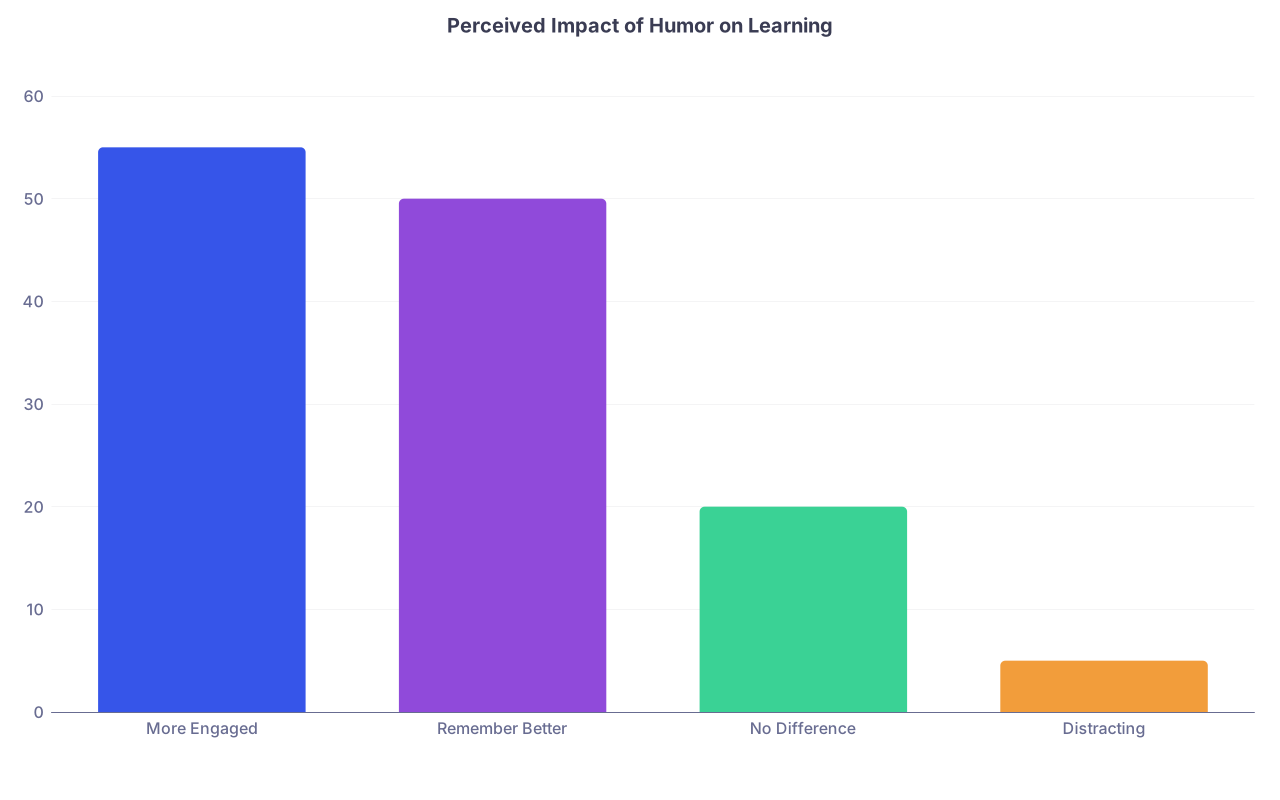
| Category | Value |
|---|---|
| More Engaged | 55 |
| Remember Better | 50 |
| No Difference | 20 |
| Distracting | 5 |
How to measure in real life (very low friction):
Post-session 10-second poll (anonymous, QR code)
- “Did the analogies / jokes help you remember the content today?”
- Helped a lot
- Helped somewhat
- No difference
- Got in the way
- “Did the analogies / jokes help you remember the content today?”
Spot check recall next day
- “Yesterday we talked delirium vs dementia—who remembers the ‘house guest’ rule?”
Watch nonverbal response
- Are people smiling then leaning back in, or are they tightening up?
If more than ~10–15% say “got in the way,” you are overdoing it or off-target. Dial back, simplify, and reattach humor to the main point.
A 15-Minute Prep Protocol You Can Use This Week
Here is how to retrofit an upcoming teaching session using this mini-lesson template.

| Step | Description |
|---|---|
| Step 1 | Choose topic |
| Step 2 | Identify 1 pain point |
| Step 3 | Write humor hook |
| Step 4 | Create 3-point content burst |
| Step 5 | Design humorous anchor |
| Step 6 | Draft 1 micro-case |
| Step 7 | Plan 2-line debrief |
Time-box it to 15 minutes:
Choose topic (1 minute)
“Tomorrow’s intern teaching: AKI vs CKD.”Identify 1 pain point (2 minutes)
“They always mix up acute creatinine bumps with chronic baseline elevation.”Write humor hook (3 minutes)
- “Creatinine is that friend who never texts you back clearly. Sometimes they have been distant for years; other times something happened yesterday and now they are suddenly not okay. By the end of this, you will know which friend you are dealing with.”
Create 3-point content burst (3 minutes)
- Onset, prior labs, ultrasound / kidney size. Bullet it.
Design humorous anchor (3 minutes)
- “AKI vs CKD as ‘sudden breakup vs slow-growing apart’ in a relationship.”
Draft 1 micro-case + 2-line debrief (3 minutes)
- Brief case, ask: “Sudden breakup or slow drift?”
- Debrief: translate analogy into clinical criteria.
Then go. Do not overpolish. Test. Adjust.
FAQs
1. What if I am just “not funny” and feel awkward trying this?
You do not need to be naturally funny. You need to be structured. Start with one analogy for one topic you already know well. Write it down and practice it once out loud before teaching. Deliver it calmly, without trying to “sell” the joke. Many learners prefer low-key, dry humor over performative energy. Your job is not to be a stand-up comedian; your job is to give their brain something sticky to attach the concept to.
2. How often should I use humor in a single teaching session?
Use it like a high-yield drug: small, targeted doses. For a 60-minute session, 2–3 intentional humor moments are plenty—a hook, one central analogy, and perhaps one brief callback. If you are inserting jokes every two minutes, you are teaching stand-up, not medicine. The rule of thumb: if the humor does not clearly support a concept, cut it. One strong analogy that learners remember beats ten scattered jokes they forget.
Open your teaching calendar for next week, pick one session, and write a 2–3 sentence humorous analogy for that topic right now. Then plug it into the Hook → Target → Teach → Funny Anchor → Apply → Debrief template and run the experiment.