
The worst place for unfiltered tension is an operating room—and the second worst is an operating room with bad jokes.
You already know this: tension in the OR is inevitable. Complication brewing, case running long, staff short, surgeon on edge, anesthesia behind, turnover delayed. The vibe starts to sour. Voices get sharper. People stop asking questions. That is how mistakes happen.
You also know the flip side: the best teams have a way of cutting the tension without cutting the professionalism. They reset the room in 10–20 seconds with a well-timed, light joke or a small human moment. Nobody does stand-up. Nobody undermines safety. They just… let the pressure valve hiss for a second.
That is what I am going to give you—a concrete, repeatable 5-step script you can use to:
- Cool down a room that is getting hot
- Re-engage a team that is shutting down
- Use light humor without being “the clown,” “too familiar,” or inappropriate
Not theory. A working protocol.
Step 0: The Rule That Trumps Everything
Before any “script,” there is one hard rule:
Safety and hierarchy beat humor every single time.
If:
- The patient is crashing
- A critical step is happening
- The attending is giving instructions
- A serious conflict is in progress
…you do not joke. You shut up, listen, and act.
Humor is a tool for:
- Micro-tension (snippy comments, mild frustration, long silent rooms, eye rolls)
- Quiet, building stress when the case is stable
If anything feels unsafe or unstable: no step, no script, just focus.
Now, assuming the case is stable but tense, here is the 5-step script.
Step 1: Name the Tension (Silently) and Check the Vitals of the Room
You do not start by talking. You start by noticing.
Quick mental checklist, takes about 5 seconds:
Is the patient stable?
- Vitals trend okay?
- No active catastrophe?
If not stable: you are not in humor territory.
Where is the tension coming from?
- Surgeon frustrated at the anatomy or equipment
- Anesthesia annoyed about time, blood loss, blood pressure
- Circulator / scrub tech irritated about instruments, turnover, missing supplies
- OR staff conflict (just had a spat, unresolved comment, etc.)
Is the attending in “open” or “closed” mode?
- Open: Still talking, still teaching, still interacting
- Closed: One-word answers, clipped tone, intense focus
If the attending is clearly in closed mode at a critical step: pause any idea of humor. Wait.
When do you proceed?
- Patient is stable
- Frustration is present but not explosive
- There is at least a few seconds of cognitive “space” (suturing skin, waiting for blood, prepping equipment, flipping the room, etc.)
You are not a comedian. You are a pressure regulator. Your job is not to be funny. Your job is to get the room 10% less rigid.
Step 2: Start with a Neutral, Grounding Comment
Before humor, you lay a “safety mat.” The first thing out of your mouth is neutral and anchored in the work.
Why? Because jumping straight into a joke when people are irritated makes you look oblivious. Or worse, disrespectful.
Good neutral openers:
- “Okay, let me confirm—next instrument you want is the ___?”
- “So we are still planning [X] for closure, correct?”
- “Just to be sure, we are keeping the same plan for the second side?”
- “Time check: we are about [X] minutes in.”
Short, practical, and safe.
What this does:
- Shows you are engaged in the case, not in your own head
- Re-centers the team on the shared task
- Signals that you are calm, which itself is tension-reducing
Half the time, this alone helps the room relax a notch. You may not even need humor yet.
You can think of this step as the “professional reset button.” Hit that first.
Step 3: Use Self-Deprecating, Low-Stakes Humor—Never Punching Down
Once you have grounded things with a neutral comment and confirmed the room is not in active crisis, you can add a thin layer of light humor.
The safest category: self-directed, low-stakes, work-adjacent humor.
You are not mocking the patient. Not mocking a colleague. Not mocking a complication. Not mocking another specialty. You are typically poking fun at:
- Your own learning curve
- A universal OR annoyance
- The ridiculousness of medicine in general
A few concrete examples that I have heard work well:
- Resident struggling with retraction on a long case:
- “This must be how gym memberships feel when people actually show up.”
- Long laparoscopic case, everyone clearly tired, but stable:
- “I am starting to think this gallbladder has stock options in the hospital.”
- After asking a clarifying question you are 90% sure you know the answer to:
- “Just want to avoid the classic ‘confidently wrong intern’ move.”
- After the third time you adjust the light and attending still tweaks it:
- “OR lights: 1. Me: 0.”
Notice what these all have in common:
- Short
- Clean
- No profanity
- No politics, religion, or off-color references
- Easy for people to ignore if they do not want to engage
If no one laughs? That is fine. You are not bombing on stage; you are just offering a small release. One person smirking behind a mask is enough.
- Humor about the patient: “This guy really did a number on himself.” Absolutely not.
- Humor about nurses or staff: “So anesthesia finally showed up.” Completely unacceptable.
- Humor that trivializes complications: “Well, that blood loss will keep admin busy.” No.
- Anything sexual or appearance-related. You know this. I am stating it anyway because tired brains make bad calls.
If your joke can only be funny at the expense of someone powerless in that room, you are doing it wrong.
Step 4: Invite a Micro-Response, Then Get Out of the Way
Good tension-cutting humor is not a monologue. It is a nudge.
After your short line, you give the room space for a micro-response:
- A chuckle from anesthesia
- A quick one-liner back from the attending
- A grin from the scrub tech
You do not keep talking. The fastest way to kill your credibility is to chase the laugh.
The rhythm looks like this:
- Neutral grounding comment
- Brief, self-deprecating or universally relatable joke
- Silence. Let them choose whether to engage.
- You return to competent, focused work regardless.
Example script in real time:
- You: “So we are still closing with Vicryl and Monocryl, right?”
- Attending: “Yes, same plan.”
- You (as you start helping close): “Perfect. My suture skills are emotionally prepared… mostly.”
- Room: Small laugh or nothing.
- You: Focused on closing, no more commentary.
You have done three things:
- Confirmed the plan
- Signaled you are human, not robotic
- Shown that you can read the room and not over-talk
If the attending does pick it up:
- Attending: “Emotionally prepared is all we ever are.”
- You: Small chuckle. Shift back to work.
Key point: let them have the last word. That preserves hierarchy and keeps you firmly in the “professional with a sense of humor” category—not “wannabe comedian.”
Step 5: Re-anchor on Task and Appreciation
Humor is the exhale. You follow it with a deliberate re-anchoring on the work and the team.
Why this matters: If you end on the joke, you risk looking like you are not taking the case seriously. If you end on task, you look mature.
Simple ways to re-anchor:
- Comment on progress:
- “That looks much better than earlier.”
- “Field is nice and clean now.”
- Acknowledge teamwork:
- “That suction made a big difference, thanks.”
- “Appreciate the extra set of hands there.”
This does two things:
- It signals, “I am here to do good work first, ease tension second.”
- It positively reinforces the team, which lowers the emotional baseline for everyone.
A very practical, short sequence might look like this in full:
- Neutral:
- “Time check—looks like we are about 2.5 hours in.”
- Light humor:
- “That is about 2 hours longer than my attention span in med school lectures.”
- Room: Mild chuckle, or nothing.
- Re-anchor:
- “Field looks great, by the way. Anything else I can do to help right now?”
You have:
- Not undermined anyone
- Not distracted from the patient
- Not made yourself the center of the show
- Still cut the tension a bit
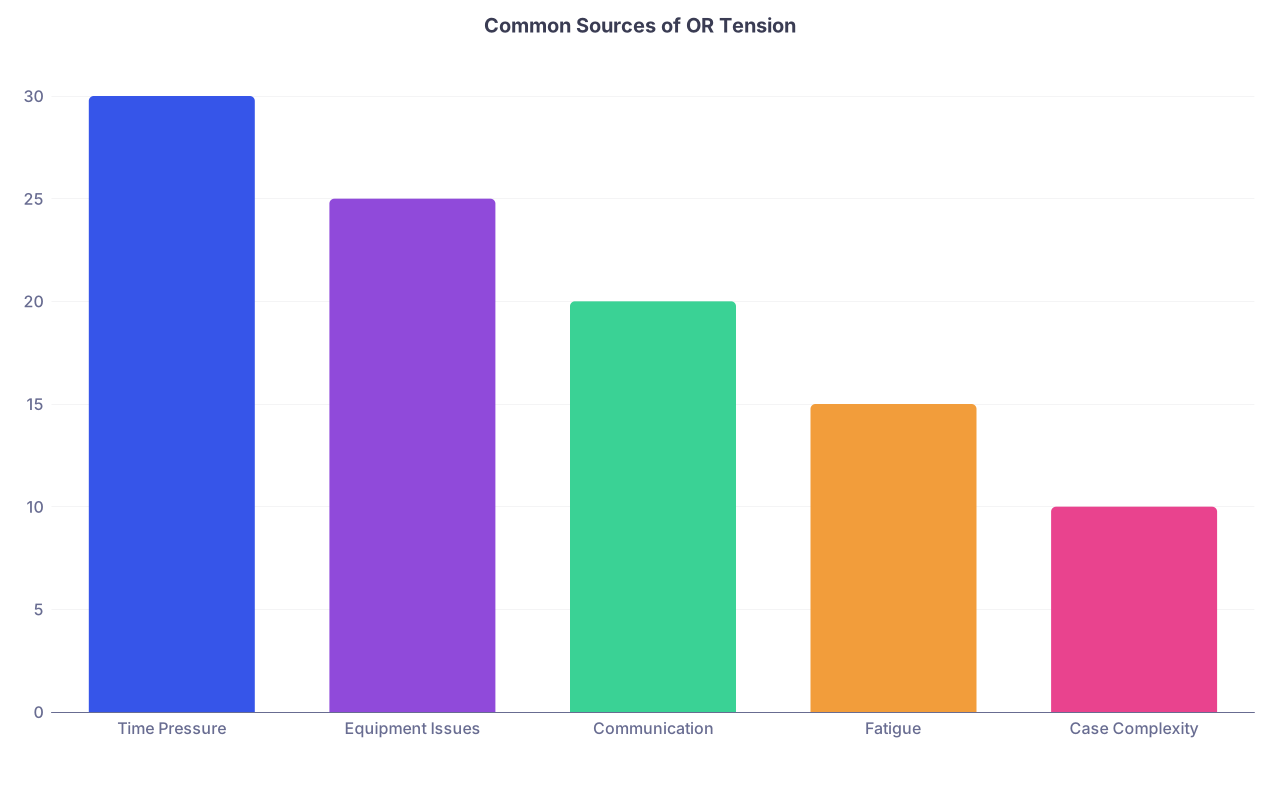
| Category | Value |
|---|---|
| Time Pressure | 30 |
| Equipment Issues | 25 |
| Communication | 20 |
| Fatigue | 15 |
| Case Complexity | 10 |
The 5-Step Script in One Line Each
If you remember nothing else, remember this:
- Scan: Is the patient stable and is the attending at a non-critical step?
- Ground: Say a neutral, task-focused line.
- Lighten: Add one short, self-deprecating or universal, clean joke.
- Pause: Let the room respond or ignore. Do not chase it.
- Re-anchor: Comment on the work or thank someone specifically.
That is the script. Short, simple, and surprisingly effective.
What “Light Humor” Actually Looks Like in Real Cases
Let me walk through a few realistic OR scenarios and show you how to run the script without sounding forced.
Scenario 1: Long Case, Everyone Quiet, Surgeon Mildly Irritable
- 5-hour abdominal case
- Vitals stable, but the attending has had a few sharp comments about exposure
- Room is quiet, slightly tense, but no active catastrophe
You as senior resident:
Ground:
- “We are about five hours in; next step after this anastomosis is leak test, right?”
Attending: “Yes, then leak test.”
Lighten:
- “Good, that gives my legs just enough time to forget what walking feels like.”
Room: A couple of smirks, maybe a chuckle.
Re-anchor:
- “Suction is ready and I will adjust retraction as you go.”
Outcome: You normalize the fatigue without minimizing the operation. You show presence, not distraction.
Scenario 2: Equipment Problem, Surgeon Clearly Annoyed
- Laparoscopic tower acting up
- Camera focus fighting everyone
- Scrub and circulator scrambling
Junior resident:
Ground:
- “We have tower 2 booting up now; do you want to keep this one running until 2 is fully ready?”
Attending: “Yes, stay on 1 until 2 is up.”
Lighten (carefully):
- “This camera must be on the hospital’s Wi-Fi plan.”
Room: Likely a quick laugh from anesthesia or scrub.
Re-anchor:
- “I will hold off any big moves until we are sure image quality is better.”
Outcome: You acknowledged the shared annoyance (equipment), never blamed any person, and then immediately promised safe, cautious behavior.
Scenario 3: Anesthesia Concern About Time / Blood Pressure
- Case running longer than booked
- Anesthesia slightly snappy about time / positioning / blood loss
- Surgeon and anesthesia have had a couple of short exchanges
Senior resident, trying to ease but not interfere:
Ground (to anesthesia):
- “BP has been holding steady in the last 10 minutes, correct?”
Anesthesia: “Yes, acceptable now.”
Lighten:
- “Good. My heart rate was probably higher than the patient’s for a minute there.”
Quick grin behind the drape.
Re-anchor (to team):
- “We are almost done with this step; anything you need from our side before we move on?”
You made yourself the target of the joke, not anesthesia, not the surgeon, not the patient. Safe and effective.

Guardrails: When Humor Backfires (And How to Recover)
You will misjudge a moment at some point. Everyone does.
A few classic ways humor backfires in the OR:
You speak during a critical maneuver
Attending is threading a wire, dissecting around a major vessel, or managing a tricky airway. You toss a joke. Their jaw tightens.Recovery:
- Stop talking immediately.
- After the critical step: “Apologies, I should have waited.”
Then shut up and be excellent for the next 30 minutes.
You accidentally touch a nerve
You comment on something you thought was universal (“orthopedics time,” “surgeons and handwriting,” etc.) and someone clearly did not find it funny.Recovery:
- Quick, clean: “You are right, that was not the best line. My mistake.”
No long apology speech, no over-explaining. Own it and move on.
- Quick, clean: “You are right, that was not the best line. My mistake.”
You get labeled as the ‘jokey’ trainee
Happens when you overdo it—making comments in every case, trying to be “the funny one.”Fix:
- Go quiet for a stretch of cases with that attending.
- Let your work be very focused, your questions succinct, your humor nearly zero.
- Rebuild your baseline reputation as serious and capable.
You can add light comments back later, in very small doses.
If there is a theme here, it is this: humor in medicine is seasoning, not the meal. Once it becomes noticeable as a trait, you are using too much.

Training the Skill Without Risking the Patient
You do not need to start practicing this for the first time in an OR with a legendary grumpy attending. You can train it in safer environments.
Where to practice:
Pre-op and post-op rooms
Brief interactions with nursing, anesthesia, and patients’ families (still professional, of course).Sign-out and handoff conversations
One quick, human moment in the middle of a dense data exchange.Simulation labs and skills sessions
Perfect place to see how people respond to your natural style.
What to practice:
Short, one-line comments
If your humor needs a 20-second setup, it is wrong for the OR.Self-directed humor
Practice making yourself the butt of the joke, not others.Graceful silence
Practice saying one line… and then shutting up. It is harder than it sounds.
Once you have tested these muscles, you bring them back to the OR in micro-doses.
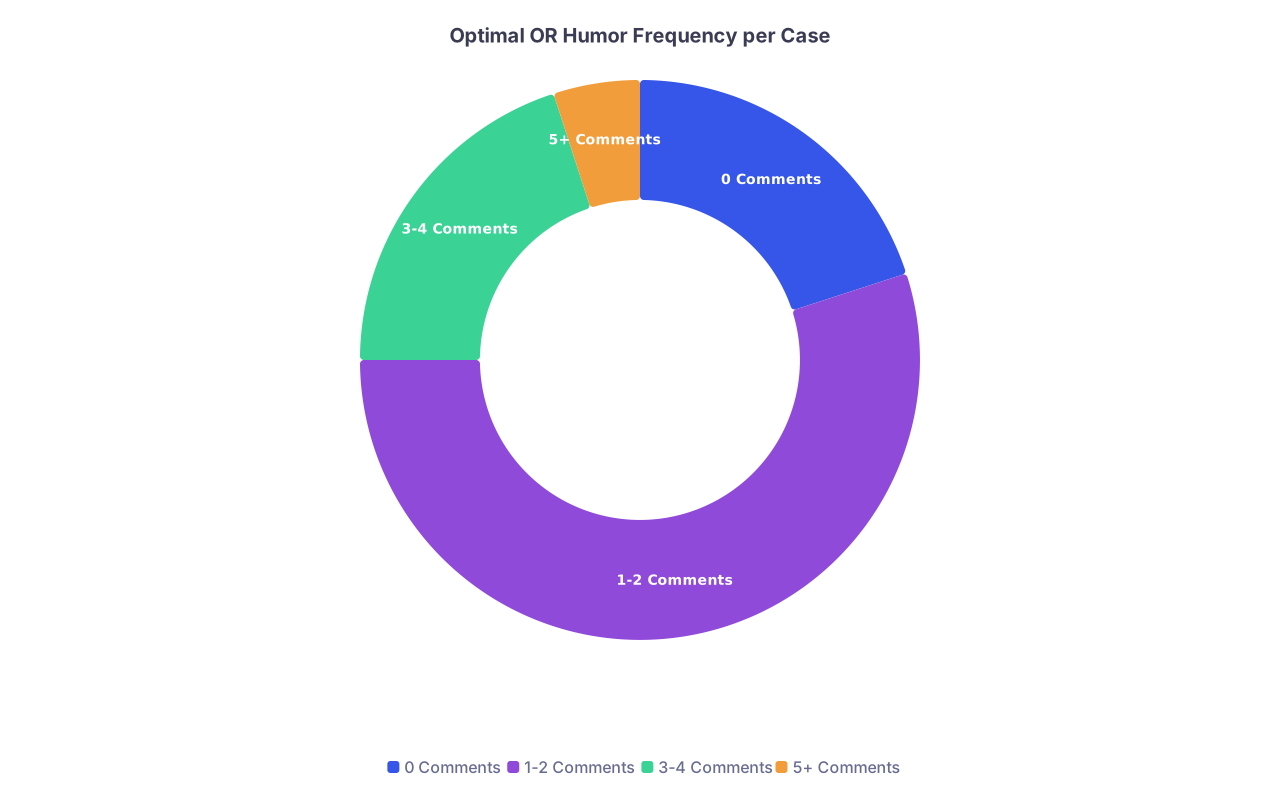
| Category | Value |
|---|---|
| 0 Comments | 20 |
| 1-2 Comments | 55 |
| 3-4 Comments | 20 |
| 5+ Comments | 5 |
How This Scales with Seniority
Your role in the humor ecosystem changes as you move up.
As a Medical Student or New Intern
- Use the script at very low frequency.
- Maybe 0–1 light comments in an entire long case.
- Focus on Steps 1, 2, and 5 (scan, ground, re-anchor). Step 3 (humor) is optional.
Your priorities:
- Do not distract
- Do not over-share
- Be memorable for your work and attitude, not your jokes
As a Senior Resident
- You are now partially responsible for the emotional climate of the room.
- You can use the script a bit more often—especially to support juniors and staff.
Example:
- Intern clearly nervous placing their first stitch. Attending watching. You say calmly:
- “First one is always the hardest. My first stitch looked like abstract art.”
- You normalize the anxiety, get a small laugh, then immediately coach the intern seriously.
As an Attending
Now you are the thermostat. Your tone sets the entire room. The 5-step script still works, but you have more leverage:
- You can de-escalate your own frustration with self-directed humor:
- “Apparently I decided to choose the most stubborn plane of dissection today.”
- You can re-open a shut-down room:
- “Everyone is awfully quiet. Either we are all very focused or someone hid coffee in here without sharing.”
Used well, this makes you the attending people want to work with: serious about the medicine, humane about the culture.

| Step | Description |
|---|---|
| Step 1 | Scan patient and room |
| Step 2 | Ground with neutral task comment |
| Step 3 | Optional light self humor |
| Step 4 | Pause for micro response |
| Step 5 | Re anchor on task or appreciation |
Quick Comparison: Good vs Bad OR Humor
| Situation | Good Line (Safe) | Bad Line (Avoid) |
|---|---|---|
| Long case, everyone tired | "My legs forgot what sitting feels like." | "At this rate we should bill for rent." |
| Equipment glitch | "This scope is on hospital Wi-Fi." | "Who ordered the cheapest camera again?" |
| Student nervous | "My first knot was a modern art piece." | "Relax, nobody dies from a bad knot." |
| Delayed turnover | "OR time moves in dog years." | "Maybe if people worked faster, we’d be home." |

FAQs
1. What if my attending never laughs or seems to hate any humor?
Treat that as a boundary. For those attendings, stick almost entirely to Steps 1, 2, and 5: scan, ground, re-anchor. Your “humor” can be limited to a very mild, work-related comment with the team when they are clearly relaxed, but you do not need to perform. Being consistently calm, prepared, and respectful is far more valuable than trying to make a stoic attending smile.
2. Can I use dark humor in the OR if everyone else is doing it?
You should not lead with dark humor, and you certainly should not introduce it as a trainee. Senior people sometimes use dark humor as a coping mechanism among peers, but it is very easy to cross lines and very hard to un-ring that bell. If you are early in training, default to clean, light, self-directed humor only. When in doubt, sit it out.
3. How often is “too often” to use humor in a single case?
If people can remember more of your jokes than your clinical contributions, that is too often. As a rough rule for trainees: in a 2–4 hour case, 0–2 light comments is plenty. Some cases will have none, and that is fine. Let the complexity and the attending’s style dictate frequency. Your goal is a slightly lighter atmosphere, not entertainment.
4. What if my joke falls completely flat and nobody reacts?
Do nothing. Do not repeat it. Do not explain it. Just shift your full attention back to the work. The fastest way to turn a harmless miss into a problem is to draw more attention to it. Silence after a joke is not an emergency; it is data. Use it to dial back for that particular room or attending.
Key points: Use humor in the OR like medication—right dose, right timing, right patient. Follow the 5-step script: scan, ground, light comment, brief pause, re-anchor on task. And remember: your primary job is competence; humor is just the tool you use to keep humans functioning like humans under pressure.