
It’s 3:12 a.m. You should be asleep, but instead you’re replaying a five‑second moment on a continuous loop: the standardized patient said something, your brain misfired, and you laughed. Not a joyful, empathetic chuckle. The wrong kind of laugh. At the wrong time. In an OSCE.
Now your stomach’s doing cartwheels and you’re thinking:
“That’s it. I just failed the station. Or the OSCE. Or… my entire career?”
I’m right there with you. This is exactly the kind of thing my brain loves to grab onto and gnaw like a dog with a bone.
Let’s walk through what actually happened, what examiners care about, how bad this really is (spoiler: probably not career‑ending), and what you can still do.
First: Let’s Be Honest About What Happened
You laughed. At the wrong time. That’s the headline.
Maybe it was during a breaking bad news station and the SP phrased something awkwardly and your nervous system went, “Fight, flight, or… laugh.”
Maybe the patient said, “So… does this mean I’m dying?” and you did that horrible, tiny, breathy exhale that felt like the loudest cackle in human history.
Or maybe you were fumbling the ophthalmoscope, realized you hadn’t even introduced yourself properly, panicked, made a self‑deprecating crack, and then laughed at your own joke while the SP was describing chest pain.
Whatever the details, your brain now translates this to:
- “The examiner thinks I’m a sociopath.”
- “The SP is going to write ‘zero empathy’ and I’m done.”
- “This will go on some permanent record that every residency director will see forever.”
I’m going to push back on that.
Not to be nice. Just because I’ve seen how these exams actually work and how examiners actually think.
What OSCE Examiners Are Really Scoring (It’s Not Your Soul)
You know those checklists and global rating scales? That’s your shield here.
OSCEs aren’t “vibes‑based character evaluations.” They’re structured. Boringly structured.
| Component | Weight/Impact |
|---|---|
| History/Exam steps | High |
| Communication | High |
| Professionalism | Moderate–High |
| Time management | Moderate |
| Random awkward moments | Very low |
Professionalism and communication do matter. A lot. But they’re not binary. It’s not “laughed once = fail professionalism forever.”
What examiners usually care about:
- Did you introduce yourself?
- Did you wash your hands or sanitize?
- Did you explain what you were doing?
- Did you show empathy?
- Did you maintain boundaries and respect?
- Did the overall interaction feel safe and appropriate?
A single nervous laugh will not, by itself, outweigh everything else unless:
- It was clearly mocking or cruel and
- You did nothing to repair or contextualize it.
The key word: pattern. Examiners look for patterns of disrespect, not isolated awkward human moments.
If the rest of your station was basically competent and your tone for the majority of the interaction was kind, attentive, and professional? That’s what sticks.
The “Nervous Laughter” Problem: You’re Not the First
I’ve seen this happen.
The student who snorted during a pelvic pain station because the SP mispronounced a word and it hit her funny. She wanted to die on the spot.
The guy who laughed when the SP said, “I’m worried it’s cancer,” because he’d just misheard something and his brain lagged, then he realized what they’d said and his whole face went white.
Here’s what actually happened in those cases:
- The SP wrote comments like “seemed a bit nervous at first” and “overall kind and reassuring.”
- The faculty examiners barely clocked the split‑second weirdness because they were busy tracking the checklist.
- The final scores? Normal. Maybe a little ding on communication if it genuinely disrupted the flow. But not “failed station,” and definitely not “failed OSCE.”
OSCE rooms are full of weird human stuff: trembling hands, squeaky stools, people mixing up left and right, SPs forgetting their script, real coughs, awkward silences, misplaced laughter.
You feel like a spotlight was on your every microexpression. In reality, you were one slightly awkward moment in an exam day full of them.
Worst-Case vs Realistic Outcomes
Let’s spell this out because anxious brains love undefinable doom.
Absolute worst‑case scenario (and it’s rare)
Your laugh happened during something obviously serious (self-harm, death, discrimination, abuse), and:
- It sounded dismissive or mocking
- You didn’t apologize or correct the tone
- You showed no empathy afterward
- The SP and examiner both perceived it as “unprofessional / insensitive”
What could happen then?
- You might lose some professionalism/communication points
- You might barely pass or even fail that single station
- In extreme cases, if the behaviour was clearly objectionable and repeated, the school could flag it for remediation or professionalism review
Even in this nuclear version, it’s still not “your career is over.” It’s, “You may need to do remediation, feedback, or a repeat assessment.” Annoying. Stressful. Embarrassing. But fixable.
Much more realistic scenario
Your laugh was clearly nervous, brief, and not directly mocking the patient.
You might get:
- No impact at all because the examiner interpreted it as nerves
- A tiny ding in a subjective communication/global rating box
- An SP comment like “seemed a little nervous but was kind overall”
Translation: the station outcome depends far more on your history, exam, and overall empathy than that one weird second.
Did You Try to Repair It? That Matters.
Think back. After you laughed, did you do anything like:
- “I’m sorry, I know this is a serious topic, I tend to laugh when I’m nervous, but I really do want to understand your concern.”
- Softening your tone: “That does sound really scary. Tell me more about what’s worrying you.”
- A clear empathetic follow‑up: “I’m glad you told me that. That must be hard to sit with.”
If you did anything even vaguely like that? You probably recovered enough that the examiner mentally labeled it: “Nervous, but appropriate overall.”
Even if you didn’t explicitly address the laugh, if your next several lines were clearly serious and empathetic, that’s still repair. Examiners notice directionality: did the encounter trend toward appropriate or away from it?
OSCEs are engineered to simulate real life. In real life, people misspeak, misreact, backtrack, and repair. Showing you can course‑correct actually makes you look more mature, not less.
What This Does Not Do to Your Future
Here’s what your brain is probably whispering:
- “Programs will see I laughed in an OSCE.”
- “There’s now some secret file: ‘unprofessional, weird laugh, don’t rank.’”
- “This will show up in my dean’s letter.”
No.
Unless your behaviour triggered an official professionalism incident with documentation and follow‑up, there is no “laugh note” anywhere.
Most OSCE results live as:
- Numeric scores
- Maybe pass/fail per station
- Maybe brief generic comments
Nobody is writing: “On May 3rd at 14:32, student emitted inappropriate high‑pitched giggle at mention of pulmonary embolism.”
Residency programs see if you passed your clinical skills requirements. They might see “needs improvement” if you legitimately failed a major component and needed remediation. They do not get a highlight reel of your awkward moments.
And even if you did fail that one station?
OSCEs usually use aggregate scores or multiple stations for pass/fail. One station is almost never the entire exam. You’d have to systematically underperform on many domains to tank the whole thing.
How to Actually Learn Something From This (Without Torturing Yourself)
The urge is to obsessively replay it and diagnose your character as fundamentally defective. That’s… not useful.
Here’s what actually helps.
1. Label it correctly in your head
Not: “I’m an unprofessional monster.”
More accurate: “I had a nervous, human reaction in a high‑stress artificial exam environment. It felt huge, but was probably exam‑minor.”
Your brain will fight this reframe. It likes catastrophe. But repeat it anyway.
2. Practice a “nervous laugh script” for next time
You can’t promise yourself you’ll never laugh when anxious. That’s not how brains work. You can pre‑plan a recovery move.
Something like:
- “Sorry, I laugh when I’m nervous sometimes. What you’re saying is serious, and I want to make sure I understand.”
Then follow with a reflective/empathic statement:
- “It sounds like you’ve been really worried about this.”
- “That must be really upsetting to feel that way.”
Rehearse that out loud with friends, partners, your mirror, whoever. So if your nervous system ever misfires again, the repair script is ready.
3. Get some actual data (not just your feelings)
If your school gives OSCE feedback, use it. You might find:
- Your communication score was… fine.
- The SP commented on entirely different things (“good eye contact,” “rushed at the end,” etc.).
- Nobody even mentioned it.
If you’re extremely worried, talk (briefly, calmly) to a clinical skills tutor or faculty member:
“I had a nervous laugh in one station when the patient shared something serious, and I’ve been really anxious that it came across as insensitive. I did try to be empathetic afterwards. Is that the kind of thing that usually fails a station?”
They’ve seen a lot. You’ll probably get something like: “No, that happens all the time. We care more about overall pattern and how you handled the rest.”
Perspective: Real Clinical Life Is Messy Too
In actual clinical practice, weird reactions happen all the time. From everyone.
I’ve seen:
- Residents laughing from sheer exhaustion and then immediately apologizing and grounding themselves.
- Attendings mixing up words when talking about serious diagnoses and then rephrasing.
- Patients making dark jokes about their own mortality and everyone in the room doing that small, awkward shared laugh.
What matters isn’t that no one ever laughs. It’s whether the patient feels respected, heard, and safe. Whether you show up consistently with empathy in your overall behavior.
If this incident is bothering you this much? That alone tells me your default setting is not “cruel” or “careless.” Cruel people aren’t awake at 3 a.m. worrying they mishandled an SP’s feelings.
Reality Check: How OSCE Scores Usually Shake Out
You’re imagining a giant red FAIL stamp because your brain thinks in absolutes.
The OSCE world looks more like this:
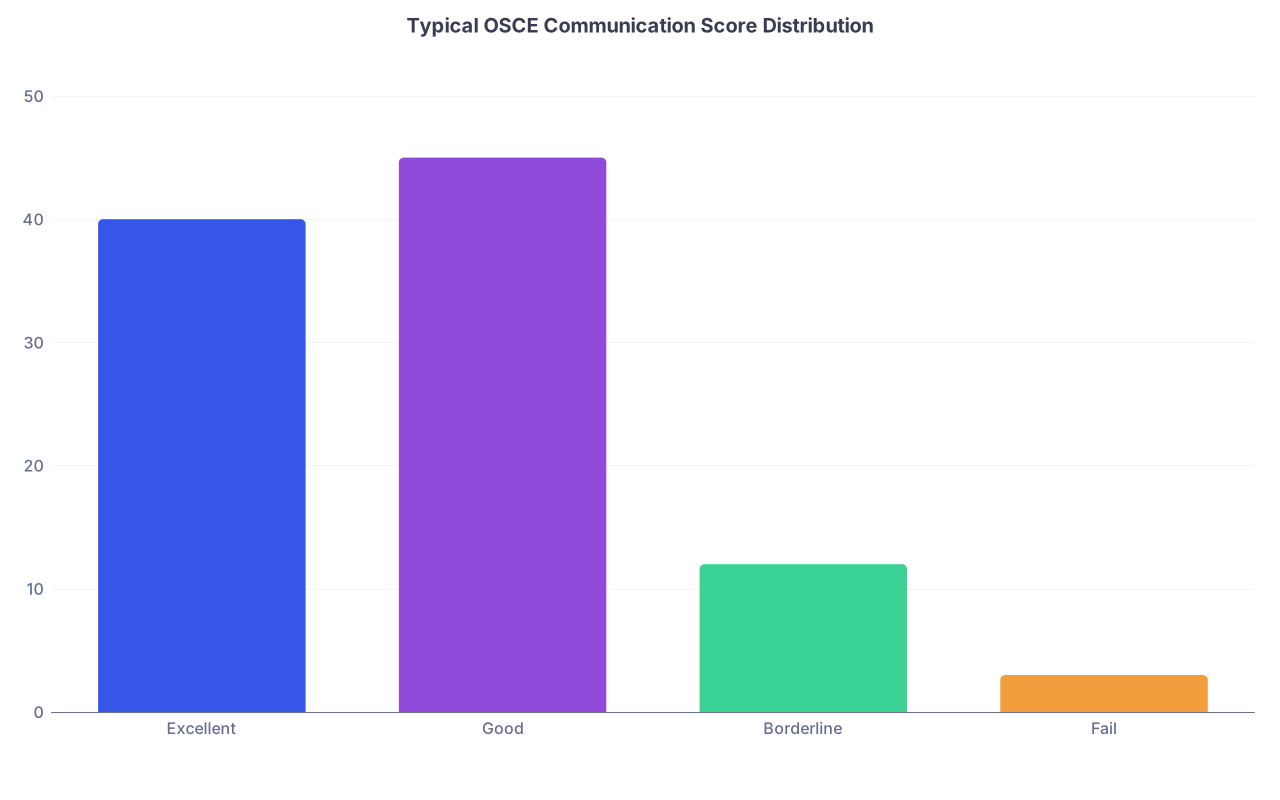
| Category | Value |
|---|---|
| Excellent | 40 |
| Good | 45 |
| Borderline | 12 |
| Fail | 3 |
Most students land somewhere between “good” and “borderline” on communication. Only a small fraction hit actual “fail,” and those are usually the ones who:
- Completely ignore the patient’s emotional cues
- Are openly dismissive or rude
- Miss large chunks of the station’s core tasks
A single awkward laugh surrounded by otherwise decent communication doesn’t drop you straight into the “fail” bucket.
If You Truly Think It Was Bad
Let’s say your internal replay is brutal. You’re convinced it wasn’t just nervous, it was clearly at the patient’s expense, and you did nothing to fix it. The nuclear possibility.
You still have options:
- You can use this as a hard line in your career of, “I never, ever blow off patient emotion again without acknowledging it.”
- You can intentionally over‑practice empathy phrases until they feel automatic rather than forced.
- You can even write about growth from difficult encounters later in your career, if it ends up shaping how you behave. Not this literal story (don’t confess OSCE sins in applications), but the core theme: “I realized how fragile trust is, and now I’m intentional about protecting it.”
People don’t become good clinicians by never messing up. They become good clinicians by messing up, hating how that feels, and deciding they won’t let that be their pattern.
Quick Mental First Aid for Tonight
Because you probably still won’t sleep easily.
- Remind yourself: this is one tiny data point in an entire training career.
- Ask: “If my friend told me this story, would I say their career is over?” (No. You’d roll your eyes at them and say, “You’re fine.”)
- Timebox the rumination: give yourself 10–15 minutes to worry and replay, then deliberately switch to something else—podcast, trashy show, anything. Your brain will try to drift back; pull it away each time.
You can’t fix the past 5 seconds. But you can absolutely prevent those 5 seconds from poisoning the next 5 months.

FAQ – 5 Questions You’re Probably Still Thinking About
1. Could I actually fail the entire OSCE because of this laugh?
Almost certainly not. Failing an entire OSCE usually requires consistent problems across multiple stations: missing major tasks, completely lacking empathy, or serious professionalism issues. One badly timed laugh—even in a serious station—might hurt that station slightly, but it’s not the kind of thing that tanks the whole exam by itself.
2. Will this show up in my dean’s letter or residency applications?
No, unless it escalated to an official professionalism incident with documentation and remediation, which is extremely unlikely from a single awkward laugh. Programs don’t see OSCE bloopers. They see course outcomes: pass/fail, maybe general comments like “strong clinical skills” or “communication improving.” There is no “laughed at OSCE” field anywhere.
3. Can the standardized patient fail me personally because of this?
SPs provide feedback and complete their part of the scoring, but they don’t single‑handedly “fail” you. Their input is part of a structured scoring system. If the overall interaction was reasonably respectful and empathetic, their comment might be something like “seemed nervous” at worst. Faculty interpret everything in context, not off one reaction alone.
4. Should I bring this up to a faculty member, or will that just make it worse?
If it’s haunting you and affecting your sleep or confidence, a brief, matter‑of‑fact conversation with a clinical skills tutor or faculty member can actually help. Something like: “I had a nervous laugh when the SP shared something serious, and I’ve been worried it came across as insensitive. I tried to be empathetic afterwards. Is that the kind of thing that usually fails a station?” They’ll likely reassure you and maybe give tips. You’re not “confessing a crime”; you’re asking for guidance.
5. How do I stop this from happening again in future OSCEs or with real patients?
You probably can’t 100% prevent nervous laughter forever. But you can pre‑plan a recovery: acknowledge it briefly (“I’m sorry, I sometimes laugh when I’m nervous, but I do take what you’re saying seriously”), then pivot straight into empathy (“That sounds really frightening; tell me more about what’s worrying you”). Practice this out loud. The goal isn’t to be perfectly composed, it’s to show you can repair and refocus on the patient.
Two things to walk away with:
- One awkward, badly timed laugh is not the death of your career. It’s a tiny, emotionally loud blip in a boring, checklist‑driven system.
- What matters long term isn’t whether you were flawless in an OSCE; it’s whether you use moments like this to sharpen your awareness, your empathy, and your recovery skills for the real patients who actually need you.