
The fastest way to blow up trust on a diverse medical team is a joke that lands in the wrong culture.
Humor is powerful in medicine. It keeps you sane on call, defuses tension in codes, makes 2 a.m. notes barely tolerable. But when you’re working with colleagues from five countries, three primary languages, and wildly different cultural wiring, your “harmless” joke can be anything but.
This is not about being “less funny.” It is about being surgical with where, when, and how you use humor so you do not cut the wrong structure.
You’re on a multicultural team in medicine—students, residents, attendings, APPs, nurses, techs, admin. Let me walk you through how to survive and actually thrive with humor across cultures and languages.
1. Understand the Hidden Rules: Humor Is Not Universal
People assume humor is some universal bonding language. That is wrong. What feels “light” or “obvious sarcasm” to you can sound hostile, unprofessional, or just confusing to someone else.
Here’s what you’re up against:
- American-style sarcasm often sounds rude or literal to people from cultures where direct mockery is not normal in professional spaces.
- British dry humor can sound like low-key cruelty if you’re not used to it.
- Self-deprecation is bonding in some cultures (US, UK, parts of Europe), but in others it reads as incompetence. You joke “I’m a terrible surgeon,” someone from another culture might think, “Why would you say that out loud?”
- Jokes about hierarchy play differently where hierarchy is sacred. Making fun of an attending, even gently, can horrify someone trained to show overt deference.
On a diverse team, the baseline assumption has to be: my default humor is not automatically safe.
So your first move is not to “be funny.” Your first move is to observe.
Watch:
- Who jokes with whom?
- Do attendings crack jokes in front of residents?
- Do nurses tease residents or keep it formal?
- Does anyone use sarcasm? Or is it mostly light banter and situational humor?
You’re mapping the local humor culture. Treat it like learning the hospital’s EMR—don’t pretend you already know it.
2. Safe “Starter” Humor That Works Across Most Cultures
You still want to build rapport. You do not want to turn into a humorless robot for fear of offending someone. So you start with the safest, most cross-cultural forms of humor and slowly calibrate.
Good starting zones:
Situational absurdity
Comment on the shared weirdness of medicine:- “Only in medicine do we call this ‘post-call’ and still make people work.”
- “Of course the printer jams only when we need 20 discharge summaries.”
Mild self-deprecation about effort, not competence
- Good: “Apparently my coffee requires a loading dose today.”
- Risky: “Honestly I have no idea what I’m doing” (that can trigger real concern).
Gentle exaggeration
- “That pager went off so many times I’m pretty sure it’s sentient now.”
“We’re all in this together” humor
- “We’ve officially entered the ‘is it breakfast or dinner?’ part of the call.”
What you avoid initially:
- Jokes about nationality, accents, or cultural stereotypes
- Teasing someone personally (appearance, habits, mistakes)
- Dark humor in mixed or new groups (we’ll come back to that)
- Any humor involving patients when non-medical staff or outsiders are present
You earn the right to be edgier over time. You do not start there.
3. Language Barriers: When Your Punchline Gets Lost (or Dangerous)
Multilingual teams have an extra landmine: translation.
If your joke depends on wordplay, idioms, or subtle tone shifts, people working in their second or third language may miss it. Worse, they might think you meant the literal words.
Example:
You say (with a grin), “Oh great, another admission. This is exactly what I wanted.”
Your fellow US-trained friends hear sarcasm.
Your colleague from a more literal language environment hears: You actually like admissions and maybe you’re weirdly happy about it. Or they hear only confusion.
So what do you do in a multilingual environment?
Strip the sarcasm text-only tone
Instead of: “Amazing. More consults.”
Try: “Of course we got three consults at 4:59. Perfect timing.”
Still humorous, but less dependent on vocal irony.Avoid obscure idioms
Things like “let’s throw spaghetti at the wall” or “open a can of worms” confuse people and are not funny enough to justify the confusion.Use shared visual references
- “This schedule is like a bad ECG—chaotic and slightly dangerous.”
- “My inbox looks like the ED waiting room.”
When a joke clearly does not land: own it fast
“That was supposed to be a joke, clearly not my best work.”
That resets the tone and gives people permission to move on without awkwardness.
Never pressure non-native speakers with “You didn’t get it?” or “You had to be there” energy. If humor becomes a test of belonging, you’ve failed as a teammate.
4. Dark Humor: The ICU-Level Risk
Let’s talk about the radioactive stuff: dark medical humor.
Yes, it exists. Every unit has it. I’ve seen Gen Surg teams on night float make jokes that would get you fired in a clinic hallway at noon. ICU night shift, ED boarding at 3 a.m., code debriefs—this is where the darkest humor lives.
But here’s the rule: dark humor is a closed-system coping tool, not public entertainment.
You use it:
- With people who have explicitly shown they’re comfortable with it
- In private spaces (call rooms, closed work rooms, not elevators, halls, or near patients/families)
- When it punches up at the system, not down at patients or vulnerable groups
You do not:
- Introduce dark humor with people you just met on a multicultural team
- Make dark jokes in mixed groups that include:
- Students you do not know
- Nurses or techs you have not worked with closely
- Staff from cultures where talking openly about death or suffering is sacred, not comedic
- Turn a real tragedy into your edgy comedy bit
Also, realize this: different cultures have very different comfort levels about joking around death, disability, mental illness, religion. If you’re not sure? Treat those as no-fly zones for humor at work.
5. Jokes About Culture, Accent, or Identity: Just Don’t
If you’re working on a diverse team, let me be blunt: jokes about someone’s country, accent, English level, religion, or appearance are a terrible idea. Even if they joke about it first.
Common traps I’ve watched on teams:
- Mocking or copying someone’s accent “playfully”
- “Light” jokes about arranged marriage, large families, stereotypical foods
- Jokes about “Asian time,” “Latino time,” “This is such a German thing,” etc.
- “Friendly” nicknames based on race, country, or body size
I’ve watched people defend this with “But they know I don’t mean it” or “We’re close friends.” Maybe you are. But you’re not performing just for them. You’re performing in front of the whole team. Someone else from that group may not find it funny at all. Or a junior trainee might feel they have to laugh so they don’t seem uptight.
Also, humor travels. A joke said in the workroom gets repeated. Context gets lost. Now you’re the attending or senior resident whose quote about “X nationality being like this” is circulating out of your control.
If you really want cross-cultural bonding, ask curious questions instead:
- “Hey, what’s the dynamic like in ORs where you trained?”
- “What do people joke about in med school where you’re from?”
Let them set the tone. Not you.
6. How to Recover When a Joke Goes Wrong
You will mess this up at some point. Everyone does. The difference between someone who destroys trust and someone who builds it back is how they respond.
Scenario: you make a joke, the room goes quiet, one person stiffens, someone averts their eyes. You know it hit wrong.
Here is your script:
Acknowledge quickly and plainly
“That did not come out right. I’m sorry.”Reset the frame
“I was trying to be funny about the situation, not about you.”
Or: “I thought that was okay to joke about. It was not.”If it clearly affected one person, follow up one-on-one later
Keep it simple:- “Hey, earlier I made that joke about ____. I realized that might have been offensive. I’m sorry. I’ll be more careful.”
Then stop. Don’t make them comfort you.
- “Hey, earlier I made that joke about ____. I realized that might have been offensive. I’m sorry. I’ll be more careful.”
Do not:
- Say, “I was just joking”
- Say, “You’re too sensitive”
- Turn it into a debate about intent vs impact
- Argue your “right to humor”
In a culturally diverse environment, the grown-up move is: impact matters more than your comedic ambitions.
7. Using Humor to Include, Not Exclude
On a diverse team, the most powerful function of humor is inclusion. If your jokes create an in-group and an out-group, you’re doing it wrong.
Watch for these failure modes:
- Inside jokes based on one language that exclude people who do not speak it
- “Remember in our med school in X country…” stories that leave others permanently on the outside
- Reference-heavy humor from one culture (American pop culture, K-dramas, Bollywood, anime, local politics) with no attempt to loop others in
You do not need to erase your background. You just need to be aware of how often you’re leaving others standing outside the circle.
Simple fixes:
- If you drop a very specific reference and see blank stares, add: “Basically, it means everything is on fire, but we’re pretending it’s fine.”
- Rotate humor sources. Some days you lean on global memes (coffee, sleep deprivation, night float suffering) instead of hyper-local references.
- Explicitly invite others’ humor: “What do you all joke about during call where you trained?” Then shut up and listen.
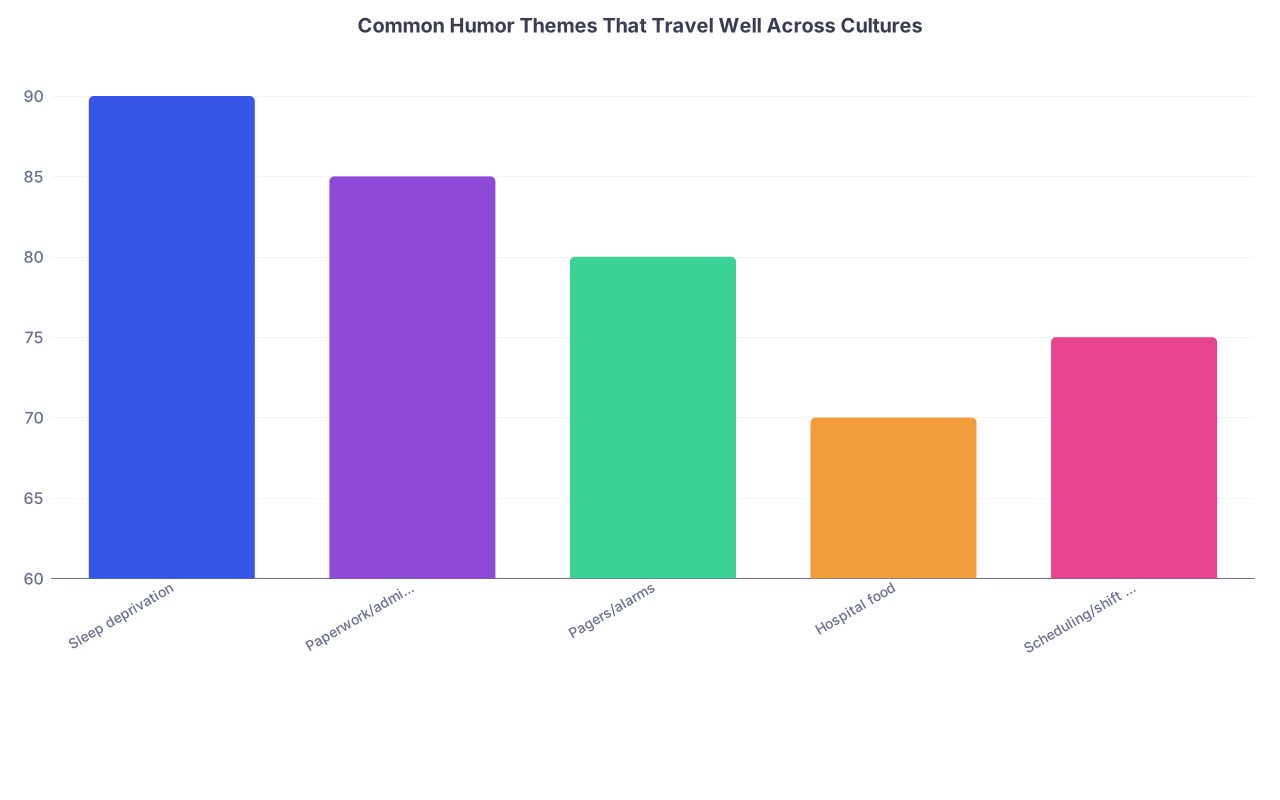
| Category | Value |
|---|---|
| Sleep deprivation | 90 |
| Paperwork/admin chaos | 85 |
| Pagers/alarms | 80 |
| Hospital food | 70 |
| Scheduling/shift swaps | 75 |
The point isn’t perfect equality of understanding. The point is: people should not feel like perpetual outsiders in your team’s comic universe.
8. Calibrating Humor With Specific People
Humor tolerance is not only cultural. It’s personal. Same nationality, same language, totally different comfort zone. That means you calibrate person by person.
You look for:
- Do they initiate jokes with you?
- Do they ever tease you gently?
- Do their jokes have any edge or are they always very soft?
- Do they ever deploy sarcasm?
Then you increment slowly. You don’t jump straight from “That was a long day” to “We’re all dead inside, right?”
Practical progression:
- Start with situational humor that is clearly neutral and non-targeted.
- If they respond well and reciprocate, you can add mild self-deprecation.
- If they start making edgier jokes themselves, you mirror their level, not yours.
One more rule: do not “test” people with borderline jokes to see what you can get away with. That’s how you end up being “the unsafe person” on the team.
9. Leadership and Power: Humor Hits Harder From the Top
If you have power—attending, senior resident, charge nurse, chief—you don’t get the same comedy license as everyone else. That is not unfair. It’s reality.
Your jokes carry:
- Evaluation power
- Career consequences
- Social weight
So:
- Joking about someone’s performance? Feels like criticism, not humor.
- Teasing a junior for being slow? That’s not banter; it’s pressure.
- Self-deprecation about your knowledge? They may wonder if they should trust you in a crisis.
More useful leadership humor:
- Jokes at your own expense that don’t undermine competence. “I’ve had coffee but my brain is still buffering.”
- Humor at the expense of the system. “Of course the EMR updated in the middle of flu season. Perfect strategy.”
- Normalizing stress. “If that case made your heart rate spike, welcome to the club. Mine did too.”
If you’re a leader on a diverse team, your real job is to create a climate where other people feel safe enough to show their authentic humor. Not to dominate the room with yours.
10. Concrete Do/Don’t Guide for Daily Practice
Here is the stripped-down version you can actually remember on call:
| Situation | Do This | Avoid This |
|---|---|---|
| New multicultural team | Observe, use neutral situational humor | Sarcasm, edgy jokes, cultural jokes |
| Multilingual group | Simple language, clear tone | Wordplay, idioms, fast sarcasm |
| Talking about patients | Respectful, minimal humor | Anything that sounds mocking/dehumanizing |
| Dark humor urge | Keep it private, with known-safe people | Using it in mixed/open spaces |
| Joke falls flat or offends | Apologize briefly, adjust | Defend intent, blame sensitivity |
11. Future of Medicine: Humor Will Need “Cultural Competence” Too
We keep talking about cultural competence in patient care. The future is going to require cultural competence in colleague humor as well, especially as teams get more global, more virtual, and more linguistically mixed.
You will be on:
- Zoom M&Ms with physicians in three time zones
- International tumor boards
- Cross-border tele-ICU consults
- Multisite research teams with very different humor norms
The teams that function best won’t be the ones with no humor. They’ll be the ones where humor is:
- Intentional
- Inclusive
- Tuned to the mix of cultures and languages in the “room”
If you learn to read the room now—in your residency lounge, in your OR team, on your service—you’re training for that future.

| Step | Description |
|---|---|
| Step 1 | Think of a joke |
| Step 2 | Do not say it |
| Step 3 | Say it, watch reaction |
| Step 4 | Calibration ok |
| Step 5 | Own it, apologize briefly |
| Step 6 | Target is a person or identity? |
| Step 7 | Depends on sarcasm or wordplay? |
| Step 8 | Multilingual or new group? |
| Step 9 | Room relaxed and smiling? |
Bottom line
Three things to keep in your pocket:
- Your default humor is not neutral. On a diverse team, assume you need to calibrate it, not just unleash it.
- Start with situational and self-directed humor, avoid culture/identity targets, and keep dark humor strictly to trusted, private circles.
- When a joke goes wrong, own it quickly, adjust, and move on. The real “skill” is not being perfectly funny. It is being safe enough that people still want you on their team tomorrow.