
The problem is not that you are “too serious.” The problem is that your residency has confused constant joking with team culture.
You are not broken because you don’t roast your co-residents every 5 minutes. You are not unprofessional because you choose your words carefully on a night float sign-out. But if you’ve picked up that your nickname is “robot,” “gunner,” “Dr. Intense,” or the classic “we’re going to get you to loosen up by the end of intern year,” then you’re in a real, specific situation that can hurt evaluations, relationships, and your day-to-day happiness.
Let’s fix that—without asking you to become the loudest clown in the workroom.
Step 1: Get Clear on What’s Actually Happening
First move: define the problem precisely. “They think I’m too serious” is vague. You need behaviors.
Ask yourself, and if you trust one co-resident, ask them too:
- When do I feel most out of place?
- What exactly are people saying about me? (not your guess—the actual words)
- When did I first notice it shift from light teasing to a reputation?
Common patterns I’ve seen:
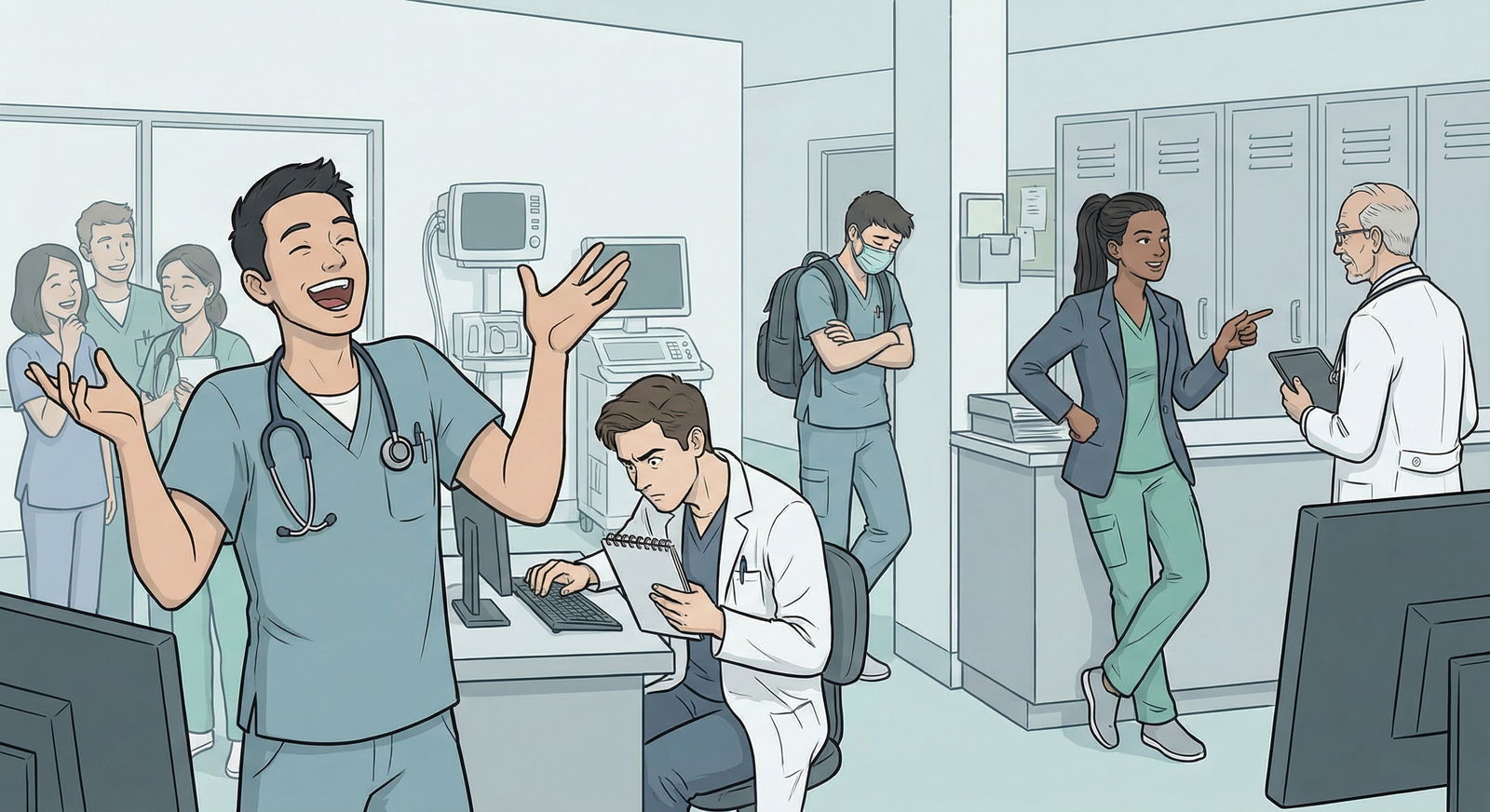
Morning workroom. Everyone’s riffing on a patient’s bizarre chief complaint, someone makes a wildly dark joke about the EMR, and you’re just…still finishing your note. Someone: “Wow, tough crowd. Paging Dr. Serious.”
Sign-out. You give structured, tight handoffs. Others interrupt with jokes about “this trainwreck patient,” and you bring it back to, “Anyway, her lactate is trending down.” Eye rolls. “He always sounds like he’s presenting at M&M.”
Social stuff. Group chat is 90% memes, 10% logistics. You only engage on logistics. People: “We thought you hated us until halfway through the year.”
Write out 3–5 real scenes from your week. You’re not doing this to judge yourself. You’re trying to understand the mismatch between how you operate and how the group signals belonging.
Because that’s what all this is: belonging signals. In your program, the main signal seems to be “we joke about everything all the time.” You don’t have to fully buy in—but you do need to understand the code.
Step 2: Separate Three Different Risks
Residency joking culture is a messy bundle of:
- Harmless humor that actually builds connection
- Edge-of-the-line humor that’s uncomfortable but survivable
- Actual unprofessional or toxic behavior masquerading as “we’re just joking”
You need to be very clear which is which, because your strategy changes.
Here’s the rough breakdown I use:
Harmless culture stuff
- Self-deprecating jokes about being tired
- Light roasting about coffee addictions, running notes late, always being early, etc.
- Memes about call, EMR, residency life
If this is all that’s happening and you’re labeled “too serious,” you mostly have a perception problem, not a real safety issue.
Edge-of-the-line
- Dark humor about death, codes, disasters
- Jokes that hint at burnout, substance use, or hating patients
- “We joke because otherwise we’d cry” stuff
This can be functional coping or a red flag, but you can usually stay at the edge—acknowledge it without diving in.
Actually problematic
- Racist/sexist/homophobic ableist “jokes”
- Mocking specific patients by name or clear identifiers
- Humiliating a junior in front of others as “teaching”
- Pressuring you to join in on something that violates your ethics
Here, your goal is not “fit in better.” Your goal is: protect yourself, protect patients, and, if realistic, gradually influence the culture or use formal channels.
For now, let’s assume you’re mainly in bucket 1 and 2 but feeling like you’re in 3 because you’re so uncomfortable. Later I’ll touch what to do when it’s actually toxic.
Step 3: Decide Your Non‑Negotiables
You do not need to become the “funny one.”
You do need to consciously choose:
- What you are willing to do to soften the “too serious” rep
- What you’re not willing to do, no matter what your senior says in passing
Concrete examples of reasonable boundaries:
- “I don’t make jokes about specific patients, period.”
- “I’m not going to comment on people’s bodies or relationships, even as a joke.”
- “I’ll laugh along at residency memes, but I’m not going to trash the nurses or consultants.”
Knowing your lines makes your behavior consistent. People ultimately respect consistent. They may poke at it, but they know what they’re going to get with you.
Write 3 sentences that start with: “I’m okay with…” and 3 that start with “I’m not okay with…” about humor at work. That’s your backbone.
Step 4: Add Just Enough Warmth to Change the Narrative
In most programs, “too serious” doesn’t actually mean “this person never jokes.” It usually means:
- They don’t give any emotional feedback signals
- They don’t show personality in low-stakes moments
- They unintentionally look disapproving when they’re just thinking
You can fix this without changing who you are. You’re not adding jokes; you’re adding warmth cues.
Tiny behaviors that shift perception
Pick 2–3 of these to start:
The 2-second smile rule. When you walk into the workroom, lift your face for a genuine 1–2 second smile and a “Hey all” before you sit. That’s it. No bit, no joke. Just a human greeting instead of a neutral march to the computer.
Name + small talk. When a co-resident enters: “Morning, Sam. How was your night?” You don’t need to follow it with witty banter. The question itself signals you’re part of the group.
Low-stakes self-deprecation. Used sparingly, this goes a long way:
- “I think my brain just blue-screened; can you repeat that?”
- “If I open one more note, my soul is going to hard quit.”
Laugh with, not at. You don’t have to add jokes. But if something is clearly funny to the group and not offensive, let yourself actually smile or chuckle instead of staying stone-faced while you chart.
Offer one harmless personal fact per week. “I crashed at 8 pm post call and woke up still wearing my badge.” “I meal prepped and still ate vending machine Pop-Tarts.” That’s enough to humanize you.
This isn’t performative. It’s like slightly increasing the brightness on your monitor so people can see what’s on the screen.
Step 5: Script Responses to “You’re So Serious”
The worst part is being called out in the moment.
You know this one: Workroom laughing, you’re working, someone: “Wow, you’re so serious all the time.” Everyone looks at you, waiting.
If you freeze or defend yourself, it reinforces the image. You need 2–3 preloaded, short, half-joking lines. Not perfect comebacks. Just lines that show you’re not offended and you’re aware of the dynamic.
Steal one of these and adjust to your personality:
- “This is my fun face. It’s very subtle.”
- “I’m fun on weekends. Right now I’m just trying to not forget the potassium.”
- “Give me 5 more years of training, you’ll break me eventually.”
- “Hey, someone has to be the designated responsible one.”
And then—this is key—you move the conversation forward:
- “Anyway, did anyone call cards back on that patient?”
- “Alright, what’s left before sign-out?”
You acknowledge their frame, lightly play along, but do not sit there defending your personality. You’ve already lost if you start explaining, “I’m actually not that serious, it’s just…”
You can also gently invert it once you have some standing with the group:
- Co-resident: “You’re so serious.”
- You: “True. You’re so unserious. Balance.”
Delivered deadpan, with a small smile, that often gets a laugh and resets the dynamic.
Step 6: Use One-on-One Allies Strategically
You do not need the entire program to suddenly decide you’re secretly hilarious. You need 1–3 people who get you and can translate you to the rest.
Find:
- The co-intern you actually like talking to
- The senior who seems genuinely kind underneath the sarcasm
- A chief who’s a little more emotionally intelligent than the average bear
Pull one of them aside casually. Not as a formal summit. More like walking to Starbucks after a shift.
Say something like:
“Hey, random question. I’ve gotten a few jokes about being ‘too serious.’ I know I’m not the most outwardly goofy person, but I don’t want to seem like I hate everyone. Anything I’m doing that reads colder than I intend?”
That does three things:
- Signals you’re self-aware, not rigid
- Invites real feedback (you might get something gold like “honestly, your resting face is intense, but when you talk 1:1 you’re totally normal—so talk a little more in the workroom”)
- Creates someone who is now, unofficially, on your side
Sometimes those people will actually advocate for you when you’re not around: “Oh, she’s not serious, she’s just focused. On nights she’s actually really funny.” That’s how reputations soften.
Step 7: Protect Yourself from Truly Toxic “Humor”
Let’s not pretend all of this is harmless. Some residencies hide real nastiness under the joke umbrella:
- “We call our obese patients ‘frequent flyers’ haha.”
- “We always page [consult service] with a fake polite voice and then trash them here, it’s how we cope.”
- “Tell us your worst patient story, we’re ranking them.”
You do not have to join in. In fact, you shouldn’t.
Your minimal playbook here:
Neutral disengage. Look at your computer, adjust your focus, chart something, stand to go see a patient. You’re not doing a dramatic protest. You’re just not providing fuel.
Deflection, not confrontation (most of the time).
- “Anyway, what’s the plan for the next admission?”
- “On a different note, who’s on cross-cover tonight?”
Pick your battles for direct pushback. When it crosses a line you can’t tolerate:
- “I’m not comfortable joking about that.”
- “Let’s not talk about patients like that.”
Short, flat, no sermon.
Document patterns if it’s bad. Dates, people, comments. If this becomes an evaluation or safety issue, those notes matter.
And if an attending is leading the charge with “jokes” that are clearly discriminatory or hostile, that’s no longer “dealing with being too serious.” That’s a professionalism/HR/PD conversation. Don’t carry that alone—loop in a chief, trusted faculty, or GME.
Step 8: Guard Your Evaluations Without Selling Your Soul
Here’s the ugly truth: “too serious” can creep into your evals as “not a team player” or “difficult to work with,” even when you are absolutely fine.
You fight that with receipts and framing.
On day 1–2 of a rotation, be a little more explicit about collaboration:
- “I’m usually pretty focused on tasks, but I’m always happy to help anyone who’s behind. Just flag me.”
- “I’m not the most loud in the room, but I’m really invested in the team running smoothly—tell me how you like things done.”
Do at least one proactive, visible helpful thing per week:
- Offer to pick up an extra discharge
- Stay 10 minutes late to help a struggling intern finish sign-out
- Offer to call a family if the senior is buried
When asking faculty for feedback midway:
- “Anything I can do to come across as more approachable to the team? I’ve gotten the ‘serious’ label before, and I want to make sure it doesn’t read as ‘closed off.’”
Now if an attending is about to write something lazy like “seems a bit distant,” they remember that you asked specifically about being a good teammate. That often softens their language.
Step 9: Build a Life Outside the Joking Bubble
If all your social oxygen is your program’s group chat, you will suffocate if you don’t fit the humor norm.
You need at least one of these:
- Non-med friends who think it’s hilarious that you’re the “serious one” because they’ve seen you doing karaoke
- A partner or sibling who knows your real personality
- A hobby group (climbing gym, book club, DnD, running group) where you’re not “the resident,” you’re just you
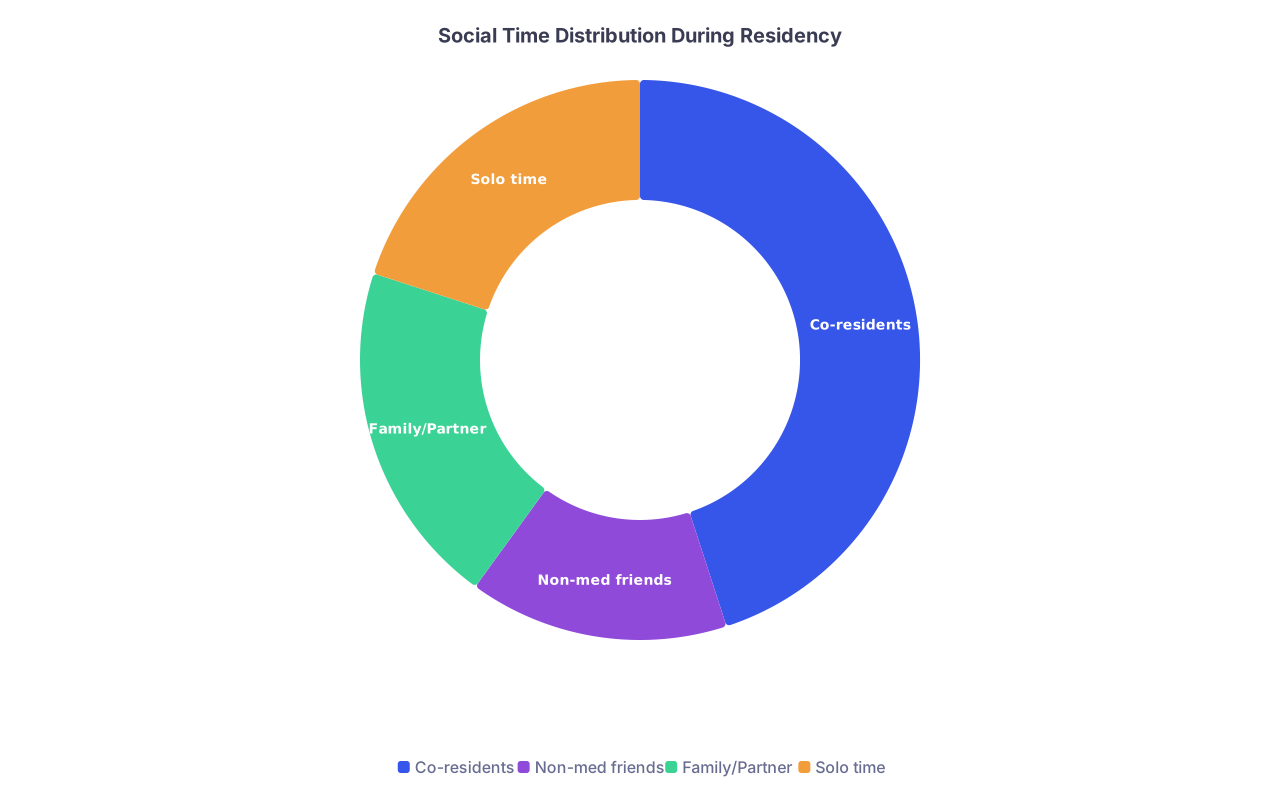
| Category | Value |
|---|---|
| Co-residents | 45 |
| Non-med friends | 15 |
| Family/Partner | 20 |
| Solo time | 20 |
Why this matters: if you’re only evaluated by a culture where sarcasm and chaos are the main currencies, you’ll start doubting your baseline self. You’ll either overcompensate (and feel fake), or burn out from masking.
Outside spaces remind you: you’re not “too serious.” You’re just in a loud room where everyone’s talking one octave above your comfort level.
Step 10: Decide How Much You Want to Influence the Culture
Long term, especially if you become a senior or chief, you actually get to shape this.
You don’t have to wage war on humor. You can redirect it:
- As a senior, when an intern is being labeled:
- “He’s not too serious, he just cares. I’d rather that than someone who shrugs off patient issues.”
- Before rounds:
- “Okay, let’s keep the roasting to each other and not the patients. We’re funny enough without that.”
- For your intern group:
- Start a running joke that’s self-directed (“We’re the spreadsheet gang,” “We’re the chronically early team”) instead of punching down.
And when you’re choosing fellowships or jobs, remember how this felt. Ask explicit questions in interviews:
- “What kind of humor is common on your team?”
- “How do you support different personality types? Is there room for quieter folks?”
Programs often act surprised by that question. Good ones have a real answer.
A Quick Scenario Walkthrough
Let me give you one exact day and what to do with it.
You’re a PGY-1 on wards. The team: very jokey PGY-3, two co-interns who love dark humor, attending is neutral but laughs along.
Morning workroom
They’re telling stories about “craziest patient of the week.”
What you do:
- Walk in, smile, “Morning.”
- Sit down, open EMR.
- As they’re wrapping up a story, you let yourself smile and say one tiny, safe line like: “Medicine really is just a never-ending plot twist.”
- Then you ask your co-intern quietly: “You got the labs on 5309? I can grab vitals.”
Mid-day, they tease you
Senior: “Look at Dr. Serious over there, probably writing a whole thesis in his note.”
You respond, deadpan but friendly:
- “I’m actually drafting my Oscar speech for best supporting intern.”
- Small smile. Then: “What do you want to make sure we include before rounds?”
You neither sulk nor pretend to be the comedian. You give them a little, then move back to business.
End of the day
You’re done with your notes, ahead of time. You notice your co-intern is behind.
You: “Hey, I’m done with my notes. Want me to pend some orders or write the discharge summary for 6112?”
Senior sees that. Later, when someone says “He’s so serious,” that same senior might say, “Yeah, but he saved your ass on those discharges last week.”
Reputation shifted half a notch. That’s how it moves. Not in one grand gesture.
| Category | Low-Risk Example | High-Risk Example |
|---|---|---|
| Self-directed | "My brain is buffering today." | "I need three shots to get through call." |
| Patient-related | "This chart is a novel." | Mocking patient appearance or behavior |
| Team-related | "We live in this workroom now." | Insulting a co-resident's competence |
| System-related | EMR and paging jokes | Trashing specific nurses or consultants |
The Future: Serious People Are Exactly Who Medicine Needs
Here’s the irony. The future of medicine—with AI decision support, more complex ethics, sicker patients, and more public scrutiny—does not actually need more chaos energy. It needs people who can hold complexity, stay grounded, and still be human.
That’s you.
You’re never going to be the residency meme lord. Good. We already have plenty of those. What you can be is:
- The person families trust on the worst day of their life
- The senior who notices the intern shrinking under “jokes” and has their back
- The attending who normalizes that you can be both serious about the work and kind with your team

And yes, you can learn to play along with enough of the humor that you’re not misread as cold or hostile. That’s a skill. Not a personality transplant.
Your job over the next months is not to become “the funny one.” Your job is to:
- Understand the code
- Decide your boundaries
- Add enough warmth that your seriousness reads as care, not contempt
With those pieces in place, you’ll survive this joking residency with your integrity intact—and maybe even be the one who, years from now, makes sure the next “too serious” intern doesn’t get steamrolled.
You will have other challenges—burnout, career decisions, maybe leading your own team—that need this same clarity and backbone. But that is a story for another day.