
The way most teams “joke around” on call would get any normal workplace sued into dust.
You’re not crazy. A lot of what’s passed off as “just roasting” in medicine is lazy bullying wrapped in dark humor. But here’s the catch: you still have to work with these people tomorrow. And next month. Maybe for the next three years.
So the question isn’t, “Is this OK?”
The question is, “What do you do at 2:17 a.m. when your upper just turned you into the punchline for the fifth time and everyone laughed?”
Let’s walk through what to do in the actual moment, what to do after, and how to set boundaries without turning it into A Big Thing™ that follows you around the program.
Step 1: Know What Game You’re Actually Playing
On call, you’re not just doing medicine. You’re in three games at once:
- Safely manage patients.
- Protect your own energy so you don’t fall apart.
- Manage social politics on a tired, overstimulated team that thinks sarcasm is a personality.
If you pretend you’re only playing Game #1, you’ll keep getting blindsided by #2 and #3.
Here’s the uncomfortable reality:
A lot of “roasting” is a power move. It’s disguised as:
- “We’re just giving you a hard time.”
- “We roast everyone; it means we like you.”
- “This is how we blow off steam.”
Sometimes that’s actually true. Sometimes it’s just cruelty with good public relations.
Your job is not to psychoanalyze each joke. Your job is to decide:
- Is this banter, where I feel included?
- Or is this at my expense, where I feel smaller, not safer?
If your body is telling you, “I dread walking into sign-out because I’m the joke again,” listen to that. That’s your red flag.
Step 2: In-the-Moment Tactics (When They Roast You… Again)
Let’s say you’re a PGY-1 on night float. You present a case, stumble on a number, and your senior says:
“Wow, did you even open the chart or are we just free-styling medicine now?”
Everyone laughs. It lands wrong. You feel your face get hot.
Here are options you can use right there, without drama.
Option A: Deflect with a Line That Reclaims Control
You don’t have to clap back with equal cruelty. You just need to shift the frame so you’re not the helpless butt of the joke.
Examples:
- “I did open the chart. Clearly not enough to meet your standards, though.” (Dry, calm.)
- “Fair. I’ll double-check before the next one. For this one, here’s what I’m actually worried about…”
- “Nice. I’ll add that to the highlight reel of tonight. Anyway, labs show…”
The move here:
Acknowledge the comment briefly, don’t reward it, pivot hard back to patient care.
You’re signaling, “I heard you. I’m not devastated. But I’m also not here to be your entertainment.”
Option B: Call It Out Softly, In Real Time
If the roast is clearly over the line (“Are you normally this slow or just on nights?”), it’s reasonable to tag it:
- “Ouch.” (Pause. Eye contact. Then back to the task.)
- “Harsh.” (Then keep going with what you were saying.)
- “Well, that feels encouraging.” (Said dryly, then move on.)
You’re not starting a fight. You’re putting a little yellow flag on the field. People who still have a working conscience will register it.
Option C: Use “The Look”
Under-rated tool: just stop talking for a second and look at them.
Not a death stare. Just:
- Slightly raised eyebrows.
- Brief silence.
- Then: “Anyway…” and continue.
Silence makes adults deeply uncomfortable. It also makes the group aware something slid past respectful.
This is especially useful if you’re not ready to use words yet.
Step 3: When It’s Repeated or Targeted – Upgrade Your Response
The one-off joke is one thing. The pattern is the problem.
Pattern looks like:
- Your mistakes get turned into recurring bits.
- They only roast you (or you and one other person).
- They revisit humiliating stuff (“Remember that time you…?”) in front of new staff.
When it’s a pattern, you need to do something outside the instant-joke moment.
Option D: The Quiet, Direct, One-on-One
This is the move most people avoid. It’s also the one that works best.
Pick a time when they’re not stressed:
- After rounds.
- Walking between wards.
- In the workroom when it’s just you two.
Script (use your own words, but this structure works):
Start with the shared goal.
“I know we’re all just trying to survive nights and keep things light.”Name the behavior, not their character.
“When you keep bringing up that time I missed the lab result in front of everyone…”State impact without drama.
“…it makes it harder for me to speak up or ask questions. I end up shutting down a bit.”Ask for a specific change.
“Can you lay off that joke? I’m fine being teased sometimes, but that one’s getting in the way.”
Then stop talking. Let them respond.
Most decent humans will:
- Apologize.
- Downplay (“I didn’t realize it was a big deal.”).
- Adjust behavior.
If they roll their eyes or mock you for bringing it up? Great. You just collected data on someone who is not safe. That changes your next steps.
Step 4: Pre-Emptive Boundary Setting (Yes, You Can)
This is advanced, but it saves you a ton of pain.
You can set tone early when you join a new team or rotation.
Day 1, informal banter starts. Someone says, “We’re pretty savage on this team. We roast everyone.”
Possible response:
- “I’m here for some dark humor. Just keep me out of the humiliation Olympics and we’ll be good.”
- “I’m fine joking around; I just don’t do well when it’s personal. Roast the system, not me.”
- “Roast away, as long as the patients are safe and it doesn’t slow us down.”
You’re drawing a box: “I’m not humorless, but I’m not your chew toy.”
You can also set personal “no-go” zones explicitly if needed:
- “I’m fine with jokes about being slow on notes, but don’t go after my accent / background / personal stuff.”
Anyone who blows past that is telling you exactly who they are.
Step 5: When It’s Actually Harassment (Not Just Bad Jokes)
Let’s be blunt. Some “roasting” is just discrimination with better branding.
Red lines:
- Comments about race, gender, orientation, religion, body, mental health.
- Jokes that imply you’re unsafe, incompetent, or stupid in front of others, repeatedly.
- Sexual comments. Full stop.
If this is happening, your priority shifts from “smooth team dynamics” to “protect myself and create a record.”
Here’s the playbook:
Document.
Not in your feelings app. In a factual log.- Date, time, location.
- Who was present.
- Exact words as close as you can remember.
Test a direct boundary once, if safe.
“Comments about my [accent/gender/whatever] aren’t OK. Don’t do that again.”Loop in a safer senior.
Could be: chief resident, program director you trust, another attending.Use language like:
- “I need to discuss some professionalism issues I’m experiencing on call.”
- “I’ve noticed a pattern of comments from Dr X that are affecting my ability to function on the team.”
Know this isn’t “drama.”
Drama is screaming in the hallway.
Quietly and clearly describing a pattern is adult behavior. If your culture labels it drama, that culture is broken, not you.
Step 6: Reading the Room – Is This Actually Bonding?
Sometimes, weirdly, the roasting is how the team shows inclusion. Think surgical call when the attending says to the intern:
“Your note was… brave. Ambitious. Incorrect, but ambitious.”
Everyone chuckles. The tone is warm. They’re not cutting your credibility in front of the patient. They’re deflating the tension.
You can usually tell it’s healthy if:
- They roast themselves more than anyone.
- They spread it around; no one is the permanent butt of the joke.
- When you say, “OK, too far,” they actually back off.
- They support you when it matters: in front of consultants, nurses, and patients.
In that situation, leaning into light self-deprecating humor can actually bond you with them:
- “Don’t worry, my note-writing will be fellowship-level by PGY-6.”
- “I aspire to be as fast with notes as I am with ordering coffee.”
As long as you’re not genuinely undermining yourself, that’s fine. Just keep an eye on your inner voice. If it starts repeating their roast lines alone at 3 a.m., they’re going too far.
Step 7: Protecting Your Headspace on Call
You can’t always fix the team. You can reduce how much it wrecks you.
Practical stuff that actually helps:
Micro-decompression.
After a harsh comment, take 20 seconds at the computer.
Do: one slow breath in for 4, out for 6. Drop your shoulders.
This keeps you from spiraling into “I’m an idiot” mid-call.Re-anchor to the patient.
Mentally say: “My job is this patient, not this joke.”
It sounds cheesy. It works.Have one “safe person” to text.
Another resident, co-intern, friend.
Message: “Senior just made me the punchline again. I handled it, but ugh.”
Sometimes you just need a “Yeah, that’s messed up” from someone not on that shift.Name the tactic to yourself.
“They’re using humor as a power flex again.”
That moves it from “I’m failing” to “They’re doing that thing they do.”
Step 8: Specific Scenarios and What to Say
Let me give you scripts. Edit them to sound like you, but use the backbone.
Scenario 1: You Paged the Attending, They Roast You
Attending: “You woke me up for this? Are you trying to set a record for worst night float?”
Response options:
- “I’d rather wake you up than miss something important for the patient. Here’s what I’m seeing…”
- “I get that it’s late. I’m calling because I don’t want to miss X. Here are the vitals and labs.”
You’re not apologizing for being cautious. You’re re-centering on patient safety.
Scenario 2: Group Laughter After a Presentation Mistake
Senior: “Wow, bold to present without actually checking the BMP.”
Everyone laughs. You did check; you just misspoke.
You:
“Fair, that came out wrong. I did check; sodium is 130, potassium 4.2. I’ll be clearer next time.”
Short. Factual. You correct the narrative without whining.
Scenario 3: Repetitive “Bit” About Your Personality
Co-resident keeps saying, “Well, you know [Your Name], always anxious and overreacting,” whenever you advocate for a patient.
Pull them aside after:
“Hey, about the ‘always anxious and overreacting’ comments. When you say that after I bring up concerns, it undercuts what I’m trying to advocate for and makes it harder for me to speak up. Don’t frame me that way, especially in front of others.”
If they say, “It’s just a joke,” you respond:
“I’m telling you it’s not landing as a joke for me. I need you to stop with that one.”
Clear. Direct. No debate.
Step 9: When You Regret Not Saying Anything
You’re driving home post-call. You’re replaying the moment they roasted you. You’re thinking of 47 comebacks you should have used.
Fine. Use that.
You can still follow up later:
“Hey, yesterday when you said X in front of everyone, that stuck with me. I know you were probably joking, but it made it harder for me to focus and felt undermining. I’d appreciate it if we keep things more about the work and less about me as the joke.”
You’re allowed to retroactively set a boundary. There’s no expiry date.
Step 10: If You’re the One Doing the Roasting (And You’re Realizing It Now)
If you’re reading this and thinking, “Oh. I’ve said some of that…” good. That means your conscience still works.
Course-correct like this:
- Pick one person you know you’ve gone too far with.
- Say, “I’ve been thinking about how I joke on call. I’m realizing some of my comments may have landed more harshly than I intended. If I’ve made you feel targeted, I’m sorry. I’m working on cutting that out.”
- Then actually cut it out.
No five-paragraph essay. No “But we all do it.” Just stop.
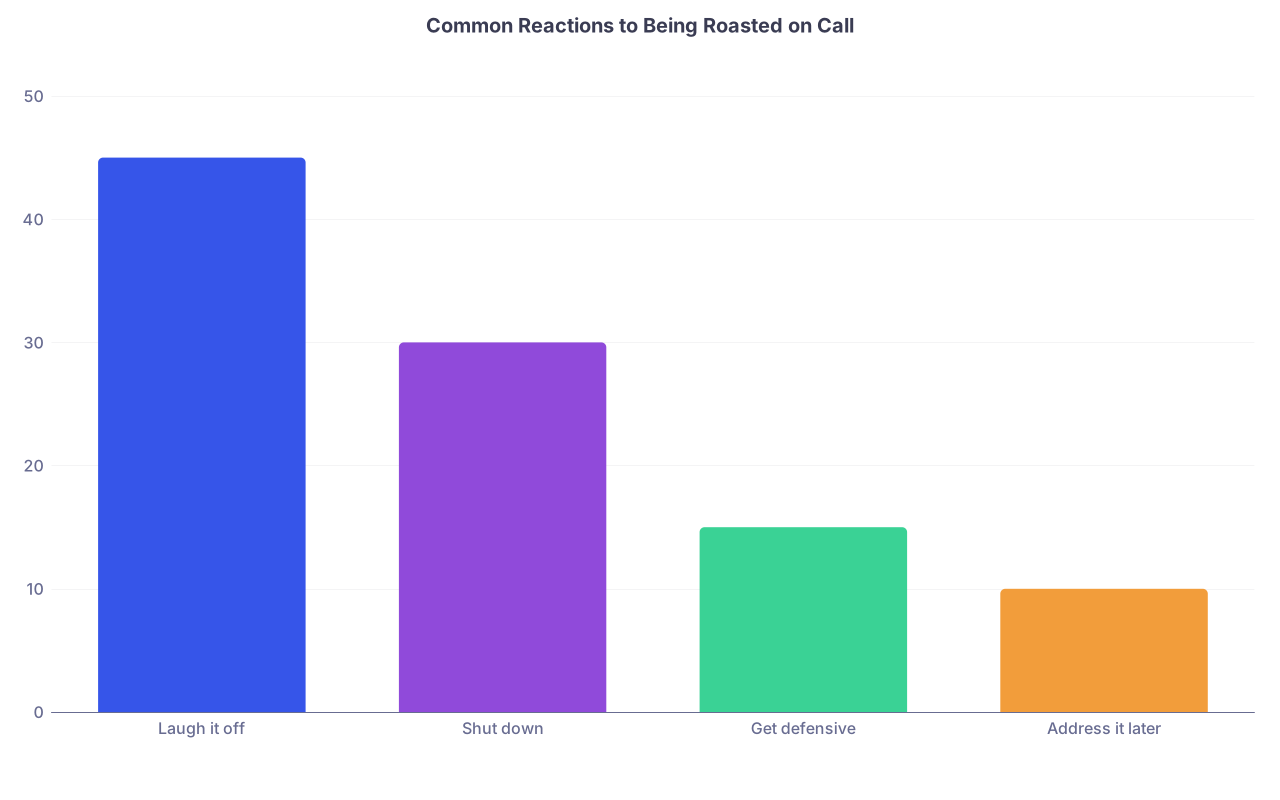
| Category | Value |
|---|---|
| Laugh it off | 45 |
| Shut down | 30 |
| Get defensive | 15 |
| Address it later | 10 |


| Step | Description |
|---|---|
| Step 1 | Roasting comment on call |
| Step 2 | Deflect and pivot |
| Step 3 | Tag it softly - Ouch or Harsh |
| Step 4 | Document mentally |
| Step 5 | Decide if safe to talk 1 on 1 |
| Step 6 | Quiet direct convo |
| Step 7 | Loop in trusted senior or chief |
| Step 8 | One time or pattern |
| Step 9 | Mild or over the line |
| Situation | Simple Phrase |
|---|---|
| Joke lands too harsh | "Ouch. Anyway..." |
| Pattern of one specific joke | "Can we retire that one? It’s getting old." |
| Attending complains about page | "I’d rather wake you than miss something." |
| Personal topic as joke | "That’s not a joke topic for me." |
| Needing to push back gently | "I know we’re joking, but I’m serious about this part." |

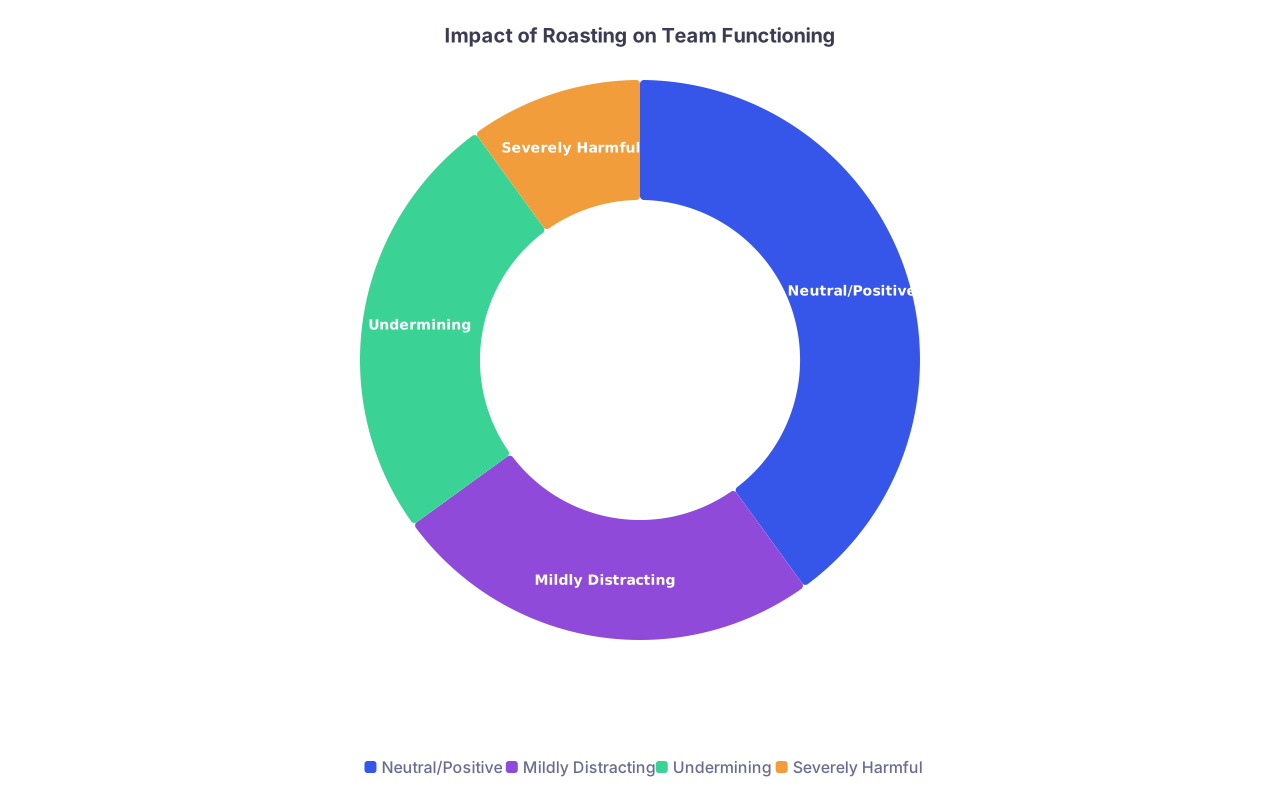
| Category | Value |
|---|---|
| Neutral/Positive | 40 |
| Mildly Distracting | 25 |
| Undermining | 25 |
| Severely Harmful | 10 |