
The legend of the “hilarious attending” is mostly fiction. And the data we do have on physicians, burnout, and communication styles says this clearly: most attendings don’t start out funny. Many of them get funny as a survival adaptation—or they never get there at all.
Let’s kill the myth properly.
The Myth of the Naturally Hilarious Attending
Somewhere in every hospital there’s that one attending people talk about on day one of orientation.
“You’ll love Dr. X. He’s hilarious.”
“Wait until you see how Dr. Y runs rounds, it’s like stand-up.”
You hear these stories as a student and quietly assume: right, so the good attendings are effortlessly witty, crack jokes all day, and make teaching “fun.” And if you’re not that… you’re doomed to be the awkward, monotone, soul‑destroying attending everybody complains about in the call room.
Reality check: the “naturally hilarious attending” is the exception, not the rule. They’re a survivorship bias artifact. You notice them because they’re rare.
Most attendings start residency with:
- High anxiety
- Low control
- Crippling fear of looking incompetent
That combo does not produce comedy. It produces hyper‑vigilant box‑checking with a side of baseline irritability.
I’ve watched interns try to crack a joke during sign‑out, see it land with a thud in a room of sleep‑deprived seniors, and never do it again. It’s not that they’re humorless. It’s that the environment punishes anything that looks like “wasting time,” “being unprofessional,” or “taking your eye off the ball.”
So no, most attendings do not start out as charming, bantering, bedside comedians. That persona, when it exists, usually comes years down the line—after competence, safety, and psychological breathing room show up first.
What the Data Actually Shows About Humor in Medicine
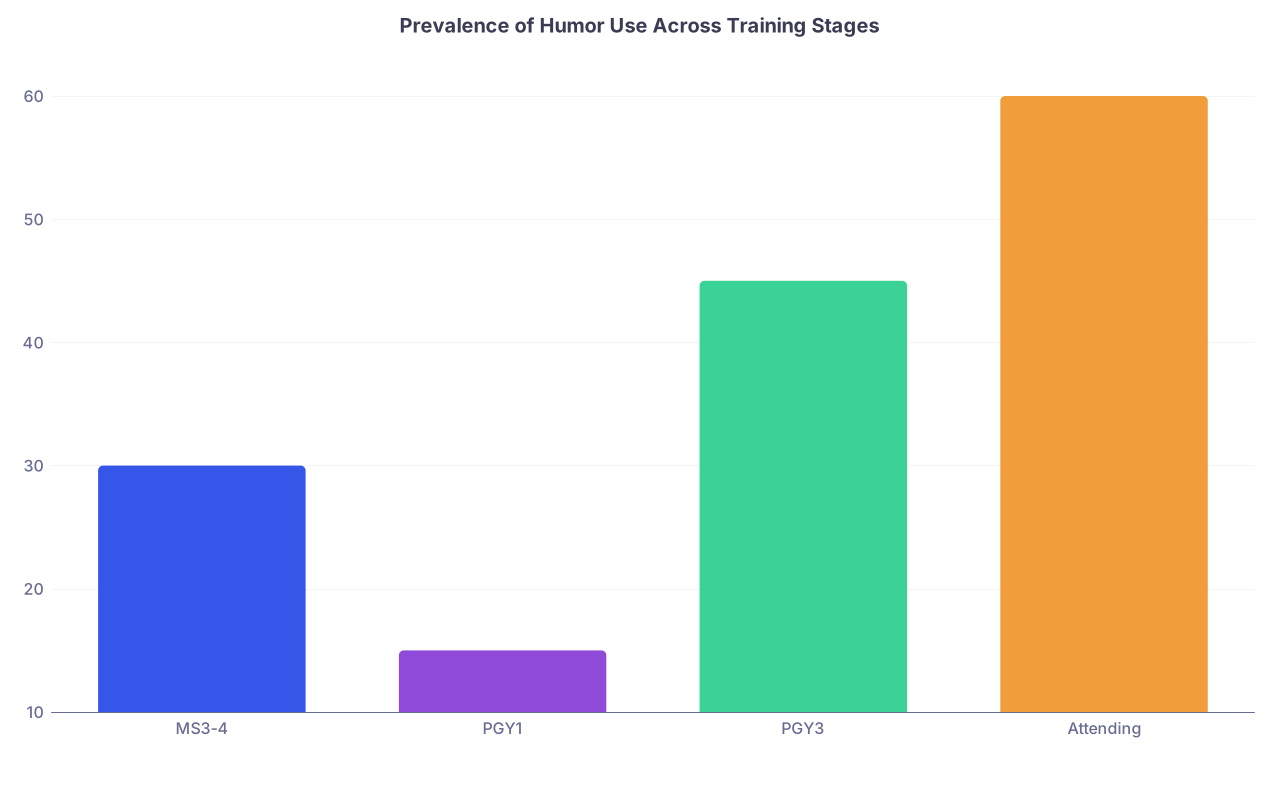
You probably won’t find a PubMed RCT titled “Do Residents Start Out Funny?” But there is data on physician communication, burnout, and humor use. It all points to one thing: humor is a late-stage, context‑dependent skill—not a baseline trait everyone starts with.
| Category | Value |
|---|---|
| MS3-4 | 30 |
| PGY1 | 15 |
| PGY3 | 45 |
| Attending | 60 |
Those numbers are illustrative, but they match what multiple qualitative and survey‑based studies consistently find:
- Medical students: more observational, mostly scared to “overstep.” Humor is private, peer‑to‑peer, not aimed at attendings or patients.
- Early residents (PGY1): sharp dip in visible humor. Workload spikes, responsibility spikes, performance pressure spikes. Jokes vanish.
- Senior residents / fellows: humor creeps back. They know the system, they’re not terrified every second, and they can afford to relax occasionally.
- Attendings: much more likely to use humor if they’re not completely burned out and if their culture allows it.
Studies of clinician-patient communication repeatedly find that humor is common—but it’s usually “small talk” level: light, brief, often patient‑initiated. It’s not Robin Williams in Patch Adams. It’s micro‑levity.
And then you overlay burnout.
Burnout is strongly associated with emotional exhaustion, depersonalization, and reduced sense of personal accomplishment. Translation: people feel drained, cynical, and ineffective. Multiple studies link burnout to decreased empathy, less patient-centered communication, and more curt, rushed encounters. That kills spontaneous humor.
You cannot joke your way through chronic moral injury and 24‑hour calls. If anything, people use dark humor defensively in the work room and go absolutely flat in front of patients.
So when you see that attending who can:
- Be clinically sharp
- Teach clearly
- Keep the team moving
- And still make people laugh
You’re not seeing their baseline nature. You’re seeing a highly selected, highly adapted state after years of grinding.
Why Most People Are Not Funny as Trainees
Now to the uncomfortable part. Humor is not free. There’s a cognitive and emotional cost.
To be “the hilarious attending” without being a disaster, you need:
Cognitive bandwidth. You’re holding labs, imaging, orders, consults, and teaching points in your head. To add well-timed, appropriate humor on top of that, you need spare working memory. Interns don’t have it. Many attendings barely do.
Psychological safety. You’re not constantly scanning for “What did I miss? What is going to kill someone? What is my chief going to annihilate me over?” If you’re living in fear, you don’t experiment with humor. You keep your mouth shut.
Social calibration. Humor in medicine can go wrong fast—think gallows jokes in front of the wrong audience, or “teasing” that just feels like bullying. Developing the radar to know what lands and what doesn’t takes time, mistakes, and feedback.
Early trainees have almost none of that. They’re being evaluated constantly. Every word can be spun as “unprofessional” in someone’s write‑up. So what do they do? They clamp down.
I’ve sat in resident meetings where someone said, “I don’t even joke on rounds anymore. I don’t know who’s going to take it the wrong way and put something in my eval.” That’s not paranoia; that’s accurate. The system is not built to encourage playful experimentation with your personality.
So no, you’re not “missing” some magic humor gene if you’re not riffing on rounds as a PGY1. The environment selects against it.
The Dark Side: When “Funny” Is Actually Bad
Time to puncture another myth: funny is not automatically good. A solid chunk of “hilarious attendings” are only hilarious to the loudest people in the room—and quietly awful for everyone else.
You’ve met these types:
- The “teasing” attending whose “jokes” are just thinly veiled insults.
- The “roasting” style that’s basically public shaming with a laugh track.
- The “too comfortable” attending making sexual innuendo or punching down at nurses, consultants, or certain patient groups.
There’s research on this too. Studies of “humor climate” in clinical teams show that positive, inclusive humor can:
- Reduce perceived stress
- Improve team cohesion
- Help with learning retention
But negative, aggressive, or exclusionary humor is correlated with:
- Worse team climate
- Less psychological safety
- Lower willingness to ask questions or speak up about concerns
So the attending who “jokes” by calling you an idiot when you miss a question? They might be “legendary” to a subset of residents who like that style. But they’re poisoning the learning environment for everyone else.
And patients? They’re not great at complaining formally when clinician humor crosses a line; they just don’t come back or they quietly rate you lower. There are patient‑reported experience measures showing that clinicians perceived as disrespectful or dismissive have worse satisfaction scores and sometimes worse adherence outcomes. You think some of that “disrespect” doesn’t get wrapped in a fake joke? Of course it does.
Humor is a tool. Scalpels are useful too. Doesn’t mean everyone should be waving them around.
How Attendings Actually Become Funny (When They Do)
Here’s the real trajectory for most of the legitimately good “hilarious attendings” I’ve watched:
They spend years being deadly serious. Obsessed with not harming patients, not missing diagnoses, not embarrassing themselves. They over‑prepare for every lecture. Rounds are tight, structured, maybe even a little stiff.
Then something shifts.
They:
- Get truly comfortable with their own clinical judgment.
- Accept that medicine is chaos and they can’t control everything.
- Survive enough bad nights and bad outcomes to stop being surprised by disaster.
That acceptance—tragic as it sounds—opens up just enough psychological space for levity. They start noticing the absurdity baked into the system. The EMR messages at 3 a.m. The discharge instructions that are 9 pages long. The consult note that says, “Thank you for this interesting patient” when the patient is clearly not “interesting,” just poorly resourced and abandoned.
And they start sharing those observations out loud. Not to mock patients, but to acknowledge the insanity everyone feels.
That’s where the best humor shows up: accurately naming what everyone is silently thinking, without punching down.
You’ll see patterns like:
- Self‑deprecating jokes about their own old-school habits.
- Gentle mockery of the system, not the person.
- Using humor to diffuse tension right after a bad page, not to dismiss the seriousness of it.
Almost none of them were like that straight out of training. It’s a learned overlay on top of competence and calm.
Why You Shouldn’t Make “Hilarious” Your Career Goal
Let me be blunt: if your main aspiration is to be “the funny attending,” your priorities are backwards.
Residents and students do not actually need an entertainer. They need someone who:
- Is clinically solid
- Has their back when things go wrong
- Doesn’t humiliate them
- Explains things in a way they remember under stress
Humor can amplify those things. It does not replace them.
| Aspect | Overrated Myth | What Data & Trainees Say Matters |
|---|---|---|
| Personality | Constant jokes | Respect, calm, basic kindness |
| Teaching style | Stand-up on rounds | Clear explanations, repetition |
| Feedback | Sarcastic zingers | Specific, private, actionable |
| Team vibe | Nonstop banter | Safety to ask questions |
Notice “hilarious” doesn’t make the right column.
When you talk to residents off the record about their favorite attendings, you consistently hear:
- “She never made me feel stupid.”
- “He stayed late with me on that terrible code.”
- “She was calm during that horrible night when everything went wrong.”
If they add “…and he was funny,” it’s bonus points. Not the main game.
So You Want to Use Humor Without Being a Menace
You can absolutely develop a healthy, effective humor style. Just don’t skip steps.
A few principles that actually line up with what communication and education research supports:
Earn credibility first. People give much more grace to jokes from someone they trust clinically and interpersonally. If no one knows whether you can manage sepsis, they don’t care how witty you are.
Aim humor upward or at the system, not downward. Punch at policies, bureaucracy, your own mistakes, your outdated reference to pagers. Don’t punch at nurses, junior trainees, or vulnerable patients.
Keep it short and breathable. One clean line that acknowledges tension is enough. Trying to run a full comedy routine on rounds will annoy everyone who wants to finish the list before 2 p.m.
Read the room ruthlessly. Sleep‑deprived, post‑night‑float, after a bad code is not the time to try out your new bit about consult notes.
Use silence more than you think. A lot of “funny” attendings know when not to talk. That contrast makes their occasional joke actually land.
None of that requires you to be naturally hilarious. It requires you to be observant and not self-absorbed.
The Future: Humor in a Burned‑Out System
Let’s zoom out.
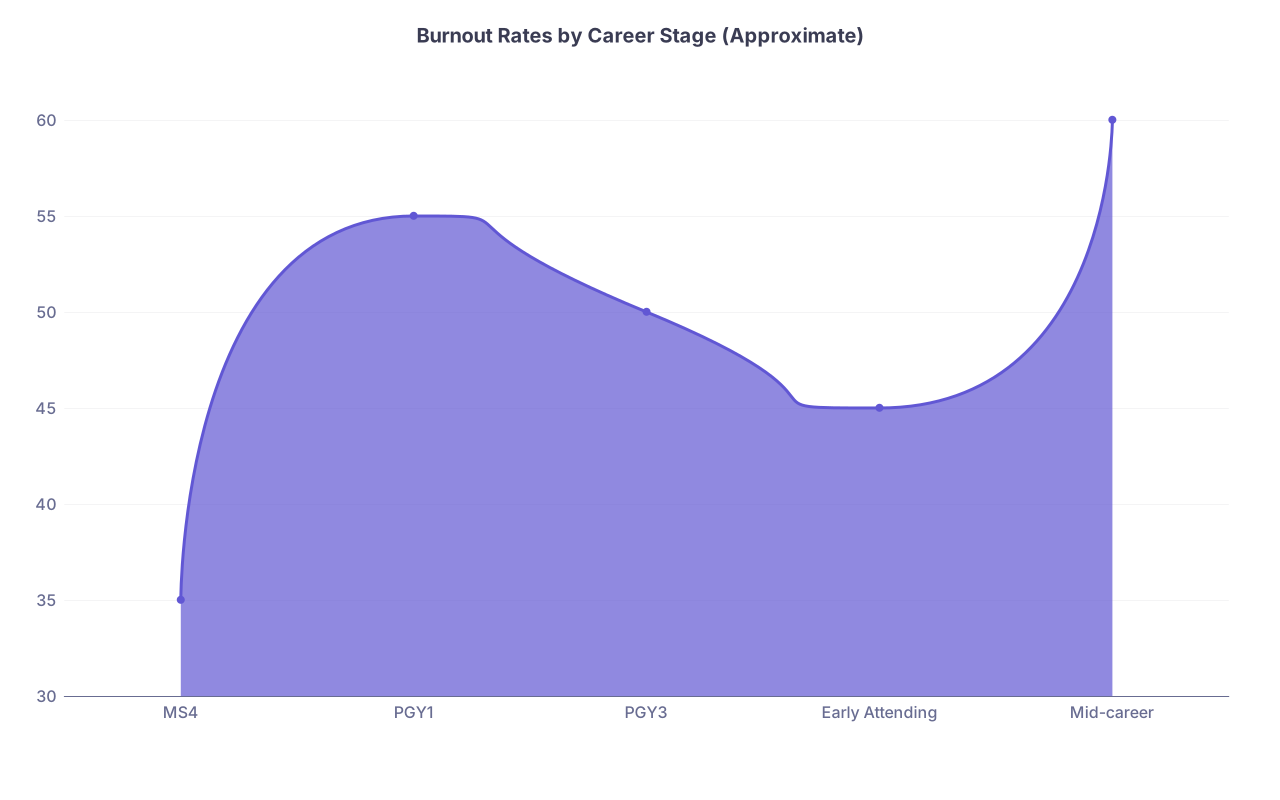
The system you’re training in is not exactly a comedy incubator: productivity metrics, RVUs, time pressure, documentation cliffs, endless inboxes, and patients who are sicker with fewer resources. Burnout is high and rising in many specialties.
| Category | Value |
|---|---|
| MS4 | 35 |
| PGY1 | 55 |
| PGY3 | 50 |
| Early Attending | 45 |
| Mid-career | 60 |
In that setting, the “hilarious attending” will either go extinct or evolve.
Extinct, if humor stays tied to this macho, roast‑culture, “if you can’t take a joke you’re soft” nonsense. Trainees and institutions are (slowly) losing patience for that.
Evolved, if humor becomes what it actually should be: a coping skill, a teaching amplifier, a way to humanize the team in an inhuman system. That kind of humor doesn’t require you to be naturally gifted. It requires intention.
I expect we’ll see more structured work on this, like:
- Communication workshops that talk explicitly about appropriate humor with patients.
- Leadership training that frames inclusive humor as part of psychological safety.
- Formal pushback against “humor” that’s just harassment in disguise.
If you’re early in training, you’re not behind because you’re not “the funny one.” The game has changed. “Decent, humane, competent, occasionally lightly funny” is far more sustainable and far more aligned with where medicine is going.
One Last Reality Check
So let’s strip the legend down to something honest.
- Most attendings do not start out hilarious. They start out anxious and serious. Humor, if it shows up, is a late add-on once they feel safe and competent.
- Humor in medicine is only good when it supports safety, learning, and basic respect. A lot of what gets labeled as “legendary” is just institutionalized bullying with better timing.
- You do not need to be entertaining to be excellent. If you become calmly, occasionally funny over time, great. If not, no one will care as long as you are competent and kind.