
The idea that laughing at work means you are not taking medicine seriously is wrong. Not just “a little simplistic.” Wrong in a way that burns people out, wrecks team cohesion, and quietly harms patient care.
You’ve probably heard some version of it on the wards: “This is serious. We’re not here to joke around.” Usually from the loudest person in the room who confuses solemnity with professionalism. The data—and decades of real clinical culture—tell a very different story.
Let’s take this myth apart.
The Myth: Serious Doctors Don’t Laugh
I’ve watched this play out on ICU nights. The intern cracks a tired joke at 3 a.m. over bad coffee. A patient is crashing in the next room. A senior nurse smiles. Then someone, often a new fellow desperate to look “in control,” shuts it down: “Guys, come on, this is serious.”
That unspoken rule? Serious illness = serious faces.
It sounds respectful. It feels intuitive. And it’s quietly toxic.
There are three separate assumptions baked into that mindset:
- Laughter = distraction = unsafe
- Laughter = disrespectful to patients, especially the very sick
- “Real” professionalism looks like emotional flatness
All three crumble when you put them next to what we actually know about stress, cognition, and team performance in medicine.
What the Evidence Actually Shows About Humor and Performance
Strip away the moralizing and you’re left with biology and psychology. High-acuity medicine is chronic high-stress exposure. Acute stress in short bursts helps performance. Chronic, unrelenting stress fries it.
Here’s where humor comes in: not as a cute extra, but as a documented cognitive tool.
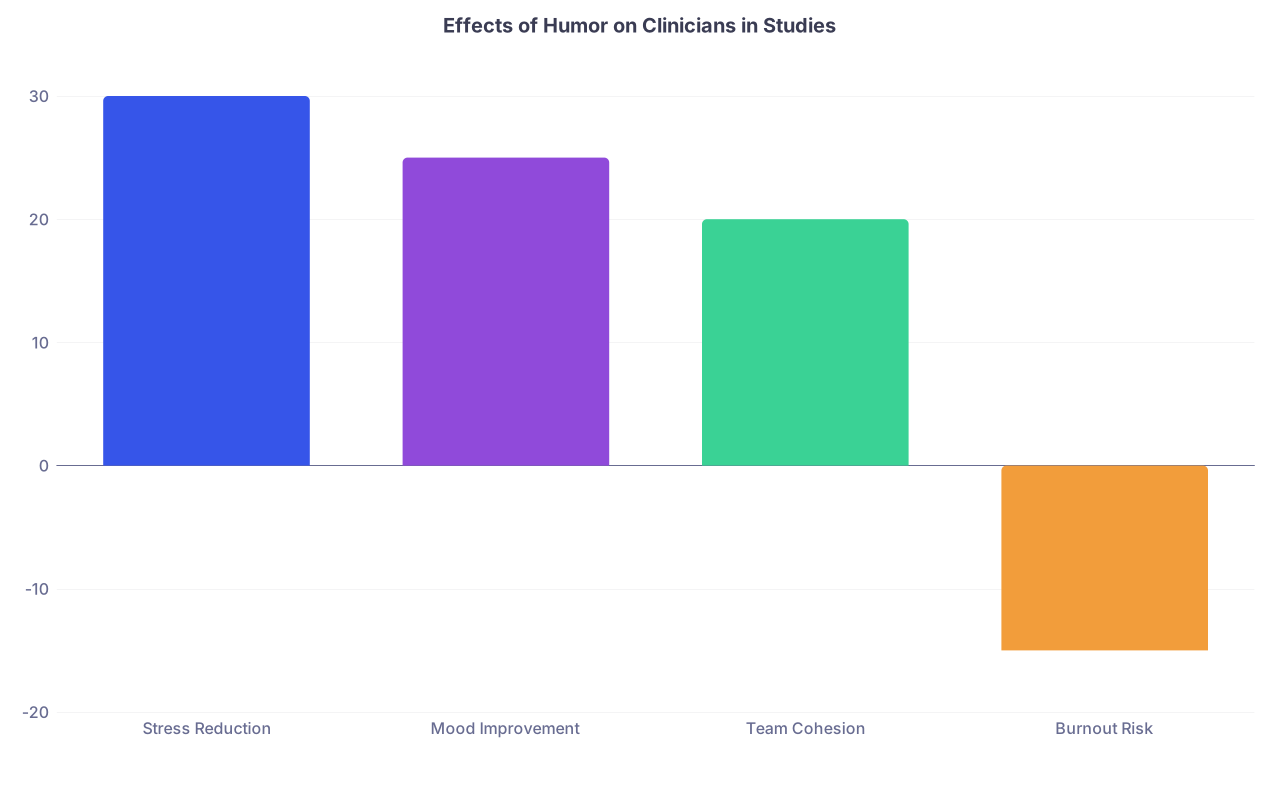
| Category | Value |
|---|---|
| Stress Reduction | 30 |
| Mood Improvement | 25 |
| Team Cohesion | 20 |
| Burnout Risk | -15 |
That chart’s a simplification, but it captures something real: multiple small experimental and observational studies across healthcare and other high-stress professions show that shared humor:
- Lowers perceived stress and anxiety
- Improves mood and resilience
- Strengthens social bonds in teams
- Can correlate with lower burnout
We’re not talking about YouTube prank videos in the OR. We’re talking about:
- A sarcastic one-liner in the charting room at 2 a.m.
- Dark humor between ICU nurses who just coded their third patient of the night
- A resident joking about the “Four Horsemen of the On-Call Breakfast”: cold coffee, dry muffin, pager, and regret
None of that means people aren’t taking the work seriously. It usually means they’re trying to stay intact enough to keep doing it.
There’s a well-known framework in clinical psychology around “coping strategies.” Humor is classed as an adaptive coping strategy. Not perfectly adaptive in every context, but far better than the alternatives many clinicians reach for: emotional numbing, depersonalization, alcohol, workaholism.
It’s strange: we’ll happily accept a surgeon with a vodka habit as “old school,” but a hospitalist who laughs on rounds? Suspicious.
Burnout, Not Laughter, Is What Kills Seriousness
If you actually care about “taking medicine seriously,” then you should care about burnout. Because burned-out clinicians make more mistakes, show less empathy, and leave practice earlier. That’s not a vibe problem. That’s a patient safety problem.
Look at any major burnout survey of physicians and residents from the last decade. Same patterns:
- Emotional exhaustion
- Depersonalization
- Reduced sense of personal accomplishment
Now compare that to what humor—used well—does: it rehumanizes, reconnects, and gives people micro-moments of control and perspective in situations where they otherwise have none.
| Coping Style | Short-Term Effect | Long-Term Effect on Care |
|---|---|---|
| Dark/shared humor | Stress relief, bonding | Often protective |
| Emotional numbing | “Efficient,” detached | More errors, less empathy |
| Overwork | Feels productive | Faster burnout |
| Substance use | Temporary relief | Impairment, absenteeism |
The irony: the people grimly insisting on “no laughing, this is serious” often end up defaulting to the worst coping strategies. They push everything down, they demand the same from others, and ten years later they either quit, become bitter, or turn into the attending everyone dreads: technically excellent, emotionally radioactive.
Seriousness isn’t about your facial expression. It’s about the reliability and integrity of your actions over time. And humor, especially shared humor, is one of the few renewable resources that keeps those actions steady.
The Line Everyone Worries About: What About Patients?
Here’s where the myth has a valid emotional hook. People imagine a cartoon: doctors laughing over a dying patient.
Let’s separate scenarios, because context is everything.
Scenario 1: Laughing with patients
This one’s straightforward. The evidence here is actually quite clean: when patients perceive their clinicians as warm, human, and emotionally present, trust goes up, adherence goes up, satisfaction goes up. Appropriate humor is one of the fastest shortcuts into that territory.
Think of oncology consults where a patient cracks a joke about chemo hair and the oncologist riffs gently with them. Or the geriatric patient who swears about their walker and the resident smiles and answers in kind. That’s not disrespect. That’s joining.
I’ve lost count of how many times I’ve seen a scared patient or family member visibly relax after a small, well-timed joke:
“Do you smoke?”
“Only when my mother-in-law visits.”
“Good news. I have no authority to regulate mother-in-laws.”
That 4-second exchange may do more for rapport than 10 minutes of perfectly delivered pathophysiology.
Scenario 2: Laughing near patients, about something else
This is the gray area that fuels most anxiety. Staff in the hallway, joking. Family sees it, interprets it as “they don’t care.”
Here’s the actual standard: perception matters. Not because laughter is inherently disrespectful, but because you do not control how stressed, grieving people interpret limited data.
So yes, be strategically aware. Don’t be loud and performative outside a room where someone is getting life-altering news. Step into a break room. Drop your volume. This isn’t about shame—it’s about signal management. What signals do you want to send to people who are scanning for any hint that their loved one is being taken seriously?
But do not confuse “tone awareness” with “no humor allowed.” That’s performative severity, not professionalism.
Scenario 3: Laughing about patients
This is the actual problem zone. And it’s not about laughter per se—it’s about contempt.
There’s a sharp divide between:
- Bonding over the absurdity of the system: the broken pager, the third EMR crash, the 12th prior authorization for the same medication
- Mocking a patient’s body, culture, socioeconomic status, mental illness, or misfortune
Both may technically involve “jokes.” Only one corrodes your moral core and your team’s culture.
Anyone who’s been around long enough has seen that line crossed. A patient with obesity reduced to a nickname. A psych patient described as “just another crazy.” These aren’t harmless. Teams that normalize contemptful humor very reliably become teams that cut corners on care for the people they roll their eyes at.
So the rule is not “don’t laugh.” The rule is: punch up, not down. Aim the humor at systems, at yourself, at shared hardships—not at the vulnerable person who has no power in that room.
The Future of Medicine: More Complexity, More Need for Humor
Look at where medicine is going: more complexity, more moral distress, more algorithmic oversight, more litigation anxiety. Less autonomy, more metrics.
Removing human outlets like humor in that environment is like taking oxygen out of a pressure chamber and wondering why people pass out.
I’ll give you a concrete example: telemedicine. You’re in a five-by-five room staring into a webcam, clicking boxes, reading scripted empathy prompts built into the EHR. There’s already a push toward “standardizing” provider behavior even more. If you’re not careful, the next step is sterilizing it emotionally.
Meanwhile, the clinicians who still manage to slip in a light, authentic joke—about the dog interrupting the video visit, about both of you forgetting what day it is—end up with patients who feel like they’re talking to a human, not just a billing entity.
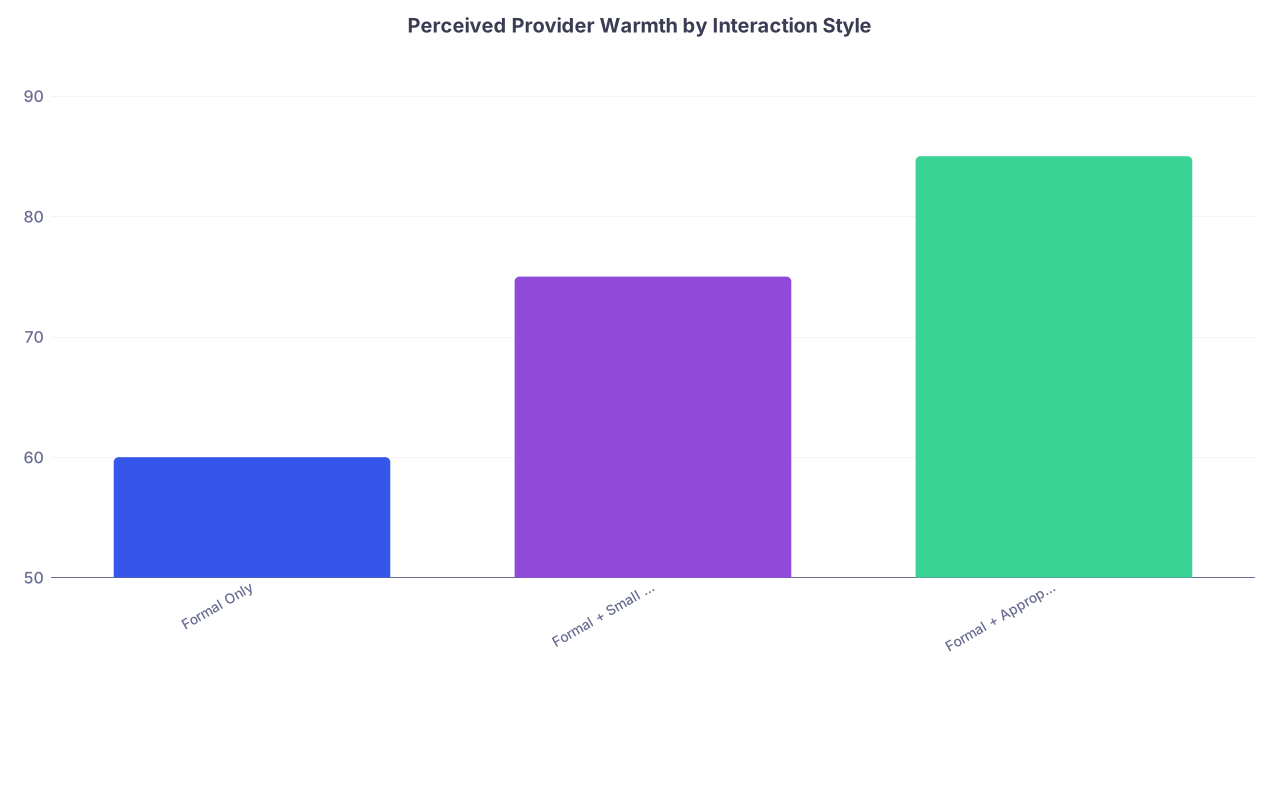
| Category | Value |
|---|---|
| Formal Only | 60 |
| Formal + Small Talk | 75 |
| Formal + Appropriate Humor | 85 |
That’s representative of how patient satisfaction and perceived warmth tend to scale with genuine interpersonal behaviors, humor included. And it matters, because “human-ness” in medicine isn’t a cosmetic add-on. It’s core to whether patients tell you the embarrassing truth, follow your recommendations, and come back.
On the training side, as simulation, AI tools, and remote learning expand, you’re going to see more dehumanizing elements creep into medical education. More screen time, less shoulder-to-shoulder apprenticeship. The informal culture—jokes between cases, shared dark humor after a bad night—used to be built-in. Now it has to be defended on purpose.
If you want a future of medicine that isn’t staffed by hollowed-out protocol technicians, guard humor fiercely. It’s one of the last cheap, scalable tools for keeping medicine human for both sides of the stethoscope.
The “Professionalism” Lie
Let’s talk about the word that gets misused more than almost anything in training: professionalism.
Too often, “professionalism” gets weaponized as “act how I expect you to act.” Which usually means: act like a 1980s white male attending who never admits feelings and lives at the hospital.
Here’s what professionalism actually is, at its core:
- You show up, on time, prepared
- You do your job competently and reliably
- You treat patients with respect and protect their dignity and safety
- You support your team instead of sabotaging it
Notice what’s not on that list: “never laugh.”
I’ve seen deeply “serious” clinicians do profoundly unprofessional things: scream at nurses, belittle students, ignore patient preferences, fudge documentation. I’ve also seen teams that laugh constantly deliver meticulous, compassionate care.
The tell is this: when something goes wrong—a bad outcome, a near miss—do they drop the jokes and lean in, fully present? The good teams do. Instantly. Humor is the background radiation, not the foreground.
The teams that hide behind stone faces but deflect, blame, or emotionally check out in crises? They’re cosmetic professionals. They just look the part in the hallway.
How to Use Humor Without Being a Jerk
If you’re still worried—and you should be at least a little, because self-awareness is good—here’s a simple framework that doesn’t require a 20-page policy document.
Ask yourself three questions before or after a joke:
Who is this joke at the expense of?
- If the answer is “me,” “the system,” “the absurdity of this situation,” or “no one,” you’re usually fine.
- If the answer is “that vulnerable person who already has the worst day of their life,” stop.
Who can hear this, and what might they reasonably infer?
- If a grieving family might overhear and misinterpret your laughter as dismissal, take it to a different space.
- You’re not guilty for needing to laugh. You’re responsible for choosing where and how.
What function is this serving for me right now?
- If it helps you discharge tension and reconnect with the team, that’s adaptive.
- If it’s a thin cover for contempt or avoidance of real emotion, time to check yourself.
This isn’t moral philosophy. It’s basic social intelligence applied in an environment where the stakes are higher and everyone’s nervous system is raw.

The Dark Humor Question
You can’t talk about laughter in medicine without touching dark humor. Yes, it exists. It always has. And no, it doesn’t automatically make people monsters.
Here’s the uncomfortable truth: people who deal with death, trauma, and suffering daily almost inevitably develop some form of dark humor. Military, EMS, ICU, emergency medicine, oncology. It’s a pressure valve.
The research on this is interesting: people who use dark humor often have higher, not lower, empathy scores when you actually test them. The humor doesn’t come from not caring. It comes from caring so much that your brain builds a weird little side door just to survive.
Is all dark humor okay? No. Some of it is lazy cruelty masquerading as coping. But you can’t outlaw the category and pretend you’ve fixed the underlying problem. You just drive it underground, make people feel ashamed of a very human adaptation, and remove the chance to course-correct in the open.
The right move is cultural: mentors who can quietly say, “Look, we all make jokes to cope. Here’s where the line is. Here’s how I’ve screwed it up. Here’s how I corrected.” That’s grown-up medicine.

| Step | Description |
|---|---|
| Step 1 | Need to Cope |
| Step 2 | Risk of Numbing |
| Step 3 | Likely Adaptive |
| Step 4 | High Risk |
| Step 5 | Healthy Team Bonding |
| Step 6 | Misinterpretation Risk |
| Step 7 | Reassess and Redirect |
| Step 8 | Use Humor? |
| Step 9 | Target of Joke |
| Step 10 | Context Aware? |
So, Does Laughing Mean You’re Not Serious?
Let’s answer the title question plainly.
No. Laughing at work does not mean you’re not taking medicine seriously. In many cases, the opposite is true: the clinicians who last, who stay engaged, who keep caring deeply year after year are the ones who’ve figured out how to thread that needle—serious work, light moments.
If you equate seriousness with perpetual grimness, you’re not protecting professionalism. You’re confusing performance with substance.
The core truths:
- Humor, used well, is an evidence-supported coping tool that protects performance, connection, and longevity in medicine.
- The problem isn’t laughter; it’s contempt. Jokes that punch down at vulnerable patients and families corrode care.
- Real professionalism is about how you show up when it matters, not whether you smile or laugh between cases.
So the next time someone says, “We’re doctors. This isn’t a place for jokes,” you’ll know better. Medicine is hard enough. The work is already deadly serious. You do not need to make your face match that 24/7 for it to count.