You’re on rounds, trying not to lock your knees, and the attending’s phone buzzes. She glances down, smirks, and tucks it away with that specific micro‑eye‑roll you’ve seen before. Thirty seconds later, she drops a suspiciously timely joke about the EHR going down “for the third time this week.” The team laughs. You force a chuckle, but you know you’re missing something.
You are.
Because the real show? It’s not in grand rounds. It’s not on the formal “professional” Slack. It’s not even in the resident meme pages you all follow. The real unfiltered, unhinged medical memes live somewhere else entirely.
Let me tell you where faculty actually share memes—who’s in which group, what’s off-limits, and what they really say about you when a screenshot of your note hits the attending chat.
No, you’re not in those groups. And yes, they absolutely exist.
The Hidden Ecosystem of Doctor Meme Channels
Let’s start with the baseline truth: attendings, program directors, fellows—they’re every bit as online and sarcastic as you. They’re just better at hiding it because they’ve watched people get burned.
Think of the meme ecosystem as layered:
- Public-facing “we’re so fun and relatable” content
- Semi‑private resident and fellow circles
- Then the black box: faculty channels
That last layer is where it gets interesting.
The Fake “Main” Channels
Most academic centers now have some combination of:
- Official Teams/Slack “General” channels
- Service or rotation group chats
- Institutional WhatsApp “Call” threads
Those are not where the good memes go.
Those channels get the sanitized stuff: mildly funny EHR screenshots from Epic training, PG‑13 memes about pager fatigue, maybe an “EMR down = extra coffee” gif. The type of thing leadership would smile at during a wellness lunch.
The spicy material? That lives one layer deeper.
You’ll hear an attending say, “I’ll post that in the group,” then you never see it. That’s because your level of the hierarchy never sees those groups. It’s not a conspiracy; it’s risk management. They like their jobs.
Where the Real Memes Live: Platform by Platform
Let’s be specific. I’ll walk you through the actual places the memes live and what gets shared where.
1. The WhatsApp Attending Cabal
This is the heavy hitter.
Every specialty has some version of this: “Cards faculty,” “NICU crew,” “Surg attendings only,” “Old farts ortho,” “Real hospitalists.” The name is always just barely professional enough that if it got screenshotted in a lawsuit, a lawyer couldn’t have too much fun with it.
Content mix?
- Screenshots of wild consult notes (de‑identified if they have any sense… “any” being doing a lot of work there)
- Memes about specific hospital quirks—your OR board, your ED layout, your chronically broken CT
- Clips from TikTok / IG Reels roasting medicine, usually 3–4 weeks after residents have seen them
- “You won’t believe this order set” images
- The obligatory “med student wrote: ‘patient denies any history of asthma despite albuterol inhaler’” type thing
And once in a while, a softened meme about a trainee behavior pattern. Not your name. But your type.
The rule in these chats: plausible deniability. People avoid names and MRNs, but they absolutely laugh about patterns. The “disappears after noon conference.” The “writes 12‑paragraph HPI with 1‑line plan.” The “has a new romantic disaster every rotation.” Those are meme‑able categories.
If you’re wondering whether attendings share memes about you by name in there: the ones with sense generally don’t. The unprofessional ones sometimes do, briefly. Then a more senior person says, “Delete that.” You never hear about it, but it happens.
2. The Residents-Once, Faculty-Now Legacy Threads
Here’s a group you don’t think about: the cohort-based resident WhatsApp or GroupMe that quietly morphed into “faculty chat” as everyone graduated.
The intern‑year “Class of 2020 Medicine!” group evolves:
- PGY‑1: pure chaos—memes, call room photos, “what’s the code to the 6th floor?”
- PGY‑3: both ICU vent questions and “look at this unhinged patient portal message.”
- Attending year: half of them are now faculty. The group rebrands itself informally into the alumni/faculty backchannel.
This is where “you’ve changed” medicine memes live. Less about daily drama, more about grim humor:
- “How it started / how it’s going” matched with salary vs student loans
- EHR inbox memes (that inbox screenshot with 2436 unread messages—yeah, they circulate that)
- “Should I call my attending” memes, but now from the other side: “Should I call myself?”
You don’t get added to this until years later, if ever. And when you do, you realize half the jokes you thought you invented as a resident started three classes above you.
3. The Attendings’ “Shadow” Versions of Resident Groups
You know your resident chat that roasts terrible handwriting, new nursing documentation rules, and the fifth “wellness webinar” of the month? The attendings have the same thing.
Same topics. Different lens. Less fear of being fired. More fear of being sued.
Content examples I’ve seen:
- A meme about the 4pm Friday “admit with 64 active problems and no clear diagnosis”
- Jokes about receiving a consult that’s literally just “abnormal lab, please evaluate”
- Screenshots of ridiculous administrative emails—“Please remember to complete your 17 overdue modules on sepsis documentation and hand hygiene” with a Spongebob face attached
Interns believe attendings live in some elevated realm of professionalism. Trust me. They’re scrolling the same trash you are. Just between cases instead of between pages.
Specialty Archetypes: Who Shares What
Not every specialty memes the same way. You already know this from your own group chats, but let me lay out how it looks from the other side.
| Specialty | Meme Style | Platform of Choice |
|---|---|---|
| EM | Dark, fast, chaotic | WhatsApp / Instagram DMs |
| Surgery | Brutal, hierarchical | WhatsApp / iMessage |
| Medicine | Wordy, self-deprecating | WhatsApp / Slack |
| Pediatrics | Wholesome but savage | Instagram / WhatsApp |
| Psychiatry | Meta, therapy-flavored | Signal / WhatsApp |
| Radiology | Inside-joke visual memes | Discord / WhatsApp |
Emergency medicine faculty live in group chats that are basically stand‑up comedy with trauma. There’s a constant background of “You won’t believe this triage note” and “Admit for this? Really?” Their meme game is fast, mean, and very aware of burnout.
Surgeons meme about hierarchy. The “attending vs chief vs intern” dynamic plays out in image form. The “my case got bumped again” memes. The “clinic double‑booked every 10 minutes” memes. That’s their language of pain.
Medicine folks do walls of text. The same way they write notes. Paragraph memes. Screenshots of ridiculous lab trends with “Why” as the only caption.
Peds looks wholesome, but the peds attendings I know produce razor-sharp memes about parents, admin, and vaccine myths. Think sunshine aesthetic with sniper‑accuracy commentary.
Psych memes are meta—jokes about charting someone as “oddly related affect” while they themselves are dissociating in the parking lot listening to lo‑fi. Lots of inside‑jokes about diagnoses vs vibes.
How Grand Rounds and Meme Culture Secretly Connect
Grand rounds looks sterile. Slide decks. p‑values. Clip art. You’d assume memes don’t show up there.
Let me clue you in: half those “funny” stock images in grand rounds are stolen memes, stripped of their watermark and cleaned up to survive CME.
Faculty will literally workshop slides in group chats:
“Is this meme too dark?”
“Can I show a Residents vs Attendings meme without HR hunting me?”
“Is this too clearly about our ED?”
They send three options. The group picks the safest one for grand rounds and saves the unedited ones for the chat.
There are two parallel versions of many grand rounds talks:
- The “we live in a functional health system” public talk
- The “this EMR is a soul‑devouring monster and we all know it” meme‑laced version that lives in screenshots and chats
Every time you see a slightly edgy joke slip into an M&M conference, just know: the original version was worse. Sharper. It got toned down after someone in the faculty chat said, “Committee X will hate that; change it.”
So yeah. Meme culture absolutely informs teaching. Just with a heavy filter when it hits the podium.
Where Faculty Stalk Resident Meme Culture
Here’s the part that makes people uncomfortable: some of your “resident-only” meme spaces aren’t as closed as you think.
The obvious ones: public or semi‑public Instagram meme pages, TikTok accounts, Twitter threads. I’ve sat in a workroom and watched faculty scroll through “medstudentproblems”-type accounts and cackle. They see the exact same “my attending did X” jokes you send to each other.
But it goes deeper.
Several real things I’ve seen:
- A faculty member quietly following the big anonymous “Med Twitter” accounts and recognizing local situations being subtweeted
- A PD aware of a private meme account run by residents at their program and letting it live—until a line gets crossed
- Chiefs screenshotting especially good resident memes and dropping them into the faculty chat as “look how they’re experiencing this”
You’re not being monitored like the NSA. No one is combing every joke. Most faculty have better things to do. But if something about your program blows up online—an especially sharp meme, a viral TikTok—it will land in a faculty group chat within 48 hours.
The conversation that follows is almost always the same:
- Half the group: “This is hilarious and all true.”
- A quarter: “We should probably do something about this.”
- A quarter: “Can someone please tell them to take it down before GME calls us.”
So yes, meme feedback sometimes drives change. Yes, sometimes it just drives annoyance. Depends on how public you made it.
What They Will Not Meme About (Lines Even Cynics Respect)
Let me be clear on one thing before you decide everyone’s a monster.
There are places most faculty will not go, even in “secret” chats. Partly ethics, partly self-preservation, partly sheer mutual respect.
Things that rarely, if ever, get memed in serious faculty circles:
- Catastrophic patient outcomes they were directly responsible for
- Identifiable patient cases that could ever be linked back with a quick Google
- Trainees’ core personal tragedies—deaths in family, major health diagnoses
- Active investigations, lawsuits, or formal complaints
You’ll hear gallows humor, yes. Dark jokes about codes, the 5am OR start, the Q4 call that somehow became Q2. But when it comes to specific, raw patient or trainee suffering, the better people shut that down fast.
I’ve heard it happen:
“Guys, not this case.”
“Delete that. Seriously.”
“We’re not talking about that here.”
The boundary isn’t perfect. But it exists. And the fact that there’s pushback tells you something important—everyone knows there’s a line.
If you’re worrying you’re a constant meme topic in faculty chats, you’re probably overestimating your importance. They’re too busy memeing about admin.
How You Accidentally End Up in the Meme Stream
Let’s talk about you.
You do occasionally show up filtered through all this. Not usually as “Sarah Patel, MS4,” but as an archetype.
Here’s how that happens.
The classic routes:
- Your documentation style is so extreme it becomes legend. The 3‑page past surgical history copied from three admissions ago. The one‑word plan: “Monitor.”
- Your pager etiquette is chaotic. Never answers. Or calls for every potassium of 3.4 at 2am with full formal signouts.
- You become “the TikTok resident” or “the influencer med student” and someone surfaces one of your public posts in a chat.
When this happens, it’s not “let’s destroy this person.” It’s more: “Here’s this pattern we’re seeing. Is it just me?” Meme as diagnostic tool.
And yes, sometimes it turns corrective. I’ve watched a meme‑adjacent conversation turn into: “We need to actually talk to them about this. They don’t realize how they’re coming off.”
That feedback then shows up to you as:
“Hey, can we chat about your notes?”
“Let’s talk about your consult calls.”
“Some people have mentioned…”
You never see the meme. You feel the consequences.
The Future: From Hallway Sarcasm to Permanent Screenshots
Ten years ago, this stuff lived in call rooms and back hallways. Dark humor died in the workroom. Now? It’s immortalized in group chats that never really die.
And faculty are starting to get spooked by that.
Several trends I’m watching start to shift things:
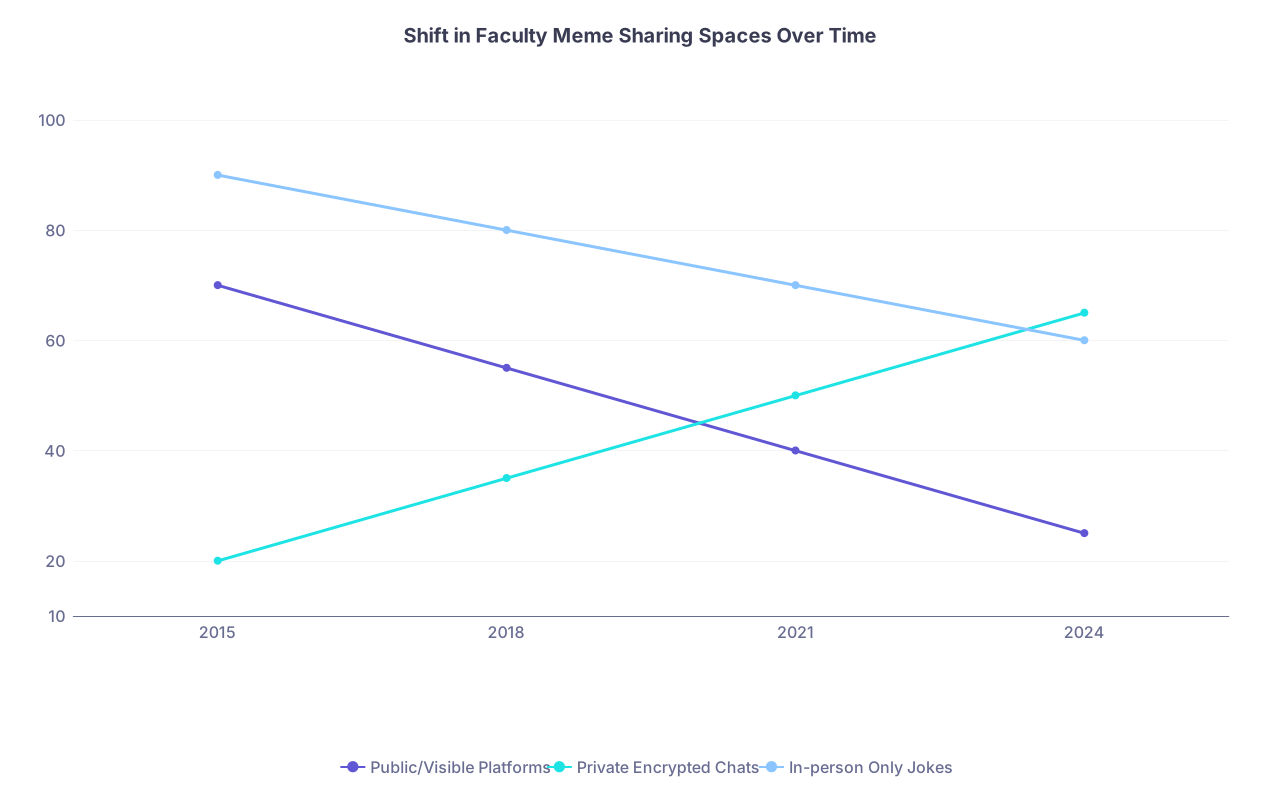
| Category | Public/Visible Platforms | Private Encrypted Chats | In-person Only Jokes |
|---|---|---|---|
| 2015 | 70 | 20 | 90 |
| 2018 | 55 | 35 | 80 |
| 2021 | 40 | 50 | 70 |
| 2024 | 25 | 65 | 60 |
More people are sliding from:
- Posting on Facebook, Twitter, open forums
- To private WhatsApp / Signal / iMessage groups
- With a noticeable rebound to: “I’ll tell you this story in person only”
Senior faculty are the most paranoid. They’ve watched colleagues get pulled into discovery for emails and messages. They’ve heard “all communications are discoverable” enough times that they’re actually starting to believe it.
So the future looks like:
- Leaner, smaller meme circles with people they’d trust with their career
- More in-person sarcasm that never touches a keyboard
- Meme content turning more about systems (admin, EHR, RVUs) and less about individuals
You’re going to see more grand rounds with “AI in medicine” and “digital professionalism” sections. What you won’t see is the parallel conversation in the chats:
“Can we still send each other memes about getting 17 new inbasket messages while peeing?”
Short answer: yes. With care.
How to Exist in This World Without Getting Burned
Let me give you the only actually practical part of this: how to operate knowing all this is happening.
First, accept this truth: everyone is memeing about this system because it’s barely tolerable without humor. That includes you, your seniors, your attendings, your PDs. Humor is pressure relief. If you try to scrub it all away, people snap.
Second, assume anything you send in a group of more than three can be screenshotted. If it would look bad blown up in ethics committee, you’re playing with fire. Faculty think this way now too, at least the ones who like their licenses.
Third, don’t flatter yourself into paranoia. You’re not the star of their chats. Ninety percent of the faculty meme content is:
- EHR
- Administration
- Clinic no‑shows
- Insurance insanity
- RVUs vs reality
Your mistakes? Annoying in the moment. Maybe archetypal. Rarely meme‑worthy for long.
Last, pay attention to which attendings joke with you, in front of you, and which ones never let the mask slip. The ones who show their sense of humor responsibly are usually the ones you want to model. They’ve figured out the line and how not to cross it.

| Step | Description |
|---|---|
| Step 1 | Faculty Meme Chat |
| Step 2 | Stays as meme only |
| Step 3 | Discuss in faculty meeting |
| Step 4 | Chief feedback to trainee |
| Step 5 | Trainee experience changes |
| Step 6 | Harmless system joke |
| Step 7 | Pattern about trainee behavior |
That’s the real pipeline: memes as signal. Frustration as data. Converted into feedback, if the adults in the room are doing their job.
Where Faculty Really Share Memes: The Uncomfortable Truth
So where do faculty really share memes?
In half‑hidden WhatsApp and iMessage groups you’ll never be in.
In legacy residency chats that aged into faculty lounges.
In side DMs during grand rounds when the speaker puts up a “motivational” burnout slide and everyone quietly shares the same “this is fine” dog.
They are not above it. They are not immune to it. They are just more practiced at not getting caught doing it.
If you remember nothing else, keep these in your pocket:
- The meme culture you see as a student or resident is the PG‑13 teaser trailer. The R‑rated version lives in small, encrypted groups you’ll only join long after you graduate.
- You are occasionally the subject but rarely the star; most of their jokes are about systems, not individuals. Your patterns might trigger feedback, not a roast session.
- Humor is currency and coping mechanism. Faculty use it the same way you do—just with more to lose and a sharper instinct for what must never, ever be in writing.
You’re not crazy: there is a whole other layer of medicine joking about this place. And one day, after you sign your own attending contract, your phone will buzz during grand rounds and you’ll see your first “real” faculty meme thread.
You’ll laugh. Then you’ll look up at the podium, straighten your face, and keep playing both sides.