
The inside jokes of academic medicine are not jokes. They’re a coded language—a faculty whisper network that tells you who has power, who’s expendable, and what’s actually valued when the microphones are off.
You’re about to get the translation.
The Whisper Network Is Real (And You’re Already In It)
Let me be blunt: every department has two communication systems.
The official one: town halls, emails from the Chair, “strategic vision” PowerPoints, wellness initiatives, glossy DEI statements.
And the real one: the hallway eye-rolls, the closed-door laughter after a faculty meeting, the late-night text threads, the comments muttered after you leave the Zoom call.
That second one? That’s where decisions actually get made. Not purely, not cleanly, but heavily influenced by:
- Who’s considered “one of us”
- Who’s considered “high risk”
- Who’s considered “safe to ignore”
The inside jokes are the surface bubbles of all that.
You think you’re just hearing a sarcastic line about “protected time.” What you’re actually hearing is a whole unwritten policy about who gets protected time and who gets used as service cannon fodder.
Let me walk you through the greatest hits and what they really mean.
“Protected Time” – The Longest Running Joke in Academic Medicine
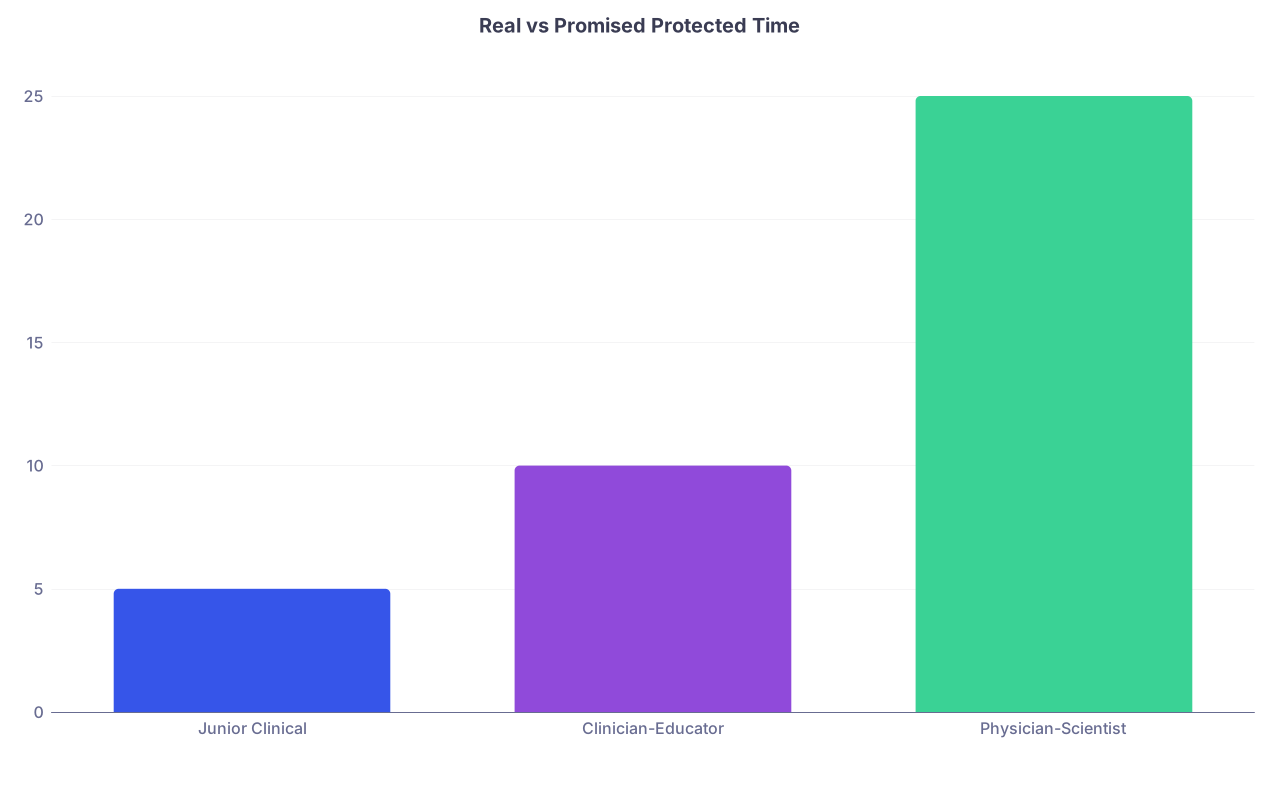
If there’s a single phrase that makes attendings smirk at each other in faculty meetings, it’s this: “You’ll have 40% protected time for research.”
Here’s what faculty actually hear: “We’ll promise you 40% protected time on paper and then page you constantly until you’re too exhausted to remember you were ever supposed to write a grant.”
The inside joke is that everyone knows this, but we all play along. I’ve watched new hires nod earnestly when the division chief walks them through their “time allocation,” while senior faculty are literally biting their lips not to laugh.
| Category | Value |
|---|---|
| Junior Clinical | 5 |
| Clinician-Educator | 10 |
| Physician-Scientist | 25 |
The chart you’re imagining? That’s basically the unspoken truth. For most junior people:
- “40% protected” = 5–10% actually protected
- The rest gets eroded by:
- Last-minute coverage
- “Quick” committee work
- “Can you just see this add-on real fast?”
And the joke faculty tell each other: “Protected time is what they call it when they schedule your clinic over your writing day and ask if you can be ‘flexible.’”
The whisper-network translation: Unless your work brings in money (grants, billing, philanthropy) or prestige (pubs in big journals, national talks), your protected time is optional. For you. Not for them.
“Mentorship” – Or, Who Gets Quietly Adopted
The public line: “We have a robust mentorship program where all junior faculty are supported.”
The backchannel reality: people do not have “a mentor.” They have one of these:
- A politically connected senior person who has actually decided you’re “worth it”
- A well-meaning but powerless mid-career faculty member who can’t protect you
- A committee-assigned name that exists primarily for ACGME documentation
The inside joke among senior people: “Oh, they’re with that mentor? Yeah, good luck.”
I sat in a promotions committee once where someone said, “Well, clearly they didn’t have good mentorship,” and everyone just nodded like this was a natural disaster instead of a system choice.

You’ll know you’re really in the whisper network when you start hearing:
- “Oh, she’s one of Dr. X’s people.” Translation: doors will open.
- “He’s with Y.” Translation: maybe a kind person, but no political weight.
- “Who’s sponsoring them?” Translation: if the answer is “no one,” they’re invisible.
That’s the actual mentorship algorithm. The official program is decoration for accreditation.
“Fit” – The Nicest Word for “No Chance”
You’ll hear this one behind closed doors after interviews, search committees, and conferences: “Good applicant, but I’m not sure they’re a fit.”
No one says what they mean out loud, but you’ll see the pattern after you’ve heard it 50 times.
“Not a fit” usually codes as one or more of:
- Too outspoken for the current power structure
- Too “different” from the current faculty (race, background, training pathway) for the risk tolerance of the group
- Too academic in a clinical workhorse division—or too clinical in a research-heavy division
- Too independent; reads as “won’t be controllable”
| Phrase Used | Common Hidden Meaning |
|---|---|
| Not a fit | Politically inconvenient |
| Might not thrive | We will not support their success |
| Needs more seasoning | Too junior / not in our inner circle |
| Strong, but… | Someone we know is already slotted |
Faculty joke with each other: “Fit means they didn’t train here, didn’t train where we trained, or didn’t remind anyone of themselves at 30.”
The whisper-network advice you’ll never hear in public: If you keep hearing “fit” as feedback and no one can define it concretely, it’s not about you. It’s about the department’s tolerance for change. Which is usually close to zero.
The “Rising Star” Label – Marked for Success (or Survival)
Here’s one almost no trainee hears directly, but faculty use it constantly: “Oh, she’s a rising star.”
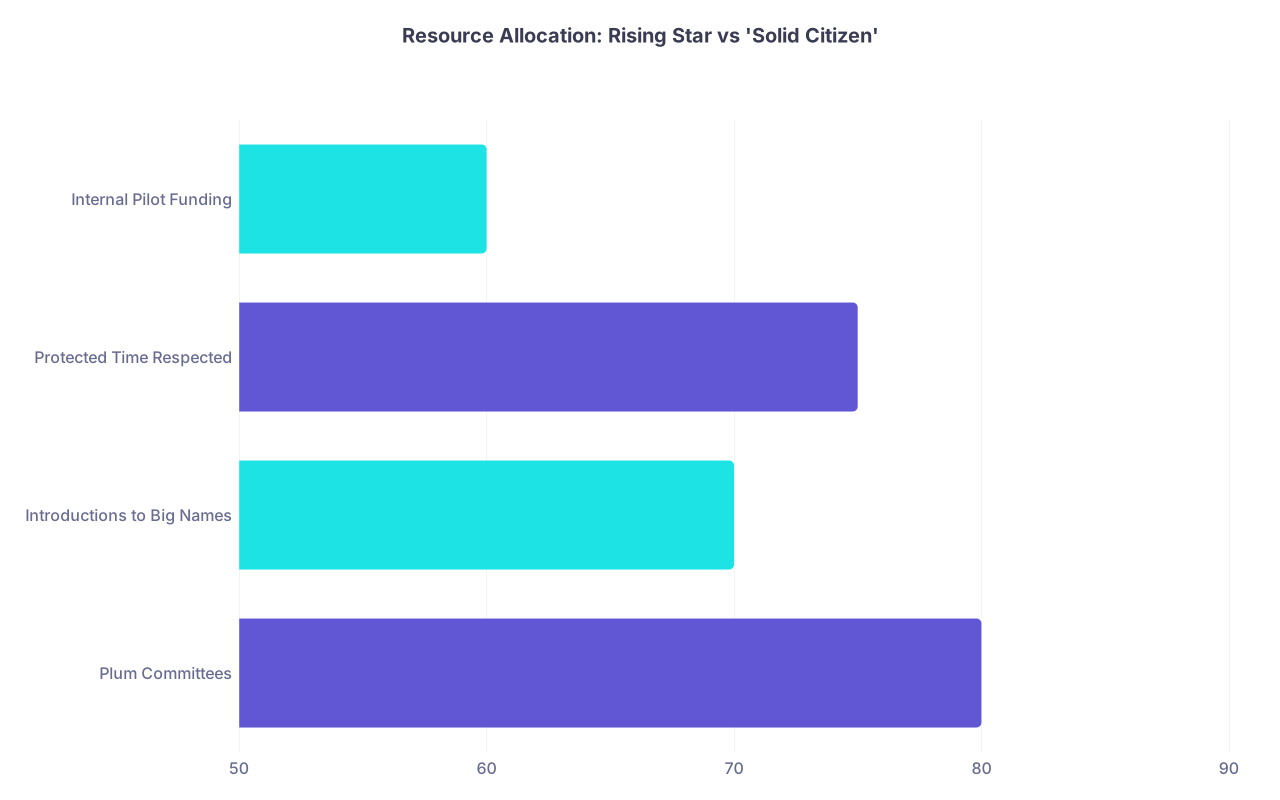
People think that just means “talented.” It does not. It means: “We as a group have decided to invest limited resources in making sure this person succeeds.”
Grants get pushed their way. National talk slots “suddenly” open. A nasty reviewer mysteriously backs off. They get named on multi-PI grants they barely touched. I’ve watched this happen in real time. It’s not imaginary.
| Category | Value |
|---|---|
| Plum Committees | 80 |
| Introductions to Big Names | 70 |
| Protected Time Respected | 75 |
| Internal Pilot Funding | 60 |
Now, what’s never charted: the “solid citizen.” The workhorse. The person who:
- Covers sick call
- Takes all the late consults
- Precepts extra residents
- Gets called “reliable” and “such a team player”
The inside joke at senior meetings: “We can’t promote everyone, or who’s going to run the service?”
The whisper meaning: if you’re getting praised more for “being great with the residents” than your scholarship, you’re being quietly anchored as infrastructure, not trajectory.
“We Value Education” – Translation: We Value Free Labor
Any time you hear a department say “We’re really an education-focused place,” faculty will share a particular look. Half pride, half “we know this is how they get away with underpaying us.”
Let me be clear: many people truly love teaching. They mean it. The system does not.
The inside joke is this: teaching is always the first justification for subpar pay and the last thing that gets concrete support.
I’ve watched this exact pattern:
- Young faculty gets told, “We’d love for you to be core faculty for the residency. Great opportunity.”
- They pour hundreds of hours into curriculum development, feedback, remediation.
- Their RVUs tank, their scholarship output drops.
- Promotion time comes: “Your teaching is excellent, but your scholarly productivity is thin.”
And behind closed doors, someone says, “Well, we do need strong teaching faculty, not everyone needs to be promoted quickly.”
The whisper-network warning goes like this: “If you’re not tracking your teaching into publications or funded projects, you’re donating your career progression.”
“Wellness” – The Most Cynical Joke of the Last Decade
Nothing gets darker faculty humor than mandatory “wellness” initiatives.
You’ve probably heard something like: “Please attend our resilience seminar (unpaid, after hours) to learn how to better tolerate systemic dysfunction.”
In faculty offices, the jokes are vicious:
- “I don’t need yoga, I need three fewer clinic slots.”
- “We did a burnout survey last year. The intervention was more surveys.”
- “They hired a Chief Wellness Officer instead of a fourth hospitalist.”

| Step | Description |
|---|---|
| Step 1 | Overworked Faculty |
| Step 2 | Burnout Survey |
| Step 3 | Wellness Town Hall |
| Step 4 | Mindfulness Session |
| Step 5 | Back to Same Workload |
| Step 6 | Higher Burnout |
That loop? People live inside it.
The inside joke hides real information: When wellness is led by the same people who control staffing and scheduling, it’s theater. When wellness leads to actual schedule changes, FTE shifts, or protected time that is respected—no one jokes. They just quietly sign their contracts early.
The whisper litmus test: if your “wellness” initiative doesn’t cost the institution real money or power, it’s not wellness. It’s PR.
“We’re Like a Family Here” – Run. Just Run.
When faculty hear this line used on residents or junior hires, they stir in their seats. Because they know exactly what it predicts.
Families:
- Ask you to sacrifice “because we’re all in this together”
- Make you feel guilty for setting boundaries
- Pretend conflicts are about loyalty instead of structure
In academic departments, “we’re like a family” almost always means:
- Blurry expectations about work hours
- Informal asks that become formal obligations
- Hierarchy disguised as “closeness”
The whisper joke is harsh: “We’re like a family” = “We reserve the right to emotionally manipulate you instead of pay you.”
I’ve seen junior people take that line as reassurance. Senior people take it as a warning label.
“The Optics” – The Hidden Curriculum in One Word
Any time you hear administrators say, “The optics of this are not great,” you’ve just hit the nerve center of the whisper network.
Optics > reality, almost every time.
Faculty jokes here are quieter, because the stakes are higher. But you’ll hear things like:
- “We can’t do that, the optics are bad” (even if it’s ethically correct but politically uncomfortable)
- “We need someone on this committee for optics” (you know exactly what this means)
- “Having a trainee complain is bad optics” (so the solution becomes silencing, not fixing)
The whisper translation: optics is how the institution will measure your worth. Not your actual behavior, not your private conduct—your perceived function in their narrative.
If you threaten the optics, you get managed. If you improve the optics, you get protected. It’s that simple.
How Whisper Networks Actually Work (And Why You Never See the Threads)
Whisper networks aren’t some carefully curated secret society. They’re just… who talks to whom when there’s no official record.
Let me sketch the flow for you.

| Step | Description |
|---|---|
| Step 1 | Residents |
| Step 2 | Chief Residents |
| Step 3 | Junior Faculty |
| Step 4 | Mid-career Faculty |
| Step 5 | Program Leadership |
| Step 6 | Chair |
| Step 7 | Outside Institution Contacts |
A few uncomfortable truths:
- Residents think gossip stops at chiefs. It doesn’t. It goes upward instantly, selectively filtered.
- Chiefs think they’re protecting residents by anonymizing complaints. They rarely are. Patterns are obvious.
- Junior faculty think venting to mid-career people is “safe.” Sometimes it is. Sometimes it’s how your name ends up prefaced with “a bit high maintenance but…”
Faculty humor here takes the form of “you didn’t hear it from me, but…” which is code for “this is already being discussed at higher levels; you’re late to the story.”
The real insider move is not “avoid the whisper network.” You can’t. The move is: control what version of you it spreads.
Jokes You’ll Hear, And What They’re Really Saying
Let me decode a few of the greatest hits you’ll hear in every academic hospital in the country.
“Another task force. Great, we’ve solved it.”
Meaning: They’re creating a structure to avoid making a decision. Your problem has been scheduled, not fixed.
“Must be nice to have that kind of protected time.”
Meaning: That person is either 1) politically powerful, 2) heavily funded, or 3) being groomed. Pay attention to who gets this comment and who doesn’t.
“He’s very passionate.”
Meaning: He’s loud, and leadership finds him either useful or exhausting. Could go either way.
“She’s very ambitious.”
Meaning: She wants something beyond what we assumed for her. Watch to see if they say it with admiration or concern. That tone is everything.
“Yeah, we ‘encourage’ that.”
Meaning: We will applaud you if you pull it off in your own time, and we’ll ignore it if you fail—because we never committed anything.
How To Listen Like an Insider (Without Becoming a Cynic)
You don’t have to turn into a bitter attending who rolls their eyes at everything. You do, however, need to tune your ear.
Here’s how faculty who survive—and sometimes thrive—actually listen:
They separate what’s said in public from what’s laughed about in private, and assume the private version is the operational truth.
So when you hear:
- “We support scholarly activity.” You ask: Whose charts get blocked for writing days that actually stay blocked?
- “We care about teaching.” You ask: Who got promoted prominently on the strength of education in the last five years?
- “We care about wellness.” You ask: Whose FTE changed after they raised burnout concerns?
That’s not cynicism. That’s pattern recognition.
And here’s the piece people rarely say out loud: you can use the whisper network for good. To protect trainees. To steer them away from toxic mentors. To quietly warn a class about a rotation director who punishes pregnancy or illness. This happens every year. It’s one of the only reasons some people survive places that would otherwise chew them up.
FAQ: The Stuff You’re Probably Still Wondering
1. How do I avoid being the butt of the inside jokes as a trainee or junior faculty?
You cannot avoid ever being joked about. Everyone is, at some point. What you can avoid is being categorically written off.
Three practical moves:
- Do not overshare your frustrations to people you do not know well. Especially over email or group chats. Venting is fine; choose your audience like your career depends on it. Because it does.
- Deliver on whatever you do agree to. The whisper network forgives a lot if you’re reliable. Even difficult personalities get protected if they’re productive.
- Be intentional about who you let “sponsor” your narrative. You want at least one person in any room that matters who, when your name comes up, says, “No, they’re solid. I’d back them.”
2. Can I ever trust leadership when they talk about culture and change, or is it all fake?
Some leaders are absolutely serious. The key signal: where does the money go?
If they talk culture and then:
- Hire more clinicians without adding support staff
- Fund genuine protected time that’s documented and enforced
- Accept lower short-term RVUs to build sustainable schedules
…then their jokes in private are usually at the system, not at you.
If they talk culture and then:
- Add more committees
- Push more surveys
- Create more positions with “strategic” in the title
…they’re playing optics, not substance. Trust their actions, not their slogans.
3. How do I get on the “rising star” side of the whisper network without selling my soul?
You do not get there by begging or politicking loudly. The people who actually rise do three things consistently:
- They attach their work to something the institution already cares about: grants, outcomes, accreditation, prestige. Not generic “excellence.”
- They produce visible, finished products: papers, curricula with outcomes, funded projects, national presentations. “Busy” doesn’t travel through the network. Results do.
- They learn early who in their environment actually has power and who just has titles. They invest their time with the first group, while being polite but not dependent on the second.
You don’t need everyone to think you’re a rising star. You need three to five people in the right rooms to think, “We shouldn’t lose this person.” The whisper network will do the rest for you.
Bottom line:
- The inside jokes of academic medicine are a user’s manual for what your institution truly values. Listen harder.
- The whisper network will talk about you whether you like it or not—so shape the version of yourself that’s easy to defend in absentia.
- Believe the private jokes more than the public statements. That’s where the real policy lives.