
The unfiltered truth: your jokes are usually making someone on the committee nervous.
Not always in a bad way. But nervous. Because humor in interviews is like doing a central line—when it’s done well, everyone nods approvingly and forgets about it by the next day. When it goes even slightly wrong, your name gets remembered for all the wrong reasons.
I’ve sat in those rooms. I’ve watched students try to be “the funny one.” I’ve watched program directors roll their eyes in the debrief and say, “Nice kid, but did you hear that joke about anesthesia?” And I've seen the opposite—a dead-serious applicant drop one dry, perfectly placed line, and the whole room softens. That person gets bumped up a tier.
You want the inside view of what we actually think when you crack jokes on interview day? Good. Let’s go there.
The First Thing We Think: “Risky Move”
The instant you crack a joke, every experienced interviewer has the same reflexive thought: this could go either way.
We’re not thinking, “Wow, what a fun person.” We’re thinking, “Please don’t say something I have to defend at the rank meeting.”
Humor in an interview hits three checkpoints in our heads:
- Is it appropriate for the setting?
- Is it punching down, sideways, or (safest) at yourself?
- Does it show awareness—or obliviousness?
If you’re joking about yourself being nervous, about the weather, about the coffee, about the chaos of Zoom interviews glitching—most of us relax. That reads as socially aware. You’re reading the room. You’re using humor the way residents actually do at 2 a.m. in the workroom: to diffuse, not to dominate.
If you make a joke that includes any of the following, your stock drops instantly:
- Nurses
- Other specialties (“you know surgeons…” / “psych people are all crazy, right?”)
- Patient stereotypes
- Gender, race, religion, politics
- The program’s city in a condescending way
That’s when someone on the committee mentally tags you as a potential problem. And trust me—no matter how good the rest of your file looks, “potential problem” is a death sentence in tight rank list discussions.
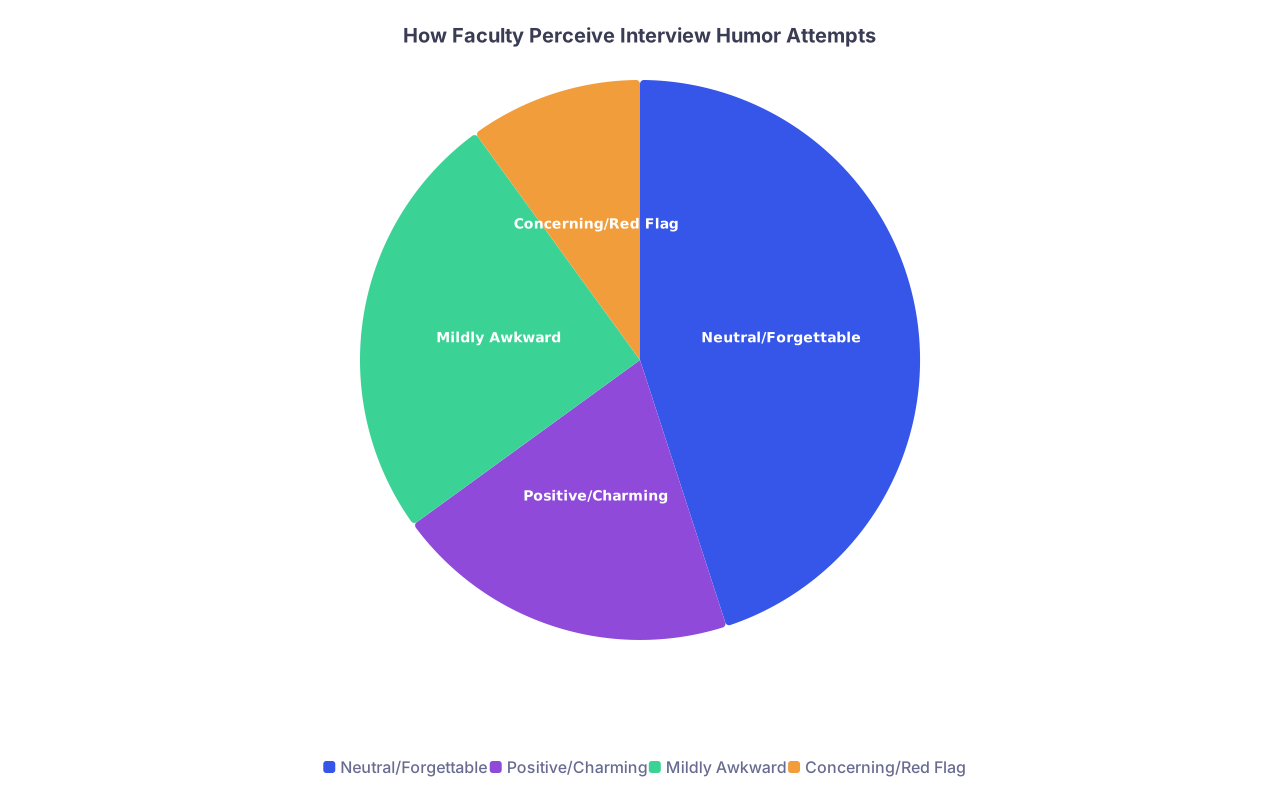
| Category | Value |
|---|---|
| Neutral/Forgettable | 45 |
| Positive/Charming | 20 |
| Mildly Awkward | 25 |
| Concerning/Red Flag | 10 |
Most jokes are forgettable. A minority really help you. A non-trivial chunk hurt you. That’s the risk profile.
We notice that.
What Happens In Our Heads During Your Joke
Let me walk you through an internal monologue I’ve heard versions of from attendings at places like Hopkins, UChicago, and a midwest community program that interviews 300+ applicants a year.
You crack a joke. While you’re talking, several parallel tracks light up:
Content filter: “Is this offensive or tone-deaf?”
This is automatic. Decades of HR trainings, Title IX sessions, and one or two bad prior experiences have hard-wired this. If it even brushes up against a sensitive category, you’ve just triggered Concern Mode.Judgment filter: “Is this appropriate for a professional setting?”
The same joke at resident lunch? Probably fine. In an interview with a vice chair who signs off on promotions? Different planet.Pattern-matching: “Do I want this person representing my program on rounds and with patients?”
We imagine you as an intern at 3 a.m. Are you going to be the one cracking poorly timed jokes when a family is crying in the hallway? If your humor feels careless, the answer is no.Signal reading: “Is this joke telling me something about you that the rest of the interview missed?”
Good humor suggests social intelligence. Bad humor suggests lack of insight. Both stick.
You usually think you’re giving us “I’m fun.” What you’re actually giving us is data about your judgment.
And interviewers live for judgment data.
The Different Kinds of Jokes—and How We Really React
Not all jokes are equal. I’ve seen each of these dozens of times. I can tell you almost word-for-word what faculty say about them afterward.
1. The Self-Deprecating Icebreaker
Example: You sit down, visibly nervous, and say with a small smile, “I promise I usually look less confused than this when a patient is talking.”
What we think:
- “Okay, they know they’re anxious. Good self-awareness.”
- “They’re not trying to impress me with bravado.”
- “Feels human, not theatrical.”
This usually plays well if it’s quick, not overdone, and followed by substance. If you keep leaning on it—“Haha, I’m a mess, I don’t know why I’m here!”—you drift from charming to insecure.
Used once or twice, appropriately? It makes us like you more. It reads as resident energy, not gunner energy.
2. The “Let Me Be The Entertaining One” Routine
Example: You’re in a group session. You keep dropping little quips, chiming in first with witty comments, trying to get laughs from the residents.
What we think:
- “This person needs attention.”
- “Are they going to hijack rounds to perform?”
- “They’re not listening as much as they’re waiting to speak.”
I’ve sat in post-interview debriefs where a resident said, “He was funny but kind of exhausting” and watch that comment tank someone from “strongly consider” to “middle of the pack.” No one wants to match the human version of a constant notification.
We want colleagues, not improv performers.
3. The “Other-Specialty” Joke
Example: “I really liked surgery, but I also like sleeping and seeing my family, so… internal medicine it is.”
You think this is harmless. It isn’t.
What we think:
- “They’re comfortable putting down colleagues to get a cheap laugh.”
- “What are they going to say about us when they’re with another service?”
- “We’ve already heard this exact joke 50 times.”
Programs are tired of stereotypical jokes about surgeons, anesthesiologists, psychiatrists, family med, you name it. A lot of us have close friends or spouses in those fields. You just insulted half the room without realizing it.
That reads as immature. The higher-tier the program, the less patience there is for this.
4. The “Dark Humor” Flex
Example: Joking about a code gone sideways, “And then the patient decided they’d had enough of us and checked out permanently.”
You have absolutely no idea how that lands with someone who may have lost a patient yesterday. Or whose child is sick. Or who remembers a lawsuit tied to a similar case. You think you’re showing you can cope with medicine’s ugliness. You’re actually telling us your filter is broken.
Behind closed doors, we’ll say it plainly: “That was gross.” Or, “No way am I putting that person in front of my patients.”
If you can’t resist dark humor, save it for when you already know and trust your team. On interview day, it’s Russian roulette with your rank.
5. The Well-Timed, Light, Observational Comment
Example: The Zoom platform glitches for the third time and you dryly add, “This is actually reassuring, I was worried our EMR was the only thing that crashed this often.”
Everyone smiles. Residents nod. No one is targeted. You’ve pointed at a shared frustration we all recognize.
What we think:
- “They’re quick on their feet.”
- “Good, they can roll with the unexpected.”
- “Feels like they’d fit in the team room.”
That’s the sweet spot. Not trying too hard. Not rehearsed. Just a normal human reacting like… a normal human.
What Jokes Look Like When We Rank You
Here’s what you don’t see: the post-interview conference room.
We go applicant by applicant. Someone pulls up your file. Scores, letters, notes from interviewers, any incidents. Humor shows up in those notes more than you’d think.
| Humor Note Type | Typical Impact on Rank |
|---|---|
| “Easy to talk to, warm” | Small positive bump |
| “A bit too jokey” | Small negative bump |
| “Comment about nurses…” | Major negative |
| “Dry sense of humor, liked by residents” | Noticeable positive |
| “Made awkward joke, seemed unaware” | Major negative |
You know what phrase terrifies applicants if they could hear it?
“Seemed unaware.”
I’ve heard that exact wording used to justify dropping someone a full tier. Because we know we can’t micromanage your behavior once you’re here. We’re not ranking a CV; we’re ranking a future colleague who will be out there representing our name.
If comment after comment reads, “Easy to talk to,” “Felt comfortable,” “Good presence with group,” that’s gold. That often includes subtle, appropriate humor. You come off as someone people actually want to page at 2 a.m.
If even one evaluator writes, “A bit too informal” or “joke about XYZ landed wrong,” there will be at least one person in that room arguing to protect the program’s reputation by ranking you lower. And often, that person wins.
How Residents React (And Why That Matters More Than You Think)
You’re not just auditioning for attendings. You’re auditioning for the residents. Their informal opinion carries more weight than most applicants realize.
Here’s the dirty little secret: some program directors don’t care how “charming” you were to them if the residents unanimously say you were weird in the social.
Residents are hypersensitive to your humor because they imagine you as their co-intern. They’re asking themselves:
- “Would I trust this person not to say something stupid in front of a patient?”
- “Are they going to make off-color jokes in the call room?”
- “Are they trying way too hard to impress us?”
Residents have a good nose for try-hard energy. Jokes that are obviously manufactured, rehearsed, or shoved into quiet moments? They talk about that later. “He was doing a bit the whole time.” You don’t want that said about you.
On the other hand, if your humor blends in with theirs—dry comment about coffee, light jab at the pager going off every five seconds, laughing at yourself when you admit you got lost finding radiology—that’s when residents say, “They’d fit in.”
And “fit in” is one of the deadliest powerful phrases in the room. It’s short for: safe, normal, capable, socially functional.
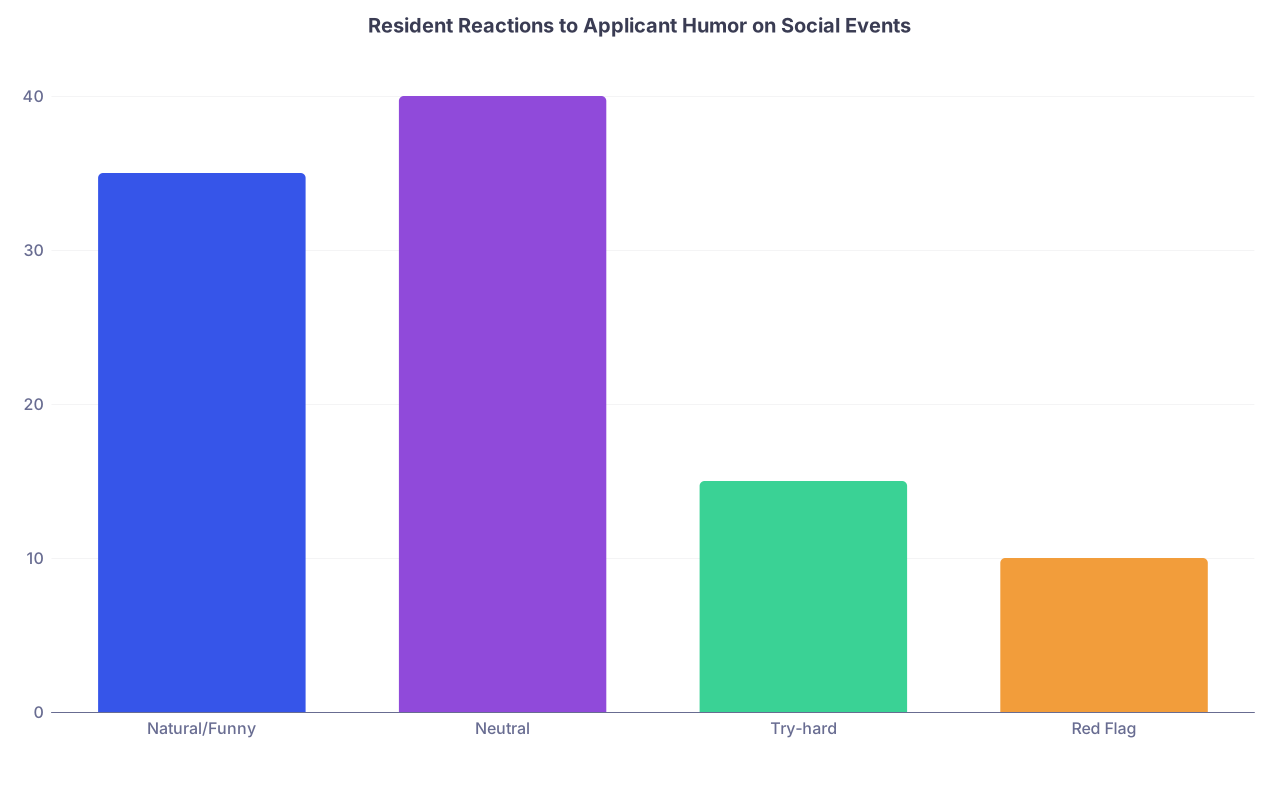
| Category | Value |
|---|---|
| Natural/Funny | 35 |
| Neutral | 40 |
| Try-hard | 15 |
| Red Flag | 10 |
Your goal is not to be the Funniest Applicant. Your goal is to dodge “try-hard” and “red flag” and live somewhere in “natural” or “neutral.”
Neutral gets ranked just fine.
Zoom vs In-Person: The Rules Shift Slightly
On Zoom, humor is harder. There’s latency, people talk over each other, facial cues are delayed. Many attempts just die on impact because no one’s sure if you were joking or if the audio cut out.
Interviewers on Zoom are already exhausted. We’re staring at boxes all day, our backs hurt, our email is piling up. Big, animated, high-energy joking often plays worse on screen than in person—it feels like noise.
Where humor does work on Zoom:
- A quick line acknowledging a pet or child making a cameo.
- Light banter when everyone’s waiting for a breakout to start.
- A self-aware comment about the awkwardness of the format.
Where it crashes:
- Long stories building to a joke. No one has patience.
- “Edgy” comments, because tone is harder to read.
- Group humor directed at one person who doesn’t laugh.
One PD actually said in a debrief I sat through: “On Zoom I basically penalize any attempt at a bit. There’s no way to be sure how it landed with everyone.”
Unfair? Maybe. Real? Absolutely.
How to Use Humor Without Sabotaging Yourself
I’m not going to tell you “don’t be funny.” That’s dumb, and also unrealistic. Real humans reach for humor when they’re nervous. Interviewers know that.
What you should do is treat humor like fentanyl: small dose, high potency, dangerous if you push too much.
Here’s what plays well, consistently:
- Short, situational, not pre-scripted. If it sounds like a tweet you saved, scrap it.
- Target: yourself, the weather, the coffee, the tech, the universal misery of EMRs.
- Tone: gentle. Not snarky, not bitter, not mean.

| Step | Description |
|---|---|
| Step 1 | Think of joke |
| Step 2 | Do not say it |
| Step 3 | Go ahead - say it once |
| Step 4 | Target is self or neutral topic |
| Step 5 | Short and simple |
| Step 6 | Any chance of offense |
One or two light comments across an entire day is enough. You’re not auditioning for a sitcom writer’s room. You’re auditioning to be trusted with vulnerable people.
You know what people almost never regret on interview day? Erring on the side of “a little more formal.” I’ve never heard someone in a rank meeting say, “They were too respectful.” But I have heard, “They were a little too casual for me,” followed by a very quiet reshuffling of the list.
The Jokes You Think Are Good That We Secretly Dislike
Let me be very specific, because this is where people get burned.
“At least I didn’t go into [insert specialty].”
You think: harmless stereotype.
We think: you’re comfortable mocking colleagues.“I guess I didn’t scare you off with my Step score.”
You think: vulnerable, real.
We think: why are you bringing that up? Also, more insecure than charming.“Good to know you’re still taking people even after seeing our med school’s reputation.”
You think: playful.
We think: negging us? Weird.“Well, I only cried twice during third year, so that’s a win, right?”
You think: relatable.
We think: do you cope well, or are you still kind of drowning?
If there’s even 10% chance an interviewer can interpret a joke as neediness, bitterness, or superiority, it’s not worth the dopamine hit of making yourself feel less tense for five seconds.
Use silence instead. Silence never got anybody flagged.
What It Looks Like When Someone Gets It Right
Let me give you a real composite example. Applicant to an IM program. Mid-tier Step scores, strong letters, nothing flashy on paper.
In their interview, they did three things with humor:
When the PD apologized because his pager went off:
Applicant smiled and said, “Honestly, it makes me feel better to see your pager also owns you.”
Room chuckled. Everyone relaxed.On Zoom social, when the resident’s cat walked across the keyboard:
“Perfect, you have a back-up night float.”
Short, kind, resident laughed.When asked how they handled burnout:
They described very concretely how they recognized their own warning signs, what they did, then added, “My friends can tell I’m in trouble when my coffee order stops making sense.”
Everyone smiled. Serious content, light touch.
Every joke was soft, self-inclusive, and secondary to actual substance. No one wrote “funny” in their notes. But three people wrote “easy to talk to,” “felt like our people,” “good presence.”
That applicant matched there.
Not because of the jokes. But the humor signaled the underlying thing that matters: mature social intelligence.
The Bottom Line: What We Actually Think
When you crack jokes on interview day, here’s what is really running through our minds:
- Are you safe to put in front of patients, families, nurses, and consultants without babysitting you?
- Do you understand professional boundaries, or are you trying to be everyone’s buddy?
- Is your humor a tool for connection, or a shield for insecurity and ego?
We don’t care if you’re hilarious. We care if you’re appropriate.
You want to be the person who leaves us thinking:
- You’re someone we can trust with a bad night and a tough patient.
- You have just enough lightness that we won’t dread being on call with you.
- Your judgment—what you choose not to say—is solid.
If your humor supports those three impressions, it helps you. If it competes with them, it quietly knocks you down the list.