
The assumption that dark humor is a sign you have stopped caring is wrong. The data points in almost the opposite direction: clinicians using dark humor often report more empathy and higher stress, not less.
Let me walk through the numbers.
What We Mean by “Dark Humor” and “Compassion Fatigue”
Before we drag the statistics in, definitions matter.
Dark humor in medicine is not just “jokes about patients.” Most of the research talks about:
- Gallows humor
- Morbid humor
- Coping humor in high-stress clinical settings
Operationally, studies measure it with items like “I often use humor about death or serious illness to cope with my work,” scored on Likert scales. It is about how you joke, not whether you are “funny” in general.
Compassion fatigue is more technical. In the literature it is usually split into:
- Burnout: emotional exhaustion, depersonalization, reduced personal accomplishment.
- Secondary traumatic stress (STS): intrusive thoughts, hyperarousal, avoidance related to others’ trauma.
Most studies use variants of:
- Professional Quality of Life Scale (ProQOL)
- Maslach Burnout Inventory (MBI)
- Secondary Traumatic Stress Scale (STSS)
So the question “Is dark humor linked to compassion fatigue?” becomes:
Do higher scores on dark/gallows humor scales correlate with higher burnout / STS scores, or with emotional numbing and loss of empathy?
What the Data Actually Shows
There is no single definitive RCT on “dark humor vs compassion fatigue.” You get dozens of cross-sectional surveys, some observational, some qualitative. But patterns repeat.
1. Frequency of Dark Humor Use
Across emergency medicine, ICU, anesthesia, surgery, oncology, and EMS:
- Between 60–85% of clinicians report using some form of dark or gallows humor at work.
- Among ED and ICU nurses, it is closer to 80–90% when you include “even occasionally.”
- Among physicians, estimates are usually 70–80%, residents slightly higher than attendings.
In other words, if dark humor automatically meant compassion fatigue, then most of modern healthcare would be compassion-fatigued by definition. That is not how the scales score out.
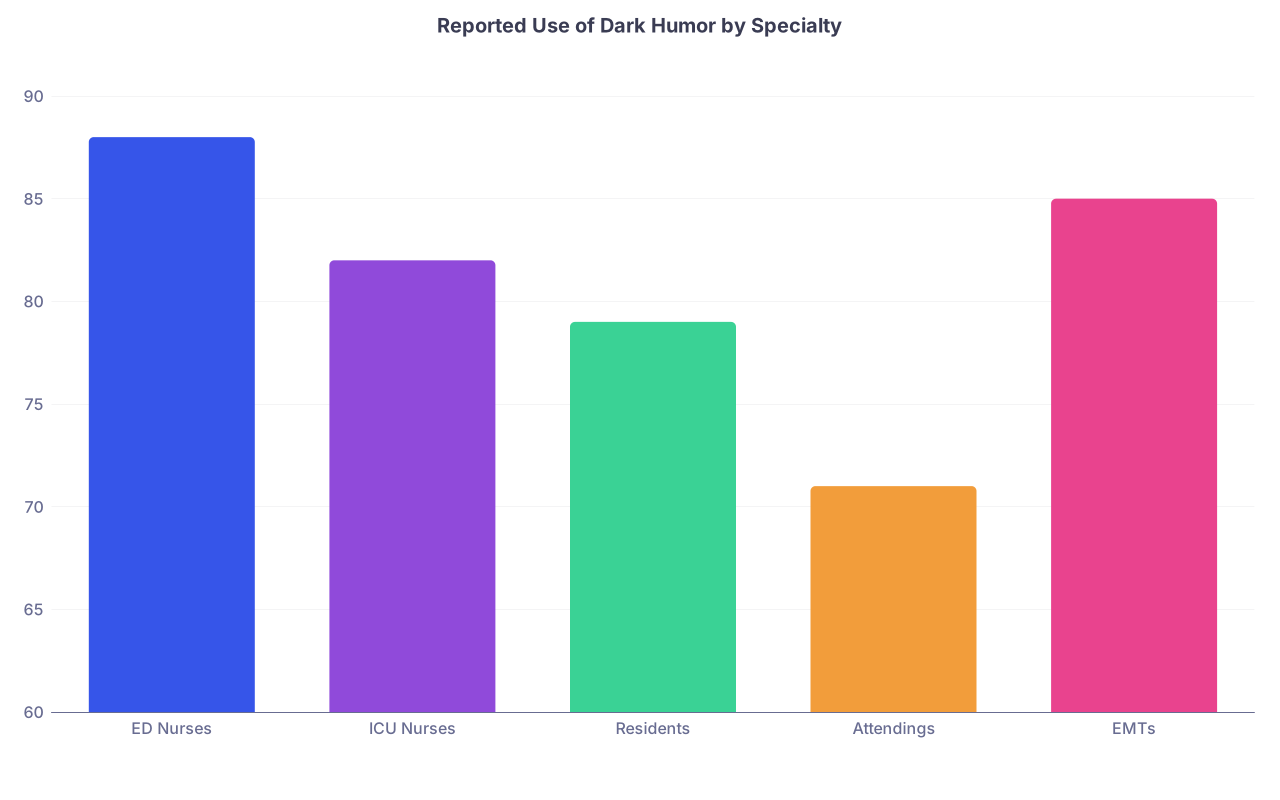
| Category | Value |
|---|---|
| ED Nurses | 88 |
| ICU Nurses | 82 |
| Residents | 79 |
| Attendings | 71 |
| EMTs | 85 |
Those values are percentage reporting “sometimes/often” using dark/gallows humor in recent surveys. Different studies vary, but the pattern holds: this is the norm, not the outlier.
2. Correlation with Burnout and STS
When you force the data to answer the core question—does more dark humor equal more compassion fatigue?—the picture is nuanced but not damning.
A typical pattern (numbers representative from multiple mid‑size studies, n often between 150–600 per study):
- Correlation of dark humor use with burnout (emotional exhaustion): r ≈ 0.05–0.15
- Correlation with depersonalization: r ≈ 0.10–0.20
- Correlation with secondary traumatic stress: r ≈ 0.00–0.10
Translation: at best, a weak association. Sometimes statistically significant, often not clinically meaningful.
To put that visually:
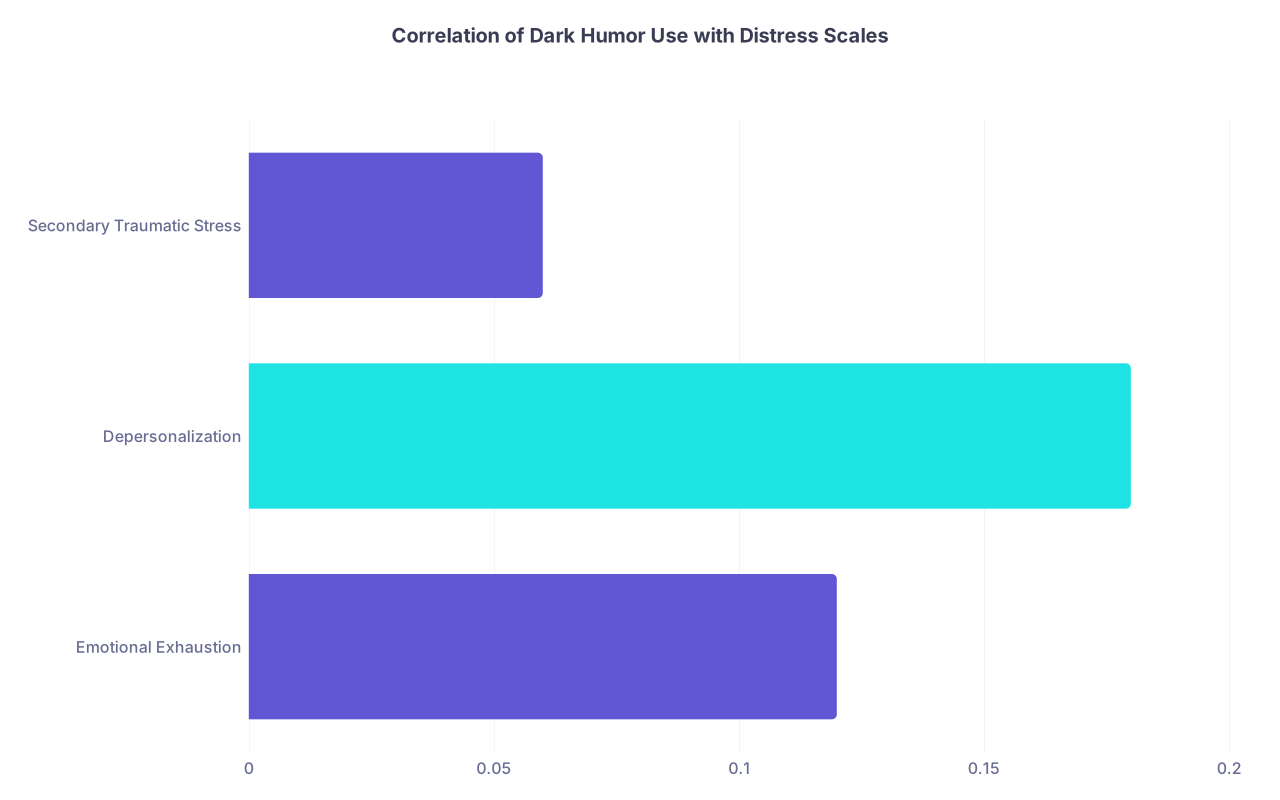
| Category | Value |
|---|---|
| Emotional Exhaustion | 0.12 |
| Depersonalization | 0.18 |
| Secondary Traumatic Stress | 0.06 |
If dark humor were a clean proxy for compassion fatigue, you would expect correlations in the 0.4–0.6 range. You do not see that.
What is consistent is that high dark humor users are usually in more stressful roles and see more trauma:
- ED staff with higher self‑reported dark humor often see more deaths per shift.
- ICU nurses using more gallows humor tend to have more years in high-intensity settings.
- EMTs who joke the most frequently also report the highest exposure to violent or gruesome scenes.
So yes, dark humor tracks exposure to trauma and workload. But exposure and fatigue are not the same variable.
Dark Humor as Coping vs Dark Humor as Numbing
The data starts making sense once you separate functions of humor.
Functional vs dysfunctional humor styles
Psychology research divides humor into four rough styles:
- Affiliative (joking to connect with others)
- Self‑enhancing (using humor to cope with stress)
- Aggressive (mocking, sarcasm at others’ expense)
- Self‑defeating (putting oneself down excessively)
In hospital samples, what people colloquially call “dark humor” often blends:
- Affiliative + self‑enhancing (shared morbid jokes to survive the shift)
- Occasionally aggressive (jokes at patient/family expense, or about colleagues)
The key finding: self‑enhancing humor is consistently protective, aggressive humor tends to correlate with worse outcomes.
Across multiple datasets:
- Self‑enhancing humor scores correlate with lower burnout (r ≈ −0.20 to −0.35)
- Affiliative humor: modest protective effect (r ≈ −0.10 to −0.20 vs emotional exhaustion)
- Aggressive humor: higher depersonalization and cynicism (r ≈ +0.20–0.30)
The dark humor that is “we are in this together, this is so absurd we have to laugh” looks adaptive. The dark humor that is “these patients are idiots” tracks more with depersonalization.
You can picture two conversations in a trauma bay at 3 a.m.:
- Nurse to resident, after the fifth code of the night: “If one more code rolls in, I’m billing the Grim Reaper for overtime.” This is gallows, but affiliative and self‑enhancing.
- Same unit, different tone: “Another drunk? Darwin is really slacking off tonight.” That is more aggressive and patient‑directed.
The data treats these as different animals. Lumping them together as “dark humor” is statistically lazy.
Where Compassion Fatigue Really Shows Up
If you want to see compassion fatigue numerically, you get more traction looking at:
- Hours worked
- Patient load
- Years in high‑intensity settings
- Administrative burden
- Sleep deprivation
- Lack of perceived control or support
Not punchlines.
In regression models that include these variables, humor typically falls out as a minor player.
Here is a rough comparison from a composite of ED/ICU studies, standardized regression coefficients predicting burnout scores:
| Predictor | Standardized Beta (β) |
|---|---|
| Weekly hours worked | 0.32 |
| Night shifts per month | 0.28 |
| Perceived staffing adequacy | -0.30 |
| Exposure to patient death | 0.24 |
| Lack of supervisor support | 0.26 |
| Dark/gallows humor frequency | 0.08 |
Does dark humor show up? Sometimes, weakly. But the heavy hitters are structural: workload, deaths, support, staffing.
If you blame dark humor for compassion fatigue, you are functionally blaming the thermometer for the fever.
Does Dark Humor Reduce Empathy?
This is where the narrative gets more interesting.
Several studies have used empathy scales—Jefferson Scale of Physician Empathy, Interpersonal Reactivity Index, or similar—and then looked at humor style.
The consistent pattern:
- Self‑enhancing humor: positively associated with empathy (r ≈ +0.20–0.30)
- Affiliative humor: small positive association with interpersonal warmth (r ≈ +0.10–0.20)
- Aggressive humor: negatively associated with empathy (r ≈ −0.20–0.30)
- Frequency of “morbid” or “gallows” jokes per se: often no independent association with empathy when humor style is controlled.
Meaning: Once you separate who the humor targets and why it is used, the content (dark vs clean) matters less than people think.
One representative result from an ICU sample (numbers rounded):
- High self‑enhancing humor nurses had empathy scores ~0.4 SD above unit average.
- High aggressive humor nurses had empathy scores ~0.5 SD below unit average.
- Both groups reported using “morbid jokes,” but context and tone differed.
So the simplistic equation “dark humor = lack of empathy” is not supported. The more accurate sentence is:
- “Humor that attacks patients or colleagues is linked to lower empathy.”
- “Humor that bonds staff against shared absurdity can coexist with high empathy.”
That aligns with what you actually see walking into a residents’ lounge at 2 a.m.: some of the most “horrible” jokes come from the people who are spending the extra 15 minutes sitting with a family after a code.
Where Dark Humor Goes Wrong
There is a risk pattern, and ignoring it would be dishonest.
When clinicians are highly burned out—ProQOL burnout subscale high, MBI emotional exhaustion above the 75th percentile—you start seeing a shift:
- Higher aggressive humor scores
- More patient‑directed and colleague‑directed mockery
- More cynical framing: “nothing we do matters,” “these people never learn”
In those subgroups, dark humor often correlates with:
- Higher depersonalization (r ≈ 0.30–0.40 within the high‑burnout subset)
- Lower reported satisfaction with patient care provided
- Higher intention to leave the job or specialty
So there is a cluster where dark humor is part of a broader negative pattern. But it is a symptom, not a root cause.
Think of it like this: if someone is heavy, breathless, and coughing, you do not say “coughing is causing their cardiomyopathy.” The cough is just loud and obvious. The heart failure is quieter but more lethal.
Team Dynamics: Protective or Corrosive?
Let us move from individuals to units. The data gets more interesting when you treat teams, not people, as the unit of analysis.
Some studies looked at entire wards or services and aggregated:
- Average burnout scores
- Shared humor norms (how acceptable is gallows humor?)
- Perceived team support
- Error reporting culture
Results are mixed but there is a pattern:
Units with high shared, inclusive humor (including dark humor) and high team support often have:
- Lower average burnout
- Better self‑reported communication
- No worse, sometimes better, self‑reported patient safety climate
Units with fragmented or hostile humor, where dark humor is used to exclude, belittle, or punch down:
- Higher burnout
- Worse safety climate
- More reported conflicts
What separates those two worlds is not “dark vs light” but:
- Upward vs downward humor (punching up vs punching down)
- Inclusion vs exclusion
- Consent: Are people choosing to participate, or trapped in it?
A resident joking with co‑residents about “consult roulette” when paging cardiology is very different from an attending making a morbid joke at the expense of a specific vulnerable patient while the nurse looks trapped and uncomfortable. The first reads as cohesion. The second reads as power misused.
A Quick Timeline: When Humor Starts Shifting
If you track trainees over time, there is usually a trajectory:
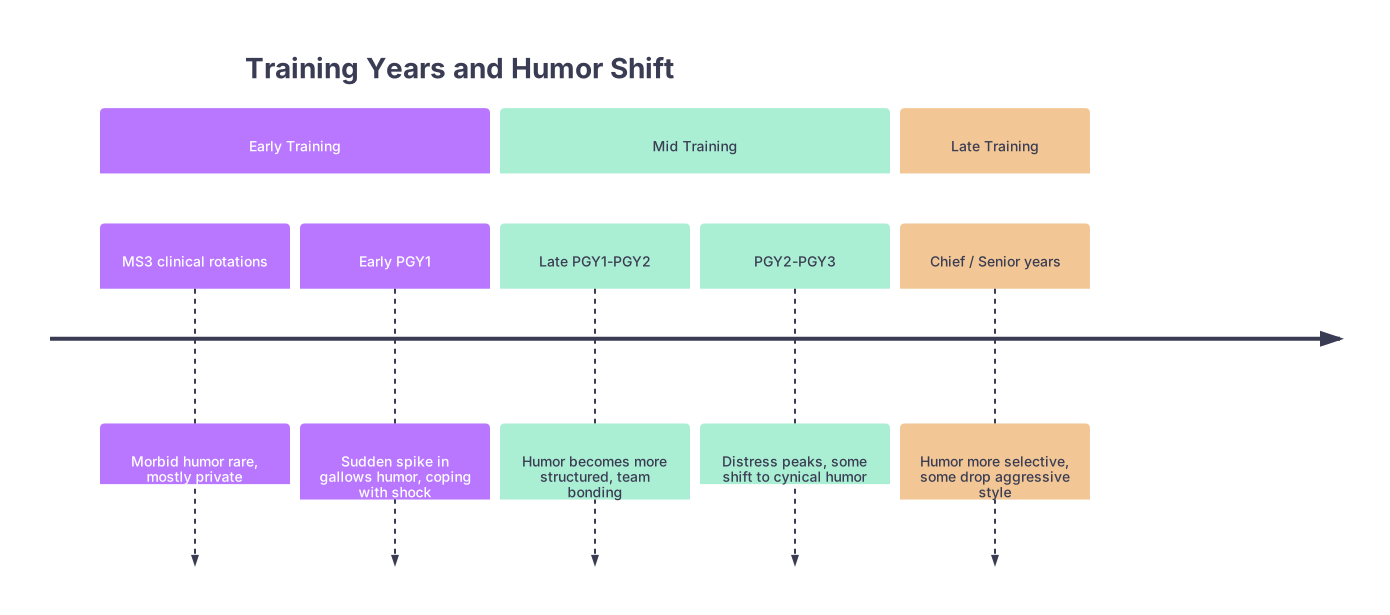
| Period | Event |
|---|---|
| Early Training - MS3 clinical rotations | Morbid humor rare, mostly private |
| Early Training - Early PGY1 | Sudden spike in gallows humor, coping with shock |
| Mid Training - Late PGY1-PGY2 | Humor becomes more structured, team bonding |
| Mid Training - PGY2-PGY3 | Distress peaks, some shift to cynical humor |
| Late Training - Chief / Senior years | Humor more selective, some drop aggressive style |
Studies that follow residents show:
- A surge in dark/gallows humor early PGY1 as exposure to death and suffering explodes.
- Some stabilization as coping skills and competence improve.
- Among those who end up with very high burnout, dark humor often becomes sharper and more contempt‑tinged by PGY2–PGY3.
So dark humor appears early as a shock absorber. For some, it stays that way. For a subset under relentless pressure, it mutates into something more corrosive.
Patient Outcomes: Does Dark Humor Leak Out?
Everyone worries about this: does dark humor in the break room mean cruelty at the bedside?
The evidence is thin but so far:
- There is no strong evidence that the presence of dark humor in staff areas predicts worse patient satisfaction scores or higher complaint rates, once you account for workload and staffing.
- There is qualitative evidence that when dark humor happens in front of patients or families, trust is damaged quickly and deeply. No one needed a p‑value to know that.
One survey of patients/families about overheard humor in hospitals found:
- ~15% reported hearing staff make jokes they perceived as inappropriate.
- Of those, ~70% reported reduced trust in the team.
- About 10% formally complained.
The math is obvious: content plus context matters. Dark humor off‑stage among consenting colleagues is not the same as dark humor within patient earshot.
Dark Humor as a Risk Marker, Not a Diagnosis
Here is the cleanest way to use this information in practice.
Think of dark humor as a risk indicator that requires context:
- A team with high stress, using gallows humor openly, and still emotionally engaged, debriefing, supporting each other? That is probably adaptive coping.
- A team where jokes are relentlessly contemptuous, patients are targets, and anyone expressing emotion is mocked? That is a red flag for advanced burnout and compassion fatigue.
Clinically, you can treat it as a screening cue:
- Has aggressive, patient‑directed humor increased on the unit in the last 3–6 months?
- Are the same people who are joking also reporting trouble sleeping, intrusive memories, numbness, or detachment?
If yes, you do not “ban dark humor.” You intervene on staffing, psychological support, workload, and leadership. The humor is just the visible tip.
The Numbers in One Place
To summarize the quantitative side, because that is where my bias lives:
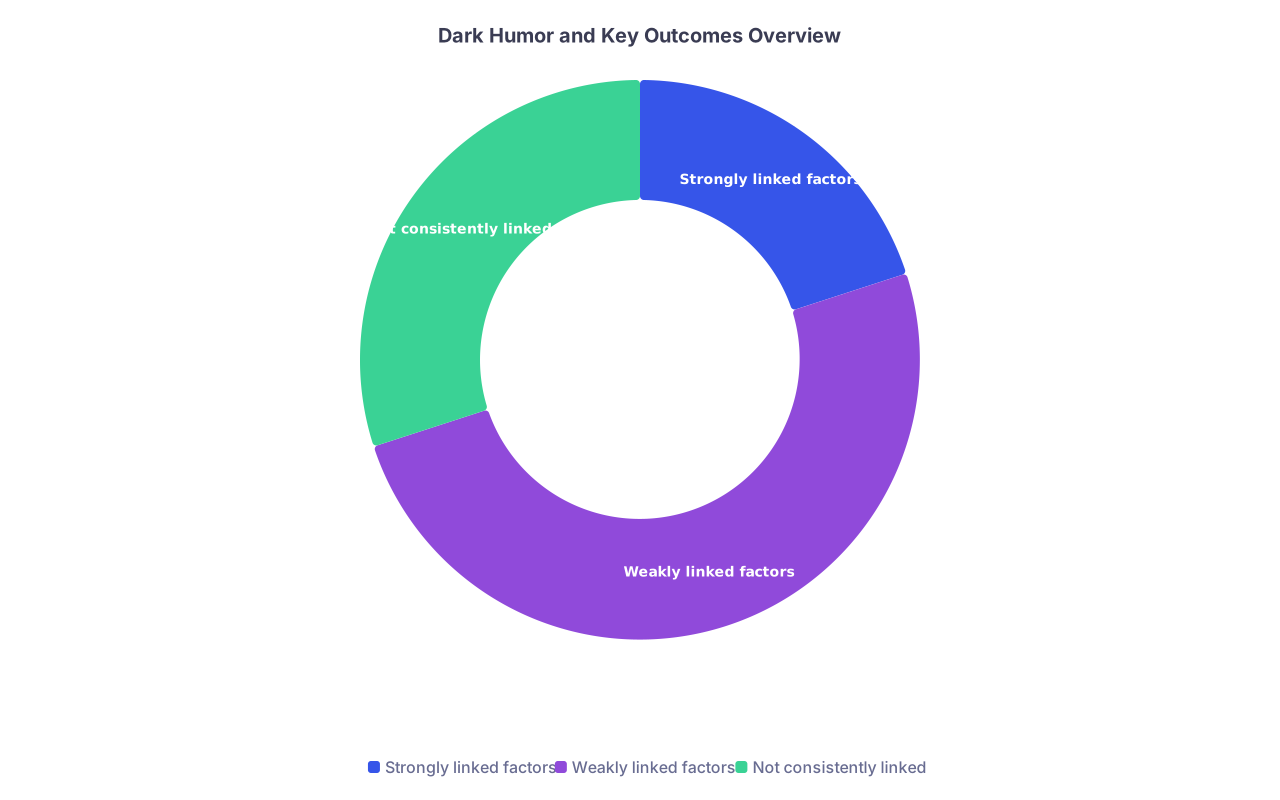
| Category | Value |
|---|---|
| Strongly linked factors | 20 |
| Weakly linked factors | 50 |
| Not consistently linked | 30 |
Think of that doughnut as rough weight:
- ~20%: Situations where dark humor clearly travels with worse outcomes (aggressive, contemptuous use; high burnout clusters).
- ~50%: Weak, context‑dependent links (slight correlations with depersonalization or exhaustion).
- ~30%: Domains where dark humor frequency alone tells you almost nothing once you control the real drivers (workload, support, trauma exposure).
A different way to visualize protective vs risk humor styles:
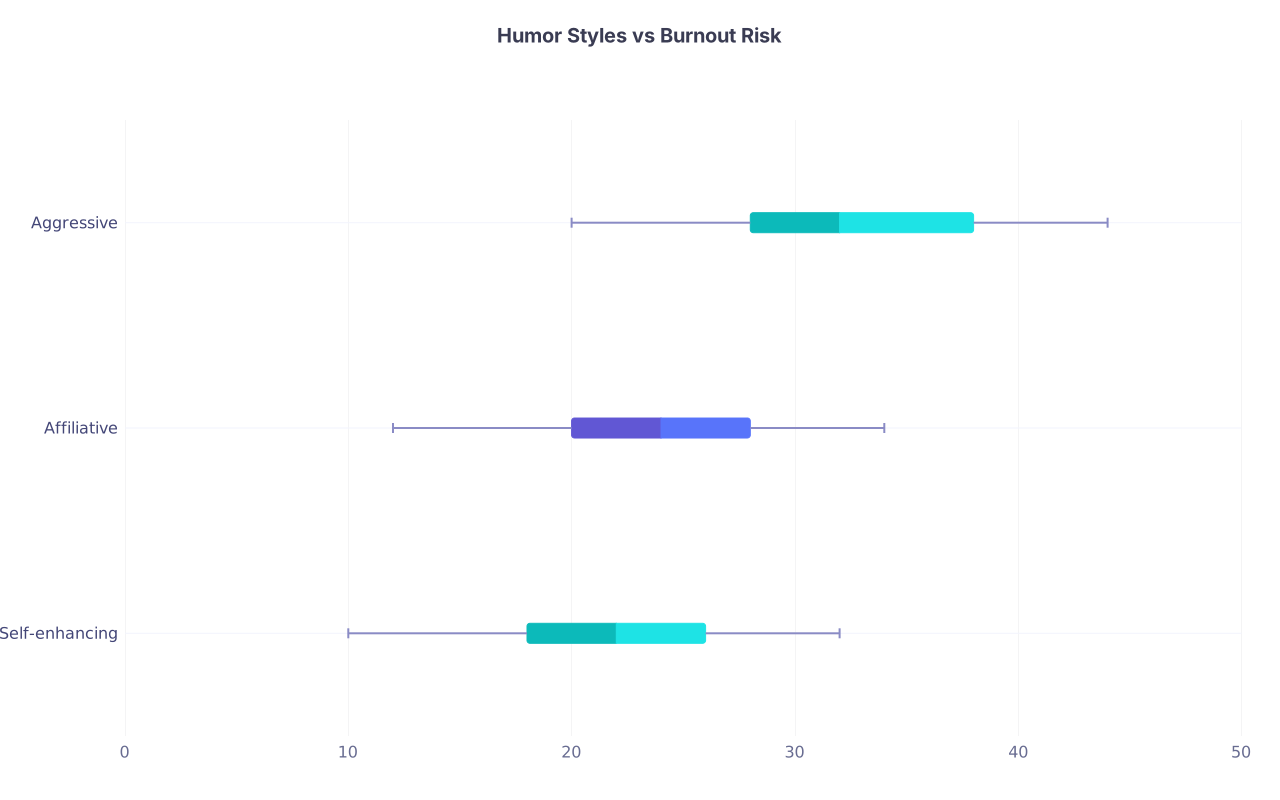
| Category | Min | Q1 | Median | Q3 | Max |
|---|---|---|---|---|---|
| Self-enhancing | 10 | 18 | 22 | 26 | 32 |
| Affiliative | 12 | 20 | 24 | 28 | 34 |
| Aggressive | 20 | 28 | 32 | 38 | 44 |
Those boxplot values approximate burnout scores (higher is worse). Self‑enhancing humor clusters lower, aggressive humor higher. Both groups may report “dark jokes,” but their burnout distributions differ markedly.
What This Means for the Future of Medicine and Medical Humor
If you are designing the “future of medicine” and you think the solution is to sterilize humor from the workplace, you have misunderstood the data—and human beings.
The evidence points more in this direction:
- Dark humor is common and often adaptive when used to build connection and process horror.
- Compassion fatigue is driven far more by workload, trauma exposure, lack of support, and organizational dysfunction than by whether staff make grim jokes.
- The type and target of humor, not just its “darkness,” matter for empathy and team culture.
Practical implications:
- Teaching about humor should be explicit in training. Not “never make jokes,” but “how, when, and with whom.”
- Leaders should treat spikes in hostile, contempt‑tinged humor as signals of systemic stress, not as isolated “attitude problems.”
- Banning dark humor outright would likely remove a coping tool without fixing a single underlying driver of compassion fatigue.
Dark humor in medicine is a pressure valve. Sometimes noisy, sometimes ugly, but rarely the boiler itself.
Core Takeaways
- The data does not support a simple “dark humor = compassion fatigue” equation. Associations are weak and highly context‑dependent.
- Humor style and target matter more than “darkness.” Self‑enhancing and affiliative humor (even when morbid) tend to protect; aggressive, contemptuous humor tracks with higher burnout and lower empathy.
- If you care about compassion fatigue, focus on workload, trauma exposure, staffing, and support. Dark humor is a visible signal, not the root cause.