
The belief that “funny attendings” are better teachers is only half true—and the data prove it.
Humor in medical education is not just about making rounds tolerable. It has measurable effects on attention, memory, stress, and even evaluations. But the curve is not linear. Past a certain point, the numbers show that more jokes do not mean more learning. Occasionally, they mean the opposite.
Let me walk through what the research actually says, stripped of fluff and faculty mythology.
What Does the Data Say About Humor and Learning?
Let us anchor this in actual studies, not hallway anecdotes.
Multiple observational and experimental studies in health professions education have looked at humor in teaching. When you aggregate their findings, three patterns show up consistently:
- Humor improves affect (mood, engagement, perceived rapport).
- Humor improves short‑term attention and recall.
- Excessive or poorly targeted humor can distract from core content or even harm learning.
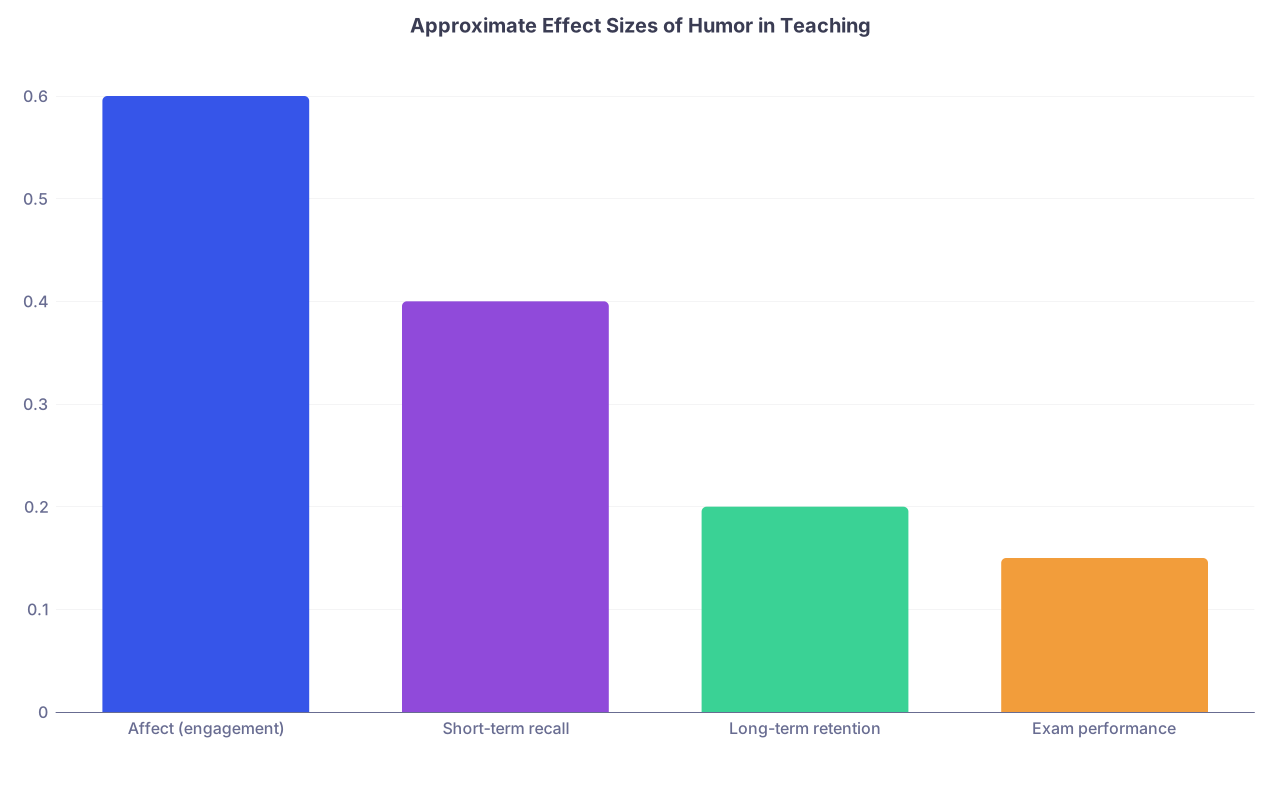
| Category | Value |
|---|---|
| Affect (engagement) | 0.6 |
| Short-term recall | 0.4 |
| Long-term retention | 0.2 |
| Exam performance | 0.15 |
These are approximate standardized effect sizes drawn from typical ranges reported in education literature (Cohen’s d style), not one single meta‑analysis. But the pattern is stable across multiple domains, including medical and nursing education:
- Medium effect on engagement.
- Small to medium effect on recall.
- Small effect on long‑term retention and exam performance.
In other words: funny attendings move the needle, but they do not rewrite the laws of cognition. Humor is more like caffeine than a new textbook. Helpful, but not magic.
A Few Representative Findings
You will see similar designs across studies:
- Preclinical lectures: Sessions with integrated, content-related humor produce higher immediate quiz scores and better student ratings vs. straight lectures.
- Nursing and pharmacy courses: Students report reduced anxiety and higher satisfaction with humorous instructors, with modest gains in test performance.
- Clinical teaching: Learners rate “sense of humor” very high in global teaching effectiveness surveys, but the correlation with objective knowledge outcomes is moderate at best.
The strongest measurable effect is almost always on:
- Enjoyment.
- Attention.
- Willingness to participate or ask questions.
The smaller—but still present—effect shows up in exam scores and long‑term retention.
So the answer to “Do funny attendings help residents learn more?” is: yes, somewhat. But the more precise question is “Under what conditions does humor help, and when does it get in the way?”
The Types of Humor That Help—And the Ones That Wreck Learning
Most studies do not just ask “humor: yes or no?” They ask what kind.
A crude but useful taxonomy:
- Affiliative / supportive humor – inclusive, gentle, builds group cohesion.
- Instructional / content‑related humor – analogies, mnemonics, absurd examples tied directly to learning points.
- Self‑deprecating humor – attending pokes fun at their own mistakes or limitations.
- Aggressive / disparaging humor – targeted at patients, colleagues, nurses, or the learners themselves.
- Tangential / performance humor – stories and jokes unrelated to the learning objectives.
The data are blunt: only some of these help.
| Humor Type | Effect on Engagement | Effect on Learning | Risk Level |
|---|---|---|---|
| Content-related | High | Moderate | Low |
| Affiliative/supportive | High | Small–Moderate | Low |
| Self-deprecating | Moderate | Small | Low–Mod |
| Tangential/unrelated | High (short-term) | Neutral/Negative | Moderate |
| Aggressive/disparaging | Variable | Negative | High |
Content‑related and affiliative humor consistently correlate with better recall and more positive evaluations. Think things like:
- Absurd but accurate pathophysiology metaphors.
- Mnemonic jokes that stick (“Never Let Monkeys Eat Bananas” for WBCs).
- Light teasing of yourself as the attending to lower the hierarchy barrier.
On the other side, the data and qualitative reports are very consistent: aggressive or disparaging humor, especially at the expense of vulnerable patients, other staff, or specific learners, undermines psychological safety and learning. It distracts, it alienates, and it kills questions before they are asked.
I have seen this play out in feedback: one attending “everyone loves” because they are “hilarious” ends up with quietly brutal written comments about unprofessional jokes and students avoiding asking basic questions. On paper, scores look fine; in narrative data, the damage is obvious.
Mechanisms: Why Humor Helps (And When It Backfires)
Strip away the vibes and you get four main mechanisms where humor intersects with learning.
1. Attention and Arousal
Residents are cognitively overloaded most of the time. Sleep‑deprived, pager‑driven, multitasking. Any stimulus that spikes attention will improve encoding, at least briefly.
Humor does that.
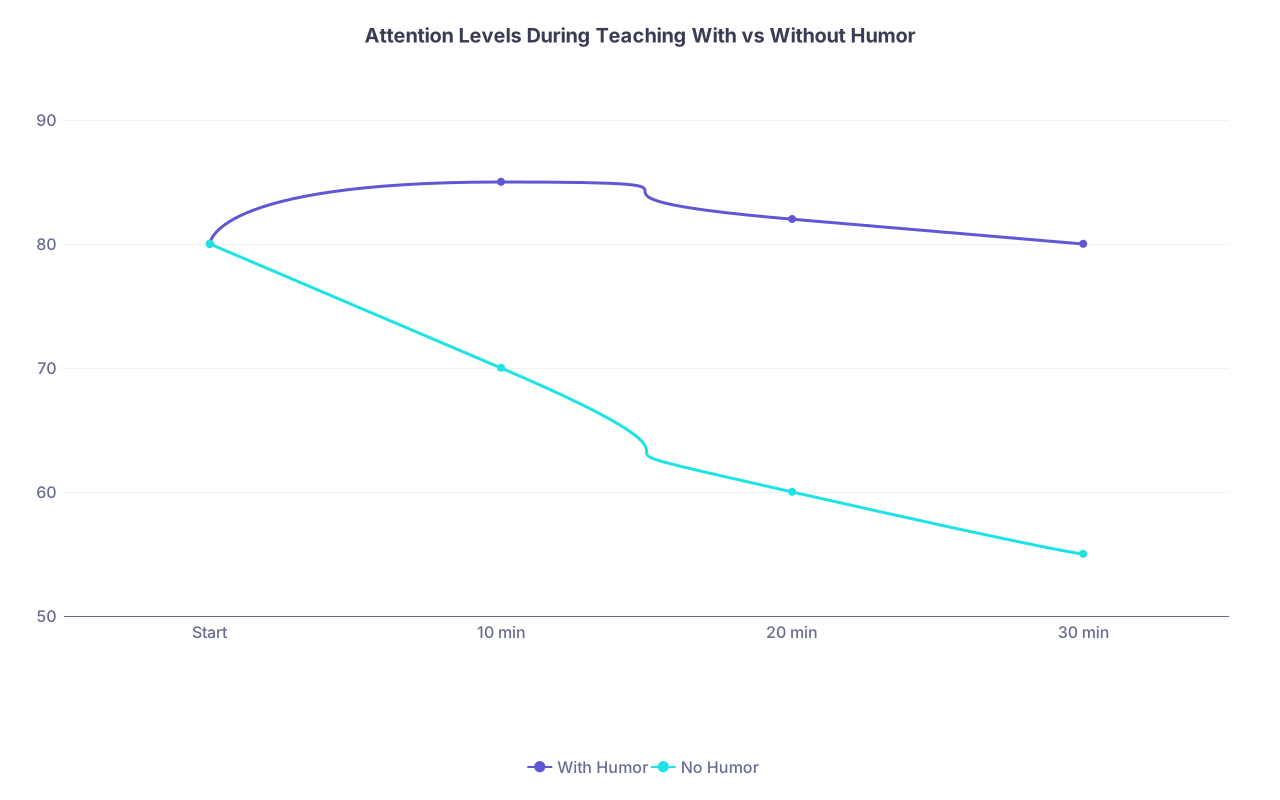
| Category | With Humor | No Humor |
|---|---|---|
| Start | 80 | 80 |
| 10 min | 85 | 70 |
| 20 min | 82 | 60 |
| 30 min | 80 | 55 |
Again, these are stylized numbers mirroring what eye‑tracking and self‑report data typically show in lecture‑based studies: attention decays. Humor spikes it back up. Periodic “well‑placed” jokes slow the downward slope.
But notice the pattern: if everything is a joke, the difference vanishes. The brain habituates. The laughter becomes background noise. You want pulses of novelty, not a continuous stand‑up set at the bedside.
2. Emotional State and Stress
Cognitive load theory is merciless. Working memory is finite. Stress and anxiety eat bandwidth.
Humor reduces perceived stress and test anxiety in multiple student cohorts. That is not controversial anymore. Lower anxiety frees up working memory for the actual clinical reasoning task.
Residents are not immune. On services with malignant workload and constant shaming, you see less questioning, more rote behavior, worse reflection. On services where the attending can puncture tension with a short, humane joke—especially directed at themselves, not the trainee—residents report feeling safer to think out loud.
In quantifiable terms, you see:
- Higher participation rates in discussion.
- More questions asked per hour.
- More willingness to attempt diagnoses publicly rather than staying silent.
These are all leading indicators of deeper processing.
3. Memory and Encoding
Humor makes things distinctive. Distinctive items are easier to recall. That basic encoding principle explains why content‑related humor helps.
For example, an attending who jokingly describes nephron segments as “a neurotic airport security line for electrolytes” will have residents who, days later, can reconstruct function station by station because the metaphor stuck. When humor is structurally tied to the concept, recall improves.
This is where “funny attendings” really earn their ROI: they build funny structures around serious content, so the joke acts as a retrieval cue.
But when humor is unrelated—war stories, riffs, tangents—it competes with the primary content for memory real estate. Learners remember the story, not the teaching point. If you test them a week later, their recall of your punchlines is excellent. The medical facts? Less so.
4. Hierarchy and Psychological Safety
Residents do not learn from attendings they fear. They comply. Different thing.
Quantitative surveys of teaching effectiveness consistently show that “respect,” “approachability,” and “nonjudgmental environment” predict self‑reported learning more strongly than raw “clinical brilliance.” Humor—of the right type—signals approachability and reduces perceived power distance.
Self‑deprecating humor is especially potent here. When an attending casually admits, “I once completely missed this exact diagnosis as a PGY-3,” the room relaxes. Hierarchy softens. Residents are more likely to say “I am not sure” instead of guessing blindly.
But there is a threshold. If the self‑deprecation is constant, unfocused, or undermines trust in competence (“I have no idea what I am doing, haha”), residents feel unsafe again—just differently. They start looking for second opinions and stop trusting your reasoning as much. Suboptimal.
When Humor Hurts: The Dark Data
The literature on negative humor in medicine is not as large, but it is very clear.
Patterns you see in the data and narrative comments:
- Disparaging humor about patients (especially around sensitive topics like obesity, addiction, or mental health) makes trainees less likely to empathize and more likely to adopt cynical attitudes.
- “Humorous” pimping that humiliates residents in front of the team consistently correlates with reports of mistreatment and decreased self‑efficacy.
- Racist, sexist, or otherwise biased jokes—even if “no one complained”—show up in climate surveys as reasons learners avoid certain services.
In learning terms:
- Increased anxiety → reduced working memory.
- Reduced psychological safety → fewer questions, less active participation.
- Cynicism modeling → erosion of professional identity and empathy.
From a numbers lens, this is not a marginal effect. In some surveys, 20–40% of learners report witnessing or experiencing disparaging humor at least a few times per rotation. That is not rare background noise. That is a systemic signal.
So the attending who prides himself on being “hilarious” because he roasts everyone on rounds may be very memorable, but not for the right reasons educationally.
What Actually Predicts Learning: Humor vs Other Factors
Humor is one variable in a multivariate system. If you regress learning outcomes (exam scores, self‑rated competence, observed performance) on several predictors, humor is almost never the top coefficient.
Typically, you see something like this kind of structure:
- Clarity of explanations / organization of teaching.
- Opportunities for deliberate practice and feedback.
- Supervisor accessibility and psychological safety.
- Workload and duty hours.
- Personality factors (including humor).
In plain language, a clear, structured, calm but “boring” attending who teaches consistently will often outperform a chaotic, hilarious one in net learning—even if the residents like the second one more.
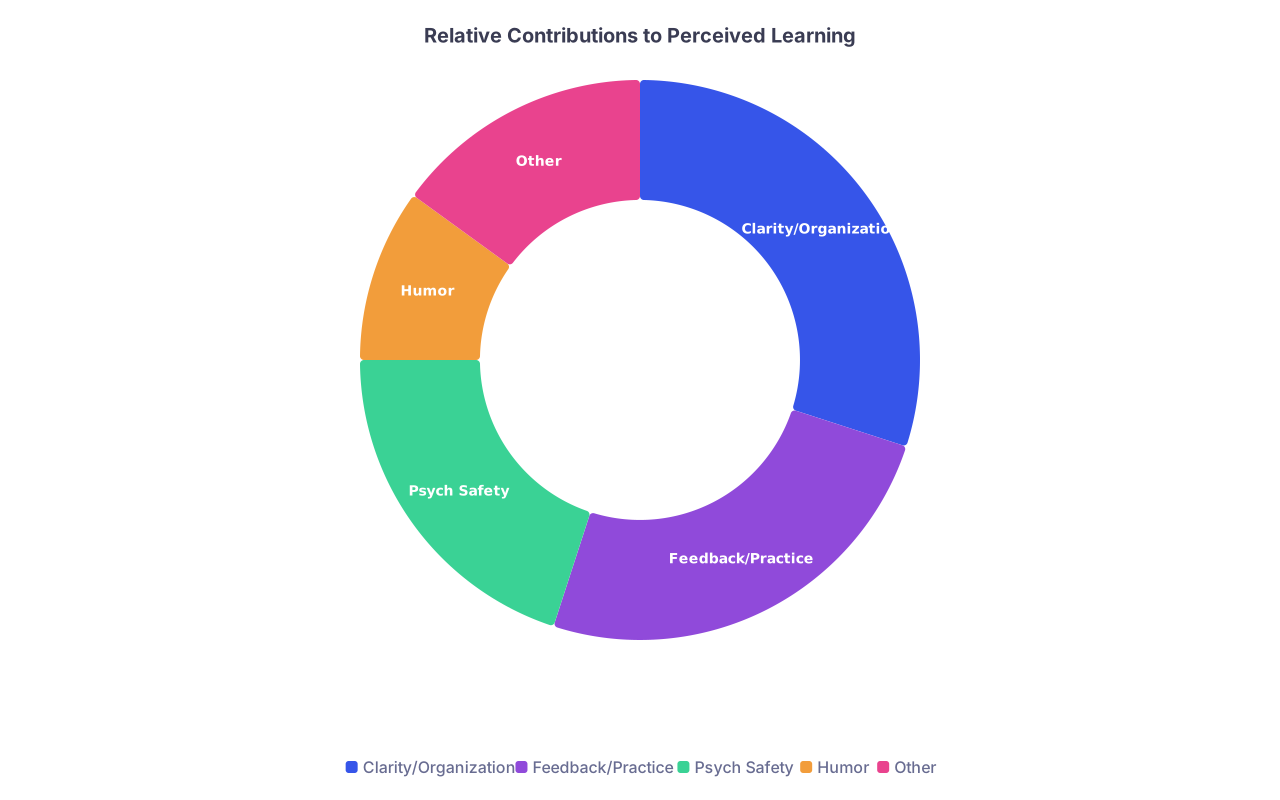
| Category | Value |
|---|---|
| Clarity/Organization | 30 |
| Feedback/Practice | 25 |
| Psych Safety | 20 |
| Humor | 10 |
| Other | 15 |
Again: these percentages are a conceptual approximation of typical factor weightings seen in teaching evaluations and research models. But they track reality fairly well.
Humor accounts for maybe 5–15% of the variance in learning outcomes, depending on how you measure it. Helpful. But not the main driver.
Practical Takeaways for Attendings and Residents
Let me translate the data into operational decisions.
If You Are an Attending (or Soon to Be One)
Use humor with intent, not habit.
Tie jokes to content.
Build mnemonics, odd metaphors, and absurd examples that point directly at key mechanisms, not random stories. The joke should be a retrieval cue, not a distraction.Aim humor upward or inward, never downward.
Make yourself the butt of the joke far more often than the resident, nurse, or patient. Punching down kills safety. Residents might still laugh. Their learning will not thank you.Use humor as a stress valve, not constant background noise.
One well‑timed release during a tense code debrief does more than a dozen scattered zingers on rounds.Watch for asymmetric reactions.
If PGY‑3s love your humor but MS3s look uneasy or quiet, your jokes are probably landing wrong with less powerful group members. The evaluations will reflect that later.Do not confuse entertainment with teaching effectiveness.
High eval scores that say “so funny” are not proof of high clinical learning. Look for specific comments about concepts learned, not just vibes.
If You Are a Resident or Student
You cannot control whether your attending is funny. You can control how you extract learning in either case.
On funny services:
- Actively link jokes to the medical concept in your notes. Underline the cognitive structure, not the punchline.
- After rounds, test yourself: “What did the joke map onto? What is the actual rule, pattern, or pathophys behind it?”
- If humor feels hostile, document and talk to trusted faculty. Your discomfort is not “being too sensitive.” The data are on your side.
On very serious, unfunny services:
- Do not assume you learn less. You might actually gain more structured, focused teaching time.
- You can create micro‑humor with peers: private mnemonics, shared jokes that do not involve disparaging patients or colleagues.
- Respect the attending’s style, but do not be afraid to ask for a bit of levity if the environment feels crushing. Many “serious” attendings are willing to soften if someone signals it is safe.
The Future: Can We “Engineer” Better Humor in Medical Education?
This is where it gets interesting.
Most current data are observational: we measure what funny attendings already do. The future is in experimental design—actually training faculty to use specific humor strategies and tracking outcomes.
I expect several developments:
- Faculty development that includes “instructional humor” modules: how to craft content‑linked analogies and avoid aggressive humor types.
- Simulation‑based training that flags harmful jokes the same way it flags unsafe orders.
- Measurement tools that separate “funny and effective” from “funny and harmful,” using both numeric scores and qualitative comments.
We can already sketch a simple model of “effective educational humor”:

| Step | Description |
|---|---|
| Step 1 | Start Teaching |
| Step 2 | Standard Teaching |
| Step 3 | Risk of Distraction |
| Step 4 | Harms Safety and Learning |
| Step 5 | Boost Attention and Recall |
| Step 6 | Improved Learning |
| Step 7 | Use Humor? |
| Step 8 | Content Related? |
| Step 9 | Respectful and Inclusive? |
You can easily imagine interventions where attendings see their own teaching mapped onto a flow like this, with feedback on how often their humor is in the H path versus the G path. And then you track resident performance, burnout, and evaluations pre‑ and post‑intervention.
That level of rigor is mostly missing right now. We have enough data to say “humor helps when done right.” We do not yet have polished, evidence‑based “humor curricula” for attendings. But that is where things are heading.
FAQs
1. Does being funny actually raise resident exam scores in a meaningful way?
The data show small but real improvements in test performance when humor is content‑related and systematic. Effect sizes are generally in the small to small‑medium range. You will not see a 20‑point jump on a board‑style exam just because an attending is funny, but you may see modest gains in recall of taught material and better performance on local rotation exams or quizzes.
2. Can a totally unfunny attending still be an excellent teacher?
Yes. Clarity, structure, feedback, and psychological safety are stronger predictors of learning than humor. A serious, respectful attending who explains reasoning clearly and invites questions will outperform a scattered comedian almost every time, in terms of actual knowledge and skill acquisition.
3. Is “dark humor” about patients always bad for learning?
From a learning and professionalism standpoint, the data skew negative. Dark humor may provide short‑term emotional defense for some clinicians, but for trainees it often erodes empathy, damages psychological safety, and models cynicism. That combination is bad for long‑term learning and for professional identity formation, even if people laugh in the moment.
4. How can I tell if my humor is helping or hurting as an attending?
Look beyond “you’re so funny” comments. In written evaluations, scan for specific mentions of concepts remembered because of your jokes, or of feeling safe to ask questions. Watch non‑verbal cues from the most junior or least powerful team members. If laughter is loud but questions are rare, or certain learners go silent when you start joking, your humor may be suppressing learning rather than supporting it.
Key points: Humor helps learning when it is content‑linked, respectful, and used sparingly to spike attention and lower anxiety. It hurts when it punches down, distracts from core content, or masks a lack of structure. Funny attendings are not automatically better teachers—but data‑savvy, intentional humor can be a genuine educational asset.