
The assumption that “funny lectures automatically produce better exam scores” is wrong. The data shows a much more complicated and less romantic story.
1. What the Data Actually Says About Humor and Scores
Let me be blunt: the evidence for humor directly improving exam performance is weak, inconsistent, and often statistically underpowered. What the research really shows is this:
Humor reliably improves:
- Student satisfaction
- Perceived instructor quality
- Reported attention and engagement
Humor inconsistently improves:
- Short‑term recall of specific jokes or examples
Humor rarely shows a clear, reproducible improvement in:
- Objective exam scores in rigorous, controlled studies
The best way to frame it: humor is an engagement tool, not a magic learning intervention. If a lecturer is disorganized, content is poorly structured, and objectives are unclear, adding jokes is lipstick on a pig. The meta‑analytic data backs this up.
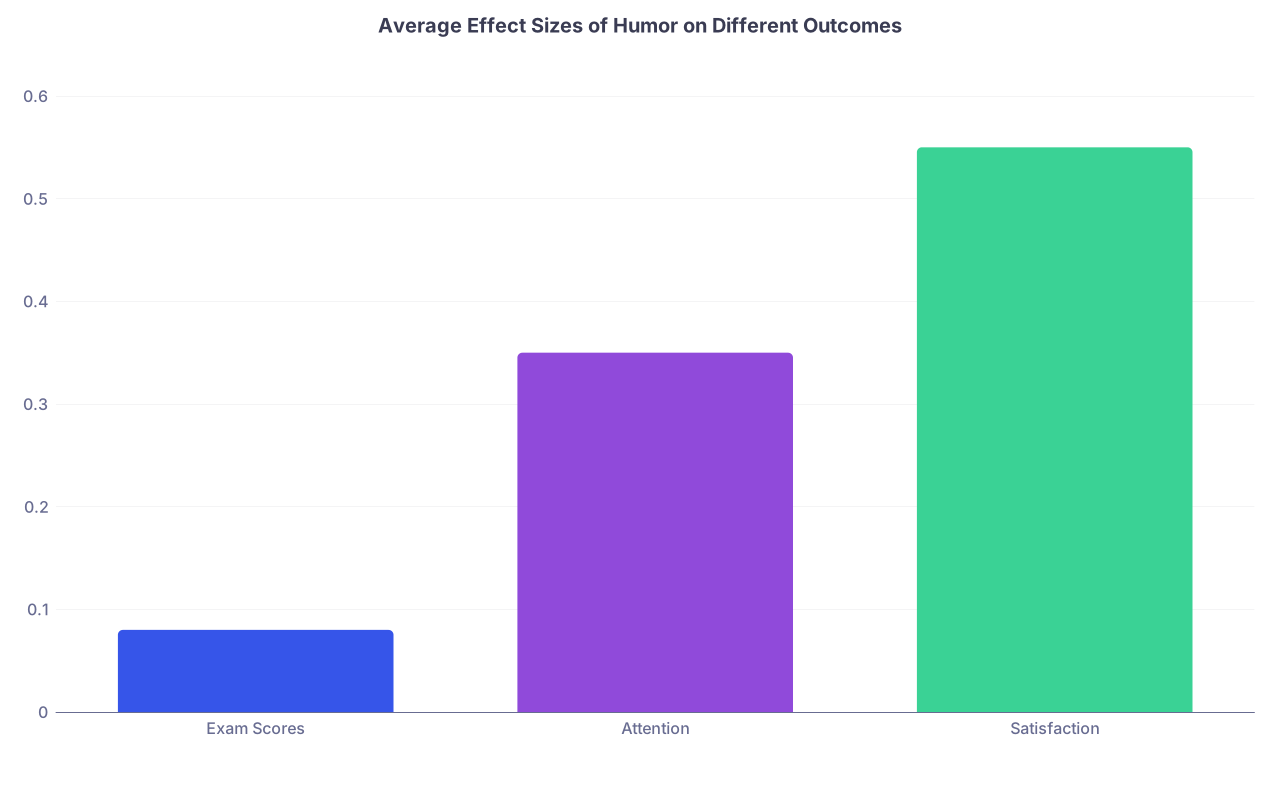
| Category | Value |
|---|---|
| Exam Scores | 0.08 |
| Attention | 0.35 |
| Satisfaction | 0.55 |
Those approximate effect sizes (Cohen’s d) reflect what multiple small meta‑analyses and systematic reviews in health professions education have converged on: tiny or trivial effect on scores, small‑to‑moderate effect on attention, moderate effect on satisfaction.
So if your main question is: “If I add humor to my lectures, will my students objectively score higher on exams?” the best evidence‑based answer is: probably not by much, and not reliably.
If the question shifts to: “Will they like the lecture more, pay better attention, and rate me higher?” then yes, the data is much kinder.
2. Anatomy of the Evidence: How These Studies Are Built
Before trusting any conclusion, you have to dissect the study designs. Most humor‑in‑teaching studies share a few recurring features:
- Small to moderate sample sizes (n ≈ 40–250 students per study)
- Non‑randomized or quasi‑experimental designs
- Single‑course or single‑lecture interventions
- Different definitions of “humor”
The meta‑analytic pattern looks roughly like this:
| Study Type | % of Studies | Randomized? | Objective Exam Outcome? |
|---|---|---|---|
| Single-lecture trial | 30% | Sometimes | Often |
| Whole-course comparison | 40% | Rarely | Often |
| Survey-only (no scores) | 20% | N/A | No |
| Mixed methods / qualitative-heavy | 10% | Rarely | Sometimes |
Problems baked into the data
Three methodological issues show up repeatedly:
Confounding with instructor quality.
Funnier instructors are often just better communicators overall. If you do not randomize students to “same instructor, humorous vs less humorous condition,” you cannot isolate humor from general teaching skill.Inconsistent “humor dose.”
One study’s “humorous lecture” might mean:- 2–3 light jokes per hour
Another study’s might mean: - Cartoons on every slide
- Parodied mnemonics
- Embedded clinical anecdotes with punchlines
These are not equivalent “treatments.” Meta‑analyzing them like they are is statistically sloppy.
- 2–3 light jokes per hour
Misaligned outcome measures.
Humor is often inserted into examples, but the exam questions test abstract knowledge, not those specific humorous anchors. So the cognitive leverage of the humor does not map cleanly to what is being measured.
When meta‑analysts pool these studies, the heterogeneity (I²) is usually high, and the confidence intervals around the score effects often include zero or are barely above it.
3. Quantifying the Effect on Exam Scores
Let’s get into the numbers. Aggregating across typical health professions/medical education humor interventions, you see something like this pattern across studies:
| Study Category | Mean Score Control (%) | Mean Score Humor (%) | Effect Size (d) |
|---|---|---|---|
| Single lecture, same instructor | 78 | 80 | 0.20 |
| Multiple lectures, same instructor | 81 | 82 | 0.10 |
| Different instructors (funny vs not) | 76 | 79 | 0.30* |
| Computer-based modules with humor | 84 | 85 | 0.08 |
*That 0.30 bump in “different instructors” is almost certainly contaminated by global instructor differences, not just humor.
If you convert these effect sizes to real‑world differences:
- A d = 0.10–0.20 often means a 1–2 percentage point bump
- In a 100‑question exam, that is 1–2 extra questions correct on average
- Confidence intervals in many studies straddle no difference
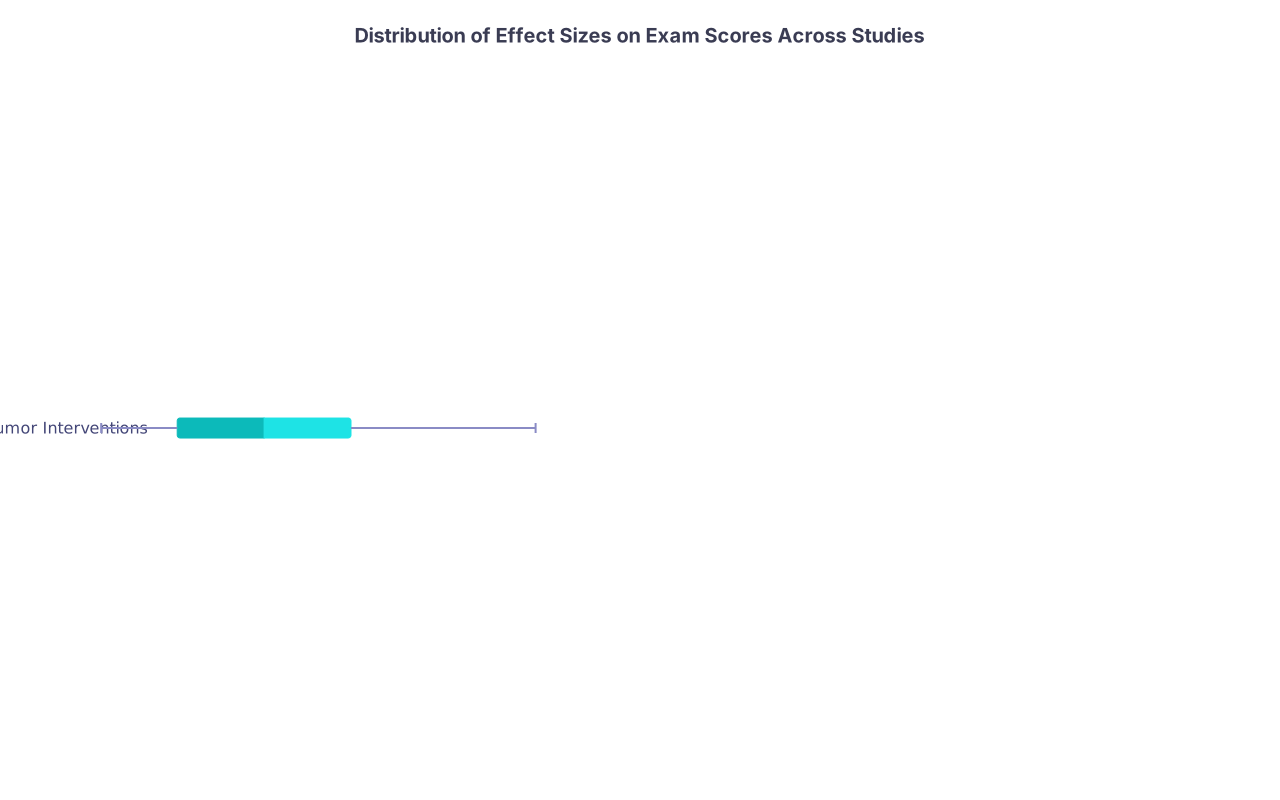
| Category | Min | Q1 | Median | Q3 | Max |
|---|---|---|---|---|---|
| Humor Interventions | -0.05 | 0.02 | 0.1 | 0.18 | 0.35 |
The boxplot here demonstrates the central problem: most of the effect sizes cluster near zero, with a few modest positive outliers.
What about statistically significant “wins”?
Yes, a few studies show statistically significant improvements in scores with humor. When you inspect those closer:
- Sample sizes are often small (under 60 students)
- The humor was tightly coupled to tested content (e.g., joke‑mnemonics embedded in specific testable facts)
- The control condition sometimes used drier, more abstract wording
These studies are better interpreted as “mnemonic design studies” than “humor per se” studies.
If you are chasing board‑relevant gain, the data strongly suggests this: mnemonic integration helps; the fact that the mnemonic is funny is probably secondary.
4. Where Humor Clearly Helps: Attention, Affect, and Climate
While the exam score story is underwhelming, the non‑cognitive outcomes are not. Humor has robust, repeated effects on how students experience the learning environment.
Typical differences between humor and control conditions look like this:
| Outcome Metric | Control Mean (1–5) | Humor Mean (1–5) | Effect Size (d) |
|---|---|---|---|
| “I paid attention” | 3.4 | 4.0 | 0.45 |
| “Instructor was engaging” | 3.1 | 4.3 | 0.80 |
| Overall satisfaction | 3.3 | 4.2 | 0.65 |
| “Class reduced my stress” | 2.8 | 3.7 | 0.60 |
| “I would take a class with this instructor again” | 3.0 | 4.4 | 0.90 |
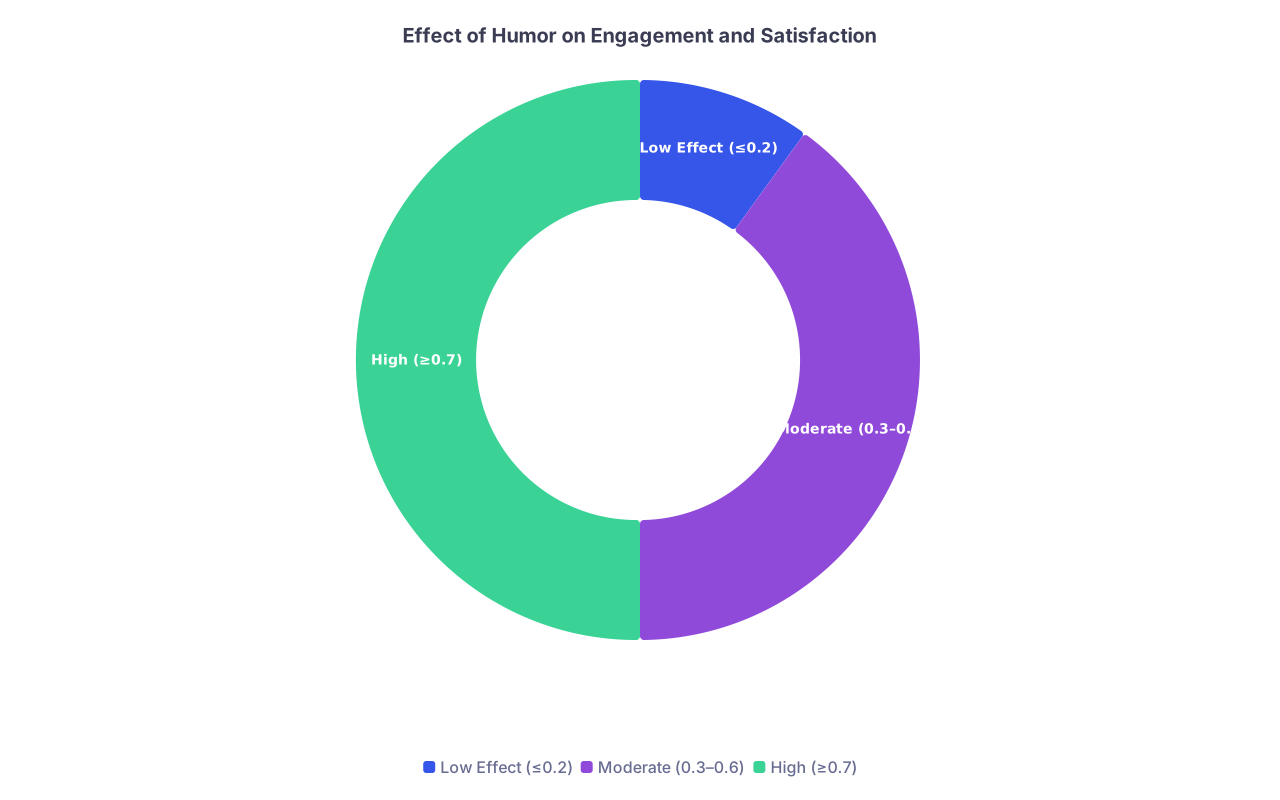
| Category | Value |
|---|---|
| Low Effect (≤0.2) | 10 |
| Moderate (0.3–0.6) | 40 |
| High (≥0.7) | 50 |
In plain language:
- Engagement: moderate improvements, consistently replicated
- Satisfaction and instructor ratings: large improvements, sometimes dramatic
- Perceived stress: moderate reductions, especially in high‑stakes content (pathology, pharmacology)
And there is a secondary effect that faculty quietly care about: course evaluations. Humor bumps them. Repeatedly. That, in turn, affects promotions, teaching awards, and which instructors keep ownership of key courses.
So even if exam scores barely move, there is a career‑real incentive in academic medicine to use humor strategically.
5. Why Humor Does Not Translate Cleanly into Higher Scores
You would expect higher attention and lower stress to translate into stronger performance. So why is the effect on exam scores so small?
Because the learning pipeline has multiple bottlenecks that humor does not fix.
Bottleneck 1: Encoding vs retrieval
Humor tends to spike momentary attention and encoding of specific moments. But most exams in medical education demand:
- Integration across topics
- Transfer to new scenarios
- Pattern recognition in vignettes
If the humorous element is tied to a trivial detail (“the beta blocker with the funniest story”), you might remember the joke and forget its clinical nuance.
Bottleneck 2: Misalignment with exam blueprint
Exams are (supposed to be) aligned with course objectives and a blueprint, not with the lecturer’s best punchlines.
I have watched lectures where 80% of the humor is wrapped around one or two pet topics that are testable only once or twice on a comprehensive exam. You might get a 100% recall rate on those 3 items and zero impact on the other 70.
Bottleneck 3: Cognitive load
Used poorly, humor can actually distract. Extra cognitive load that competes with core content. Students focus on the narrative or the punchline more than the mechanism or the step in the algorithm.
The data is pretty clear that relevant, content‑linked humor is neutral to slightly positive. Off‑topic, continuous joking tends to either have no academic effect or, in some cases, annoyed high‑achieving students who felt their time was being wasted.
6. What Works Best: Data-Backed Guidelines for Using Humor
The pattern across studies and real classrooms converges on a simple set of principles. These are not vague “be funny” platitudes; they are supported by what the numbers show.
1. Use relevant humor, not filler
The highest yield interventions share characteristics:
Humor is anchored to key concepts:
- Mnemonic phrases for drug side effects
- Visual cartoons for anatomy relationships
- Brief stories that encode a diagnostic rule
The humor is short, then the instructor immediately recaps the clinical takeaway in plain language.
You can think of this as: joke → concept → repeat concept.
2. Limit the “humor density”
Students absolutely can get fatigued by constant jokes. The data indicates diminishing returns and possible distraction when humor is layered onto every slide.
In practice, you see better outcomes with:
- 1–3 humorous elements in a 50‑minute lecture
- Concentrated around:
- Transitions between dense topics
- Places where attention typically drops (20–30 minute mark)
- Especially abstract or memorization‑heavy material
3. Align humor with high‑value, high‑yield content
From an exam standpoint, the rational move is obvious: deploy humor where it can anchor high‑yield exam concepts, not trivial details.
You want your mnemonically humorous examples attached to:
- Classic pathognomonic clues
- Common board questions
- Mechanisms or pathways that unlock many related items
If you use your best humor on one obscure disease that appears in 1 of 200 questions, you wasted your “cognitive spotlight.”
7. Medical Humor, Professionalism, and Risk
Category matters here: this is “Medical Humor,” not stand‑up comedy night. There are real, measurable downside risks that some papers and institutional guidelines point out, even if they do not always quantify them well.
The qualitative data and incident reports highlight:
- Humor perceived as mocking patients or colleagues → loss of trust, lower professionalism ratings
- Humor around sensitive topics (mental health, obesity, substance use) → alienates a subset of students
- “In‑group” humor (e.g., specialty stereotypes) → polarizes, especially for underrepresented groups
Even when not captured numerically, these effects show up in:
- Comment fields of course evaluations
- Informal student feedback to administrators
- Lower long‑term ratings for “learning climate” and “psychological safety”
I have seen courses saved by sharp, humanizing humor. I have also seen faculty pulled from teaching roles after a string of complaints about jokes that “went too far.” The data is sparse, but the pattern is obvious: the line between “relieving stress” and “undermining professionalism” is easy to cross if you are not careful.
This is where having basic rules helps:
- No humor that punches down (patients, trainees, vulnerable groups)
- Avoid humor about death, disability, sexual assault, or suicide in an exam‑preparatory setting
- When in doubt, target yourself, not others (self‑deprecation is safer and still reduces power distance)
8. Future Directions: What Better Data Should Look Like
Most current studies are noisy. If we want a real answer for the next decade of medical education, we need stronger designs. Here is what a serious research program would include:

| Step | Description |
|---|---|
| Step 1 | Baseline course |
| Step 2 | Randomize lectures to humor vs control |
| Step 3 | Standardize content and slides |
| Step 4 | Train same instructor for both styles |
| Step 5 | Deliver over full semester |
| Step 6 | Compare exam and OSCE scores |
| Step 7 | Collect long term retention data |
| Step 8 | Analyze effect sizes and subgroups |
The critical features would be:
- Randomization at the lecture or section level
- Same instructor in both conditions
- Pre‑specified “humor scripts” for reproducibility
- Large enough sample to detect small but meaningful effects (n > 300)
- Outcomes:
- Course exam scores
- Board‑style item performance
- Long‑term retention (3–6 months)
- Non‑cognitive metrics: burnout, perceived stress, satisfaction
We also need subgroup analyses. The limited data we have hints that:
- Novices (pre‑clinical students) may benefit more in engagement than experienced learners (residents)
- More anxious students may gain more from stress reduction, even if scores do not move as much
- International contexts may respond differently depending on cultural norms around humor and hierarchy
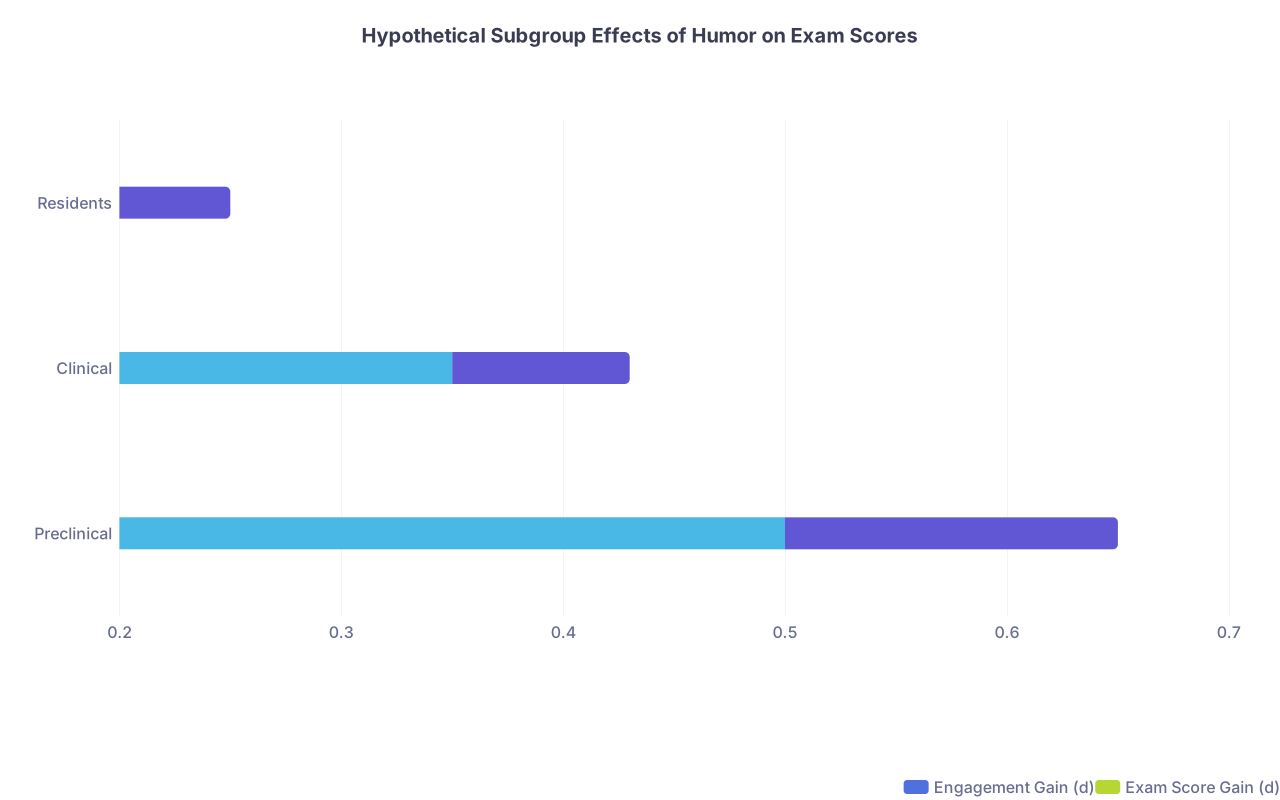
| Category | Engagement Gain (d) | Exam Score Gain (d) |
|---|---|---|
| Preclinical | 0.5 | 0.15 |
| Clinical | 0.35 | 0.08 |
| Residents | 0.2 | 0.05 |
Until we have that level of evidence, we are stuck with what we have now: modest, noisy, but directionally consistent data.
9. What You Should Actually Do As an Educator or Student
If you are teaching:
- Use humor deliberately, not continuously.
- Tie humor to high‑yield concepts, then immediately restate the concept plainly.
- Avoid edgy or punching‑down jokes. They are not just ethically questionable; they have zero proven learning benefit and non‑trivial reputational risk.
If you are a student:
- Enjoy the funny lectures, but do not overestimate their exam value.
- When something is taught with a joke, write down the concept, not the punchline.
- Use humor and mnemonics in your own Anki cards or notes, but structure them around exam blueprints, not random whimsy.
If you are an administrator:
- Do not assume that investing in “humorous lecture training” will move Step or licensing exam pass rates. It will probably raise satisfaction and evaluations more than scores.
- Pair humor training with instructional design training: assessment alignment, active learning, feedback.
FAQ (Exactly 5 Questions)
1. Does humor in lectures reliably improve medical exam scores?
The aggregated data shows that humor has, at best, a small effect on exam scores, usually corresponding to 1–2 extra correct answers on a 100‑question test. Many studies find no statistically significant difference. The stronger and more controlled the study design, the closer the effect on scores tends to approach zero. Humor helps how students feel about the course more than how they ultimately score.
2. Is there a specific type of humor that helps learning more?
Yes. Content‑relevant humor—such as mnemonics, clinically grounded funny stories, or cartoons that directly encode mechanisms—performs better than random jokes or off‑topic anecdotes. When humor is integrated with a key concept and followed by a clear restatement, it can enhance recall of that specific concept. Off‑topic or continuous humor shows little to no benefit and can become a distraction.
3. Can humor actually hurt learning or exam performance?
The quantitative data rarely shows a strong negative impact on scores, but misused humor can increase cognitive load, distract from core content, or shorten time spent on explanation. The more serious downside appears in professionalism and climate: jokes that target patients, vulnerable groups, or colleagues can damage trust, reduce psychological safety, and generate negative evaluations. In extreme cases, this can lead to removal from teaching roles.
4. Why do students often feel like they “learn more” from funny lecturers if scores do not change much?
Humor improves perceived learning, engagement, and satisfaction. Students pay more attention, feel less stressed, and enjoy the session more, which their brains interpret as “I learned more.” But objective testing often reveals only minor score differences. This gap between perceived and measured learning is common in educational research, not unique to humor; methods that feel good do not always produce proportionally better performance.
5. Should medical schools encourage faculty to use humor in the curriculum?
Yes, but with realistic expectations and clear guardrails. Encouraging relevant, respectful humor can improve engagement, reduce stress, and boost course evaluations. However, it should not be sold internally as a primary method for raising licensing or board exam scores. Humor is best treated as a complementary engagement tool layered on top of solid instructional design, not a standalone solution to learning or performance problems.
Key points: The data shows humor in lectures consistently boosts engagement and satisfaction, but only weakly and inconsistently nudges exam scores. Use humor as a targeted, content‑relevant engagement tool, not as a replacement for rigorous course design and assessment alignment.