
The belief that being funny helps you match is only half true—and the data shows exactly where that edge starts and where it stops.
Humor is not a primary selection criterion in the Match. Programs do not rank you because you made a good joke on Zoom. They rank you because you look like someone who will not melt down at 3 a.m., will not poison the team culture, and will not make their lives harder. Humor is simply one of the fastest ways to signal those deeper traits: emotional stability, social intelligence, and team fit.
Let me walk through what the data, the psychology literature, and the actual behavior of program directors suggest about “being funny” as a competitive edge.
What The Match Really Selects For (And Where Personality Fits)
Strip away the myths. The Match is a constrained optimization problem.
Programs are trying to maximize:
- Clinical productivity
- Teaching climate
- Reputation and downstream fellowship placement
- Low drama, low attrition
They use proxies:
- Board scores
- Clerkship grades
- Class rank/AOA
- Letters of recommendation
- Research output
- Interview impressions
Personality is baked into exactly one of those: interviews. But it also seeps indirectly into letters, narratives on the MSPE, and word-of-mouth.
NRMP’s Program Director Survey is the closest thing we have to “hard data” on what matters. Across specialties, PDs consistently rank the following as “very important” in deciding whom to interview and how to rank:
- Interactions with faculty during interview/visit
- Interpersonal skills
- Perceived professionalism
- Evidence of teamwork and “fit”
Those are all personality-adjacent. None say “humor,” but the way humor is used (or misused) changes those variables quickly.
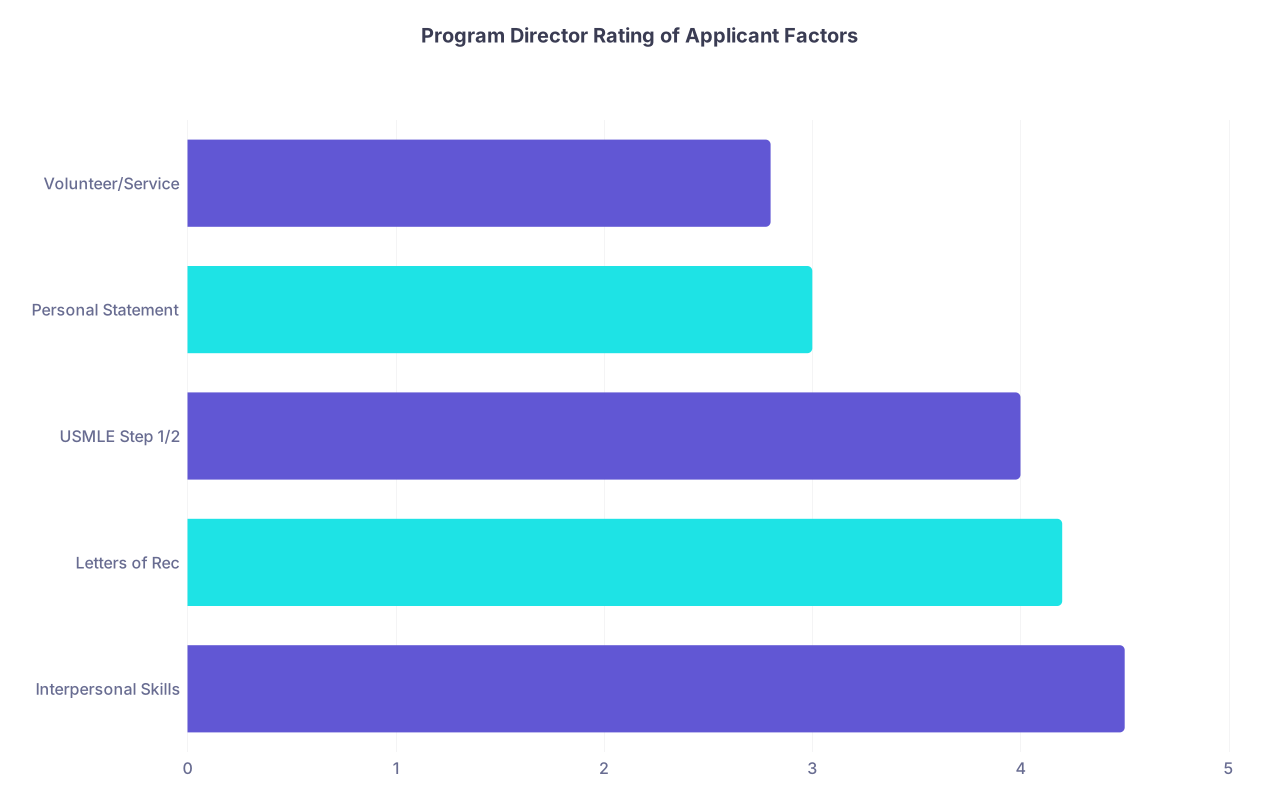
| Category | Value |
|---|---|
| Interpersonal Skills | 4.5 |
| Letters of Rec | 4.2 |
| USMLE Step 1/2 | 4 |
| Personal Statement | 3 |
| Volunteer/Service | 2.8 |
Now, the obvious question: where does “being funny” plug into those 4.0–4.5 rated factors?
Answer: humor is an amplifier. If your baseline is strong, it can push you up. If your baseline is weak or your judgment is poor, it can sink you faster than a mediocre Step score.
What The Psychology Data Actually Says About Humor
Unlike Step scores, we do not have a “Humor 259” metric in ERAS. But personality psychology has been quantifying humor styles for years.
The research (Rod Martin’s work is a good starting point) divides humor into four broad types:
- Affiliative humor – making jokes that build connection and ease tension
- Self‑enhancing humor – using humor to cope with stress, laugh at adversity
- Aggressive humor – sarcasm, teasing, put-downs
- Self‑defeating humor – putting yourself down to gain approval
If you map these to what program directors want, the alignment is not subtle:
- Affiliative + self‑enhancing humor → higher ratings of likability, leadership potential, emotional resilience
- Aggressive + self‑defeating humor → higher ratings of interpersonal risk, possible professionalism issues
You do not need to read a meta-analysis to know that “this is the guy who roasted the attending on Zoom” is not the label you want circulating during rank meetings.
The more interesting connection is with Big Five personality traits.
Humor and Big Five Traits
Aggregate data across multiple studies shows:
- Humor use correlates moderately with extroversion (r ~ 0.3–0.4)
- Positive, affiliative humor correlates with agreeableness (r ~ 0.3) and emotional stability
- Aggressive humor correlates with low agreeableness and higher neuroticism
Residency programs, when you decode their language (“team player,” “works well with others,” “great to have on the service”), are selecting for high agreeableness, moderate to high extroversion, and good emotional stability.
So the actual competitive edge is not “funny” in isolation. It is “funny in a way that is tightly coupled to high-agreeableness, emotionally stable behavior.”
That is, the intern who can crack a light joke at 4 a.m. in the MICU, reduce tension, not offend anyone, and then get back to work like nothing happened. I have watched chiefs write those people into emails: “We should try to keep her here if we can.”
Where Humor Shows Up In The Match Pipeline
You cannot upload stand-up clips to ERAS (yet), so humor leaks into the process through a few specific channels.

1. Clerkship Evaluations
Residents and attendings notice who keeps the team afloat on bad days. I have literally seen phrases like:
- “Great team morale, people enjoyed working with him.”
- “Helped lighten the mood without ever being inappropriate.”
Those lines are soft signals but they matter when letters are stacked. If two students have near-identical grades, the one described as “a joy to work with” vs “quiet, hard-working” will often be perceived as the better future colleague, especially in “personality-heavy” fields like EM, pediatrics, or family medicine.
2. Letters of Recommendation
Letters are not scored numerically, but PDs read hundreds per year. They get very good at extracting signal out of stock phrases.
What you want is some variant of:
- “She kept the team’s spirits up during a brutal run of overnight admits.”
- “Colleagues actively requested to work with him.”
These are essentially second-hand measures of social intelligence and emotional regulation. Humor is often the vehicle.
What you do not want:
- “Sometimes used humor at inappropriate times.”
- “Could be overly casual in serious situations.”
You will not see that often because most letter writers are too polite to be that direct. But when they are, it is a red flag that will be read as “high risk for professionalism issues.”
3. Interview Day
Here is where “funny” has the clearest, visible impact.
- Interviews are noisy. Everyone has similar Step scores and research. Programs need tie-breakers.
- Interviewers are humans with limited attention and short memory. They remember “the one who made us laugh” more readily than “the one with 4 posters on sepsis biomarkers.”
- Zoom fatigue is real; an applicant who keeps a room of four faculty mildly entertained for 20 minutes stands out.
But again, the style matters.
Affiliative, situational humor: safely positive.
- Light joke about your own coffee addiction.
- Comment about EMR frustrations that everyone shares, framed self‑deprecatingly.
- Smiling anecdote about a kid saying something absurd on pediatrics.
Aggressive or punching‑down humor: instant downgrade.
- Anything that makes fun of patients, nurses, other specialties, or specific colleagues.
- Dark humor that reveals contempt rather than coping.
- “Edgy” jokes that depend on political, racial, or gender boundaries.
Nobody in that room is betting a residency position on your ability to “push limits.” They want reliability and safety.
Does “Funny” Translate Into Rank List Movement?
We do not have RCTs where applicants are randomized into “humorous” and “serious” interview strategies. But certain patterns repeat across programs.
Programs essentially face a multivariate ranking problem. If we framed it as a stylized model, something like:
Overall score = 0.25*(Board metric)
+ 0.25*(Clerkship + grades)
+ 0.20*(Letters)
+ 0.20*(Interview / interpersonal)
+ 0.10*(Research / niche fit)
Humor lives inside “Interview / interpersonal” and indirectly inside “Letters.”
So what can humor reasonably change?
- If two applicants differ by 30+ points on Step or by a full grade band in core rotations, no amount of “being funny” is rescuing the weaker file into a higher rank.
- If two applicants are roughly tied academically, the more memorable, likeable, low‑risk personality often wins. Humor is a low-cost way to engineer that.
From PDs I have talked to, a realistic impact is:
- Within a given “tier” of applicants (say, those they are comfortable ranking in the top 50), interpersonal impressions can shuffle a candidate up or down 10–20 positions.
- Occasionally, an outstanding “this person is amazing to work with” impression can push an applicant from a mid-tier slot to upper-tier within that program’s list.
In other words: humor will not convert a non-competitive file into a competitive one, but it can move you several “slots” among people whose paper stats are similar.
Specialty Differences: Where Funny Helps More (And Less)
Not all specialties weight interpersonal “vibes” the same way. Some care more about research prestige, some about raw test scores, some about team culture.
| Specialty | Personality Weight* | Humor Tolerance | Notes |
|---|---|---|---|
| Emergency Med | High | High | Team-based, high acuity |
| Pediatrics | High | High | Family interaction, empathy |
| Family Med | High | Moderate-High | Longitudinal relationships |
| Internal Med | Moderate | Moderate | Large programs, research focus |
| General Surgery | Moderate | Low-Moderate | Hierarchy, seriousness |
| Anesthesiology | Moderate | Moderate | OR culture dependent |
*Subjective based on PD survey patterns, interview accounts, and emphasis on “fit.”
Broad patterns:
High interpersonal emphasis (EM, pediatrics, psych, FM):
Being likeable with good affiliative humor is a real asset. These fields spend all day in communication-heavy, team-oriented work. Being perceived as “great to have on shift” is almost part of the job description.Moderate emphasis (IM, anesthesia, radiology):
Personality matters, but academic and technical metrics are heavy. Humor helps, but mostly as a tie-breaker among well-qualified applicants.Lower humor tolerance (some surgery programs, some highly traditional academic centers):
Culture can skew more hierarchical and formal. Dry, understated wit is usually fine; overt joking, especially early in the interaction, can read as lack of seriousness.
The safe strategy: calibrate. Watch how the residents and faculty talk to each other when they think you are not “on the record” (pre‑interview social, Zoom waiting room chatter). If their banter level is low, dial your humor way down.
The Dark Side: When Humor Becomes a Liability
I have seen applicants try to “stand out” with humor and backfire spectacularly.
Common failure modes:
Using humor as a shield for anxiety.
Rapid-fire jokes, constant comments, not reading the room. Interviewers flag this as “immature,” “scattered,” or “hard to get a straight answer from.”Leaning into dark humor too early.
Residents bond over some very dark jokes at 2 a.m. That is in‑group behavior. You, as an applicant, are not in the group yet. The same joke from a stranger is risky.Punching down.
Any joke that even slightly targets patients, nurses, support staff, or marginalized groups will be remembered. Programs are acutely sensitive to anything that predicts future HR disasters.Undercutting your own competence.
Self‑deprecating humor can humanize you, but overuse starts to sound like you do not believe you belong. One or two lines is plenty. Beyond that, it looks like a confidence problem.
The quantitative way to think about it: humor increases variance. A neutral, professional demeanor has low variance—nobody loves you for it, but nobody hates you for it. Humor can move you up or down several “perception units” depending on execution.
If your risk tolerance is low (you are applying to hypercompetitive specialties, you have borderline numbers, or you are interviewing at very formal institutions), you want controlled, low‑variance humor. Occasional, warm, clearly self‑aware.
Training Your Humor Like a Clinical Skill
You are not trying to become a stand-up comic. You are trying to become someone who uses humor to show composure, connection, and judgment.

| Step | Description |
|---|---|
| Step 1 | Baseline Professionalism |
| Step 2 | Minimal Light Humor |
| Step 3 | Moderate Affiliative Humor |
| Step 4 | Focus on Clear Answers |
| Step 5 | Share Brief Anecdotes |
| Step 6 | Return to Substance |
| Step 7 | Read the Room |
A practical, almost mechanical approach:
Script 2–3 “safe” lines.
- A mild self-aware comment about interview day logistics.
- A clean, short story where a patient or child said something unintentionally funny (with full anonymization).
- A line about how you manage stress that includes a touch of levity.
Field‑test with people who have actually been on rank committees.
Not your funniest friend. Not your parent. Find a resident or faculty member. If they wince, cut it.Watch your laugh ratio.
If you are forcing a laugh every few sentences, it reads as nervous. Aim for mostly calm, with a few genuine smiles.In group settings (pre‑interview dinners, social events), aim for “supporting actor,” not “headliner.”
If everyone laughs and looks away, fine. If everyone laughs and then keeps eye contact expecting you to keep going, you are doing too much.
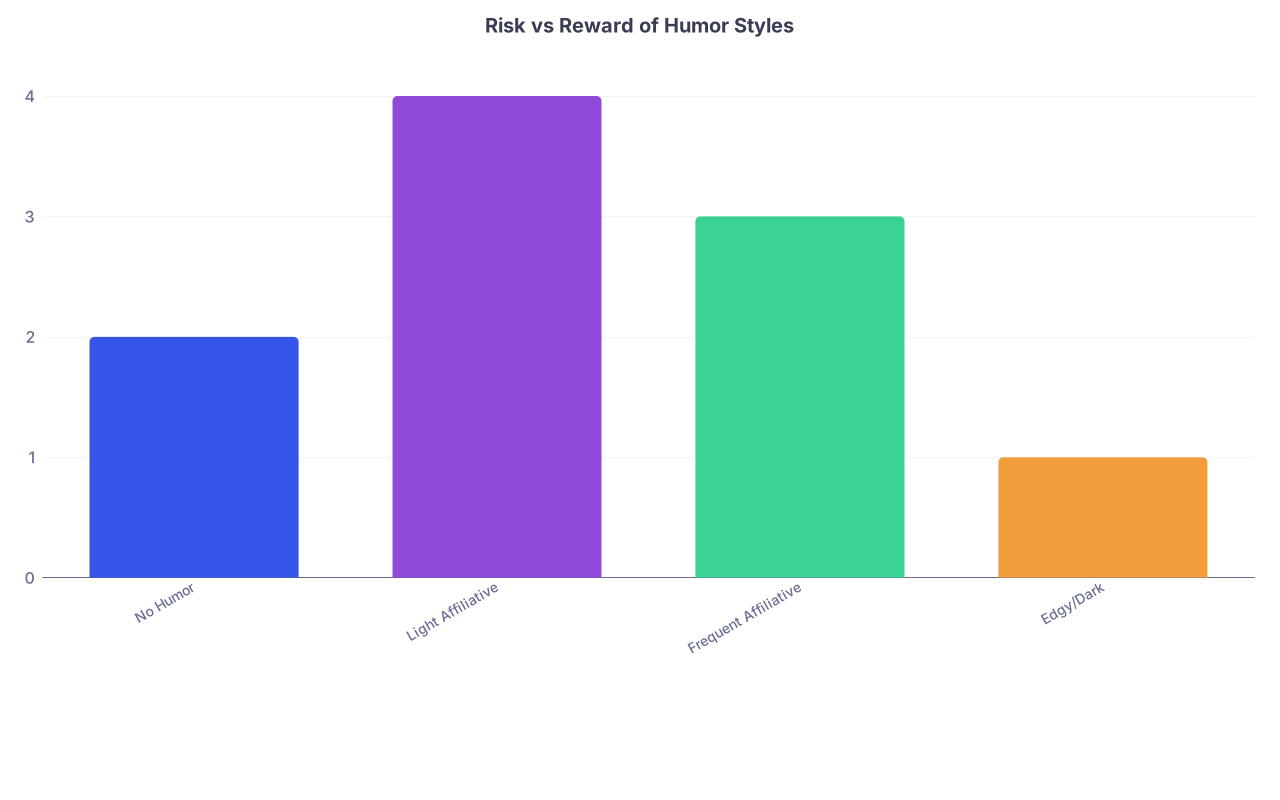
| Category | Value |
|---|---|
| No Humor | 2 |
| Light Affiliative | 4 |
| Frequent Affiliative | 3 |
| Edgy/Dark | 1 |
Interpretation: On a crude 1–5 “expected net benefit” scale, very light affiliative humor is usually optimal; excessive or edgy humor has more downside than upside.
Will Personality and Humor Matter More in the Future?
Two trends are moving in opposite directions.
Objective metrics are getting blurrier.
Pass/fail Step 1, grade inflation, and more schools using pass/fail clinical grading compress traditional signals. Programs need ways to differentiate applicants that are not just Step 2 CK and research counts.Residency burnout and attrition are under a microscope.
Programs know that a single toxic resident can tank morale and push others to leave. They are more sensitive to team dynamics, culture, and psychological safety.
This combination pushes personality—and by extension, the way you express it—into higher relevance.
Does that mean programs will start explicitly measuring humor? No. They will continue to measure things like:
- “Would I want to be on call with this person?”
- “Would this person destabilize the team?”
Humor is part of how those internal questions get answered.
At the same time, increased attention to professionalism and equity means that “off‑color” or boundary‑pushing humor will become even more dangerous. What you could get away with as casual banter 15 years ago is now a genuine institutional liability. Programs know it. They select accordingly.
So, Is “Funny” a Competitive Edge?
Condensed into data‑analyst terms:
- Being funny is not an independent predictor of matching.
- “Positive, affiliative, well‑timed humor” is a useful observable that correlates with traits programs value—emotional stability, likeability, team fit.
- Used correctly, it can move you up among applicants with similar academic profiles.
- Used poorly, it is a high‑leverage negative that can erase much of your paper strength.
The real competitive edge is not “funny.” It is:
- Competent on paper
- Calm under pressure
- Easy to work with
- And yes, able to laugh with people without ever laughing at them.
If your humor supports that story, keep it. If it competes with that story, cut it.