
The blunt answer: Teasing your attending or senior is advanced-level social maneuvering. Most trainees aren’t as good at it as they think.
You can pull it off, sometimes. But there are very specific situations to avoid unless you enjoy emotional Russian roulette with your evaluations.
Let’s break this down like a real decision problem, not a “trust your instincts” fantasy.
The Core Rule: Power Differentials Kill Most Jokes
If you remember nothing else, remember this:
Humor travels down the hierarchy safely. It travels up the hierarchy only under rare, controlled conditions.
Attendings can tease residents. Residents can tease interns. Interns can tease med students.
Reverse that flow and the risk spikes immediately.
When you “gently tease” your attending, you’re:
- Betting you’ve read their personality correctly
- Betting the timing is right
- Betting they won’t remember the joke when filling out your eval at 11:30 p.m. after a bad day
That’s a lot of bets. On someone else’s mood and your future.
So here’s the practical framework:
Teasing might be okay when all three are true:
- You have a strong, clearly warm relationship
- You’ve consistently seen them joke about themselves
- The context is low-stakes, private, and not in front of patients, nurses, or other staff
If any of those are missing, keep it straight.
Situations Where Teasing Is Almost Always a Bad Idea
Let me be direct: these are “do not pass go” scenarios.
1. In Front of Patients or Families
This is non-negotiable. Don’t tease your attending:
- In the patient’s room
- In the hallway right outside the patient’s door
- During family meetings
- Anywhere the patient or family can see or hear you
Why? Because the patient doesn’t know your “dynamic.” They just see:
- Their doctor (the attending)
- The trainee making a joke about that doctor
You’re accidentally:
- Undermining the attending’s authority
- Making the patient question the team’s cohesion
- Turning a serious encounter into a vibe check
I’ve seen an intern crack a “light” joke about an attending’s handwriting in front of a family. The family laughed. The attending smiled…but that intern’s eval mysteriously had comments about “professionalism” and “emotional maturity.”
Who do you think wins that story?
Rule: In front of patients and families, never tease up. Not even “gently.”
2. Early in a Rotation
The beginning of a rotation is scouting time, not improv night.
On Day 1–5:
- You don’t know their personality yet
- You don’t know what they’re insecure about
- You don’t know who had a complaint about them last week
- You don’t know if they’re currently burned out, sleep deprived, or getting grilled by admin
If you tease someone you barely know—especially your evaluator—you’re not “confident.” You’re gambling with zero data.
First week rules:
- Be pleasant, not performative
- Let them set the tone
- If they’re clearly joking a lot, you can join—but with safe humor: self-deprecating, observational, not personal
Teasing comes (maybe) later. After you’ve collected evidence.
3. About Anything They’re Legit Insecure About
The problem: you usually don’t know what that is…until you hit it.
Topics that are high-risk, even if they joke about them sometimes:
- Their age (too old / too young)
- Their specialty stereotypes (surgeons, psych, EM, anesthesia, etc.)
- Their academic productivity (“wow, another paper?”)
- Their appearance, clothes, hair, shoes, height
- Their clinical decisions (“bold choice of antibiotic…”)
- Their teaching style or knowledge (“you sure it’s not X?”)
You might think you’re being clever. What they hear is:
“Look at me, the trainee, poking holes in you from the safety of my non-responsible position.”
If you absolutely must joke, keep it on stuff that doesn’t hit identity, competence, or status.
4. When the Team Is Stressed or Behind
Code just ended. ED is paging nonstop. They’re two notes behind. Someone’s crashing in the ICU. The OR is delayed. They’ve been on for 12 days straight.
This is not your stand-up special.
Humor requires emotional bandwidth. Under stress, the same joke that gets a laugh on a calm day can land like a slap.
Red flags that it’s not joke time:
- They’re walking fast and answering pages mid-sentence
- Their responses get shorter, more clipped
- They’re double-charting and barely making eye contact
In those moments: be efficient, be helpful, be invisible in the best way. Jokes—especially aimed up the hierarchy—feel like “you’re not taking this seriously.”
Even if that’s not what you meant.
5. Group Settings Where They Could Lose Face
Never forget: hierarchy is social theater. People care about looking competent, in control, and respected in front of:
- Other attendings
- Fellows
- Residents (especially theirs)
- Nurses they work with daily
- Consultants or surgeons
If you tease an attending in front of others, you’re doing social judo on someone who outranks you. Many will smile and move on. Some will feel undercut. A few will quietly resent it for the rest of the block.
Especially dangerous:
- Calling them out for forgetting something
- Jokes that highlight a mistake they just made
- Mocking a habit (“Oh, there’s your third CT of the morning…”)
- Any joke that implies they’re lazy, careless, or out of touch
If they start the bit and clearly invite you in, fine. But don’t initiate a “teasing” moment that puts them on the back foot in front of others.
When Teasing Might Be Safe (If You’re Careful)
Now the part you actually want: when can you get away with it?
1. They Clearly Tease Themselves First—Consistently
Pattern matters more than one-off moments.
If an attending repeatedly makes themselves the butt of their own jokes—about being forgetful, about being obsessed with a guideline, about having terrible handwriting—and does it in front of others, it’s safer to lightly riff on that same bit.
Example:
Attending (every day): “Let me check my 34-page checklist, you know I can’t think without it.”
You (on day 10, privately or in a small group): “Don’t worry, we’d never start rounds without The Checklist.”
But even then:
- Keep it small
- Keep it affectionate, not sharp
- Start with one comment, see how they react
If they laugh genuinely and build on it? You’ve likely got green light for that one narrow topic. Not carte blanche for everything.
2. You Have a Long-Standing Relationship
Very different calculus if:
- You’ve worked with them on multiple rotations
- They know your work ethic and competence
- You’ve already had real human conversations, not just “present the patient” interactions
At that point, the relationship—not just the role—carries the joke.
Even then, smart people still avoid:
- Roast-style humor
- Anything that can be misquoted as disrespectful by others on the team
- Jokes that a random bystander wouldn’t immediately recognize as friendly
Private office banter? Big range. Hallway with nurses, students, and families walking by? Narrow lane.
3. Jokes That Put You Below Them, Not Them Below You
If you’re going to tease, angle it so the hierarchy is still intact.
Safe-ish styles:
- “You’re the boss, I just follow orders.”
- “I aspire to one day order that many labs with such confidence.”
- “I’m just trying not to embarrass you on rounds.”
These still acknowledge their authority and expertise. The “teasing” is more about the situation than about their competence.
What you don’t do: anything that even smells like “I know better than you” or “we’re peers.” You’re not.
A Simple Decision Framework (Use This Before You Open Your Mouth)
Run your idea through this quick filter:

| Step | Description |
|---|---|
| Step 1 | Thinking of teasing up |
| Step 2 | Do not tease |
| Step 3 | Probably safe once, watch reaction |
| Step 4 | New rotation or early days |
| Step 5 | In front of patient or family |
| Step 6 | High stress or behind |
| Step 7 | They often joke about themselves |
| Step 8 | Private or small group setting |
| Step 9 | Tease is mild and keeps them above you |
If you hit “No” on any of the later criteria, abort the joke.
Common Teasing Topics: Which Are Safer vs Toxic
Here’s a quick comparison of what usually flies vs what often backfires.
| Category | Safer Teasing Examples | Risky Teasing Examples |
|---|---|---|
| Work style | Always loves guidelines | Slow, disorganized, forgetful |
| Personality | Being a coffee addict | Being angry, moody, anxious |
| Clinical preferences | Favorite antiemetic or antibiotic | Over-testing, over-treating |
| Teaching habits | Love of long chalk talks | Not teaching enough, being confusing |
| Schedule | Always finds last admission | Leaving early, avoiding work |
If your joke implies “you’re less competent, lazier, or more flawed than your peers,” don’t say it. Even if they would say it about themselves.
How to Build Rapport Without Teasing Up
If you’re using teasing as your main social tool, you’re playing medicine on hard mode.
Better, simpler ways to connect:
- Be reliably prepared and on time
- Remember small personal details they share (kids, hobbies, sports)
- Ask for advice about your career or a tricky case
- Share a clean, harmless meme or story about medicine (that doesn’t target them)
- Use observational humor about your own role: “I’ve officially hit the ‘wake up before the sun and forget what day it is’ stage.”
Here’s what attendings and seniors remember long after your “joke” fades:
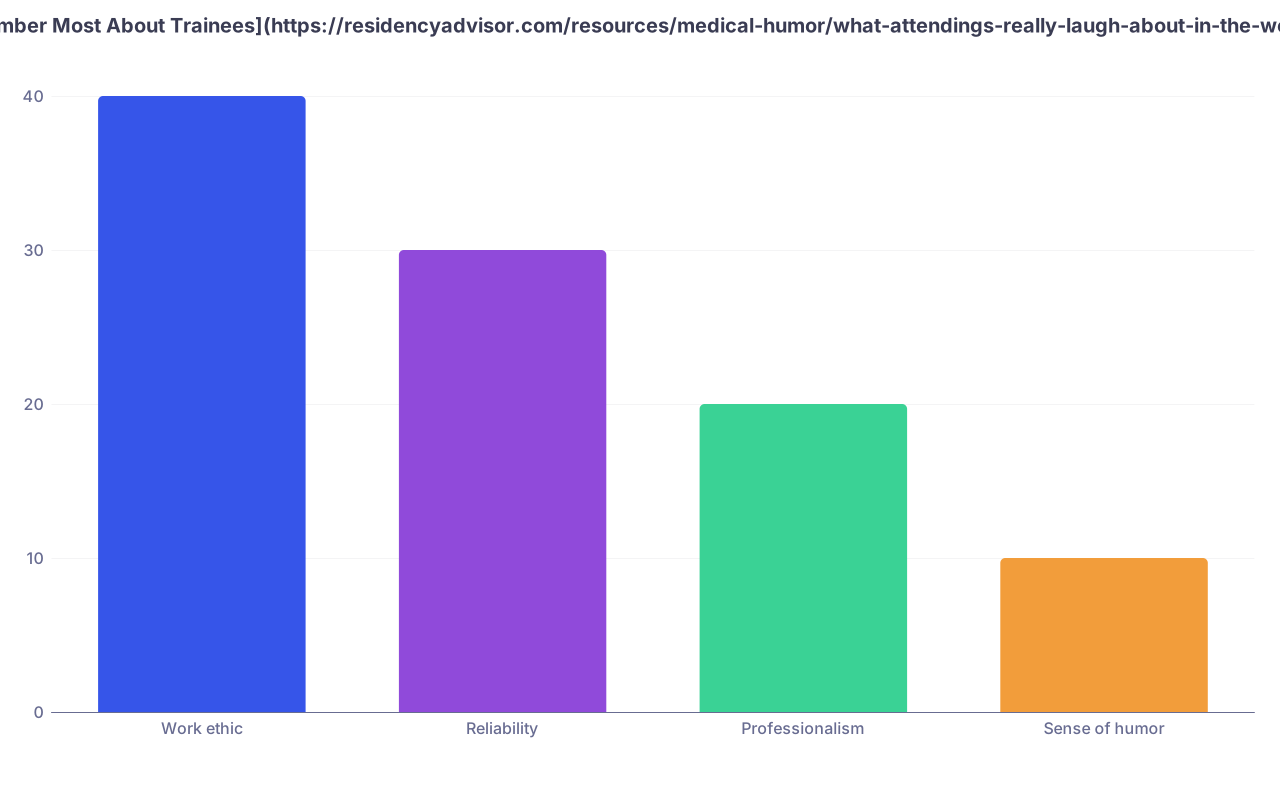
| Category | Value |
|---|---|
| Work ethic | 40 |
| Reliability | 30 |
| Professionalism | 20 |
| Sense of humor | 10 |
Humor is nice. But it’s extra credit. Don’t risk your core grade chasing extra credit.
Red Flag Reactions: When You’ve Gone Too Far
Sometimes you misjudge. Watch for these:
- Smile that doesn’t reach the eyes
- Quick subject change
- They stop joking with you afterward
- Subtle distancing: less teaching, more formality
If you sense you misfired:
- Don’t double down or explain the joke
- Dial your humor way down for the rest of the day
- If it seemed clearly off, a simple, “Hey, that joke earlier might’ve been off—I was trying to be light, not disrespectful” can reset things
One sincere line beats pretending nothing happened.
The Honest Take
Could you become the legendary student who can tease the grumpy attending and live to tell the tale? Sure.
Will most students misjudge at least one variable—timing, topic, audience, or relationship—if they regularly tease up the hierarchy? Also yes.
If you’re going to err, err on the side of respect. Nobody has ever gotten a bad eval for being “too mature and professional.”
People absolutely have for “trying too hard to be funny.”
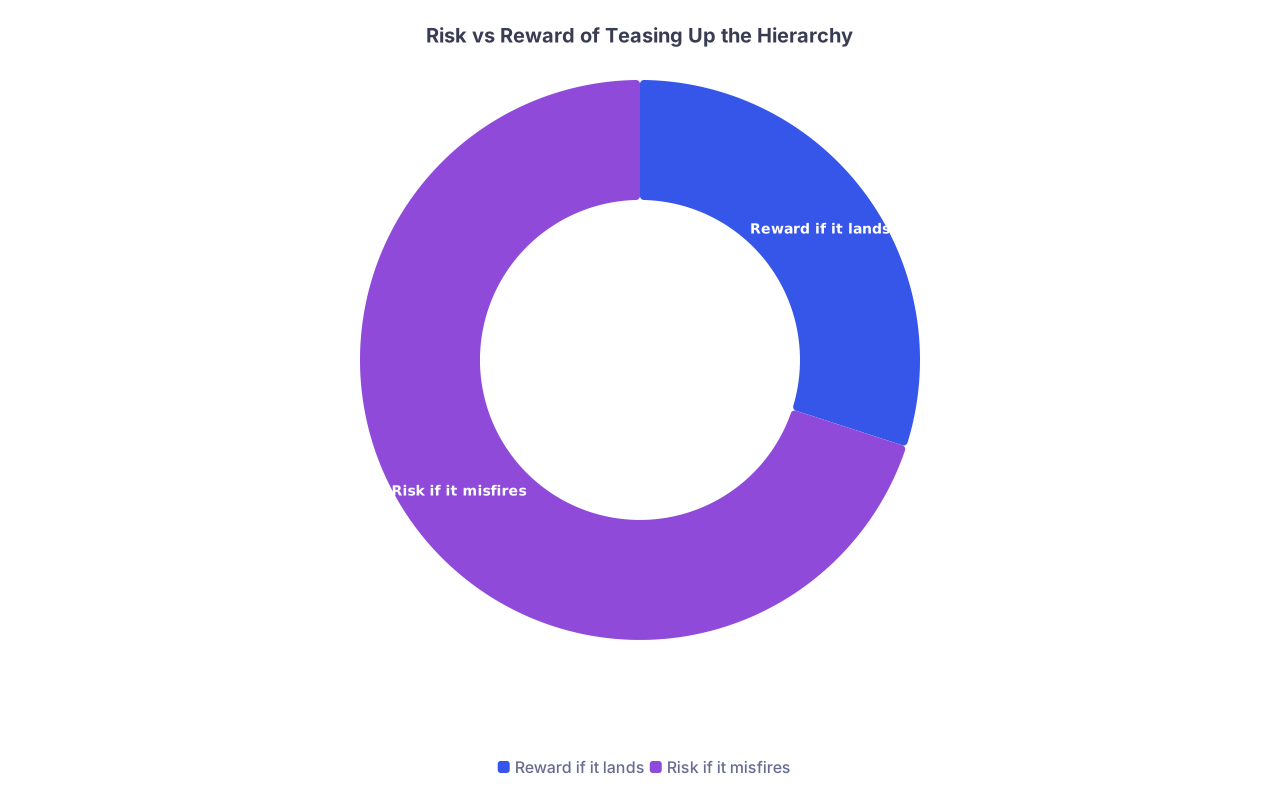
| Category | Value |
|---|---|
| Reward if it lands | 30 |
| Risk if it misfires | 70 |
FAQs: Teasing Attendings and Seniors
1. My attending teases me a lot. Is it safe to tease back?
Carefully and slowly. Start with mild, self-deprecating humor about yourself, not them. If they clearly open the door with something like, “You’re going to roast me on rounds one of these days,” you can respond lightly, but keep them “above” you in the joke. And absolutely avoid doing it in front of patients or people you don’t know well.
2. Is it different in “chill” specialties like EM or psych?
Culture varies by specialty, but the power differential doesn’t disappear. EM and psych might feel more relaxed, but your grade, letters, and reputation still depend on people above you. Chill vibe doesn’t equal “say whatever you want.” You still use the same filters: relationship, timing, audience, and content.
3. What about roasting seniors (residents, fellows), not attendings?
Still risky, just slightly less catastrophic. Seniors are often more approachable, but they also control your day-to-day experience, call schedule flexibility, and informal feedback to attendings. Tease only if they clearly initiate joking, and never about competence, work ethic, or emotional stability. Safer to joke about shared suffering than about them personally.
4. Can I use humor to push back on something I disagree with?
No. That’s how people talk themselves into trouble. “Joking” about their dispo plan, note style, or decision-making is still challenging their authority—just with a bad disguise. If you truly need to question something, do it respectfully, directly, and privately: “I might be missing something, but I was wondering about…”
5. What if an attending says something like “You can make fun of me, I can take it”?
Translation: “I feel comfortable enough with you that you could tease me a bit.” Not: “Please attack my identity, skills, or status.” If you respond at all, make it playful and low-stakes. Think: “I wouldn’t dare, I need my grade too much,” or a tiny nudge on something they clearly over-joke about themselves.
6. How do I know if my humor reads as unprofessional vs just friendly?
Ask yourself three questions:
- Would I say this if my dean were standing behind me?
- Would I be okay with this being quoted in an eval labeled ‘professionalism’?
- Would a stranger walking by know instantly it’s friendly, not hostile?
If the answer to any is no—or even “I’m not sure”—don’t say it. Pick a safer joke, or just focus on being solid and reliable instead.
Key points:
- Teasing up the hierarchy is high-risk, low-reward; err on the side of respect, especially early, in front of patients, or under stress.
- If you do tease, keep it rare, mild, relationship-based, and in private or small groups—with them clearly above you in the joke.
- You’ll build a better reputation through reliability and professionalism than you ever will through a perfectly timed roast.