
What do you do when someone cracks a joke during M&M and you feel the laugh rising in your throat—do you let it out, or shut it down and stare at your shoes?
Let me be blunt: yes, you can laugh during M&M or tumor board. But you can also absolutely wreck your reputation or hurt people if you get it wrong.
The real rule is simple:
Laughter is about who and what you’re laughing at, when it happens, and why it’s happening.
Let’s break this down like adults who’ve actually sat through the 7 a.m. M&M with cold coffee and a barely-digested night float.
The Core Rule: Punch Up, Not Down — And Never at the Patient
If you remember nothing else, remember this:
- Never laugh at the patient, their family, or their outcome.
- Never laugh at the complication, the death, or the suffering.
- Never laugh down the hierarchy (mocking nurses, techs, juniors).
- If you’re going to laugh, it better be:
- Self-directed
- System-directed
- Absurdity-directed
It’s okay to laugh about:
- Your own mistake (in a humble, accountable way)
- The ridiculousness of the EMR
- The absurd scheduling chaos
- Universal residency pain (call, pager, consult notes from hell)
- A harmless quirk (your own, or a known “system quirk”)
It’s not okay to laugh about:
- A preventable death
- A delayed diagnosis that harmed someone
- A missed tumor that progressed
- A colleague’s competence in a mocking way
- A nurse/consultant/another specialty as a punchline
If the joke makes an actual human being—especially a vulnerable one—the “target,” you’re in the red zone.
Where The Line Usually Is in M&M
M&M is supposed to be a psychological safety + accountability space. When it’s done well, you get:
- Brutal honesty
- Shared learning
- Clear ownership without humiliation
When it’s done badly, you get:
- Public shaming
- Performative blame
- Dark humor used as armor that cuts the wrong people
So what kinds of laughter are generally acceptable?
1. Self-deprecating humor from the presenting resident or attending
Example:
“You’ll notice I ordered the CT at 2 a.m. and then promptly forgot to check it until sign-out. So, excellent use of resources there.”
If the room chuckles, that’s fine. You’re owning the mistake. You’re not trivializing harm; you’re humanizing your fallibility.
System jokes that highlight real problems
“We placed the order, and then it disappeared into the EMR Bermuda Triangle where consults go to die.”
This kind of gentle system humor can make it easier to talk about structural failures—if it’s anchored in a serious fix.
Release-valve moments after a heavy case
Sometimes after a brutal death or complication discussion, someone will make a mild joke about coffee, the projector failing, or how many acronyms medicine has invented for the same complication. The room exhales. That’s not disrespect; that’s coping.
Where it crosses the line:
- Sarcastic comments about “well, maybe if they had just come in sooner…” (victim-blaming)
- Laughter when a slide shows a catastrophic outcome
- Snickering when a junior is clearly struggling to present
- “Roasting” another specialty that isn’t in the room
If you’re wondering, “Is this a bit much?” — it probably is.
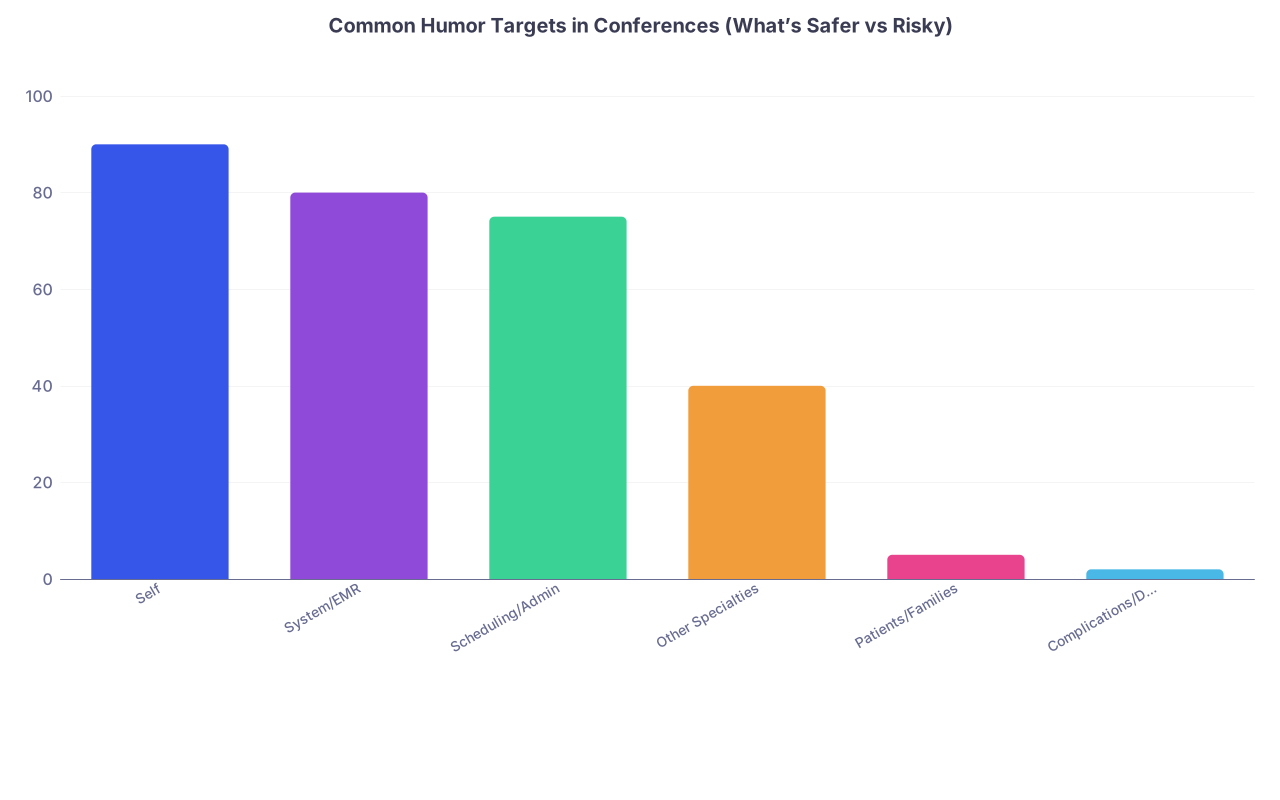
| Category | Value |
|---|---|
| Self | 90 |
| System/EMR | 80 |
| Scheduling/Admin | 75 |
| Other Specialties | 40 |
| Patients/Families | 5 |
| Complications/Deaths | 2 |
Higher values = more generally acceptable as humor targets; lower = avoid.
Tumor Board Has a Different Emotional Tone
Tumor board is not usually as explicitly about “what went wrong,” but it carries a different emotional load:
- Complex, life-altering decisions
- Multi-specialty perspectives
- Often recent, emotionally fresh diagnoses
So the unwritten rules get even stricter.
What’s typically okay:
- Light banter about scheduling (“Med onc clinic is already booked through 2050.”)
- Gentle self-deprecation (“My contouring on that CT was optimistic, to put it kindly.”)
- Mild specialty stereotypes where everyone’s in on it (surgeons vs rad onc vs med onc) if there’s trust in the room
What’s not okay:
- Smirking or laughing when a scan shows obvious progression
- Jokes about prognosis
- “At least it’s not [other worse cancer]” type comments
- Anything that feels like you’re forgetting there’s a real person whose life is hanging on this discussion
Ask yourself: If the patient or their family were quietly sitting in the back row, would this still feel okay?
If the answer isn’t a hard yes, don’t say it.

| Step | Description |
|---|---|
| Step 1 | Hear a joke or funny moment |
| Step 2 | Do not laugh |
| Step 3 | Small smile or quiet chuckle ok |
| Step 4 | Who is the target |
| Step 5 | Is there active harm on slide right now |
| Step 6 | What is the mood in the room |
| Step 7 | Does leader react positively |
How Hierarchy Changes What You Can Get Away With
You don’t have the same freedom as a senior attending who’s been there 20 years and literally built the M&M culture.
That’s just reality.
Here’s the breakdown:
Medical students / junior residents
You’re being evaluated constantly. Don’t be the loudest laugh. Don’t start the jokes. Quiet smile or small chuckle? Fine. Leading the comedy hour? No.Senior residents / fellows
You have a little more room, but your role is modeling. If your joke throws a nurse, intern, or patient under the bus, you’re undermining the culture you’re supposed to be building.Attending physicians
Your words set the bar. A cruel joke from you doesn’t just land as “edgy humor”; it lands as “this is how we treat complications here.”
Here’s the key: the lower your position, the safer it is to err on the side of too serious rather than too casual.
| Role | Initiate Jokes? | Laugh Out Loud? | Safest Style |
|---|---|---|---|
| Med Student | Rarely | Softly | Quiet smile, self only |
| Intern / PGY-1 | Seldom | Moderate | Self-deprecating |
| Senior Resident | Sometimes | Normal | Self + system-focused |
| Fellow | Sometimes | Normal | Specialty in-jokes, light |
| Attending | Yes, carefully | Normal | Culture-setting, kind |
Dark Humor vs Toxic Humor: There’s a Difference
Dark humor in medicine exists for a reason. You see things most people don’t. You need a pressure valve.
But there’s a hard line between:
- “We’re all in this awful reality together, trying to survive”
and - “I’m distancing myself from the humanity of this patient to avoid feeling anything”
In conference:
Dark humor that might be okay (if done expertly, and usually by seniors):
- Honest, slightly dark comments about the emotional weight of the job, with an undercurrent of respect.
- “If you’re not a little haunted by this, check your pulse.”
Toxic humor that isn’t okay:
- Making fun of a patient’s life choices in a way that implies they deserved their outcome.
- Jokes that imply “this is no big deal” when the patient’s outcome is catastrophic.
If the humor increases compassion, humility, and shared responsibility, it’s probably acceptable.
If it increases emotional distance, blame, or cynicism, it’s not.

Reading the Room: Practical Tells
You don’t need ESP. You just need to actually look around.
Red flags you shouldn’t be laughing:
- The room just went silent after a bad outcome slide.
- The presenting resident’s hands are actually shaking.
- The program director has that tight jaw “we’re going to talk later” look.
- A nurse, RT, or other non-physician is clearly upset.
- You’re in the middle of a root cause analysis moment.
Safer moments:
- Early logistics / housekeeping slides.
- Post-case debrief when the tone has clearly lightened.
- When a senior person makes an obviously self-targeted, mild joke and the leadership laughs.
Rule of thumb: If leadership isn’t laughing, you probably shouldn’t be either.
How to Use Humor Well in These Settings
If you’re going to bring any humor into M&M or tumor board, do it like someone who’s actually thought about it.
Good use cases:
Owning your own mistake without dramatics
“Yes, that’s my 3 a.m. note. You can tell because the grammar fell apart halfway through.”
Then pivot to: “Here’s what I should’ve done instead.”
Highlighting a broken process
“This is consult number three that was labeled ‘urgent’ and seen 36 hours later. So our definition of ‘urgent’ might need recalibration.”
Humanizing the team
“We had three services, two EMRs, and one working pager. You can imagine how that went.”
And always pair humor with seriousness:
- Joke → then clarity.
- Light comment → then concrete takeaway.
If it’s just jokes with no accountability or learning, people will (correctly) label you as flippant.
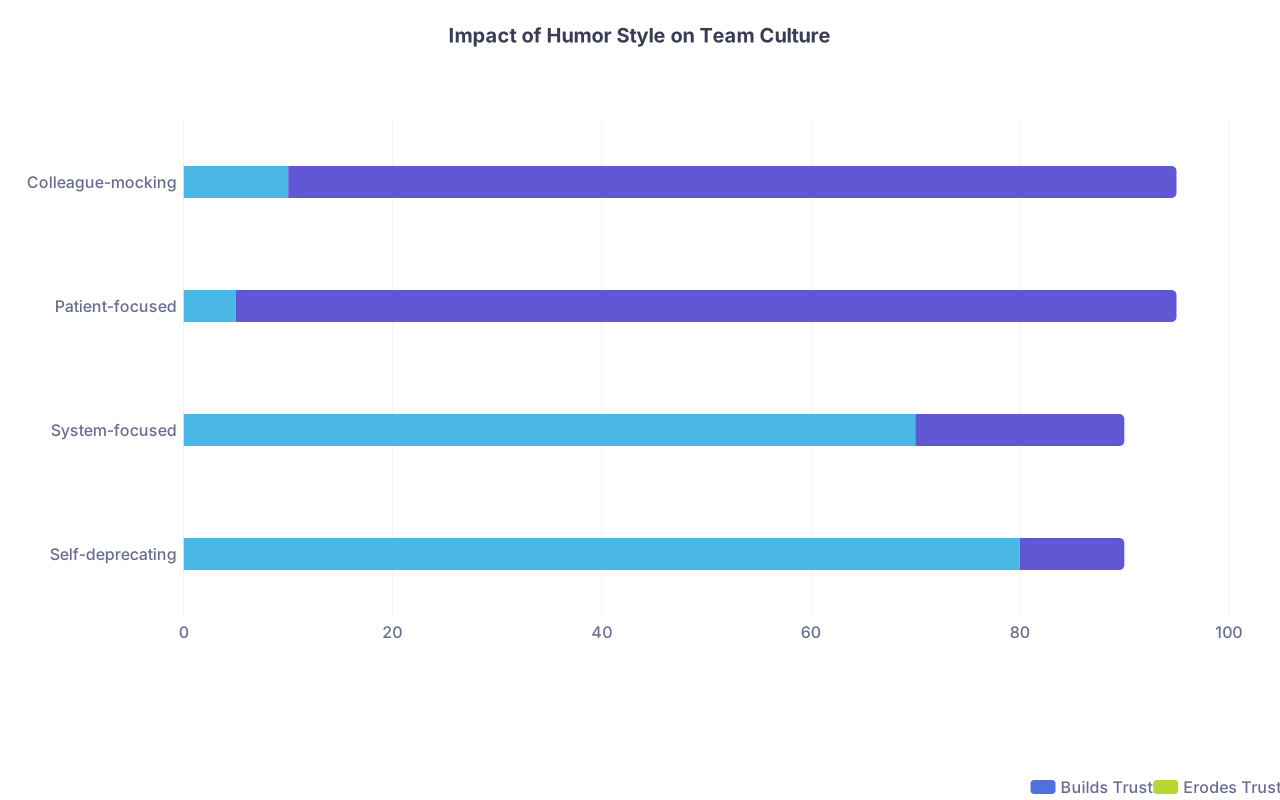
| Category | Builds Trust | Erodes Trust |
|---|---|---|
| Self-deprecating | 80 | 10 |
| System-focused | 70 | 20 |
| Patient-focused | 5 | 90 |
| Colleague-mocking | 10 | 85 |
What To Do If The Room Laughs and You Feel Wrong About It
You’ll see it at some point: a joke that lands, people laugh, and your stomach flips.
You’ve got options.
Right there in the moment (if you have standing in the room):
- “I want to pause for a second. This is actually a really painful outcome for the patient and family. Let’s just keep that in mind as we talk about it.”
- Or just don’t laugh, stay serious, refocus your body language toward the screen or speaker.
Afterward, especially if you’re junior:
- Debrief with someone you trust: “Hey, in that case earlier, the laughter felt off to me. Do you think that’s normal here?”
- If you’re the one who laughed and feel bad: you’re not evil; you’re human. Use the discomfort as a signal for better judgment next time.
You’re allowed to grow. You’re not allowed to hide behind “that’s just how medicine is” forever.

Quick Mental Checklist Before You Laugh
Run this in your head in about two seconds:
Who’s the target?
- Me / system / universal absurdity → maybe okay
- Patient / family / junior / specific colleague → no
What’s on the screen right now?
- Logistics / mild details → safer
- Catastrophic outcome / death / missed diagnosis image → don’t
How’s the room feel?
- Light, people already relaxed? → quiet laugh maybe fine
- Heavy, tense, director looks like they haven’t blinked in two minutes? → no
Who started it?
- Senior with credibility and empathy? → you can mirror lightly
- Other intern trying to be edgy? → don’t follow
If you’re still unsure, default to a small smile and silence.
FAQ: M&M, Tumor Board, and Humor
1. Is it ever okay for someone to make a joke right after presenting a death or major complication?
Very rarely, and only if it’s clearly self-directed and framed in respect. For most people, especially trainees, it’s better to let the gravity sit. If an experienced attending makes a gentle, humanizing comment that gets a small laugh after the serious analysis, that can help the room breathe—but that’s advanced-level stuff. Don’t try to copy it as a PGY-1.
2. What if my attending makes a joke I find inappropriate—should I laugh anyway to fit in?
You don’t have to perform agreement. You also don’t have to publicly challenge them in the middle of conference. Easiest move: neutral face or small polite smile, no big laugh. Then process later with someone you trust. You’re not obligated to cosign behavior that feels wrong just to look like “part of the team.”
3. Can I use humor in my own M&M presentation as a resident?
Yes, but very sparingly. Aim for one or two light, self-deprecating or system-focused comments max, and never during the description of harm itself. Put them at beginning (to connect with the room) or end (to relieve tension slightly). The centerpiece of your talk should be clarity, ownership, and learning—not your comedic timing.
4. Is it unprofessional if I never laugh during M&M or tumor board?
No. Being serious in serious spaces is not a character flaw. Some people are naturally more reserved, or the cases hit close to home. As long as you’re not sitting there with arms crossed, radiating contempt, you’re fine. You don’t have to perform lightness to prove you “fit” in medicine.
5. How do I handle it if I realize I laughed at something I shouldn’t have?
Welcome to being human. Internally: note the discomfort, label the moment (“that joke punched down at the patient”), and use it as a reference point next time. If it was especially bad and you feel guilty, you can mention to a mentor, “I laughed along and I wish I hadn’t. How would you have handled that?” That’s how you build better judgment instead of just collecting shame.
Open your calendar and check when your next M&M or tumor board is. Before you walk into that room, decide one thing: will you be the person who uses humor to hide from the weight of the work, or the person who lets humor coexist with respect? Decide now—so you’re not improvising in front of a slide with someone’s worst day on it.