
It’s 2:30 a.m. on nights. You and another intern are sitting at the nurse’s station after coding a patient who didn’t make it. The room feels heavy. Someone mutters a grim, half-joking comment about how “at least bed 12 opened up.” A couple people snort. One nurse looks furious. You suddenly wonder: Did we just cross a line? And if a chief or program director heard that… would we be in trouble?
This is the actual question: not “is dark humor real in medicine?” (it absolutely is) but “when is it okay, when is it dangerous, and where do programs actually draw the line?”
Here’s the answer you’re looking for.
The Core Reality: Dark Humor Happens, But It’s Not a Free-for-All
Let me be blunt: most residents and attendings use some form of dark, gallows humor. Especially in:
- EM, surgery, ICU, trauma
- Night float and long call
- Codes, mass casualty events, heartbreaking outcomes
People use it to not fall apart. To create a tiny bit of distance from constant exposure to death, suffering, and chaos.
But here’s the part a lot of students miss: programs tolerate private coping more than they condone it. The official stance is always professionalism and respect. The unofficial culture in most places is: “We know it happens. Just don’t be stupid about it.”
Think of it like this: dark humor in medicine lives in a narrow “gray zone” between healthy coping and career-ending behavior.
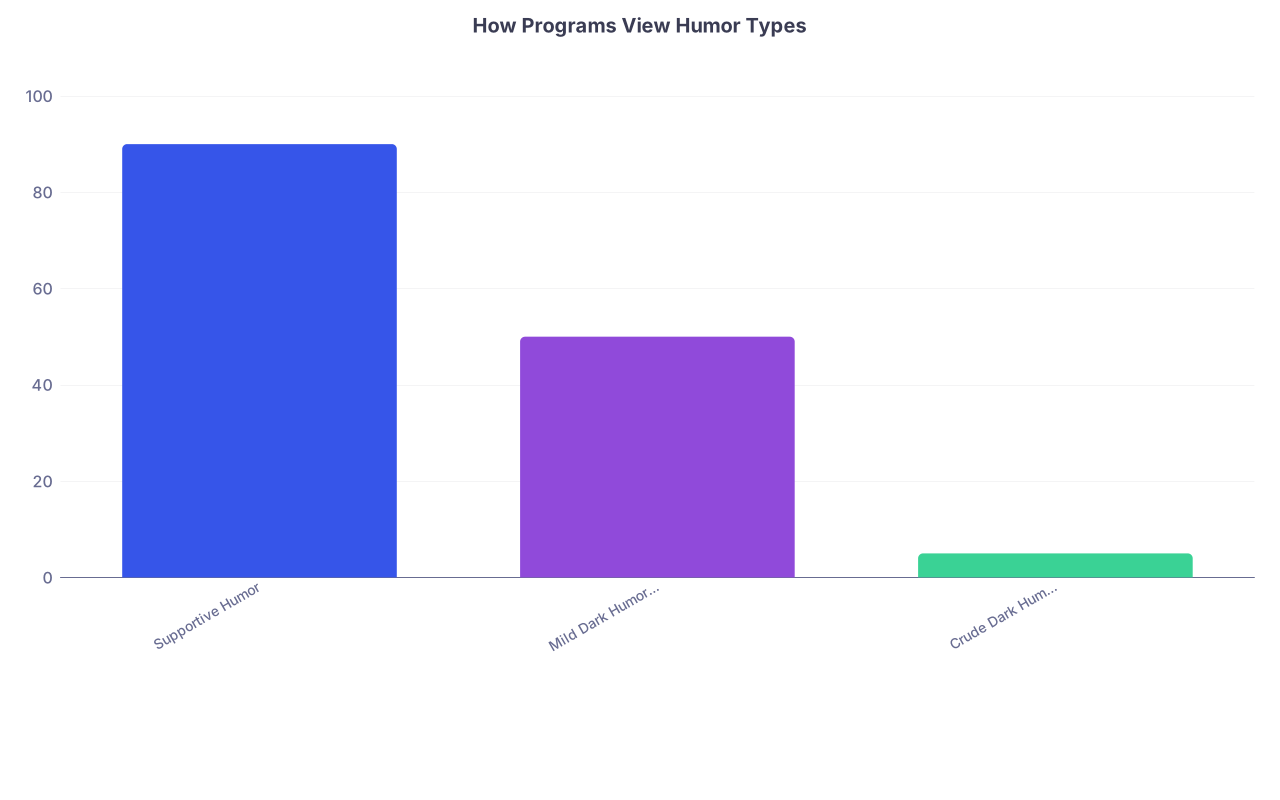
| Category | Value |
|---|---|
| Supportive Humor | 90 |
| Mild Dark Humor (Private) | 50 |
| Crude Dark Humor (Public) | 5 |
Rough breakdown of how most program leadership think:
- Supportive, self-deprecating, team-bonding humor → almost always okay
- Mild dark humor, private, about situations not patients → tolerated, sometimes even seen as “realistic”
- Crude, dehumanizing humor about patients, especially in public or recorded → not okay, and yes, people get disciplined for it
The Three Big Lines You Absolutely Cannot Cross
Use this as your working framework. If you remember nothing else, remember this.
There are three lines you can’t afford to cross if you care about your license, job, and reputation:
- Dehumanizing specific patients
- Being overheard by patients/families or non-medical staff
- Putting it anywhere permanent (text, chart, social media)
1. Dehumanizing Specific Patients
This is the fastest way to get labeled “unprofessional” and possibly reported.
Red flags:
- Jokes about a patient’s race, gender, weight, disability, or social situation
- Nicknames based on condition or appearance (e.g., “train wreck in room 4,” “the vegetable,” “the drunk in 7”)
- Laughing at the patient instead of the situation
Programs will not back you up on this. If someone complains, you’re on your own.
Safer target: the system or your own suffering, not the person.
Example of “safer” dark humor:
“I just did 10 hours of notes to say: ‘patient still sick.’”
Example of dangerous dark humor:
“She’s circling the drain; at least we won’t be doing medsurg orders for long.” (If that’s clearly about one identifiable patient.)
2. Being Overheard by Patients or Families
This one is non-negotiable. Program directors have zero patience here, because it’s indefensible.
If any of this is true, stop the joke before you start:
- In the hallway, elevator, or waiting area
- In semi-private ED bays
- On rounds near curtain-only partitions
- In any room or channel where you don’t control the audience
I’ve seen careers seriously dinged because a family member overheard a half-sentence, didn’t understand the context, and reported “they were laughing about my mom dying.” There’s no way to “explain” that in a way that lands well.
Treat public spaces like you’re mic’d and being recorded. Because half the time, you might be.
3. Putting It in Writing, Especially Online
If you remember one sentence from this article: do not put dark humor in any permanent or semi-permanent medium.
That means:
- No dark-humor posts about real patients on Instagram, TikTok, or Twitter/X
- No texts in clinic/hospital group chats joking about patients
- Definitely nothing in the chart that even hints at sarcasm or mockery

Residency and specialty boards have literally yanked people into professionalism committees for “funny” posts that referenced patients, even if “de-identified.” If someone in your hospital could guess who it is, you’re exposed.
If you want to make memes or jokes online, either:
- Keep it clearly fictional and generalized (not last night’s trauma patient)
- Or post only in truly anonymous, locked communities and still assume they could leak
What Programs Officially Say vs What People Actually Do
There’s a gap here.
Official line (handbooks, orientations, institutional policies)
This is almost always some version of:
- Maintain professionalism at all times
- Demonstrate respect and compassion for all patients
- Avoid derogatory or demeaning language
- Social media policies: never post patient information, maintain professional image, etc.
No program is going to publish: “Dark humor is normal, just don’t get caught.” They’re trying to protect patients and the institution.
Unofficial reality (what residents/attendings actually do)
Behind closed doors—call rooms, resident lounges, end of night shift huddles—you’ll hear:
- Jokes about absurd situations or system failures
- Self-deprecating humor (“I have the cognitive function of a potato after night float”)
- Sometimes very dark, trauma-adjacent humor used with trusted colleagues
Most senior residents implicitly teach you:
- Read the room. Some folks hate dark humor and that’s valid.
- Keep it to small, trusted groups.
- Focus jokes on the system, your own misery, or the absurdity—not patient identity.
| Scenario | How Programs Typically See It |
|---|---|
| Self-deprecating joke in resident room | Acceptable |
| Dark joke about a tragic case in private | Tolerated but not endorsed |
| Dark humor within earshot of families | Unacceptable, may trigger discipline |
| Dehumanizing language in chart | Severe professionalism issue |
| Patient-centered joke on public social media | High risk, often reportable |
How to Use Dark Humor Without Wrecking Your Reputation
Here’s the practical side. You’re not going to magically stop feeling the impulse to make a dark joke at 3 a.m. Your brain is trying to protect you. So you need rules.
Use this five-part filter:
Audience – Who can hear this?
Only people you trust, who share your context, and in a closed, private space.Target – What’s the butt of the joke?
Safer: the healthcare system, the workload, your own exhaustion, the randomness of disease.
Risky: specific patients, vulnerable populations, tragedies still unfolding.Format – Is it spoken and ephemeral, or written/recorded?
Spoken in a small, private group is the least risky format.
Anything that can be screenshotted: high risk.Timing – Is this immediate post-code processing, or casual day-shift banter?
Right after a horrible event, people accept that coping looks messy. Casual daytime hallway jokes read as callous.Impact – Did someone in the room go quiet, look uncomfortable, or walk away?
That’s a signal. If someone says, “Not cool,” don’t argue. Just say, “You’re right, sorry,” and move on.

| Step | Description |
|---|---|
| Step 1 | Think of dark joke |
| Step 2 | Do not say it |
| Step 3 | Probably okay, still read the room |
| Step 4 | Private space? |
| Step 5 | Trusted medical audience only? |
| Step 6 | Target is system or self? |
| Step 7 | Not written or recorded? |
If it fails any of those checks, skip it. You’re not boring; you’re smart.
Specialty Culture: Does It Really Differ?
Yeah, it does. Some services run darker than others.
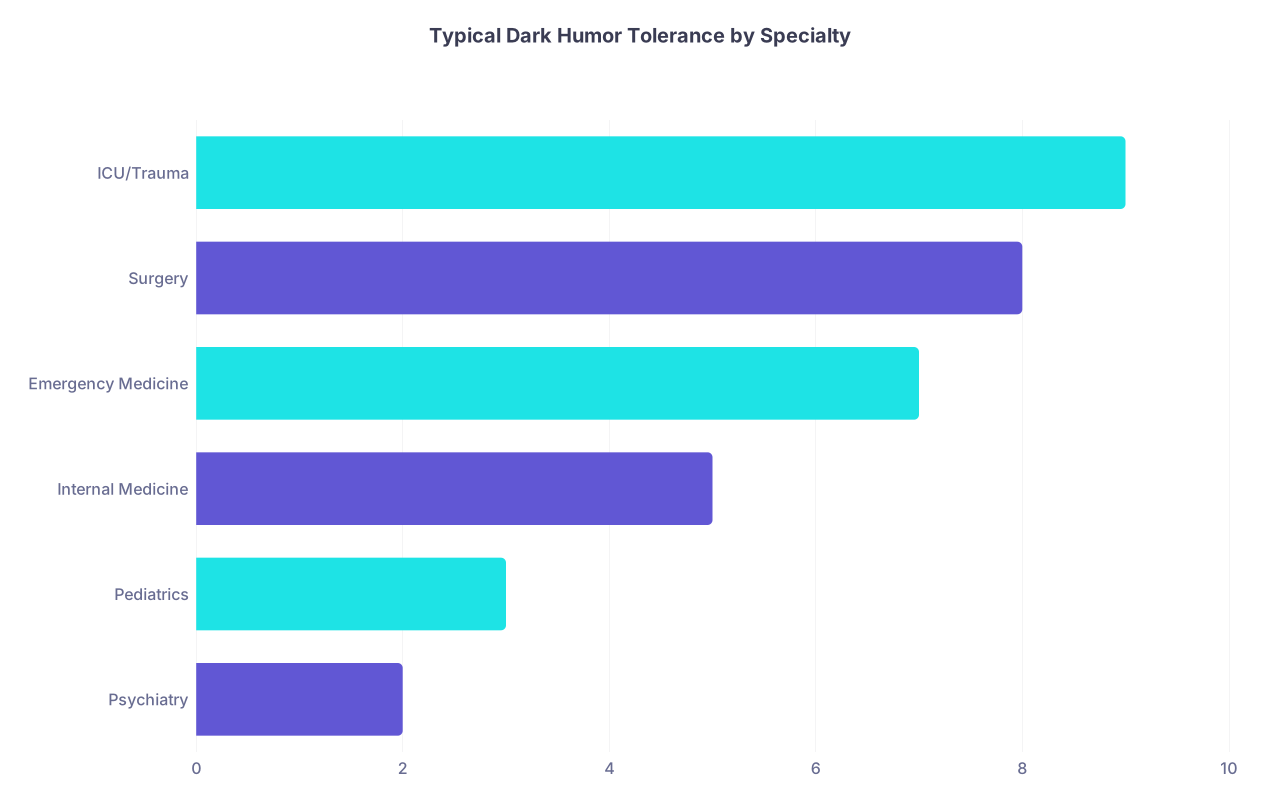
| Category | Value |
|---|---|
| Psychiatry | 2 |
| Pediatrics | 3 |
| Internal Medicine | 5 |
| Emergency Medicine | 7 |
| Surgery | 8 |
| ICU/Trauma | 9 |
Scale 1–10: higher = more dark humor baked into culture, not that it’s always appropriate.
- Psych / Peds: tend to emphasize gentler, supportive, or whimsical humor. Dark humor is usually more about burnout or system issues than patients.
- IM: mixed; some services are pretty straight-laced, others (night float, ICU) are darker.
- EM / Surgery / ICU: you’ll hear the heaviest gallows humor. Because the cases are relentless and graphic.
But remember: program leadership in all specialties cares about professionalism. You don’t get immunity because “this is how trauma people talk.”
Red-Flag Situations Where You Should 100% Avoid Dark Humor
These are the situations where even people who are usually okay with dark humor will judge you:
Immediately in front of grieving families
If you’re in or near a family meeting, code, or pronouncement—no jokes. Even to “lighten the mood” for the team. It looks cruel.Interdisciplinary settings where you don’t know the culture
New hospital, new rotation, consultants you don’t know? Assume low tolerance until proven otherwise.Around students or pre-meds you barely know
You have no idea who’s going to quote you later as “my resident said…” in a dean’s meeting.In evals, emails, or anything that touches the official record
Don’t get cute in evaluations, emails to attendings, or case logs. That’s how you end up with a “professionalism concern” that follows you.With anything that has a discriminatory angle
If the joke relies on racism, sexism, homophobia, transphobia, fatphobia, or mocking addiction/mental illness—just don’t. That’s not coping; that’s being an ass.

Alternative Coping Tools That Won’t Get You Written Up
You don’t have to pick between “never laugh again” and “career-ending comment.” There are other ways to bleed pressure.
Try:
Self-directed humor
“I just dictated the same note three times because my brain is running Windows 95.”System/absurdity humor
“We spent $50,000 to keep this person alive and $0 to make sure they can afford meds at discharge. Seems solid.”Supportive, bonding humor
Teasing each other in kind, non-cruel ways. Running jokes about the pager, the coffee, the broken elevator. Inside jokes about harmless stuff.Private decompression
Venting 1:1 with someone you trust, explicitly naming your emotions instead of converting everything into jokes: “That case messed me up more than I thought.”

Many programs are actually pushing for this—peer support, Schwartz Rounds, formal debriefs—precisely because they know that if they don’t give people safe outlets, they’ll drift into darker and riskier humor.
Quick Self-Test: Did I Just Go Too Far?
After you say something, use this mental checklist:
- Did anyone look uncomfortable or stop talking?
- Would I be okay with my words on the front page of the local paper, with my name underneath?
- If a patient’s family was secretly standing behind me, would I feel sick to my stomach right now?
- Would I be comfortable repeating this line to my PD in a professionalism review?
If the answer to any of those is “no,” the humor was probably across the line. Learn from it and tighten your filter. Don’t turn it into a hill to die on.
FAQ: Dark Humor in Medicine
1. Is dark humor ever actually “okay” in medicine, or should I avoid it completely?
It’s okay in very specific, controlled contexts: private, trusted colleagues, focused on situations not patients, and never recorded. Most programs quietly accept that as normal coping. What they don’t accept is dark humor that’s dehumanizing, public, or documented.
2. Can I get in real trouble for a dark joke if no patient heard it?
Yes, depending on who heard it and what you said. A co-resident, nurse, or student can still report you for unprofessional or discriminatory behavior. If the content is bad enough (racist, sexist, mocking patient disability), you can absolutely land in a professionalism hearing even without a patient directly involved.
3. Is it okay to follow or create medical memes that use dark humor?
Following? Generally fine. Creating? More dangerous. If your memes are clearly fictional, generalized, and don’t resemble real cases in time, place, or details, risk is lower. If they’re obviously about last night’s patient or your hospital’s specific tragedy, that’s a problem. Always assume screenshots can and will escape your intended audience.
4. How do I handle a co-resident whose dark humor makes me uncomfortable?
You’ve got options. On the spot, you can say something like, “Hey, that one feels a little over the line for me.” Or just go quiet so they can feel the shift in the room. If it’s persistent or discriminatory, talk to a chief or someone you trust. You’re not oversensitive for wanting basic respect for patients.
5. Do attendings and program directors really use dark humor too?
Many do—in private, with peers at their level, and usually with more restraint. You might not see it as a student because they’re filtering around you. Don’t take an attending’s private remark as permission for you to say the same thing in a group of interns or online. Power and context matter.
6. What about charting something like “frequent flyer” or “drug seeker” as a joke?
Don’t. Ever. Charts are legal documents. They get read in court, by auditors, by future clinicians. Slang, sarcasm, and labels like “drug seeker” not only look terrible, they can bias care and seriously damage your reputation. If you think behavior is concerning, describe it neutrally and factually.
7. I made a dark joke and someone called me out—what should I do now?
Don’t get defensive. Simple script: “You’re right, that was too much. I’m sorry.” Then adjust. If you’re worried it might travel upward, you can also have a direct, brief follow-up with the person: “I’ve been thinking about what I said earlier—thanks for calling me on it; I’m tightening up how I cope.” That shows insight, which is what programs care about most.
Today, pick one concrete rule for yourself—maybe “no dark jokes in hallways or texts, ever”—and commit to it for your next week on service. You’ll still cope, you’ll still connect with your team, and you’ll keep your name far away from any professionalism email threads.