
The belief that “real” doctors must laugh at dark medical jokes is nonsense.
You’re not broken. You’re not less “resilient.” And you’re not destined to fail in medicine if you don’t find dark jokes funny.
Here’s the straight answer: you do not need to enjoy dark humor to survive or succeed in healthcare. You only need one thing—healthy ways to cope with stress and suffering. Dark humor is just one (imperfect) tool some people use. That’s it.
Let’s break this down like an actual clinical question.
The Core Answer: No, You Don’t Need to Like Dark Jokes
If you’re asking, “Should I worry if I don’t find dark medical jokes funny?” the answer is: No. Do not worry.
What your reaction usually means:
- You’re paying attention to suffering.
- You still feel the weight of what’s happening to patients.
- Your empathy wiring is intact.
That’s not a liability. That’s the whole point of the profession.
People in medicine use different coping styles. Some:
- Laugh at dark jokes
- Go quiet and compartmentalize
- Debrief honestly with trusted colleagues
- Cry in the call room and then get back to work
- Run, paint, lift, play music, game, journal… whatever
The myth is that dark humor = “strong” and not laughing = “too soft.” That’s wrong. I’ve seen some of the most clinically solid, unflappable intensivists be very uncomfortable with dark jokes. I’ve also seen people who constantly crack edgy jokes crumble in a real crisis because the humor was hiding zero actual coping skills.
You’re fine. The real question is not “Why don’t I laugh?” It’s “How do I handle what I’m seeing?”
If you can answer that with something healthier than “I shove it down and hope it dissolves,” you’re ahead of the game.
Why Dark Medical Humor Exists (And Why It’s So Common)
You are not imagining it. Dark humor is everywhere in medicine:
- Residents joking about “frequent flyers”
- ICU teams making grim comments after a multi-code night
- ED staff using sarcasm about “Friday night special” traumas
Why? Because medicine is a perfect recipe for gallows humor:
- Constant exposure to suffering, death, unfairness
- High responsibility, low control
- Chronic sleep deprivation and decision fatigue
- Cultural expectation to be calm and stoic
Dark humor gives people:
- Distance – Turning horror into a punchline shrinks the emotional impact.
- Bonding – You laugh together, so it feels like “we’re in this together.”
- Control – If they can joke about it, it feels less like it’s crushing them.
In other words: it’s a pressure valve. Sometimes functional, sometimes not.
But it’s not mandatory equipment. It’s one strategy, not the strategy.
What It Might Mean If Dark Jokes Bother You
If dark jokes make you uncomfortable, anxious, or even angry, that doesn’t mean you don’t belong. It means something about your values is clashing with the behavior in front of you.
There are a few common patterns I’ve seen.
1. Strong identification with patients
You hear a joke about a patient and your brain goes:
“Wait, that’s someone’s mom / kid / partner. This is awful.”
That’s empathy doing exactly what it’s supposed to do. It can feel like you’re the only one seeing the human in the joke. You aren’t. Others are just managing that tension differently.
2. Fear of becoming “jaded”
You’re scared that laughing will turn you into That Doctor:
- The one who refers to people only as “the appy” or “the train wreck in 12”
- The one families pick up on as “cold”
- The one who seems more into the story than the suffering
So you resist the humor because you don’t want to slide into that version of yourself. That’s actually a sign you’re thinking carefully about your professional identity.
3. Past trauma or personal triggers
Sometimes the topic of the joke hits close to home:
- You’ve lost someone to something similar.
- You’ve been a patient or caregiver yourself.
- You grew up in a context where joking about serious things was weaponized.
Then it’s not “just a joke” to your nervous system. It’s a threat. Your discomfort is your brain trying to protect you.
The Real Risk: Not Your Sense of Humor, But Your Coping
Here’s the part you should pay attention to.
You should worry only if both of these are true:
- You are constantly emotionally flooded (sad, angry, anxious) by what you see,
- And you have no coping tools that work for you.
That’s not a humor problem. That’s a coping and support problem.
You do not fix that by forcing yourself to laugh at things you actually hate. That just adds self-betrayal to the pile.
You fix it by building your own toolkit. For example:
- A short, honest vent with a person you trust: “That case wrecked me.”
- Micro-reflection: jotting 3–5 lines after a shift about a patient that stayed with you.
- Physical reset: 10–15 minutes of movement after call before you go home.
- Ritual: washing your hands intentionally before leaving the unit as a mental “handoff.”
You can be the person who says: “I don’t do dark jokes, but I do decompress in X way.” That’s completely legitimate.
How to Respond In the Moment When You Don’t Find It Funny
This is the practical part people usually want: What do I actually do when everyone laughs and I’m just… not?
You have roughly four options, depending on situation and power dynamics.
1. Neutral non-participation (most common)
You let it pass.
- Small smile or no expression.
- Don’t pile on, don’t scold.
- Physically stay but mentally note, “Not for me.”
Example: You’re MS3 on surgery, chief makes a dark joke about a patient’s noncompliance. You don’t laugh, you look down at your note, they move on. No need for a speech.
2. Gentle redirect
If you have some relationship capital or the joke just crossed a line you can’t ignore:
- “Oof, that one’s a bit too real for me.”
- “Man, that case actually really got to me.”
- “I’m still thinking about the family from that one.”
You’re not attacking, you’re signaling discomfort. Often people will actually soften instantly—because most of them don’t want to be cruel, they’re just on autopilot.
3. Hard boundary (for truly inappropriate or dehumanizing stuff)
This is for blatantly racist, sexist, or overtly abusive “jokes.” Different category.
Short, firm responses:
- “Not okay.”
- “Let’s not talk about patients like that.”
- Silence + leaving the room.
Will this be comfortable? No. But some things really do deserve zero complicity. Pick these battles strategically, but don’t gaslight yourself into thinking you must accept everything to “fit in.”
4. Private processing later
If you freeze in the moment (very normal), step away later:
- Talk to a peer, trusted senior, or mentor: “That moment bothered me. Am I overreacting?”
- Reality-check: what was the joke, what was the context, what values got hit?
- Decide in advance how you’d like to respond next time.
You do not have to always respond live to still keep your integrity.
Dark Humor vs Red Flags: When It’s Actually a Problem
There’s a difference between “this joke is not my taste” and “this is a toxic environment.”
Here’s a quick comparison:
| Pattern | More Normal Use | Possible Red Flag |
|---|---|---|
| Frequency | Occasional, situational | Constant, every interaction |
| Target of joke | Situation, system, self | Specific patients or groups |
| After serious events | Used once to decompress | Used to mock or blame |
| Reaction if called out | Will back off or apologize | Gets defensive or escalates |
| Impact on care | No change in bedside care | Obvious contempt, worse care |
You’re not looking for a “purified” environment with zero dark humor. That doesn’t exist. You’re looking to avoid places where cruelty is rebranded as “just our sense of humor.”
If you’re consistently seeing:
- Open contempt for entire patient groups,
- Staff taking pride in being “cold” or “heartless,”
- Laughter at suffering in front of patients/families,
then your instinct to recoil is accurate. That is not “you being too soft.” That’s you detecting a cultural problem.
How This Ties Into the Future of Medicine
The old script in medicine was: “You harden or you break.” Dark humor was part of the hardening ritual.
The newer script—slowly, painfully emerging—is more nuanced:
- Yes, you need some emotional boundaries. You cannot absorb every tragedy.
- No, desensitization is not the same as professionalism.
- Yes, different people cope differently, and team culture should allow for that.
You’re going to see more:
- Formal debriefs after codes or bad outcomes.
- Schwartz Rounds–style sessions about the emotional side of care.
- Wellness structures that are more than donuts and “resilience” posters.
In that context, people who don’t default to dark jokes sometimes become the ones who:
- Name the emotional reality first.
- Model healthier, more authentic processing.
- Help shift the culture away from “we only cope by laughing at the abyss.”
So no, your discomfort is not an obstacle to the future of medicine. It actually fits the direction things need to move.
A Quick Self-Check: Are You Actually Okay?
If you’re uneasy about your reaction to dark humor, run a short internal assessment. Be honest.
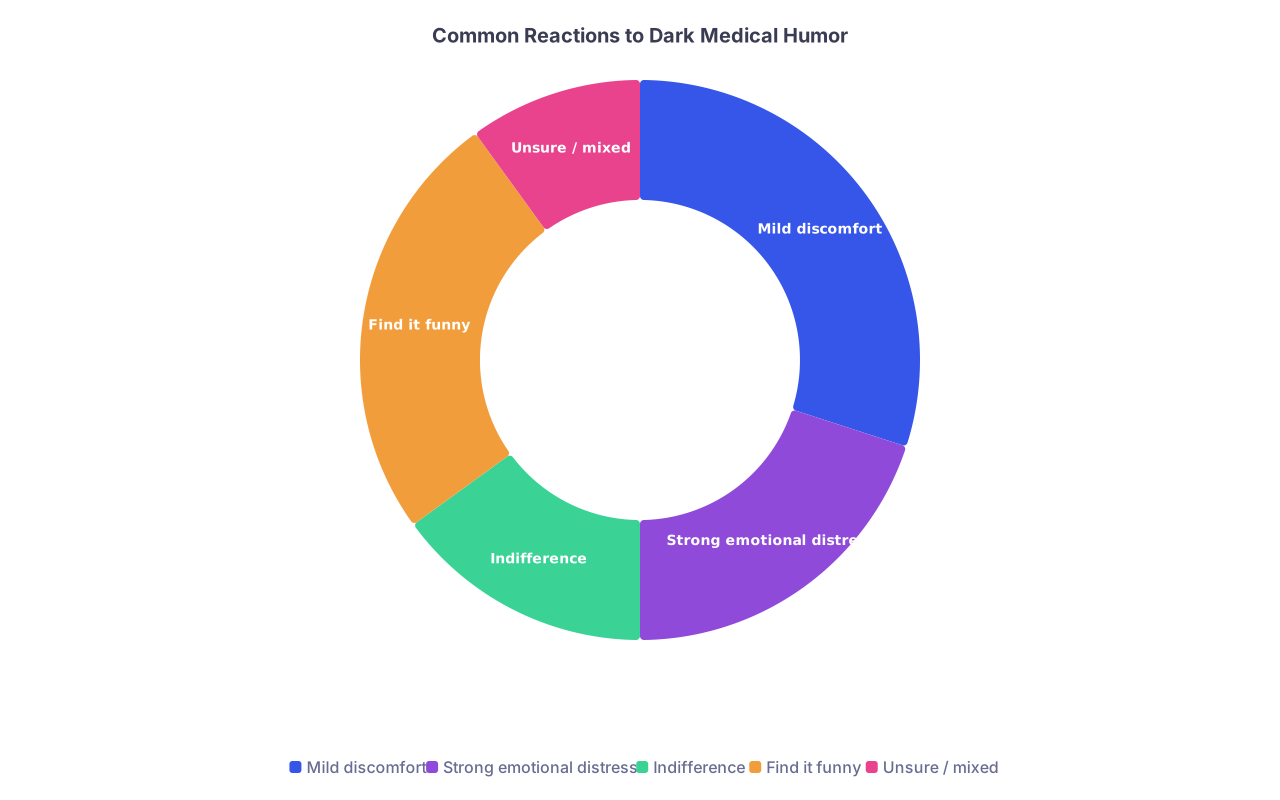
| Category | Value |
|---|---|
| Mild discomfort | 30 |
| Strong emotional distress | 20 |
| Indifference | 15 |
| Find it funny | 25 |
| Unsure / mixed | 10 |
Ask yourself:
- Do I sleep reasonably well, or am I lying awake replaying cases?
- Can I enjoy non-medical life, or do I feel constantly numb or wired?
- Do I have at least 1–2 people in medicine I can be honest with?
- When I’m bothered by a joke, can I process it and move on, or does it stick and build?
If you’re constantly stuck, not just occasionally disturbed, that’s a signal to get more support—regardless of your humor style.
What You Can Actually Do Today
Here’s a simple, concrete plan:
Decide your stance.
Say it clearly to yourself: “I don’t have to laugh at dark jokes to belong in medicine. I’ll cope in ways that fit my values.”Pick one coping tool to strengthen.
Maybe journaling three lines after a rough shift. Maybe a 10 minute walk before you drive home. Maybe debriefing with one trusted colleague.Plan a default response for next time.
Something short you can use on autopilot:- “That one’s too dark for me.”
- Or just a neutral face and silence.
That’s it. You’ve now got intention, a coping tool, and a script.

| Step | Description |
|---|---|
| Step 1 | Hear dark medical joke |
| Step 2 | Ignore or lightly engage |
| Step 3 | Neutral non participation |
| Step 4 | Set boundary or step away |
| Step 5 | Process later with trusted person |
| Step 6 | Reflect on your own coping style |
| Step 7 | How do you feel |
FAQ: Dark Medical Humor and You (7 Questions)
Does not liking dark medical jokes mean I am too sensitive for medicine?
No. It means your empathy and values are intact. Sensitivity is not the enemy. Inability to function is. If you can still care for patients, make decisions, and recover after hard days, you’re fine. Many excellent clinicians dislike dark humor and do just fine.Will I be socially isolated if I do not participate in dark humor?
Usually not, unless the culture is truly toxic. Most teams have a mix of people: some crack jokes, some smile quietly, some do not engage. You can still bond through shared work, good clinical questions, helping others, and sincere conversations. You don’t need to be the “funny one,” and you don’t need to fake-laugh at jokes that feel wrong to you.Should I confront colleagues who make dark jokes I dislike?
It depends on the content, your safety, and the power dynamics. For mildly uncomfortable jokes, simple non-participation or a gentle “too dark for me” is enough. For jokes that are clearly discriminatory or dehumanizing, a firmer boundary or quietly talking to a trusted senior, chief, or program leadership might be appropriate. You do not have to police every joke to keep your integrity.Is it unprofessional to use dark humor at all?
Context is everything. Dark humor in a private team room, never within earshot of patients or families, and not targeting specific groups or individuals is common and often tolerated. Doing it in front of patients, online, in charts, or in public spaces is unprofessional and can be career-ending. Even if you personally use dark humor, keep it far away from any context where it can harm trust.Will exposure to dark humor eventually make me numb to patient suffering?
Not by itself. Some people can joke in the workroom and then be deeply compassionate at the bedside. Others do feel themselves becoming numb—and that’s the real warning sign. Watch your own bedside behavior. If you’re starting to feel indifferent, contemptuous, or annoyed by legitimate suffering, that’s a bigger issue than what you laugh at with colleagues.How do I explain my discomfort to peers without sounding judgmental?
Keep it about your reaction, not their character. For example: “I know people cope differently, but that kind of joke really gets to me,” or “I’m still thinking about that family, so I can’t laugh about it yet.” You’re owning your own stance without labeling them as bad people. Most reasonable colleagues will respect that and adjust around you, at least somewhat.Could disliking dark humor be a sign I’m burning out?
It can be, but not always. Sometimes burnout looks like not being able to tolerate anything extra—jokes, small talk, anything. If your dislike of dark humor is paired with exhaustion, cynicism, dreading work, or feeling useless, then yes, burnout might be in the Mix. If you’re otherwise functioning and just find certain jokes gross or sad, that’s just preference and values, not pathology.
Open your notes app (or a scrap of paper) and write one sentence: “Here’s how I will cope with hard cases without using dark humor…” Fill in that blank with something that actually fits you. That’s your next step, not forcing yourself to laugh at jokes you don’t believe in.