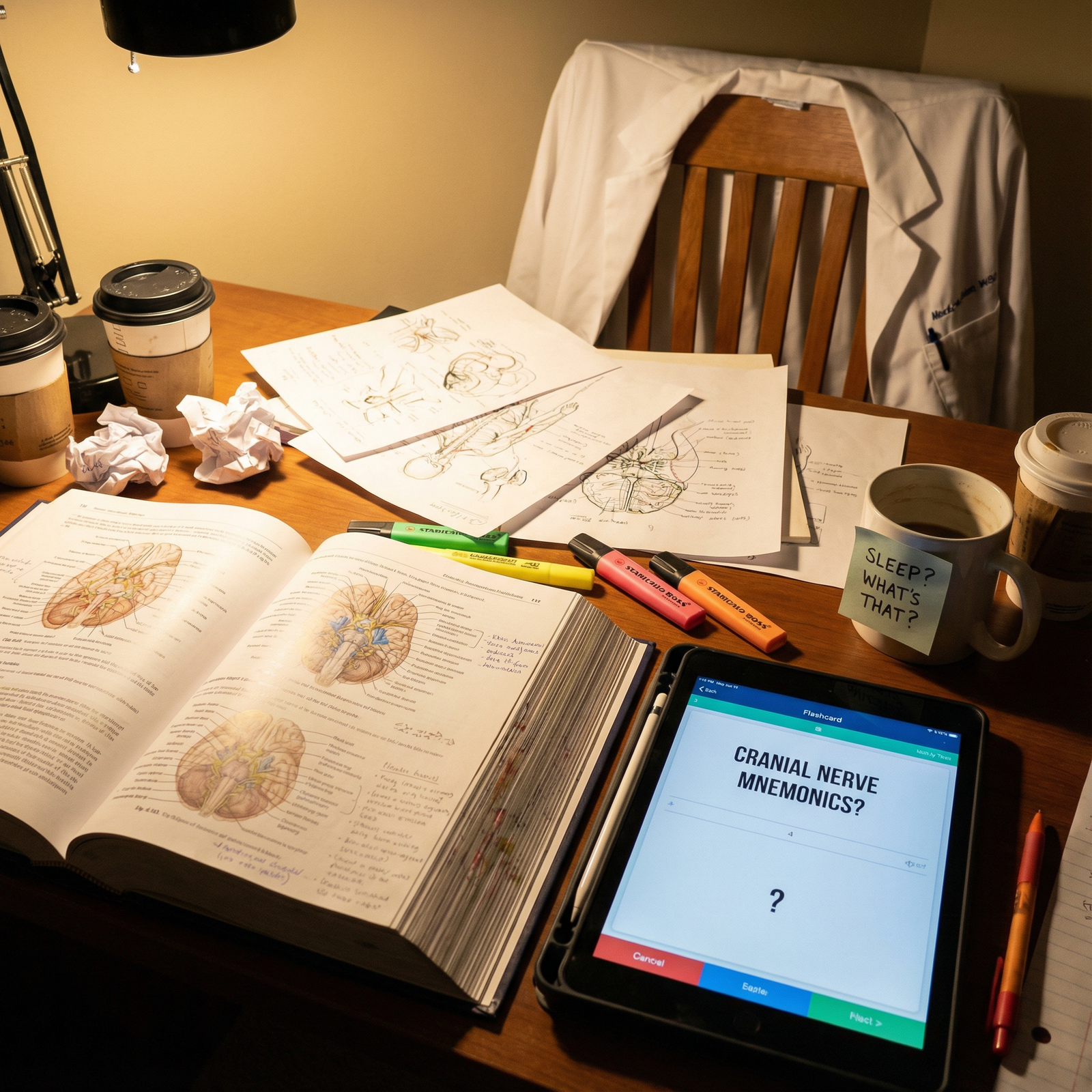
You’re on hour 9 of your medicine clerkship. Vitals are stable, the EMR is freezing every 10 minutes, and your resident just dropped a joke so dry you’re not sure if it was humor or a cry for help. Later, a standardized patient tells you, “You seem nice, but you’re a bit…serious. You can loosen up.”
And now you’re wondering: are we actually going to get graded on jokes someday? Are med schools really going to add “humor training” to the curriculum?
Here’s the blunt answer:
Yes—some version of “humor training” is coming. Not a stand-up comedy elective. But deliberate, teachable skills around using humor safely, ethically, and effectively with patients and teams.
Let’s unpack what that actually looks like—and what would be smart versus dumb ways to do it.
1. Why people are even talking about “humor training”
Start with the why. Because otherwise this sounds like a wellness committee fever dream.
We already have data—solid, boring, peer‑reviewed data—that humor in clinical care:
- Lowers patient-reported anxiety and pain scores
- Improves patient satisfaction
- Helps build rapport and trust faster
- Supports team cohesion and reduces burnout reports
No, a dad joke will not cure sepsis. But in the “soft skills that actually change outcomes” category, humor lives in the same neighborhood as empathy, clear communication, and bedside manner. Those are already explicit curricular goals.
Schools have:
- Communication skills courses
- “Difficult conversations” workshops
- OSCE stations on breaking bad news
Humor is currently treated as “either you have it or you don’t.” That’s lazy. A lot of what you think is “natural humor” is actually timing, awareness, and boundaries. Those are teachable.
So the real push is this: if we’re already teaching how to talk like a doctor, why are we ignoring one of the main ways humans actually talk to each other—through shared laughter?
2. What “humor training” in med school would actually look like
Let me kill one misconception up front:
Nobody serious is proposing mandatory improv troupes for all MS2s.
Realistic “humor training” looks much more like structured communication training with a humor module, not a comedy class.
Here’s what I expect to see in future curricula.
A. A short, required module: Humor as a clinical tool
Think 2–4 sessions folded into existing communication or professionalism courses. Content like:
What humor can do:
- Reduce perceived power distance
- Humanize you in a dehumanizing system
- Help patients talk about fear or shame
Where humor is risky or flat‑out dangerous:
- Around identity (race, gender, religion, body size, disability)
- In moments of acute distress (new cancer diagnosis, code situation)
- When it punches down or excludes someone in the room
Patient perspectives:
- Clips or transcripts of real patients saying:
- “I loved when my doctor did this…”
- “I felt mocked when they joked about that…”
- Clips or transcripts of real patients saying:
This is not about “being funny.” It’s about not being a social disaster in high‑stakes rooms.
B. Practice scenarios: When to use humor and when to shut up
The good stuff happens in practice.
You run through OSCE‑style or role‑played encounters like:
- A patient making a self‑deprecating joke about their weight
- A teen with chronic disease using dark humor
- A family member using humor to avoid talking about prognosis
- A resident making a questionable joke in front of a patient
You practice three basic moves:
- Join lightly (if appropriate)
- Pivot from humor to serious content
- Gently shut down or redirect harmful humor
No one grades you on joke quality. They grade you on judgment and empathy.

| Step | Description |
|---|---|
| Step 1 | Patient interaction |
| Step 2 | Build basic rapport first |
| Step 3 | Match tone lightly or validate |
| Step 4 | Avoid humor and stay present |
| Step 5 | Use gentle, inclusive humor |
| Step 6 | Check reaction and adjust |
| Step 7 | Is patient relaxed? |
| Step 8 | Is humor patient led? |
| Step 9 | Is situation serious or sensitive? |
3. Why this matters more in the future, not less
You’d think with more tech, more screens, and AI everywhere, humor would matter less. Wrong. It’ll matter more. Here’s why.
A. Patients will be comparing you to bots
If an AI can give them textbook‑perfect explanations, what makes you worth seeing?
- Humor
- Warmth
- Shared humanity
I’ve watched patients say, “That young doc really got me” simply because the resident laughed with them about forgetting their pillbox again, then turned it into a collaborative problem‑solving moment. That’s not something a script generator is going to replicate well.
Humor is one of the fastest ways to signal:
“I see you as a person, not a lab result.”
B. Burnout and team morale are not going away
The work is not getting easier. The paperwork is not decreasing.
The healthiest teams I’ve seen, in ICUs and EDs especially, have very intentional humor norms:
- “We never joke about patients.”
- “We debrief hard cases, even if it’s via dark humor, but we name it.”
- “We use gallows humor only with people who signed up for the job, never within earshot of families.”
No one teaches this explicitly now. You either absorb good culture or terrible culture. That’s not a strategy.
Humor training gives language to what’s already happening:
- When is dark humor a coping skill?
- When has it turned into cynicism that’s hurting care?
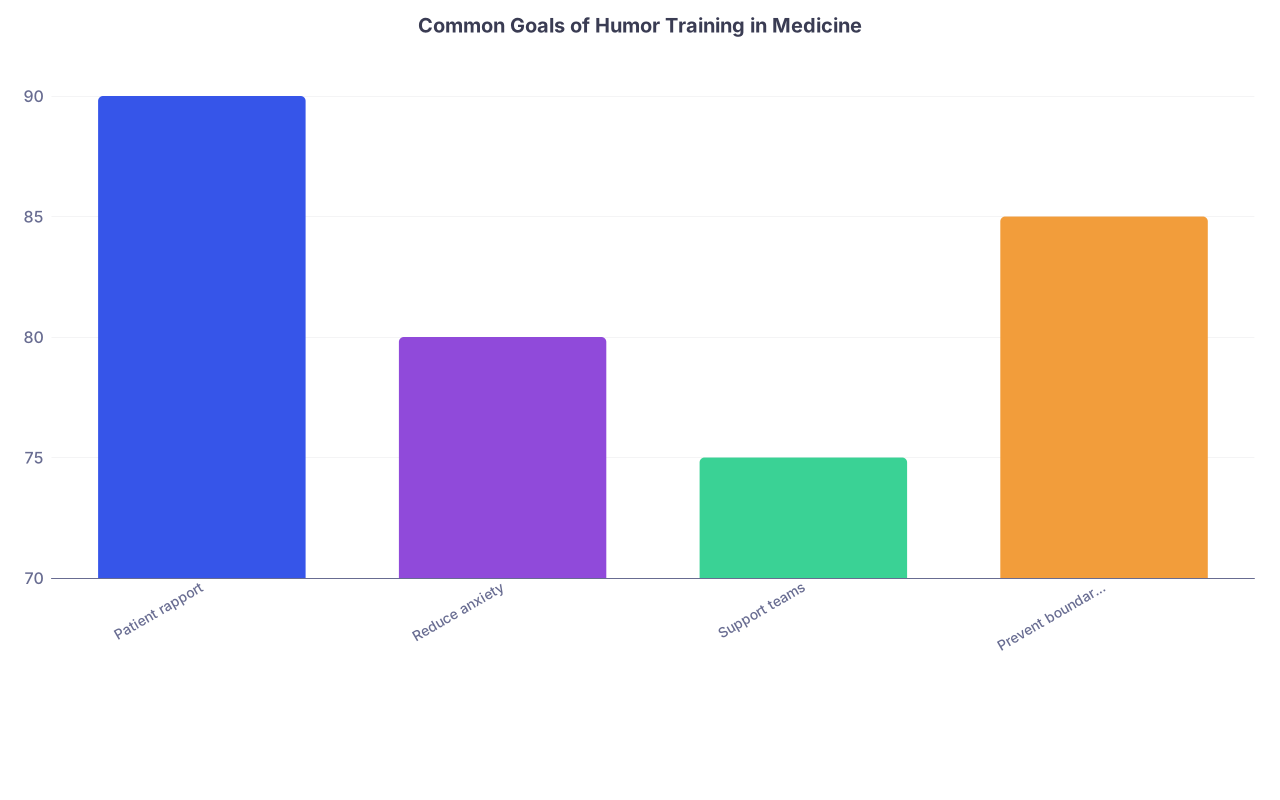
| Category | Value |
|---|---|
| Patient rapport | 90 |
| Reduce anxiety | 80 |
| Support teams | 75 |
| Prevent boundary issues | 85 |
4. What good humor training would include (and what would be a waste of time)
If curriculum committees are smart, they’ll resist the urge to turn this into a cutesy side project. Here’s the substance that actually helps.
Non‑negotiables for useful “humor training”
Ethics and boundaries first
- Humor is a power tool. Misused, it hurts the most vulnerable.
- This belongs next to professionalism, not entertainment.
Patient‑led examples
- Real patient stories of when humor healed and when it hurt.
- Not just physicians talking about how funny they think they are.
Attention to culture, trauma, and identity
- Humor is not universal.
- Patients with trauma histories, from marginalized groups, or in certain cultural contexts may interpret the same joke very differently.
Team dynamics and hierarchy
- How attendings’ jokes land differently than interns’.
- How to handle when your senior says something inappropriate in front of the team.
- How not to throw your colleagues under the bus while still protecting patients.
Space for your own style
- Some of you are naturally dry. Some, more goofy. Some, barely crack a smile.
- Training should help you find your authentic way to be warm and occasionally light, not force everyone into “TED‑talk funny doctor” mode.
Things that would be pointless or actively harmful
- Mandatory “everyone do improv!” for introverts
- Grading students on being “funny enough”
- Encouraging banter in high‑risk, emotionally intense moments
- Teaching canned “doctor jokes” (most of them are cringe and outdated)
If your school ever rolls out “Humor 101: Learn These 20 Jokes,” feel free to revolt.
| Aspect | Good Implementation | Bad Implementation |
|---|---|---|
| Focus | Ethics, safety, rapport | Entertainment, being funny on command |
| Format | Role plays, OSCE‑like practice | Lectures with no practice |
| Evaluation | Judgment, empathy, boundary awareness | Humor quantity or funniness |
| Content Source | Patient stories, real cases | Meme slides and random stand‑up clips |
| Cultural Awareness | Explicitly addressed | Ignored or treated as “common sense” |
5. Will you be tested on this? Probably—just not the way you think
This part matters if you’re still a student:
You are already being assessed on this. No one calls it “humor,” though.
What do standardized patients comment on in OSCEs?
- “I felt rushed”
- “They seemed cold / robotic”
- “They didn’t respond when I tried to lighten the mood”
That last one? That’s humor and emotional attunement. Right now it’s hiding under “interpersonal skills.”
Future versions might be more explicit:
- Checkboxes like “responded appropriately to patient’s attempt at humor or emotional shift.”
- Narrative feedback like “missed opportunity to use slight levity to reduce tension” or “overused humor in a serious context.”
I’d expect:
- No separate “humor score”
- But integrated expectations inside communication and professionalism rubrics
If you’re imaging Step 3 multiple choice questions like:
“Which of the following is the funniest response to the patient?”
Relax. That’s not where this is headed.
6. How you can actually get better at using humor with patients (right now)
Forget future curricula for a minute. You can level up this skill yourself, today, without waiting for your school to catch up.
Three practical habits:
Notice your own default mode
- Do you get awkward when patients joke?
- Do you overcompensate with too much joking?
- Do you go totally flat in any emotionally intense encounter?
Awareness beats autopilot.
Borrow light lines that are clinically safe
You do not need to be wildly original. Some simple, low‑risk, rapport‑building lines that usually land:Patient apologizing for not remembering meds:
“If you remembered every pill name, I’d be out of a job. We’ll figure it out together.”Patient making a mild self‑deprecating remark (non‑trauma, non‑identity based):
“Hey, we are not here to criticise you. We’re here to team up on this problem.” (Often with a small smile or light tone.)When the room is tense but not tragic and you need a reset:
“Ok, let’s hit pause for a second and take a breath. No pop quiz, no judgment—just you and me trying to make a plan.”
None of these are hilarious. They’re human. That’s the point.
Ask for feedback from someone who actually watches you
- Grab a senior resident or attending you trust and say:
“How do I come across with patients—too serious, too casual, just right?” - Tell them you’re specifically working on responding better when patients try to lighten the mood.
- Grab a senior resident or attending you trust and say:
Most good clinicians will give you concrete examples:
“You do great with older patients but shut down with teens,”
or “You sometimes joke too much when things are serious; I’d pull back there.”
That’s way more valuable than a theoretical lecture.
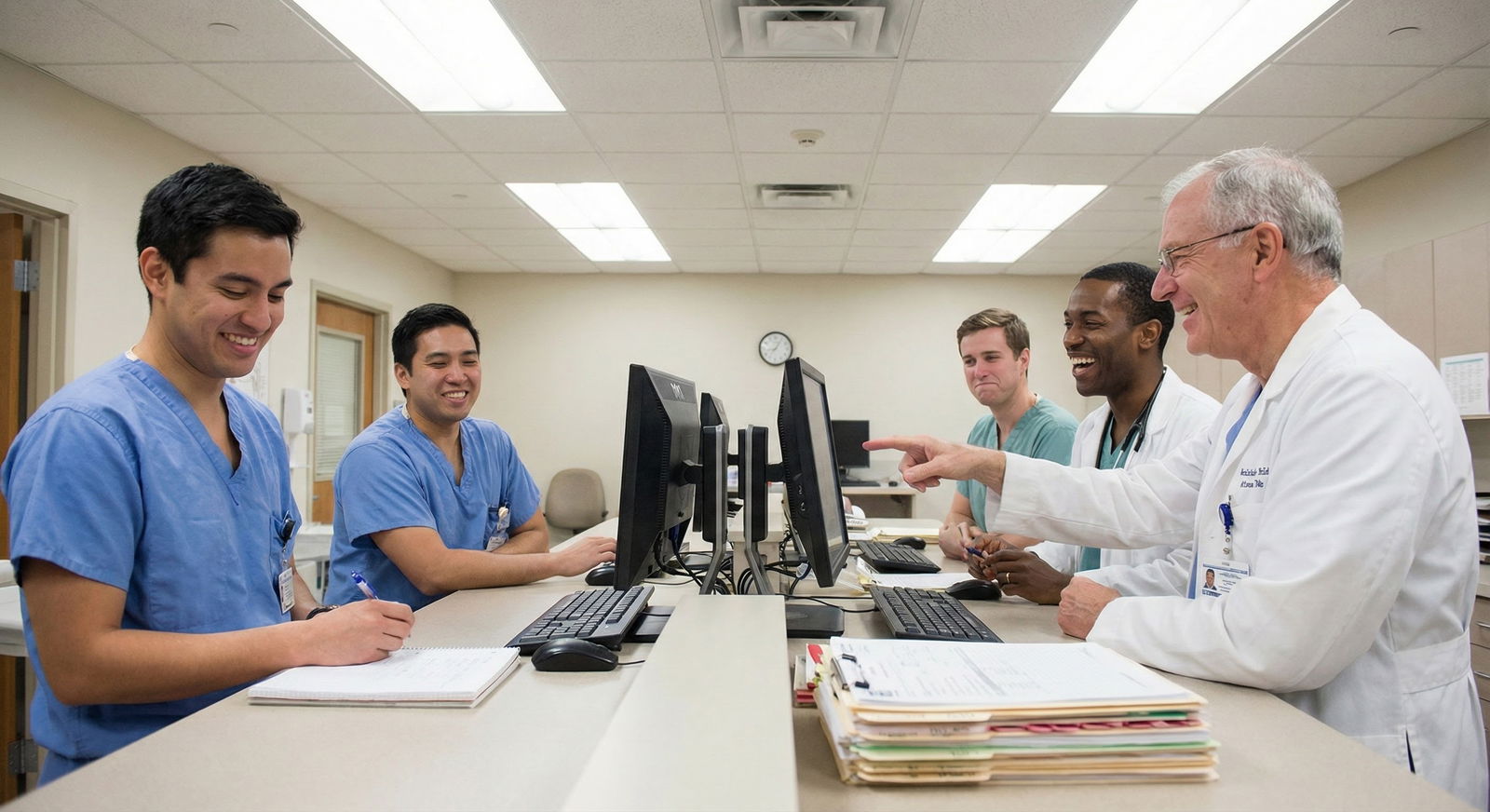
7. So…will future docs need humor training?
Yes. Because:
- Patients are humans first and disease processes second.
- You’re competing with increasingly polished, non‑human tools.
- Teams under chronic stress need healthy, not toxic, ways to cope.
- We’ve already accepted that communication skills are core clinical skills. Humor is just the part no one has named yet.
No, we do not need a generation of wannabe stand‑up comics in white coats. The goal is simple:
Doctors who know when a small shared laugh helps, and when silence and presence matter more.
Humor training, if done right, is not about getting you to crack more jokes.
It’s about making sure that when humor shows up—as it always does—you know what you’re doing with it.
FAQ: Humor Training in Medical Education
1. Will I ever be required to take a “humor class” in med school?
You’re unlikely to see a course literally titled “Humor 101,” but you’ll probably see humor folded into communication skills, professionalism, or wellness sessions. Think: a few lectures or workshops on responding to patient humor, avoiding harmful jokes, and using lightness appropriately—not a full semester class.
2. Can humor actually be taught, or is it just a personality thing?
You can’t turn every student into Robin Williams in “Patch Adams,” and you shouldn’t try. But you can teach: timing, reading the room, red‑flag zones where humor is risky, and safer ways to respond when patients crack jokes. Those are skills, not inborn talents.
3. Is dark humor in medicine always wrong?
No. In closed, trusted teams, dark humor can be a coping mechanism. The line is: does it ever touch patients or families, does it punch down, and does it make you more cynical instead of helping you process? Training should help clinicians recognise when dark humor is healthy venting and when it’s a warning sign for burnout or compassion fatigue.
4. Could humor training hurt me on evaluations if I’m just not very funny?
It shouldn’t, if done correctly. The goal is not “be funnier,” it’s “avoid harm and connect with patients.” You can score well by being warm, respectful, and appropriately responsive to patient tone—even if you almost never crack a joke yourself.
5. What’s one thing I can start doing today to improve my use of humor with patients?
Next patient who makes a light joke—about the gown, the hospital food, their own nervousness—do not ignore it. Briefly acknowledge it (“Yeah, those gowns are not exactly high fashion”), smile, then smoothly return to the clinical task. That one move—notice, join lightly, then steer—will make you noticeably more human without turning you into a clown.
Today’s next step:
On your very next patient encounter, pay attention to the first moment where the patient smiles, laughs, or makes a light comment. Afterwards, jot down what they said and how you responded. Then ask yourself honestly: did I lean into that human moment, or bulldoze past it? That tiny audit is your real “humor training” starting now.