
You’re in a cramped clinic room on a Friday afternoon. The EMR is lagging, the patient looks exhausted, and you’re about to say something a little funny to break the tension. Your brain flashes: “Is this okay? Or am I about to step on a landmine?”
This is that article. The one that tells you when humor in patient encounters is helpful, when it’s harmful, and gives you a blunt, practical decision checklist you can run in three seconds before you open your mouth.
Let’s stop pretending this is a theoretical ethics topic. You already use humor. Or you’re avoiding it because you’re afraid of screwing up. Both can be a problem.
Here’s how to do it better.
Core Principle: Patient-First Humor Only
Let me start with the line you do not cross:
If the humor makes you feel better but risks making the patient feel worse, do not use it.
That’s the rule.
Humor in medicine is a tool. Like opioids. Right dose, right situation, right patient: incredibly helpful. Wrong context: you cause harm and sometimes you do not even get feedback that you did.
So the whole checklist below is basically one question dressed up in different clothes:
“Does this joke, comment, or playful remark serve the patient’s emotional needs right now—or mine?”
If it’s mostly for you (your anxiety, your boredom, your fatigue, your need to “lighten the room”), be very careful. That’s where people get burned.
The 7-Question Humor Decision Checklist
You do not have thirty minutes to psychoanalyze every interaction. You have about three seconds. So use this:

1. Who started the humor?
Ask: Did the patient introduce humor first?
- If the patient made a joke (especially self-directed in a non-destructive way), matching their tone lightly is usually safe.
- If you are introducing humor into a serious or emotional moment, that’s automatically higher risk.
Rule of thumb:
Reacting to patient-initiated humor = usually okay if you keep it gentle.
Introducing humor in a tense moment = slow down and think harder.
2. What’s the emotional temperature of the room?
Is the patient:
- Laughing or smiling freely?
- Calm, neutral, mildly anxious?
- Tearful, shut down, angry, in visible distress?
Simple rule:
- Mild stress or awkwardness? A well-placed, gentle, non-medical joke can help.
- Active grief, crisis, or shock? Skip humor. Do not try to “cheer them up” mid-meltdown.
You are not a stand-up comic. You are holding the emotional container. If the container is already cracking, humor often feels like invalidation.
3. What is the power dynamic right now?
You are the clinician. You hold power, whether you feel it or not.
Ask three things:
- Are we talking about something high stakes? (new cancer diagnosis, pregnancy loss, ICU-level illness, capacity evaluations)
- Is the patient vulnerable in extra ways? (language barrier, health literacy gap, low trust in the system, prior trauma, marginalized identity)
- Is there an audience? (family, consultants, students, nurses all standing around)
The more “yes” answers you have, the less appropriate it is for you to introduce humor, especially anything even close to edgy, sarcastic, or dark.
Dark humor is for back rooms with trusted colleagues, not for the bedside. I’ve watched learners crash their rapport trying to show they “get it” with humor that felt dismissive to the patient.
4. Who is the target of the joke?
This is where people get themselves in trouble.
Here’s the blunt rule:
- NEVER target the patient, their body, their symptoms, their coping, their beliefs, or anyone they love.
- Do not target other vulnerable groups (other patients, other diseases, weight, age, substance use, mental health, etc.).
- Safe “targets,” if you must:
- Yourself, lightly and carefully
- The healthcare system
- Universal human experiences (waiting rooms, hospital food, the absurdity of paperwork)
If your humor requires a “But I was only joking” defense, it was a bad idea.
| Humor Type | Risk with Patients |
|---|---|
| Self-deprecating (mild) | Low–Moderate |
| System/EMR jokes | Low |
| Shared life annoyances | Low |
| Patient-directed | High |
| Dark/clinical gallows | Very High |
5. Does this match the patient’s culture, age, and style?
You do not need to stereotype. You do need to read the person in front of you.
Think about:
- Age/generation: A 24-year-old with an ankle sprain may love dry sarcasm. An 84-year-old with CHF probably will not.
- Culture and language: Humor that relies on wordplay, sarcasm, or cultural references rarely crosses cultural or language gaps smoothly.
- Personality cues: Did they make eye contact? Did they laugh at anything so far? Or are they serious, literal, and concrete?
If you’re not seeing any signals that this patient likes playful tone, do not force it. Clinical visits are not your open-mic night.
6. Are you using humor to avoid discomfort?
Be honest with yourself:
- Are you about to say something like “Well, at least you’ve got a matching pair of scars now,” because you are uncomfortable with the severity of their injury?
- Are you trying to “lighten the mood” because you feel helpless delivering bad news?
If your internal state is: “This feels awful, I want out,” your humor will often land as minimization.
Sometimes the right move is to stay serious and present. “This is really hard news. I’m going to stay here with you for a bit.”
If that feels impossible without cracking a joke, that is your growth edge—not the patient’s problem.
7. Could this joke be written down in a chart and still look okay?
This is the sobriety test.
Mentally imagine your comment written in the note or quoted in a complaint letter.
“Doctor said, ‘Well, there are worse ways to lose a leg’ and then laughed.”
Does that look defendable? Or does it look terrible out of context—and barely better in context?
If you’d be embarrassed having your joke read aloud in M&M or at a professionalism hearing, do not say it.
Practical Examples: Good, Risky, and Bad
Let’s walk through real-world style examples. This is where people actually learn.

Example 1: Blood draw with a nervous patient
Patient: “I hate needles. I’m such a baby.”
Potential responses:
- Better: “A lot of people feel that way. We will go slow and talk you through it.”
- Light, usually safe: “If disliking needles made someone a baby, half the hospital would be in diapers.”
Why this works: You normalize their fear without mocking them. The “butt of the joke” is the universality of needle fear, not the patient.
Example 2: Obesity, weight, and lab results
You’re reviewing labs with a patient with obesity and metabolic syndrome.
Bad: “Well, looks like your sweet tooth is catching up with you.”
Also bad: Any joking comment about food, body size, or self-control.
Better: Skip humor entirely. This is a high-shame, high-vulnerability topic. Patients already anticipate judgment.
If the patient jokes self-deprecatingly (“Yeah, I’m just lazy”), you can acknowledge emotion without co-signing the joke:
“Lots of people blame themselves. I’m more interested in what will actually help you from here.”
Example 3: Cancer diagnosis discussion
During the initial cancer diagnosis conversation: no humor. None. Don’t be clever. Don’t “lighten.” Just be human.
Later, once there’s some coping and maybe they introduce humor:
Patient: “Guess I picked a dramatic way to get my family to visit.”
You might respond: “You certainly know how to get people’s attention. How are you feeling about all of this right now?”
You’re acknowledging their humor without playing along with a joking tone that could derail the serious exploration that needs to happen.
Example 4: System or EMR complaints
You’re 40 minutes behind because of EMR crashes.
Safe territory: “You’ve probably noticed we’re at war with our computers. Thank you for your patience—your time matters too.”
The joke is at the expense of the system, not the patient. It shares the burden rather than dumping on them.
Example 5: Pediatrics
With kids, playful humor is almost required, but still follow the same rules:
- Do: Silly faces, playful voice, cartoon characters, fun comparisons (“This stethoscope is like a little spaceship landing on your chest”).
- Don’t: Teasing about pain, fear, or bravery (“Big boys don’t cry,” “That did not hurt, you’re fine”).
Humor should create safety, not condition them to ignore their own distress.
When Humor Is Especially Powerful (In the Right Way)
Used correctly, humor can:
- Build rapid rapport in short clinic visits.
- Reduce anticipatory anxiety before procedures.
- Help reframe chronic illness experiences in a more livable way.
- Humanize you, which increases trust and adherence.
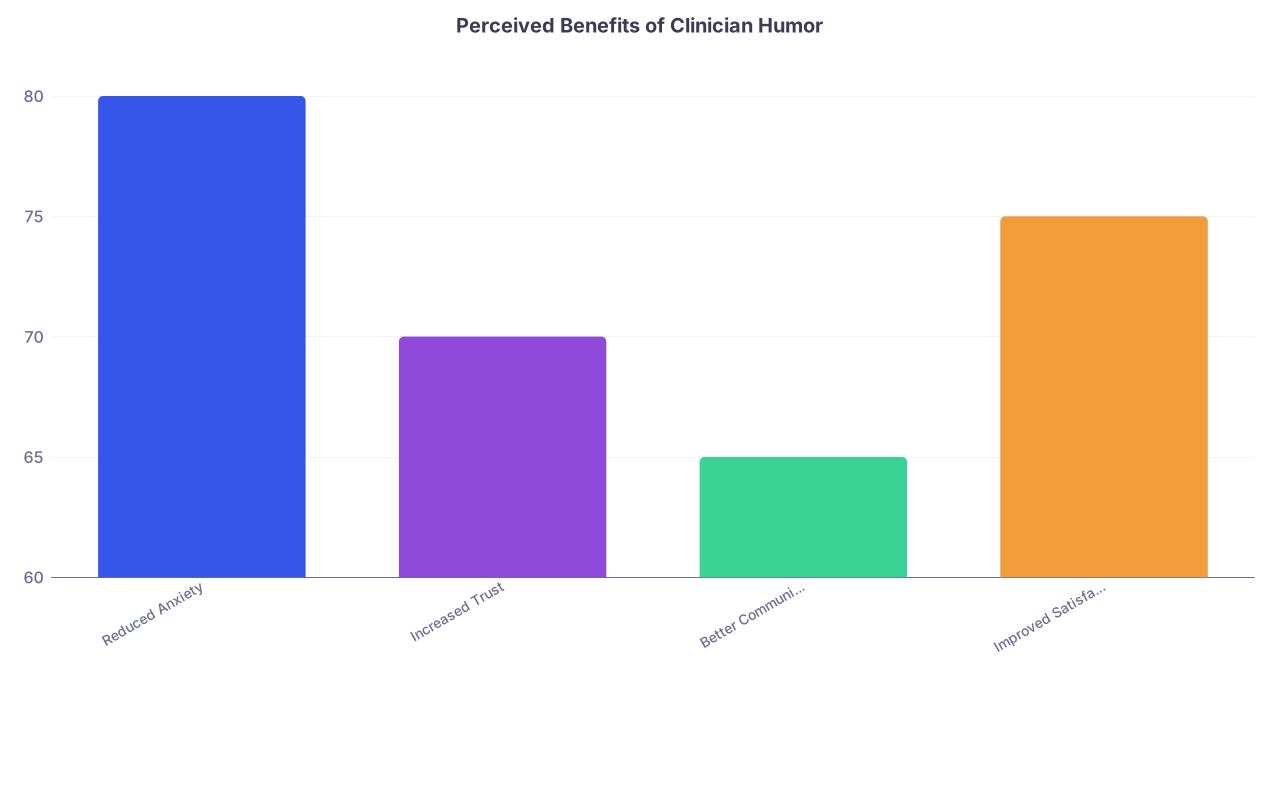
| Category | Value |
|---|---|
| Reduced Anxiety | 80 |
| Increased Trust | 70 |
| Better Communication | 65 |
| Improved Satisfaction | 75 |
Patients consistently report they value clinicians who are “serious when it counts, but not robotic.” Humor, in small, well-placed doses, is how you thread that needle.
Two patterns where humor shines:
- Routine, low-stakes visits where the main goal is relationship-building as much as content delivery.
- Long-term relationships (primary care, oncology, dialysis) where you know each other’s styles and the patient has clearly shown they enjoy a bit of banter.
Humor You Absolutely Keep Away From Patients
Let me be very clear about this list. I’ve seen versions of all of these go badly.
- Dark/gallows humor about disease, death, or disability.
- Jokes about intelligence, education level, or “common sense.”
- Jokes about adherence (“You and your meds are not exactly on speaking terms, huh?”).
- Comments about appearance, weight, hygiene, smell, clothing.
- Sexual or flirtatious humor. Ever. Even if they start it.
- Anything that could be read as racist, sexist, homophobic, transphobic, or classist—even if “you didn’t mean it that way.”
Those belong—if they belong anywhere at all—in private debrief spaces with trusted colleagues, never within earshot of patients or families.
And even there, be honest about why you’re using that kind of humor. If it’s numbing instead of processing, that’s a warning sign.
A Quick Flowchart for Real Life
If you’re a visual thinker, here’s your mental script:

| Step | Description |
|---|---|
| Step 1 | Thinking of a joke |
| Step 2 | Skip humor |
| Step 3 | Go ahead - gently |
| Step 4 | Patient started the humor? |
| Step 5 | Emotion stable? |
| Step 6 | Topic low stakes? |
| Step 7 | Target safe? |
| Step 8 | Helps patient, not me? |
If you land on “Skip humor” more often than not with certain patients or situations, that’s not failure. That’s judgment.
How to Repair When Humor Lands Badly
You will misjudge sometimes. Everyone does. The test of professionalism is what you do next.
If you see the patient’s face close off, or hear silence after your attempt:
Name it quickly and plainly.
“That comment did not come out the way I meant it. I’m sorry.”Re-center them.
“I do not want to minimize what you’re dealing with. This is serious.”Then shut up. Don’t over-explain your intention. Just course-correct.
Most patients are far more forgiving of a misstep followed by a real apology than of you plowing ahead like nothing happened.
Your Next Step Today
Pick one patient you see today and run the 7-question checklist in your head before you say anything humorous.
Literally ask yourself, in three seconds:
“Who started this, what’s the emotional temperature, and who is this really for?”
If you would normally joke automatically, try pausing and choosing more intentionally—either a safer version, or silence.
That tiny experiment will teach you more about your own habits than any policy manual.
FAQ: Humor in Patient Encounters
Is it ever okay to use dark humor with patients who use it themselves?
Rarely, and you should default to “no.” Some patients with chronic or terminal illness use very dark humor as a coping mechanism. You can acknowledge their style (“You’ve got a sharp sense of humor about this”) without matching the same level of darkness. If you do mirror it, keep it extremely gentle and immediately watch their reaction. If there’s any doubt, step back.What about making fun of myself—can self-deprecating humor backfire?
Yes, if you overdo it or undermine trust. A small amount (“I’m going to wrestle with this computer for a second; it doesn’t always like me”) is fine. But constant “I’m so disorganized” or “I have no idea what I’m doing” can make anxious patients less confident in your care, even if they laugh in the moment.Can I joke about the patient’s non-serious complaint, like a minor cold?
Be careful. What looks “minor” to you might be terrifying to them because of a backstory you do not know yet. If you want to use light humor, build it around shared experience (“Colds always seem to show up right before something important, don’t they?”) instead of implying they are over-reacting.Is it different in telehealth or phone encounters?
Yes, it’s riskier. You lose nonverbal cues, timing is harder, and delays can make a harmless comment sound flat or rude. In telehealth, cut your humor attempts in half and keep them very bland and friendly. Smile, use warm tone, and let the patient set the level of playfulness.How do I teach trainees about appropriate humor without sounding preachy?
Use concrete examples. Ask them to imagine the comment written in a complaint letter. Walk through the “Who does this serve?” question. Debrief after encounters: “You made a joke there—how do you think that landed?” Normalize that we all get this wrong sometimes and emphasize repair, not perfection.